




About this worksheet
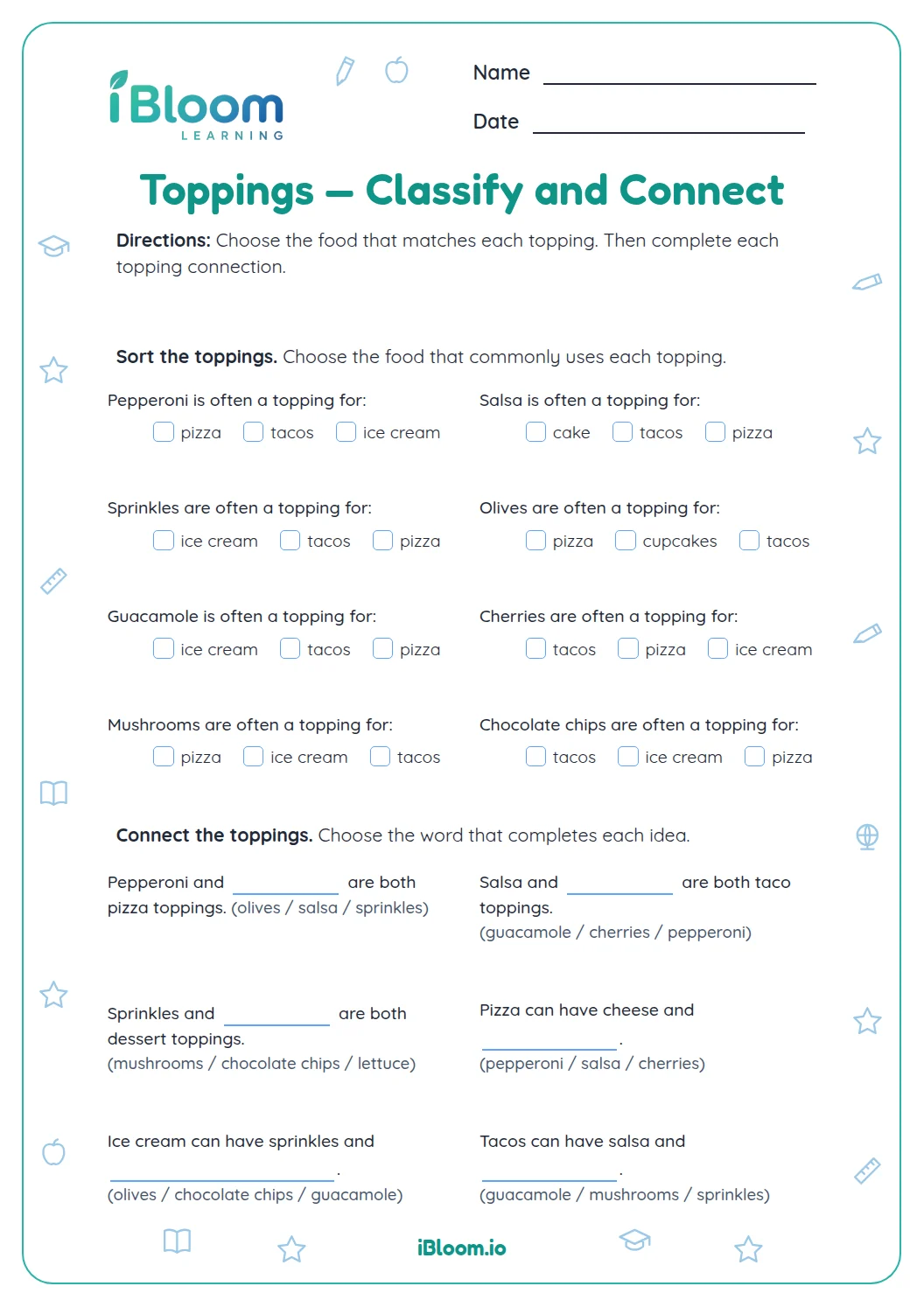
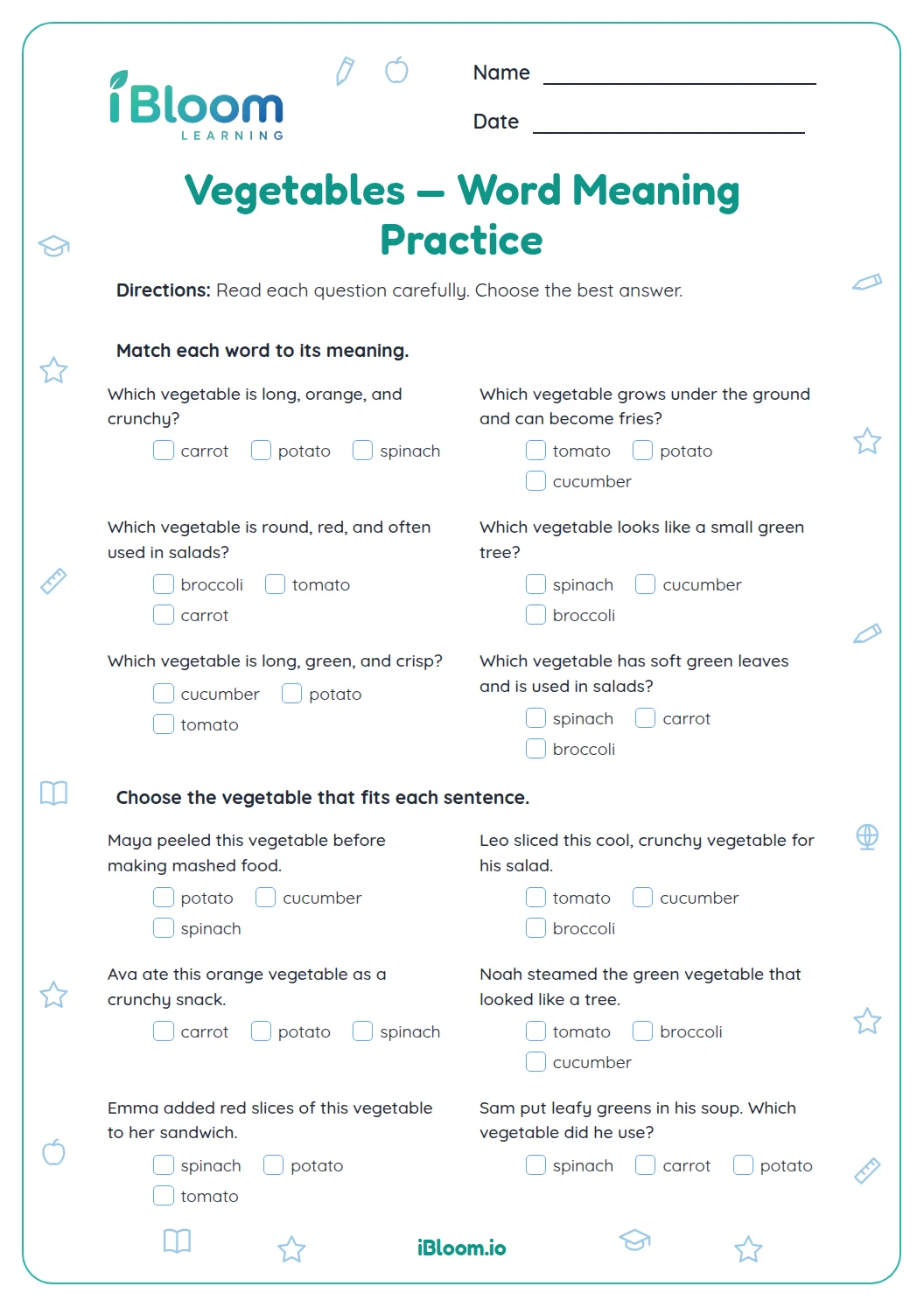
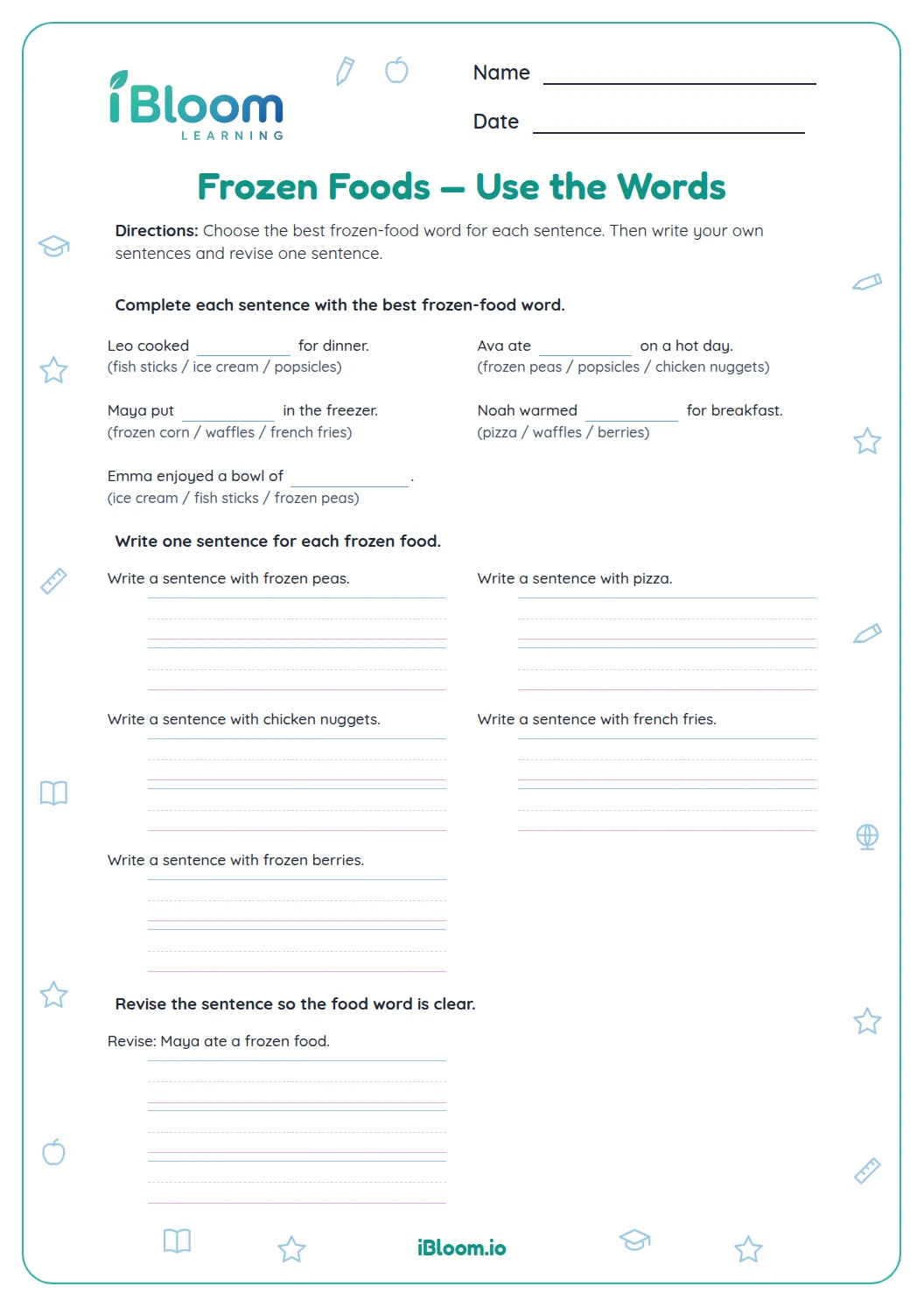
This free Grade 2 vocabulary worksheet uses familiar and less familiar topping words to practice context clues. Children choose meanings from complete sentences, fill in clue-based blanks, search for eight words, and write a sentence that hints at a word’s meaning. The page practices CCSS L.2.4.a by asking learners to use sentence-level context. A separate answer key includes a sample for the open response.
Aligned to L.2.4.a
How can a sentence help with an unfamiliar word?
Look for nearby details that describe what a food looks, tastes, or is made from. Those details can point to the meaning of a topping word.
In question 1, the clue says cheese is made from milk. That helps identify it as a food made from milk.
- 1Clue: “made from milk”
- 2Word: cheese
- 3Meaning: a food made from milk
How do you choose a word that fits a clue?
Read the whole sentence and check whether each choice fits all its details. “Sweet tropical fruit” fits pineapple in question 11, while mushroom does not.
How does the word search support vocabulary practice?
Finding each word gives another chance to notice its spelling. Question 13 includes eight words from the page, and the final task asks children to place one word in a meaningful sentence.
How to use this worksheet
- 1Read the sentence all the way through.
- 2Underline a clue about what the topping is, tastes like, or is made from.
- 3Check each choice against the clue and select the best fit.
- 4For the word search, scan one row at a time and mark each found word.
- 5Write a new sentence that gives a useful clue to one topping word.
Common mistakes and quick fixes
The mistake
Choosing a meaning based only on knowing the food, without using the sentence clue.
The fix
Point to the phrase that supports the selected meaning.
The mistake
Mixing up a topping and a clue word, such as treating “sweet” as the food itself.
The fix
Ask what object or food the sentence says is added.
The mistake
Skipping letters while searching a long word such as pineapple.
The fix
Track one letter at a time from the first letter through the final letter.
Common Core alignment
This worksheet practices the following skills.
Use sentence-level clues to determine what a topping word means.
On this sheet: Each sentence supplies a clue to the meaning of a food or topping word.
Show the official wordingHide the official wording
Use sentence-level context as a clue to the meaning of a word or phrase.
What to practice next
Make more practice
Further reading
Questions parents and teachers ask
How can a child use context clues?
A context clue is a nearby word or detail that helps explain an unfamiliar word. In question 1, “made from milk” points to cheese as a food made from milk. Encourage the child to name the clue before choosing a meaning.
What kinds of topping words are on this page?
The worksheet uses eight words: cheese, olive, mushroom, pineapple, salsa, guacamole, pepperoni, and sprinkle. Children read clues, choose meanings, complete sentence blanks, find each word in a puzzle, and write one clue sentence of their own. Each word also appears in at least one sentence clue, so the puzzle connects spelling with meaning.
Does a child need to know every topping already?
Some words may be new. The sentences give hints such as what an item is made from or how it tastes. Read the clue slowly, then compare each possible meaning with the information in the sentence. Ask the child to point to the exact phrase that supports a choice before moving to the next question.
What does the word search practice?
The puzzle gives children a chance to notice the spelling of the eight topping words. Each word appears in the grid, and the key names the complete list. The meaning questions elsewhere on the sheet connect those spellings with sentence context.
How can I help with the final writing question?
Invite the child to choose one topping and add a detail that hints at its meaning. For example, “The sweet pineapple made the pizza juicy” includes a clue about pineapple. The key provides one sample; other clear, accurate sentences can also work.
Is an answer key included?
Yes. A separate answer key page identifies the choices, the completed words, the puzzle word list, and a sample sentence. The last response can vary, so the key gives a model rather than requiring exactly the same wording.