
About this worksheet
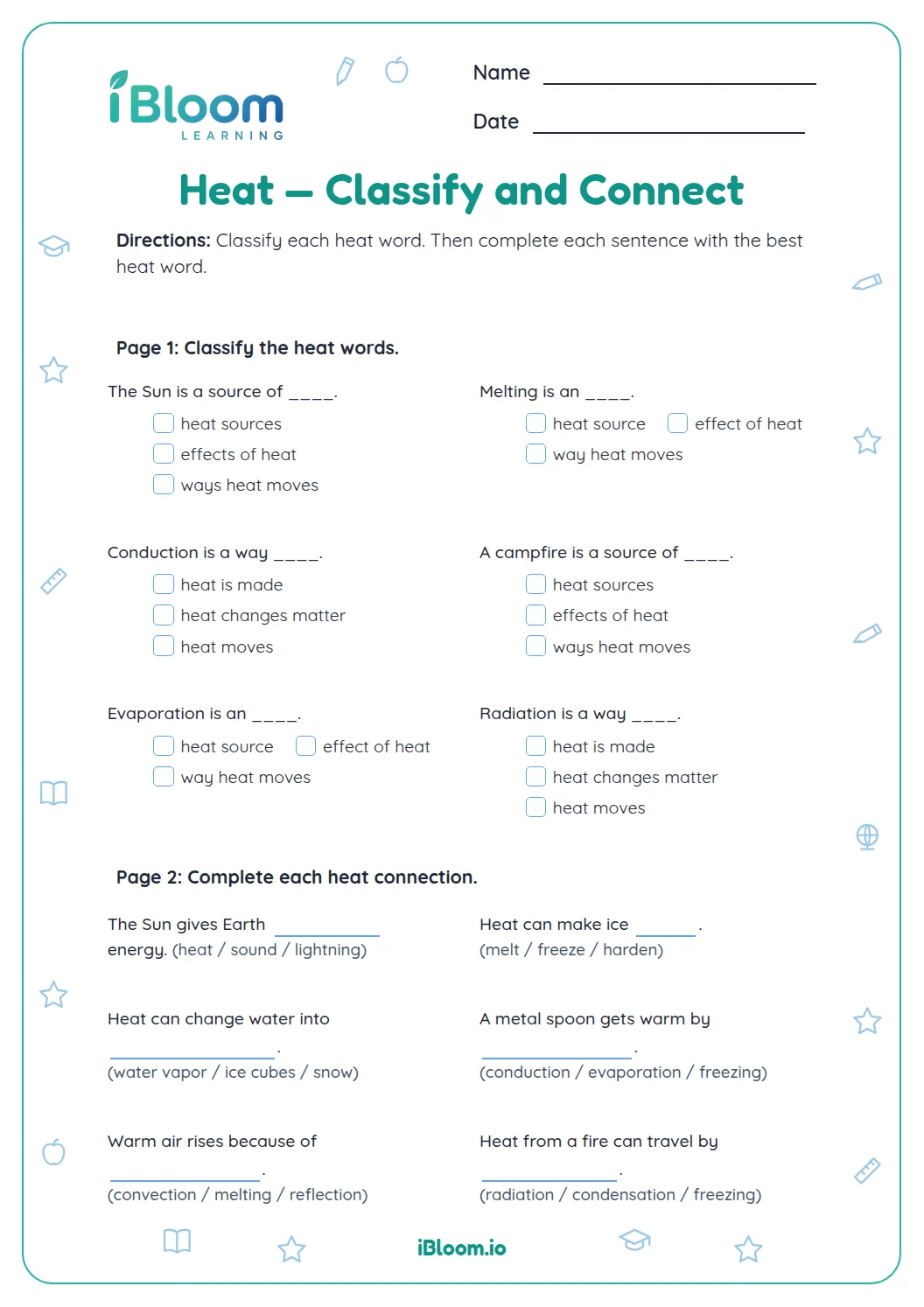
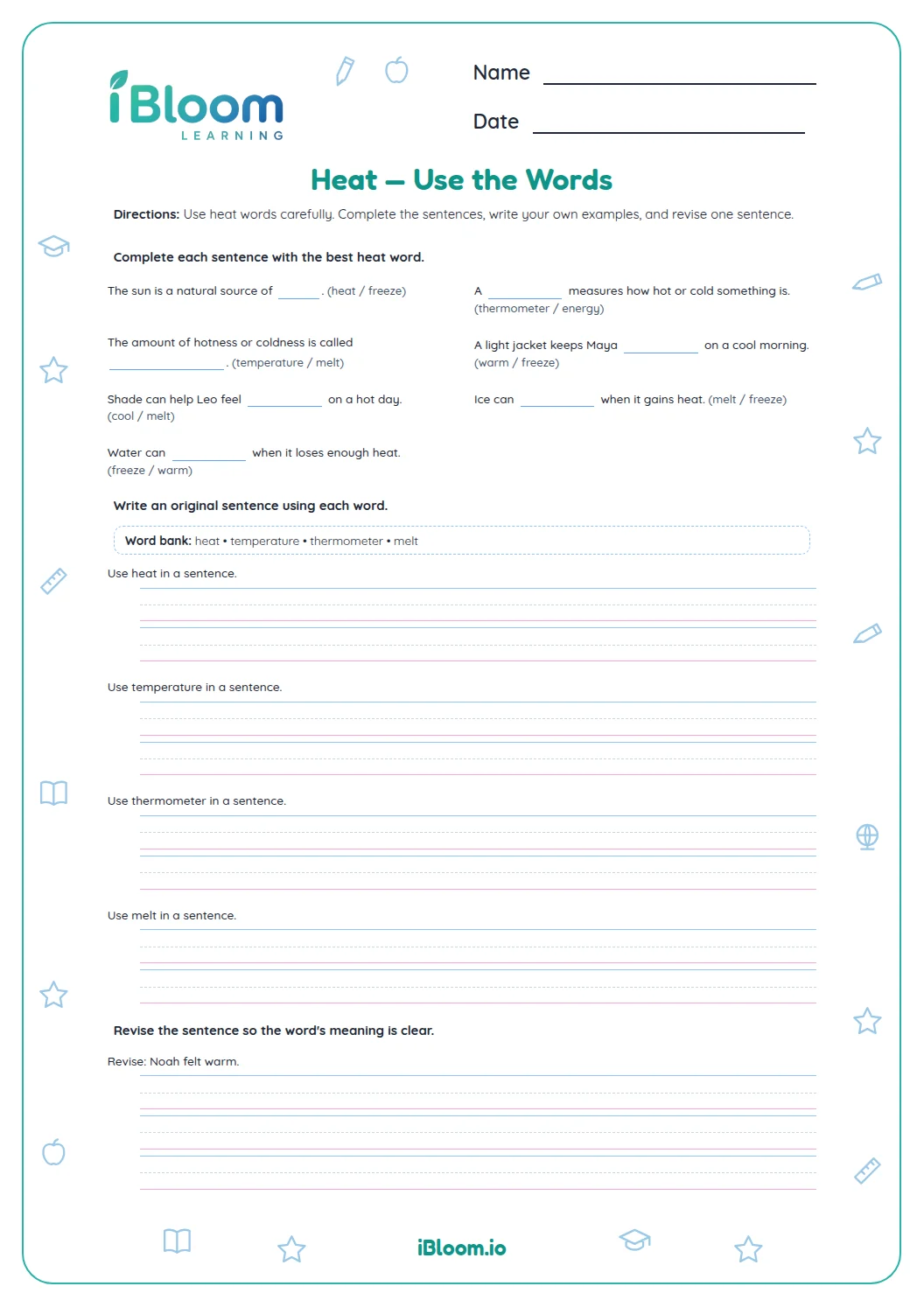
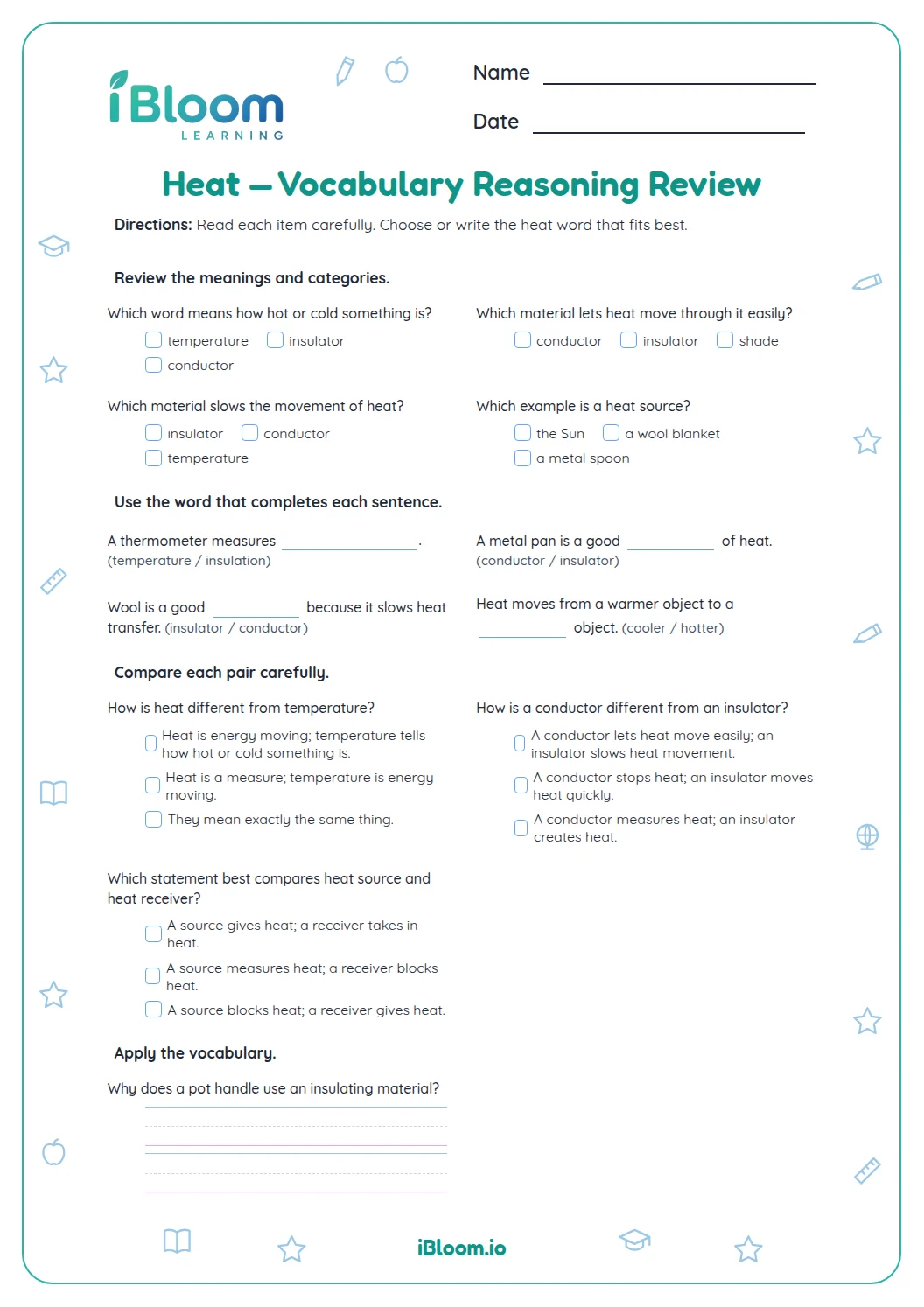
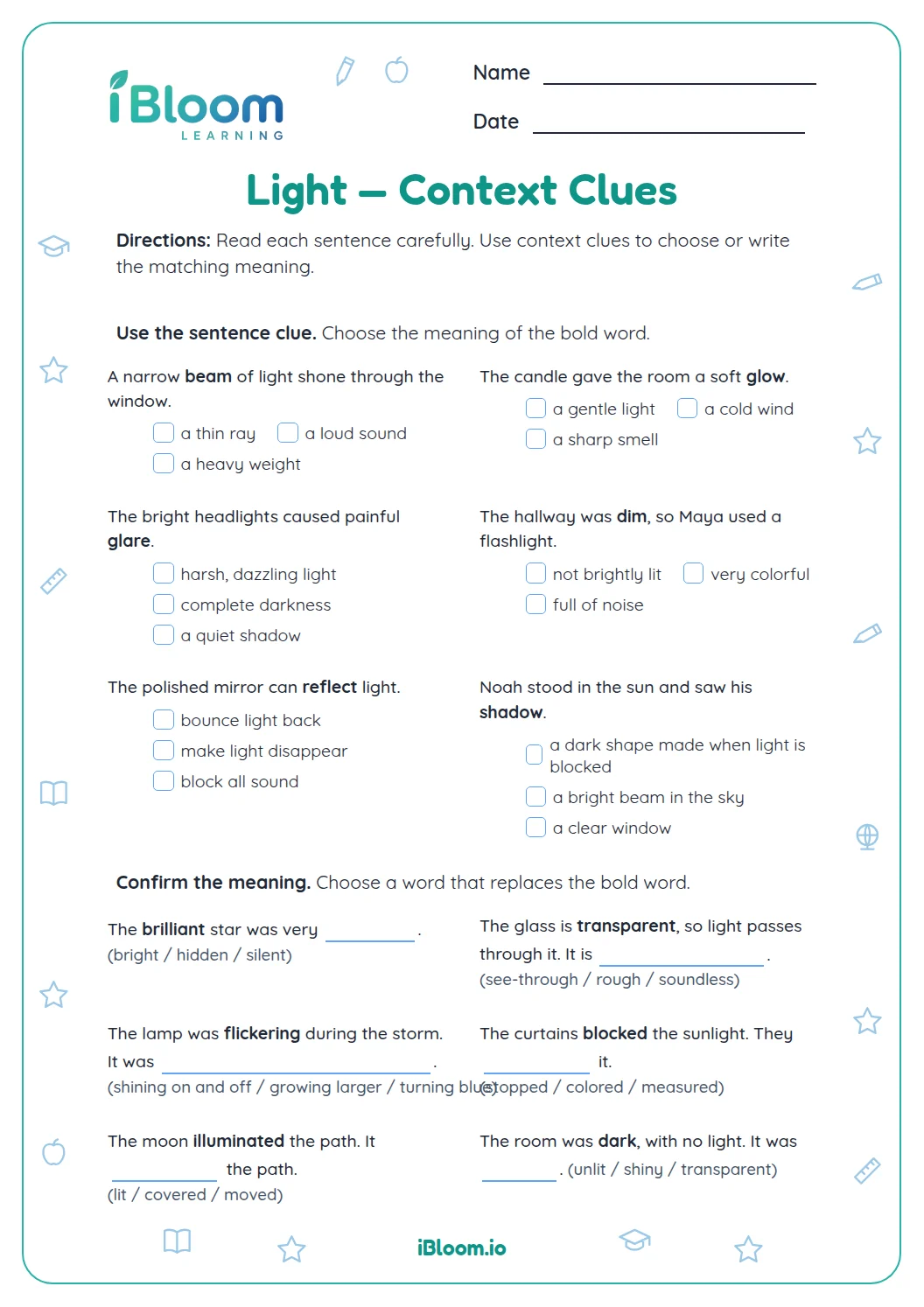
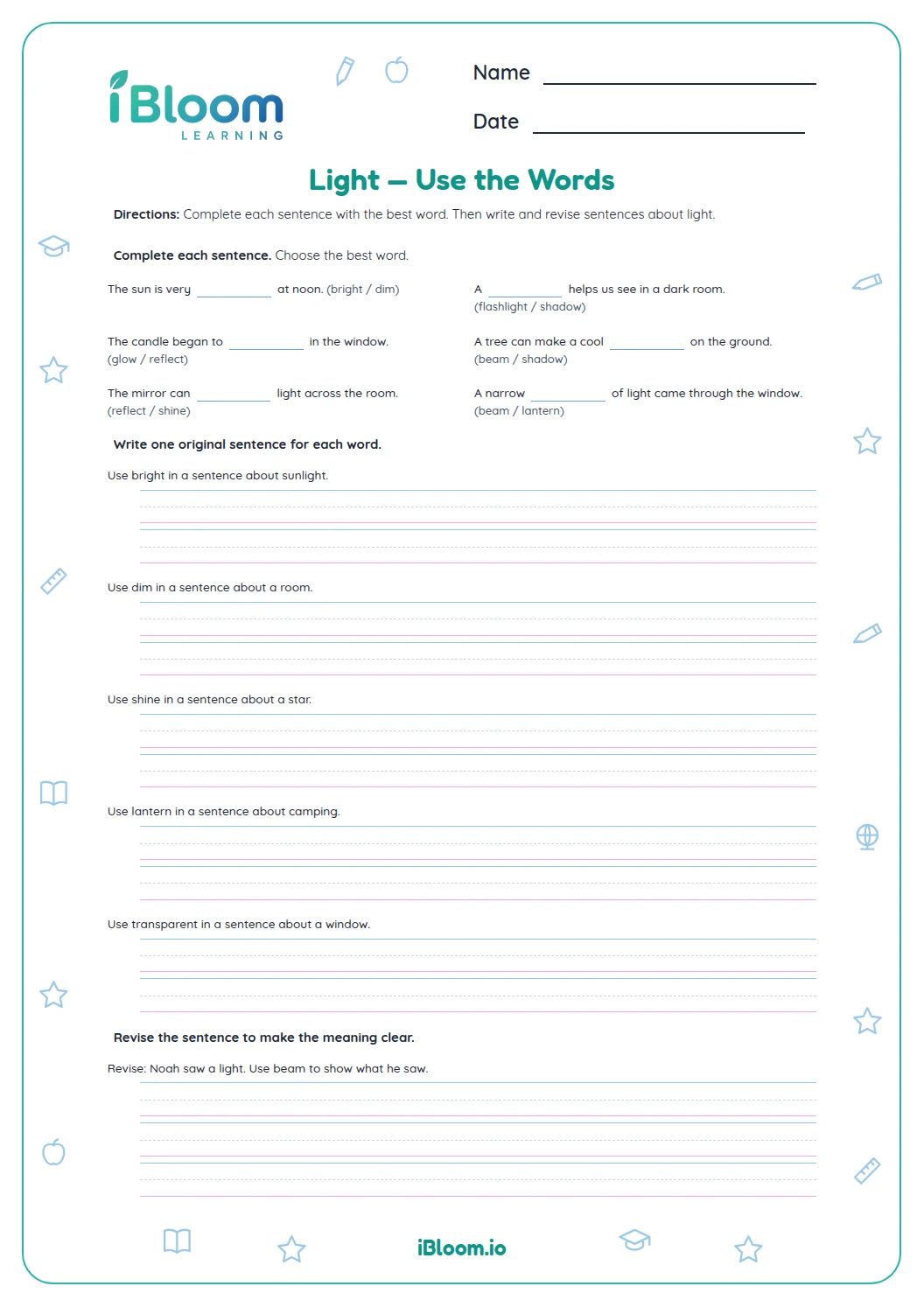
This Grade 4 vocabulary printable builds understanding of heat words in clear science contexts. Students choose definitions, use each word in a sentence, find eight terms in a word search, and recall meanings from short clues. The sentence practice connects directly to CCSS L.4.4a: using context such as definitions and examples as clues to meaning. The 14 questions occupy two worksheet pages, with the answer key on its own page.
Aligned to L.4.4a
How does a sentence help explain a heat word?
A clue in the sentence can show what a word means. In “Ice can melt in a warm room,” the warm room helps explain that melt means changing from a solid to a liquid.
How do heat words connect?
Temperature describes how hot or cold something is. Heat is energy that can make something warmer, and a thermometer measures temperature.
What does the word search add?
Finding a word gives another chance to read and recognize it. After circling a term, say its meaning and connect it to one of the sentence examples.
How to use this worksheet
- 1Read all three choices before selecting a meaning.
- 2Use the full sentence to decide which word belongs in each blank.
- 3In Part C, scan across and down for all eight vocabulary words.
- 4Reread each circled word and say its meaning.
- 5Use the final clues to recall the terms without choices.
- 6Check the key and revisit any word with a mixed-up meaning.
Common mistakes and quick fixes
The mistake
Mixing up heat and temperature.
The fix
Heat is energy; temperature tells how hot or cold something is.
The mistake
Using melt for a change into a solid.
The fix
Melt describes solid changing to liquid; freeze is liquid changing to solid.
The mistake
Treating steam as liquid water.
The fix
Steam is water vapor formed when water is heated.
Common Core alignment
The sentence questions use examples and definitions as clues to word meaning.
Use context clues such as definitions and examples to determine word meaning.
On this sheet: Students use sentence examples and short definitions to select and recall heat vocabulary.
Show the official wordingHide the official wording
Use context (e.g., definitions, examples, or restatements in text) as a clue to the meaning of a word or phrase.
What to practice next
Make more practice
Questions parents and teachers ask
What heat words are on the worksheet?
Students work with eight heat words: heat, temperature, warm, melt, steam, freeze, insulate, and thermometer. Definitions and sentence examples help distinguish related terms, and the word search gives another way to recognize them. The page revisits several terms in more than one format.
How do sentence clues help?
Read the entire sentence and look for an example or detail that explains the missing word. In “Ice can melt in a warm room,” the room’s warmth clues the change from solid ice to liquid water. This is one example from the sentence section.
What is the difference between heat and temperature?
Heat is energy that can make something warmer. Temperature tells how hot or cold something is, and a thermometer measures temperature. Keeping these meanings separate helps students choose the right word in a science sentence. Reread these definitions before completing the puzzle.
Is there an answer key?
Yes. The separate key gives the meaning choices, sentence-completion words, and the word-search list. Review any missed item by rereading its sentence and stating which clue points to the correct heat word. The answer list supports checking both meanings and spelling.
How many words should students find?
The puzzle contains eight target words: thermometer, temperature, insulate, freeze, steam, melt, warm, and heat. The word list is printed with the grid, and the answer key can be used to check each circled word. Encourage students to reread a word and explain its meaning.