

About this worksheet
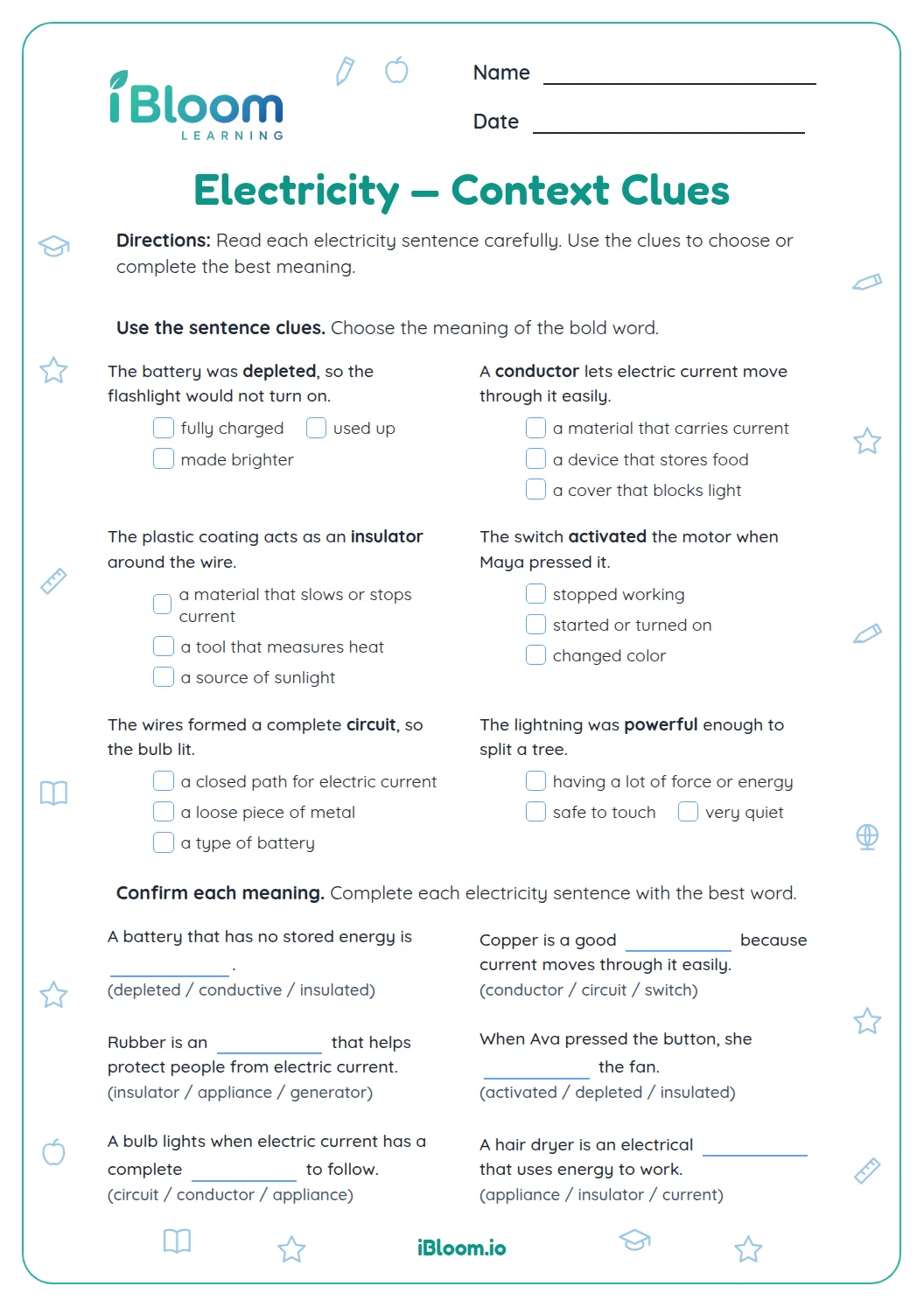
This free printable Grade 4 worksheet builds electricity vocabulary through definitions, classification, and relationships among circuit parts. Students identify a circuit, battery, switch, wire, bulb, conductor, and insulator, then use those words to reason about a working path. It practices L.4.5.c. The answer key includes selected answers and a sample explanation.
Aligned to L.4.5
What are the key electricity words?
A circuit is a path for current. A battery supplies energy, a wire carries current, a switch opens or closes the path, and a bulb can produce light.
A conductor lets current pass through it; an insulator resists the flow. These terms describe different roles, so the clue in each sentence matters.
- 1A path electricity follows is a circuit.
- 2A source that supplies energy to a flashlight is a battery.
How can you classify conductors and insulators?
Ask whether current can pass through the material easily. Copper is a conductor; rubber and plastic are common insulators. The worksheet uses these categories in material clues and circuit situations.
How do circuit parts work together?
A working circuit needs a complete path. When a switch closes the path, energy from the battery can move through the wire to the bulb. Opening the switch breaks the path and the bulb goes out.
In the final question, describe each named part’s role instead of simply listing the words.
How to use this worksheet
- 1Read the clue and identify the role it describes.
- 2For material questions, decide whether current passes easily or is resisted.
- 3For circuit situations, picture whether the path is complete or open.
- 4Use the vocabulary words precisely; a battery supplies energy while a wire carries current.
- 5Write the final explanation as a sentence that connects the battery, wire, and bulb.
- 6Check choices and compare your explanation with the sample in the key.
Common mistakes and quick fixes
The mistake
Calling the wire the energy source.
The fix
Remember that the battery supplies energy; the wire provides a path.
The mistake
Thinking an off switch completes the path.
The fix
An open switch breaks the path; a closed switch completes it.
The mistake
Confusing a conductor with an insulator.
The fix
A conductor lets current pass easily; an insulator resists its flow.
Curriculum alignment
This vocabulary page connects word relationships to a familiar science topic.
Connect related words such as circuit, conductor, and insulator to their meanings.
On this sheet: Students connect related electricity vocabulary, including conductor and insulator.
Show the official wordingHide the official wording
Demonstrate understanding of words by relating them to their opposites (antonyms) and to words with similar but not identical meanings (synonyms).
What to practice next
Make more practice
Further reading
Questions parents and teachers ask
How many electricity terms appear on the worksheet?
The worksheet has 16 questions in four parts. Students connect electricity words to meanings, classify materials as conductors or insulators, and explain how circuit parts work together. The separate answer key gives the choices and a sample explanation.
What is the difference between a conductor and an insulator?
A conductor lets electric current pass through it easily, while an insulator resists the flow. The worksheet applies the distinction to copper wire and protective materials such as plastic or rubber. Families can read the prompts aloud and ask students to point to the clue that supports each answer.
Does the worksheet ask students to build a circuit?
No hands-on materials are needed. Students use short written situations to reason about a simple circuit, its path, and the roles of familiar parts. The last prompt asks for a brief explanation. Families can read the prompts aloud and ask students to point to the clue that supports each answer.
What does a switch do in a circuit?
A switch opens or closes the path. A closed switch can complete the circuit so current can flow; an open switch breaks the path. Students apply this idea to explain why a lamp lights or goes dark. Families can read the prompts aloud and ask students to point to the clue that supports each answer.
How can I check the written response?
The answer key gives a sample sentence. Accept a different clear sentence if it says that the battery supplies energy, the wire carries current, and a complete path lets the bulb light. Families can read the prompts aloud and ask students to point to the clue that supports each answer.