


About this worksheet
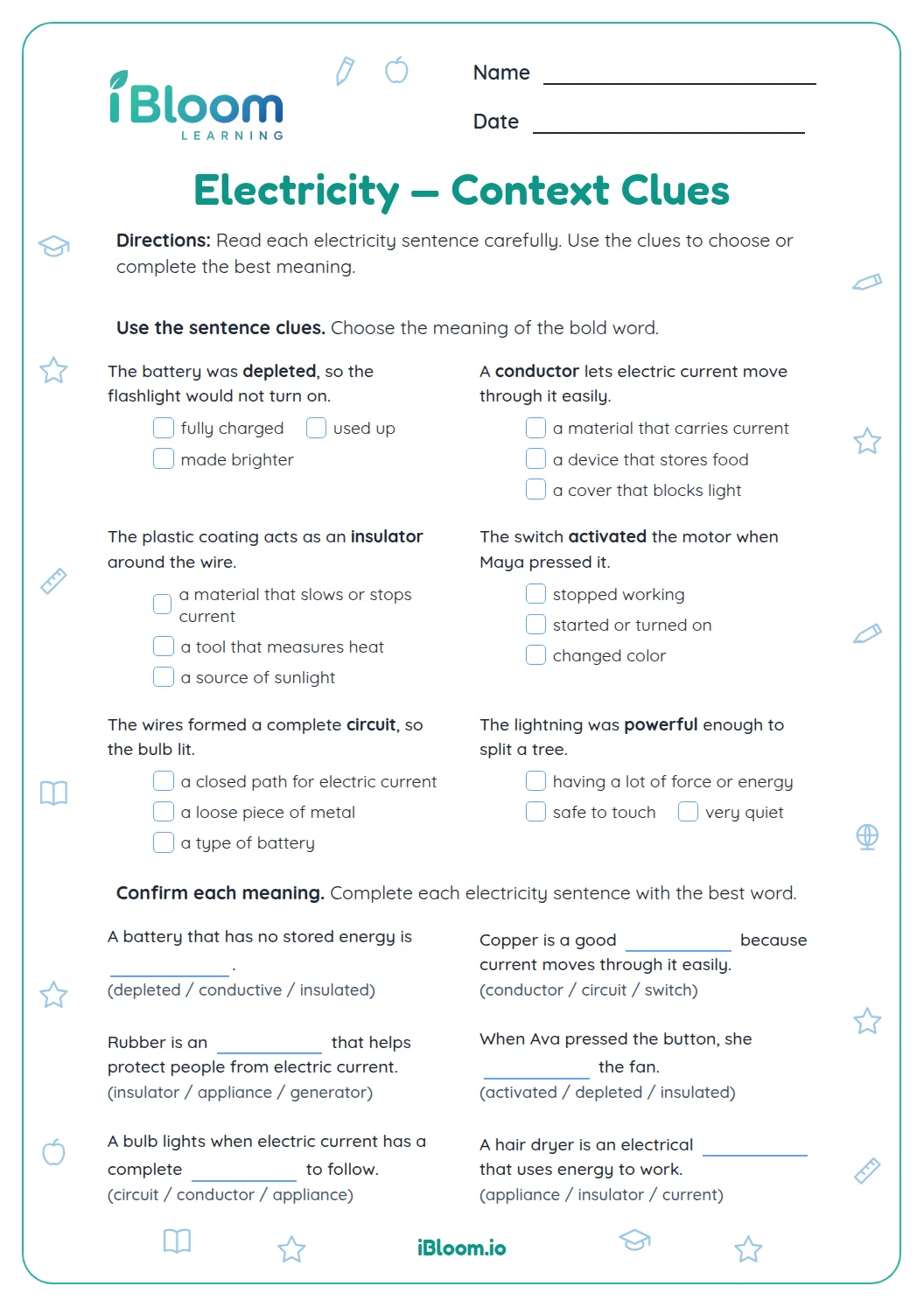
This free Grade 4 printable reviews eight electricity terms through 14 multiple-choice questions. Learners match words such as circuit, current, energy, switch, battery, conductor, insulator, and charge to meanings, then apply them to simple circuit situations. The separate answer key marks each choice. Use the prompts to ask which detail helped distinguish the correct word.
Aligned to L.4.6
How do the electricity words differ?
A circuit is a complete path for current. Current is moving electric charge; a battery supplies energy. A conductor lets current pass, while an insulator resists it. The switch opens or closes the path.
What will learners do on the sheet?
Questions 1–9 match terms with definitions. Questions 10–14 use the words in simple circuit situations, including why wire coverings use rubber and what can happen in a closed circuit.
How can a clue point to the right word?
Look for the job described, then compare it with each term. A material that resists electric current is an insulator.
- 1Clue: a material resists electric current
- 2An insulator resists current.
- 3A conductor lets current pass.
- 4Answer: insulator
How to use this worksheet
- 1Read the whole clue before looking at the choices.
- 2Name the job or property described in the clue.
- 3Compare the clue with the meaning of each electricity term.
- 4For circuit questions, trace the path from the battery through the wires.
- 5Check the marked answer key and explain one choice in your own words.
Common mix-ups and quick fixes
The mistake
Mixing up a conductor and an insulator.
The fix
A conductor lets current pass; an insulator resists the flow.
The mistake
Calling a battery a circuit.
The fix
The battery supplies energy; the circuit is the complete path.
The mistake
Treating current and energy as the same thing.
The fix
Current is moving charge. Energy is what powers a change.
Common Core alignment
This sheet practices accurate use of topic-specific vocabulary.
Use electricity terms accurately when naming parts and their jobs.
On this sheet: Learners select electricity terms accurately and apply them to circuit parts and situations.
Show the official wordingHide the official wording
Acquire and use accurately grade-appropriate general academic and domain-specific words and phrases, including those that signal precise actions, emotions, or states of being (e.g., quizzed, whined, stammered) and that are basic to a particular topic (e.g., wildlife, conservation, and endangered when discussing animal preservation).
What to practice next
Make more practice
Further reading
Questions parents and teachers ask
What electricity words does this sheet cover?
The 14 questions use circuit, current, energy, switch, battery, conductor, insulator, and charge. The first nine connect words to meanings; the final five apply those meanings to simple circuit situations. A separate answer key marks the best choice for each question.
Can learners use this sheet after a science lesson?
Yes. The questions review vocabulary through short definitions and familiar circuit examples. A learner can explain why a battery supplies energy, why a switch changes the path, or why rubber resists current. The answer key is useful for checking and discussing any uncertain term.
How does a conductor differ from an insulator?
A conductor lets electric current pass through easily, while an insulator resists the flow. Question 3 asks learners to identify a conductor, and question 4 asks for an insulator. Comparing each material’s job helps keep the terms distinct. The question wording itself gives a clue to the right choice.
What does the worksheet say about a closed circuit?
The final question describes a battery, wires, a switch, and a bulb connected in a complete loop. Learners choose that the bulb can light. The item checks how the circuit vocabulary fits together, rather than asking for a written explanation.
Is an answer key included?
Yes. The answer key is included on two separate pages and marks the correct choice for all 14 questions. Review a missed item by rereading the clue and naming the job described before selecting a term. Review the words together before checking.
How long does this worksheet take?
Plan for about 15 to 20 minutes. Learners read each clue, select one of three choices, and connect the words to circuit situations. Discussing why a distractor does not fit can add a little review time. A slower reread may take longer.