


About this worksheet
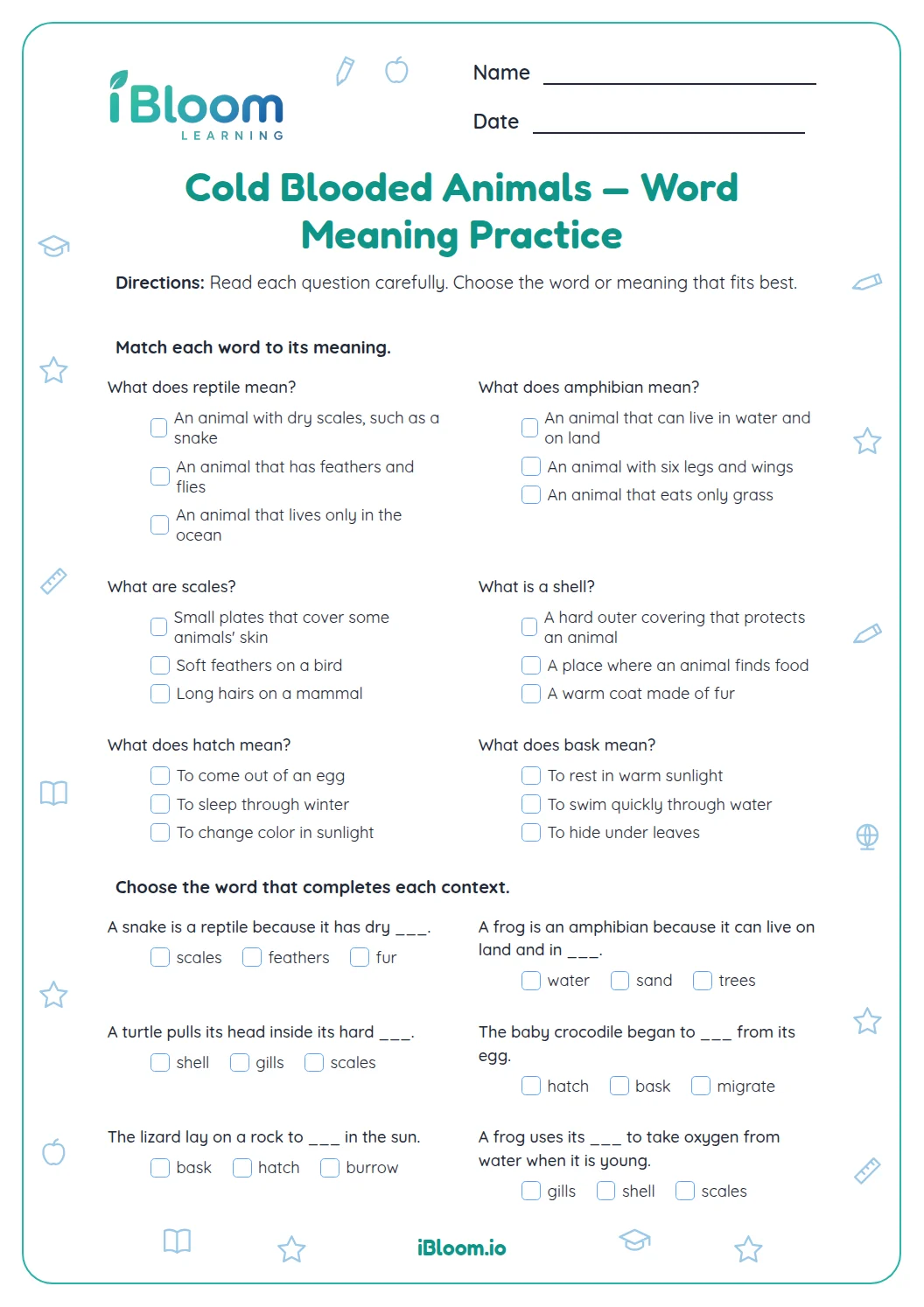
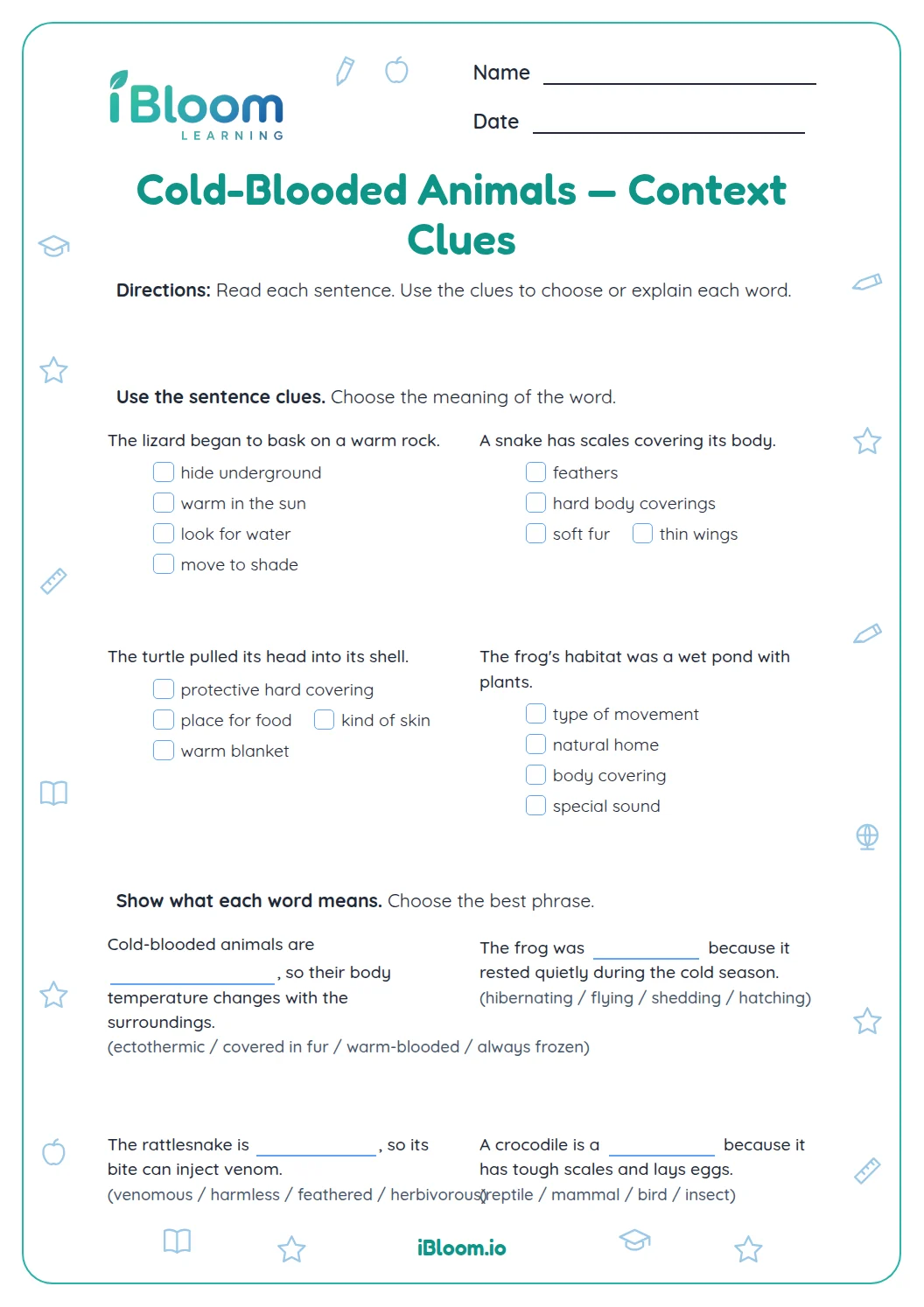
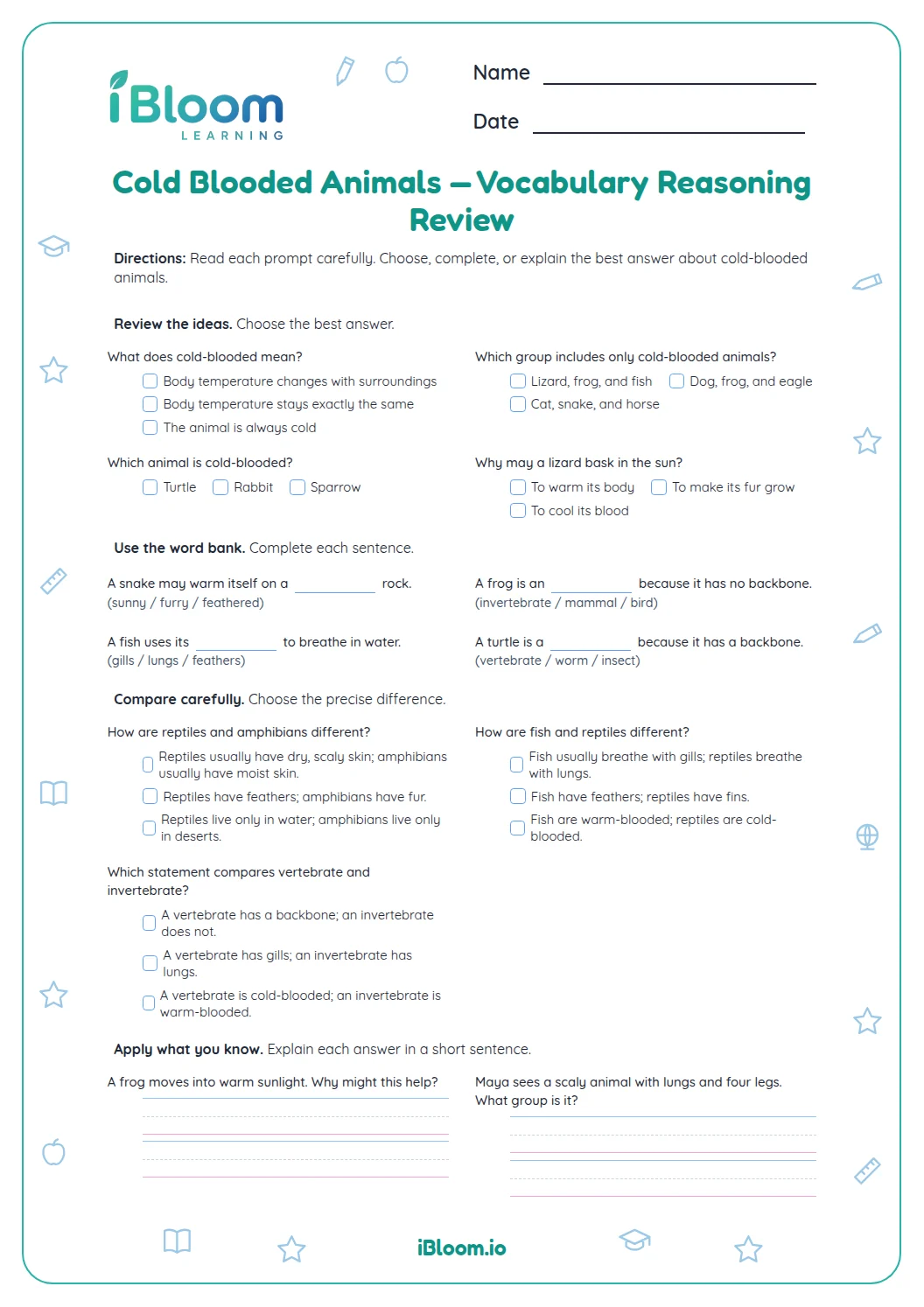
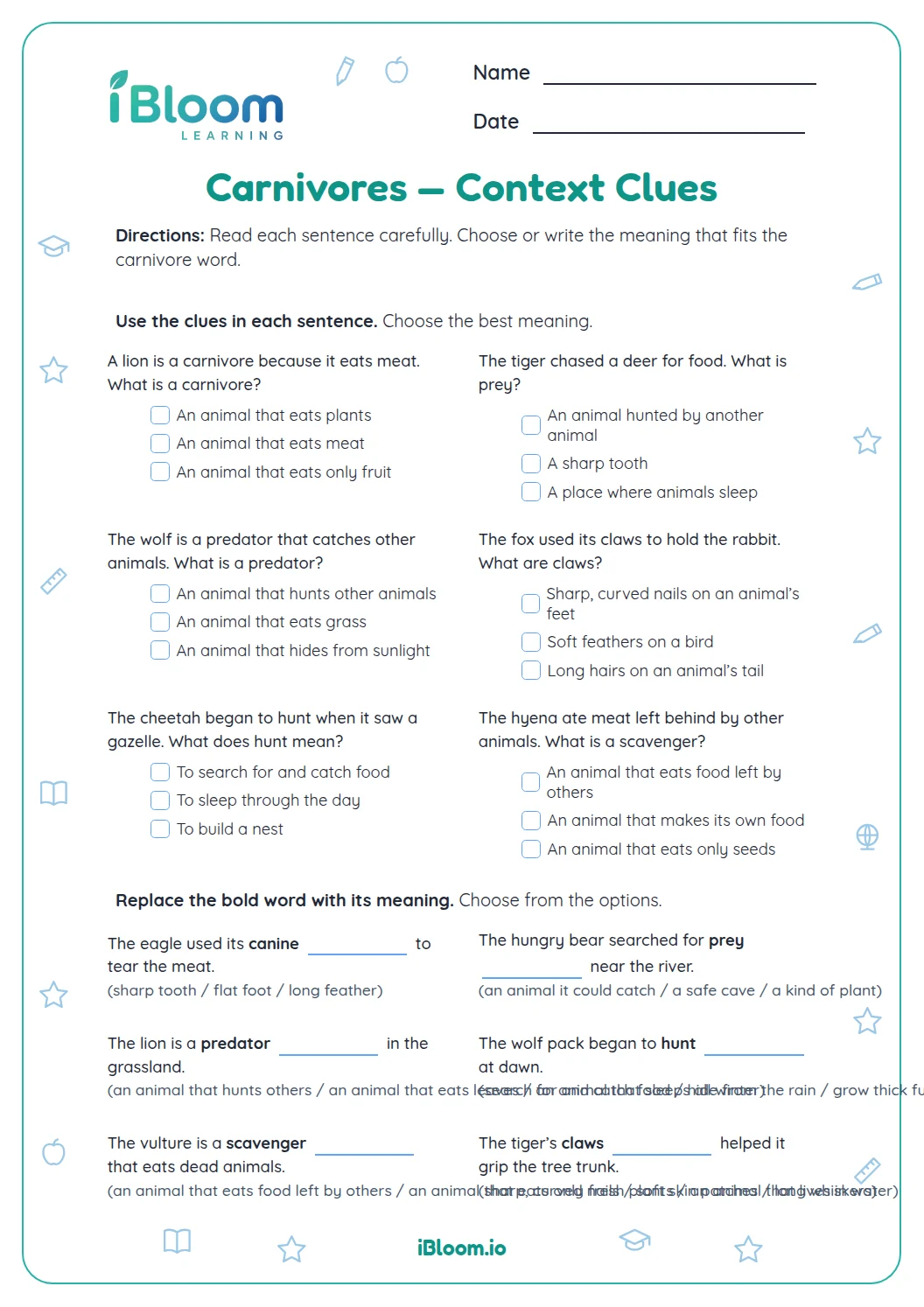
This Grade 4 printable builds vocabulary about cold-blooded animals. Children read short clues and sentences, then choose precise words such as reptile, amphibian, habitat, predator, and prey. The 16 multiple-choice questions use context to connect word meaning with animal science examples and align with CCSS L.4.4a. The answer key is separate for checking each response.
Aligned to L.4.4a
Which animal vocabulary does this practice use?
Questions cover scales, reptile, habitat, predator, amphibian, turtle, basking, and snake. Clues in the sentence help learners choose the word that fits its meaning.
How do context clues narrow a word choice?
Look for an action, example, or relationship in the sentence. “A hawk hunts a mouse” signals a predator and prey relationship. Read the full sentence before selecting a word.
- 1The mouse a hawk catches is its ___.
- 2Clue: the mouse is caught by a hunter.
- 3A hunter is the predator; the animal caught is the prey.
- 4Answer: prey
What does the worksheet include?
The 16 multiple-choice items ask learners to use animal vocabulary in short contexts, from identifying a turtle to distinguishing predator from prey. Children use sentence clues to check whether a word fits the full idea.
- 16 multiple-choice context questions
- Animal and habitat vocabulary
- Separate answer key
How to use this worksheet
- 1Find and mark all eight words before moving to the sentences.
- 2Read each sentence once for its overall meaning.
- 3Underline or say the clue that points to an answer.
- 4Try the answer in the sentence to see whether it makes sense.
- 5Use the key to review both meaning and spelling.
Common mistakes and quick fixes
The mistake
Choosing predator for the animal that is hunted.
The fix
Ask who is doing the hunting; that animal is the predator.
The mistake
Treating amphibian and reptile as the same word.
The fix
Use the sentence clue: frogs are amphibians; turtles and snakes are reptiles.
The mistake
Picking a word because it relates to animals, even when it does not fit the clue.
The fix
Read the entire sentence and test the choice in place of the blank.
Common Core alignment
Use context clues in animal sentences to clarify grade-level vocabulary.
On this sheet: Use context clues in animal sentences to clarify grade-level vocabulary.
Show the official wordingHide the official wording
Use context (e.g., definitions, examples, or restatements in text) as a clue to the meaning of a word or phrase.
What to practice next
Make more practice
Further reading
Questions parents and teachers ask
Which animal words does this worksheet use?
The worksheet uses bask, scales, amphibian, habitat, predator, prey, reptile, and words for animals such as turtles and snakes. Four sentence clues ask learners to supply a word, followed by 12 choices that test how the terms work in context. The answer key gives each intended response.
What does cold-blooded mean in this activity?
Here the term groups animals such as reptiles and amphibians whose body temperature changes with their surroundings. Children use the specific vocabulary in context, including basking, which describes an animal warming itself in the sun. A quick sketch of a food chain can make the hunter-and-hunted roles clear.
How can I explain predator and prey?
A predator hunts another animal for food; the animal hunted is prey. In the sentence about a hawk catching a mouse, the hawk is the predator and the mouse is its prey. Ask who hunts and who is caught. Ask the learner to underline the sentence clue before looking at the choices.
Can this be completed without studying the animal words first?
Yes. The sentences include clues and choices, so learners can reason through the meanings while they work. An adult can help with unfamiliar vocabulary by reading the sentence aloud and asking which clue points to the answer. Reading aloud can help a learner hear how the chosen word works in the sentence.
How long does this worksheet take?
Plan for about 20 minutes. The first four items ask learners to write a vocabulary word from a clue, and the next 12 ask them to choose a word that fits a sentence or definition. The answer key is on a separate page for checking each response.