

About this worksheet
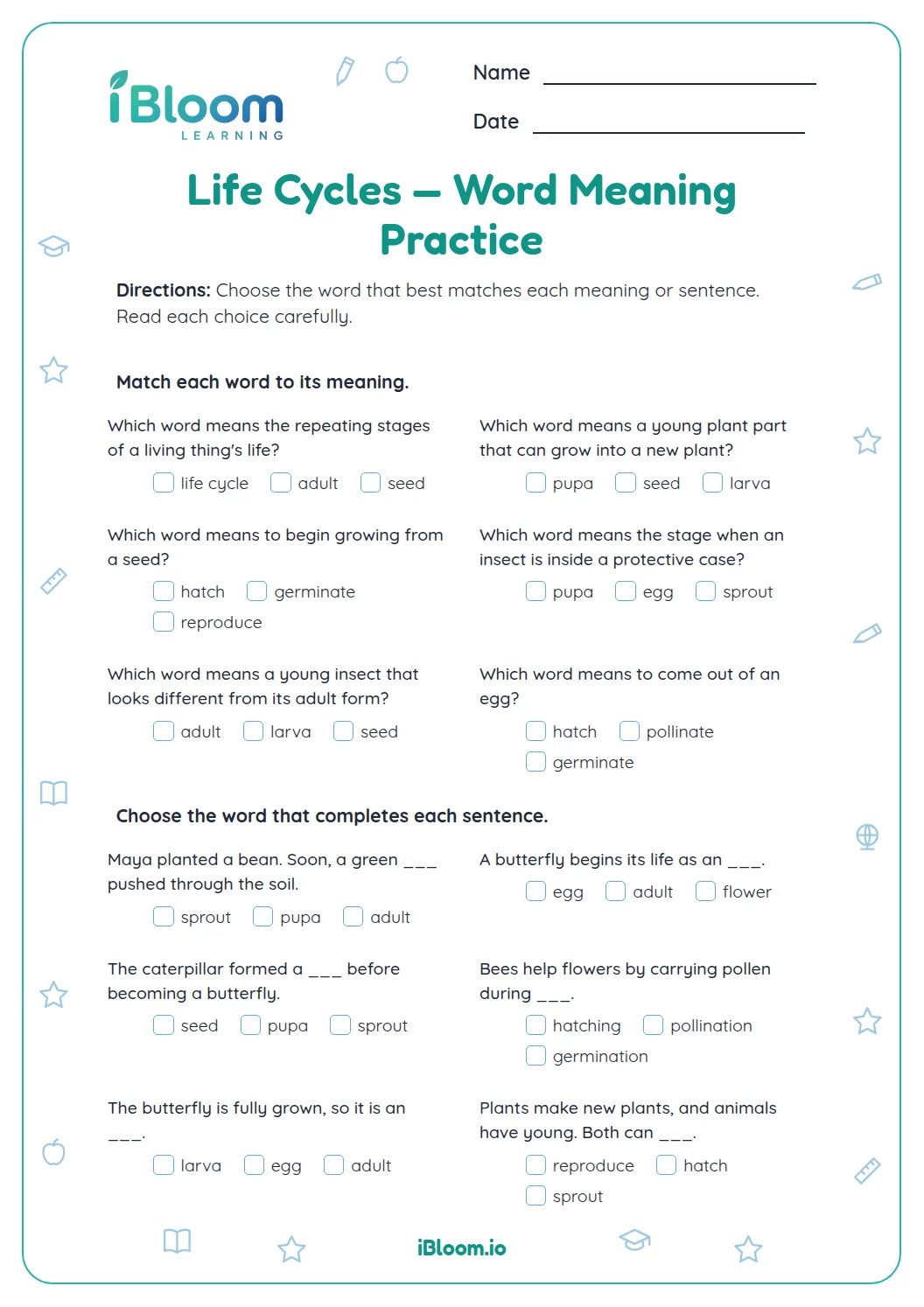
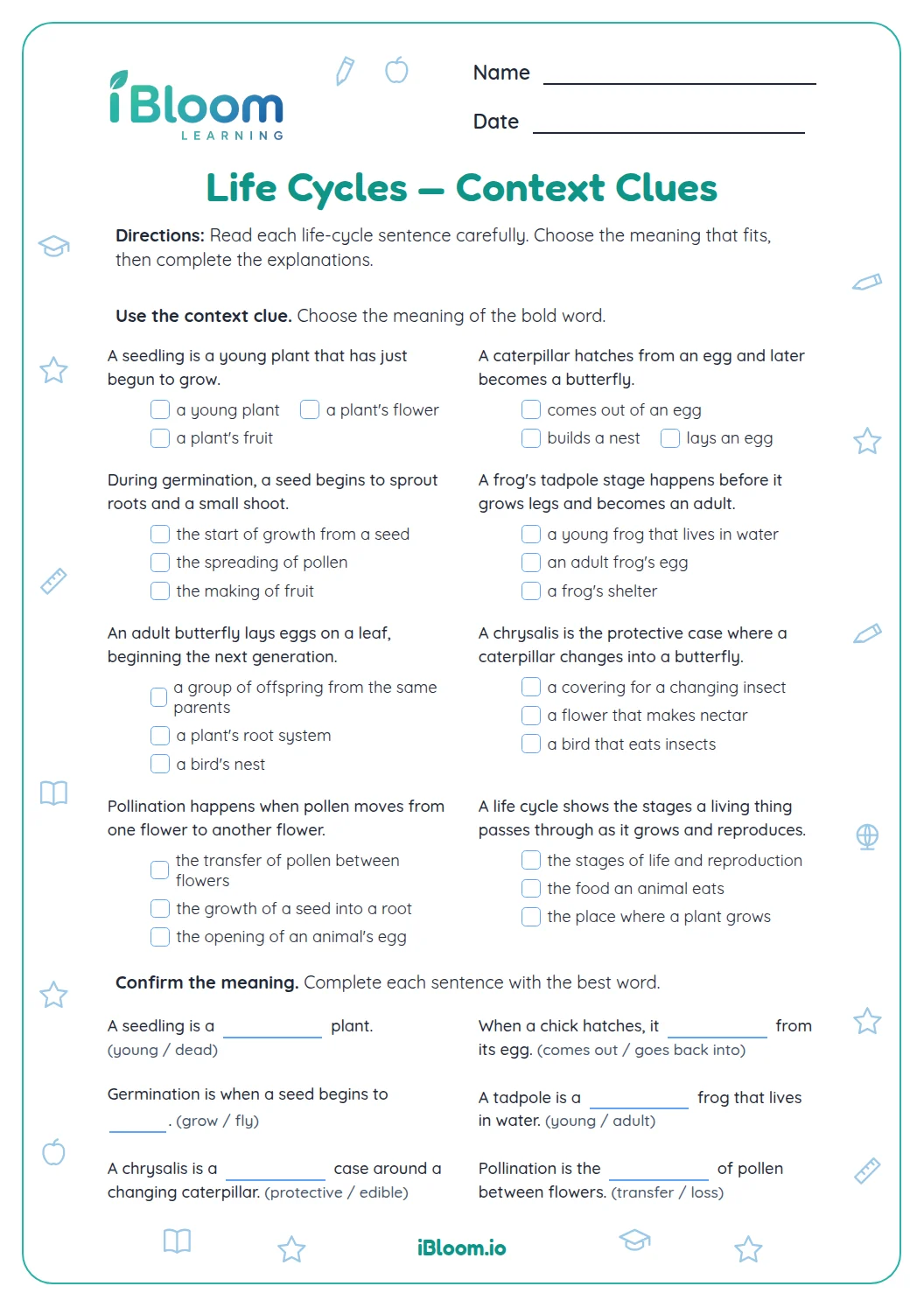
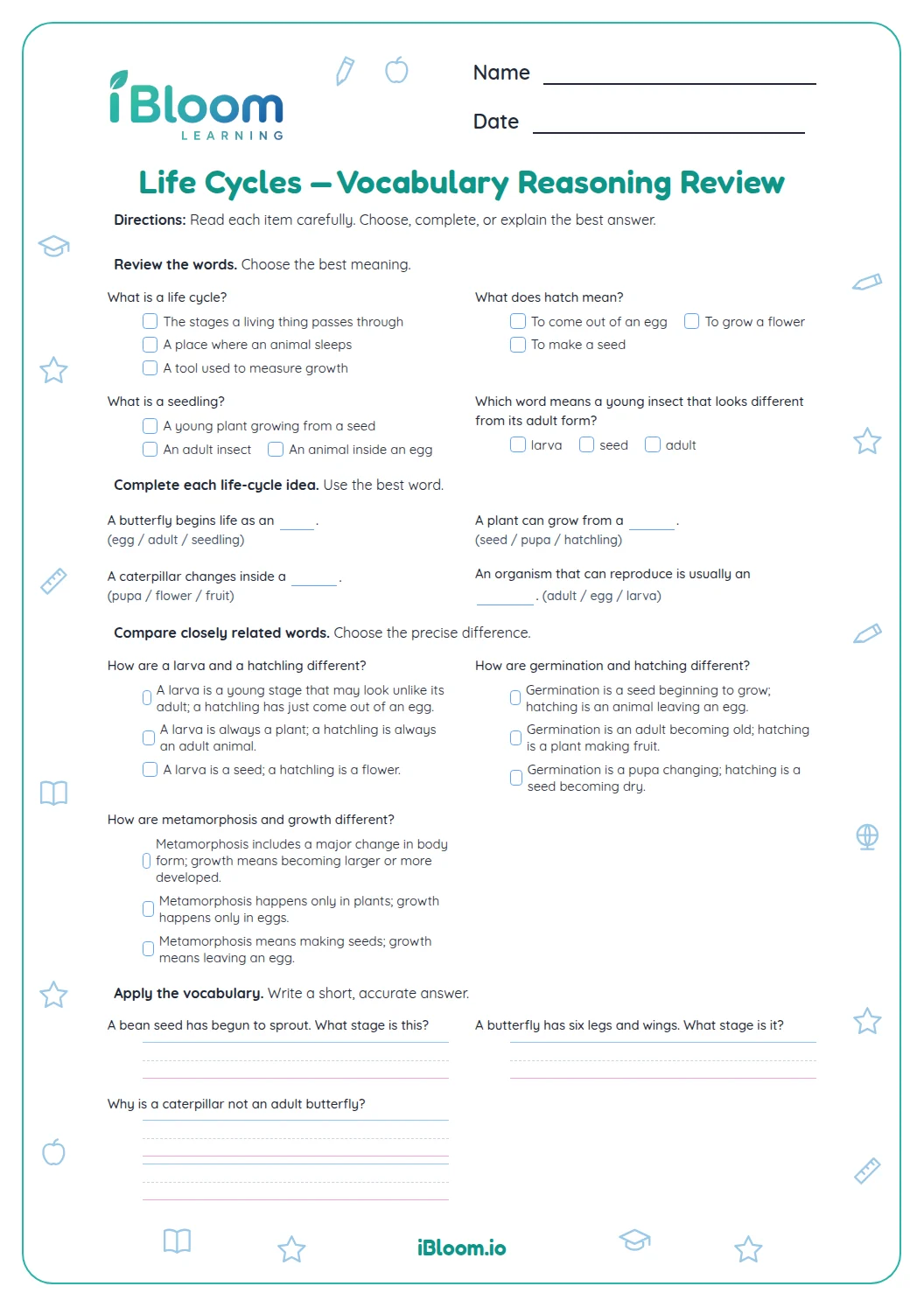
This Grade 4 vocabulary worksheet focuses on words used to describe life cycles. Students find twelve terms in a word-search grid, classify words by plant or animal stage, and use the vocabulary to order or explain life-cycle changes. It supports Common Core L.4.4.a, using context and word relationships to clarify meaning, and NGSS 4-LS1-1 through its plant and animal structure vocabulary. The answer key lists the search words and provides sample responses; suitable explanations may vary.
Aligned to L.4.4.a
Which words name stages in a life cycle?
A life cycle describes how a living thing grows and changes. Egg, larva, pupa, and adult name stages in many insects; seed, sprout, seedling, and adult plant name plant stages.
The search includes these terms along with tadpole, frog, cycle, and growth. Finding the words first makes them easier to sort and use in the next parts.
How can you classify a life-cycle word?
Connect the word to the organism and its stage. A tadpole is a young frog; a seedling is a young plant. Pupa follows larva in a butterfly life cycle.
How do stages connect over time?
Put stages in order and explain one change between them. For example, a seed can sprout, grow into a seedling, and become an adult plant. An adult plant may make seeds, beginning another cycle.
- 1Question 8: seed → sprout → seedling → adult plant
How to use this worksheet
- 1Scan the word list before searching.
- 2Circle each word as you find it in the grid.
- 3Use the organism clues to classify each vocabulary word.
- 4Put stages in order for the response questions.
- 5Use a complete sentence when explaining a change.
Common mistakes and quick fixes
The mistake
Mixing up an animal stage and a plant stage.
The fix
Name the organism that grows through each stage.
The mistake
Putting a pupa before a larva.
The fix
Recall that larva changes into pupa, then adult.
The mistake
Listing stages without explaining the change.
The fix
Use an action word such as grows, hatches, or develops.
Curriculum alignment
Students connect unfamiliar life-cycle terms with examples and definitions.
Use context clues to clarify the meaning of unfamiliar or multiple-meaning words.
On this sheet: Students connect life-cycle terms to definitions and examples in the questions.
Show the official wordingHide the official wording
Use context (e.g., definitions, examples, or restatements in text) as a clue to the meaning of a word or phrase.
What to practice next
Make more practice
Further reading
Questions parents and teachers ask
Which words are hidden in the search?
The grid contains egg, larva, pupa, adult, seed, sprout, seedling, flower, tadpole, frog, cycle, and growth. Search across the rows first, then check down and diagonal directions. The answer key lists the full set so students can confirm they found every term.
Can written answers differ from the key?
Yes. The key provides sample explanations and ordered stages. Another answer is suitable when it names a real stage or accurately describes a change. For example, a student may describe a tadpole growing legs and losing its tail in different words.
How can students classify the terms?
Connect each word to the organism and stage it names. A seedling is a young plant; a tadpole is a young frog; and larva and pupa are insect stages. Some words, such as adult and reproduction, can apply to both plant and animal life cycles.
What is a life cycle?
A life cycle describes how a living thing grows and changes through stages. On this page, students order plant stages and connect animal terms such as tadpole and frog. Many life cycles include an adult stage that can reproduce and begin another cycle.
How do plant stages go in order?
The sequence used here is seed, sprout, seedling, and adult plant. A seed begins to grow, then develops into a young plant. As an adult, the plant may produce seeds that can grow into new plants. The worksheet asks students to order these four stages.