


About this worksheet
This free printable Grade 4 vocabulary worksheet connects carnivore names with habitats and useful context clues. Children find eight animal names in a word search, classify six animals as land, water, or flying carnivores, and complete seven sentences about teeth, beaks, prey, talons, and the context clue stalked. The classification and vocabulary activities revisit the earlier sheet’s skills. A separate answer key is included.
Aligned to L.4.4.a
How do context clues help with animal vocabulary?
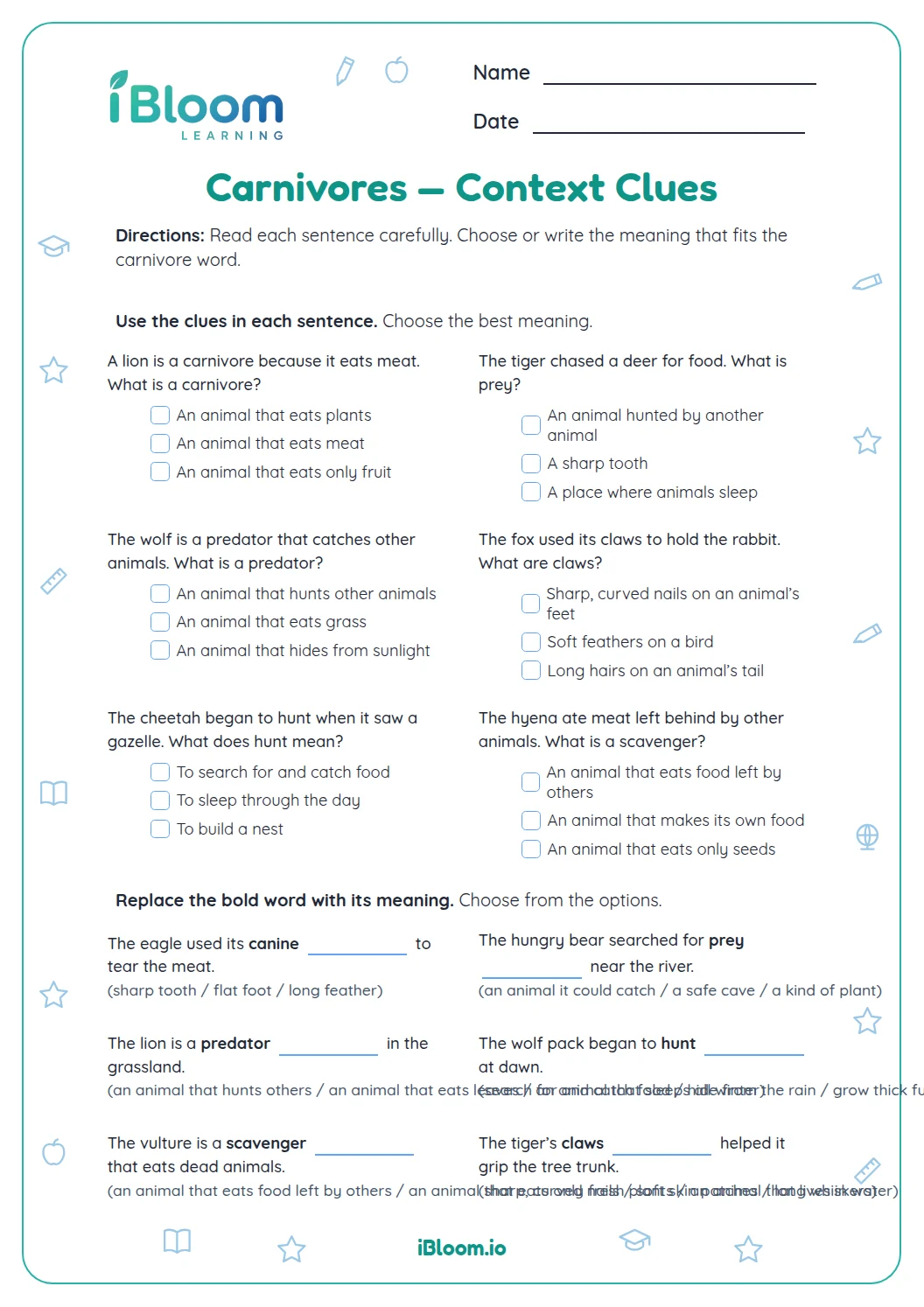
A sentence often gives clues to an unfamiliar word. In “The fox stalked its prey,” the fox is approaching an animal it hunts, so stalked means moved quietly closer. The rest of the sentence helps narrow the meaning.
The worksheet first gathers animal names in a word search, then connects the animals to habitats and precise vocabulary.
- 1The owl swooped down.
- 2“Down” tells the direction.
- 3Swooped means moved quickly downward.
What will children practice on the page?
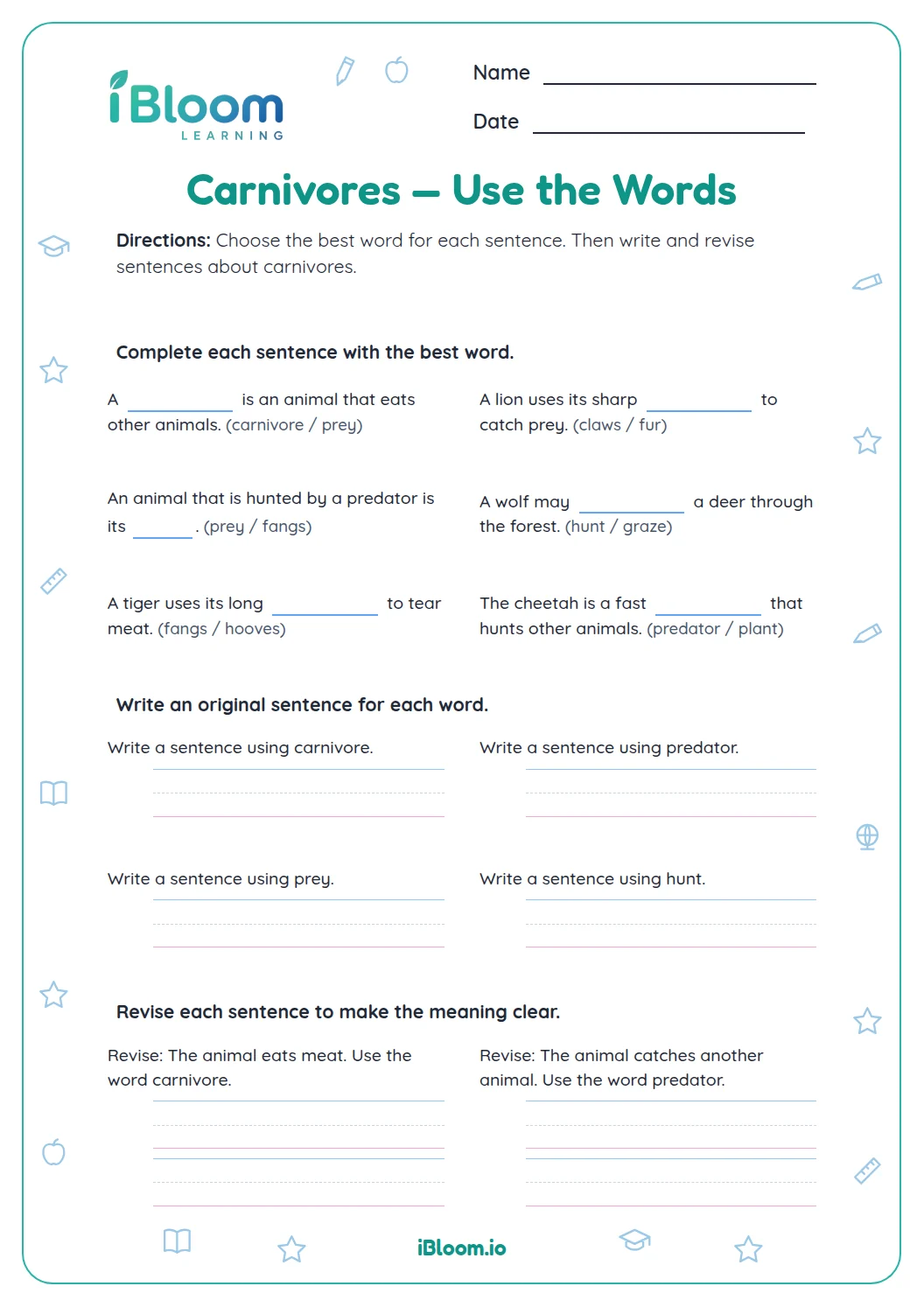
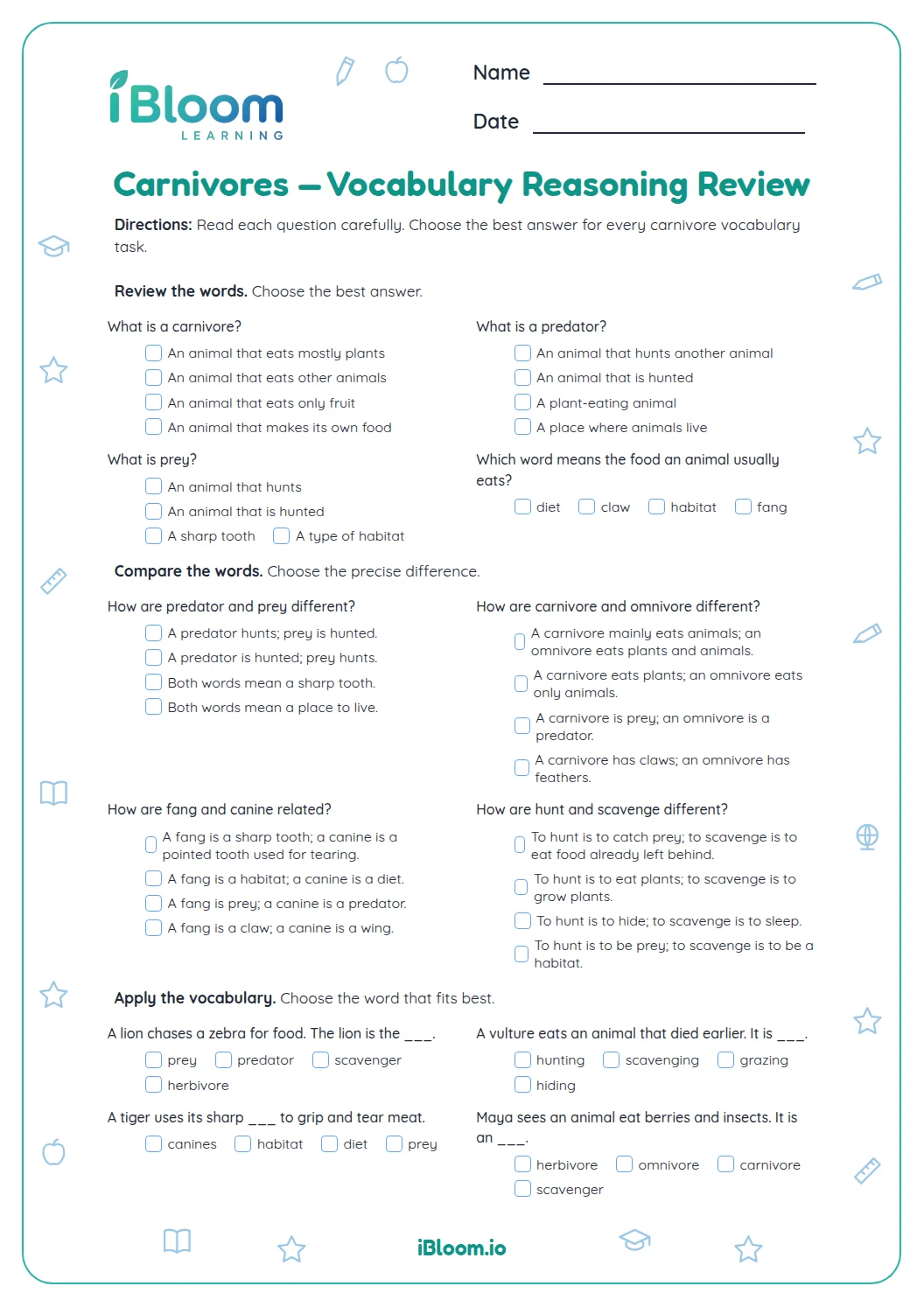
Part A finds eight animals in the grid. Part B classifies six animals by habitat group. Part C completes seven sentences using body-part, prey, and context clues.
How can the answer key help?
The key lists the hidden animals, the habitat group for each classification question, and the vocabulary completions. For context clues, accept a close meaning that fits the sentence.
How to use this worksheet
- 1Find and circle each animal name in the word search.
- 2Use where the animal hunts to choose land, water, or flying.
- 3Read the whole sentence before choosing a vocabulary word.
- 4Use nearby action words to work out what an unfamiliar verb means.
- 5Check the answer key and explain the clue that helped.
Common mistakes and quick fixes
The mistake
Choosing habitat from the animal’s name alone.
The fix
Use the sentence clue about where it hunts or catches food.
The mistake
Mixing up prey and predator.
The fix
The predator hunts; prey is the animal it hunts.
The mistake
Guessing a verb without reading the whole sentence.
The fix
Look for a direction or action clue, such as “down” in swooped down.
Common Core alignment
The context questions practice the grade-level vocabulary standard below.
Use definitions, examples, and restatements in sentences to figure out animal words.
On this sheet: Children use clues in short sentences to identify carnivore vocabulary.
Show the official wordingHide the official wording
Use context (e.g., definitions, examples, or restatements in text) as a clue to the meaning of a word or phrase.
What to practice next
Make more practice
Further reading
Questions parents and teachers ask
What does carnivore mean?
A carnivore is an animal that eats other animals. This worksheet uses examples that hunt on land, in water, or while flying. Children classify six animals by habitat group and then use sentence clues to connect animal names with vocabulary about prey, body parts, and movement.
Which animals are hidden in the word search?
The grid contains lion, tiger, wolf, fox, bear, shark, eagle, and hawk. Each word runs horizontally from left to right. After finding the names, children classify six animals by habitat and use several of the same animals in sentences about food, body parts, or hunting.
How can a child tell what prey means?
The sentence gives a clue: a wolf hunts a deer because the deer is its prey. The animal doing the hunting is the predator; the animal being hunted is prey. A child can use the action in the sentence to tell the roles apart and complete the blank.
How can a child tell what prey means?
The sentence gives a clue: a wolf hunts a deer because the deer is its prey. The animal doing the hunting is the predator; the animal being hunted is prey. Children use that action to tell the roles apart and complete the matching blank on the worksheet.
What does stalked mean in the worksheet sentence?
In “The fox stalked its prey,” stalked means moved quietly closer. The fox is approaching an animal it hunts, so the surrounding words help identify the action. A close phrase that describes a quiet approach also fits the sentence and shows how context narrows a word’s meaning.
Is an answer key included?
Yes. A separate answer key lists the eight hidden words, six habitat groups, and vocabulary completions. For the context-clue items, accept the listed meaning or a close phrase that fits the sentence. The key also makes it easy to review why an animal belongs in a particular habitat group.