

About this worksheet
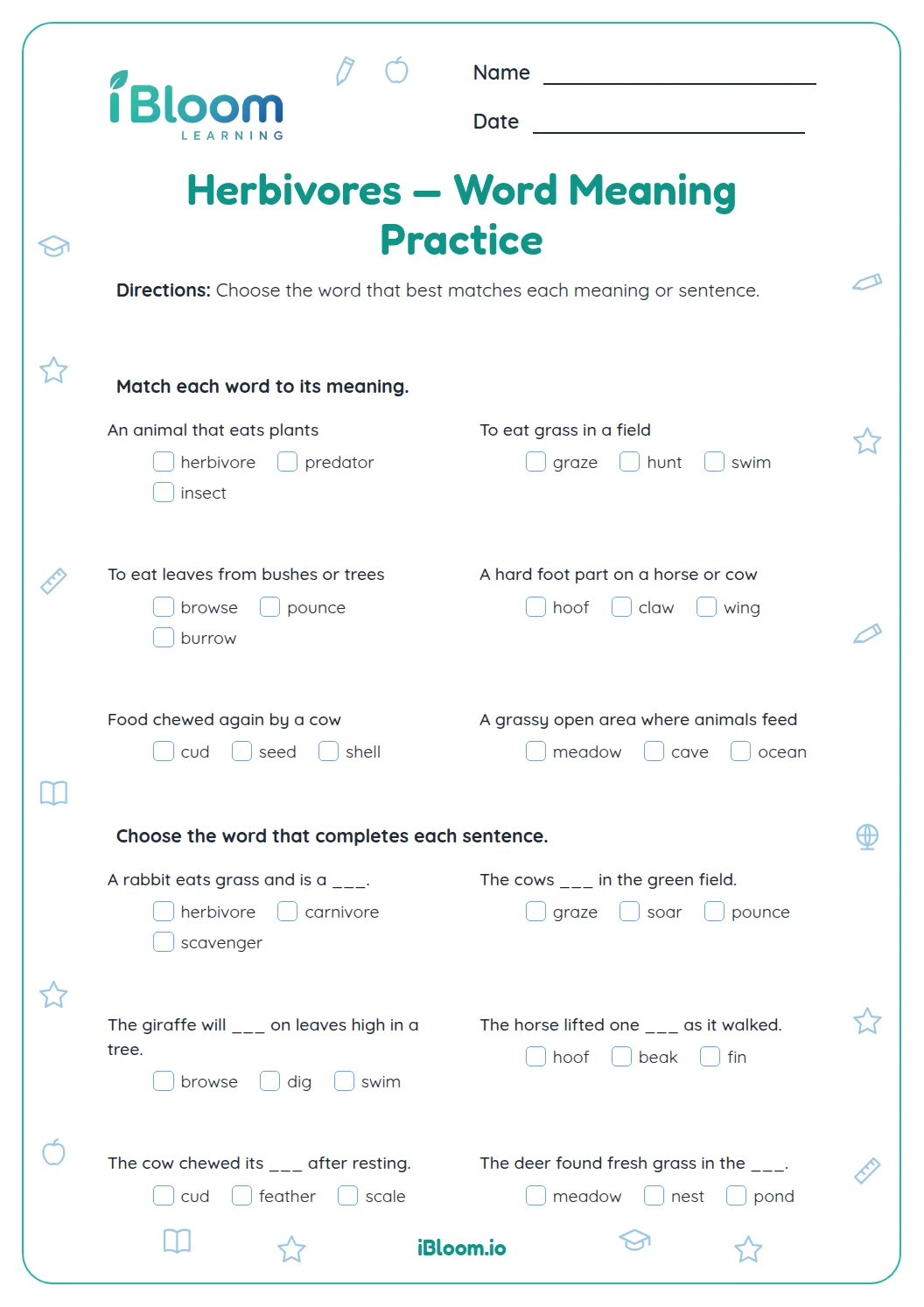
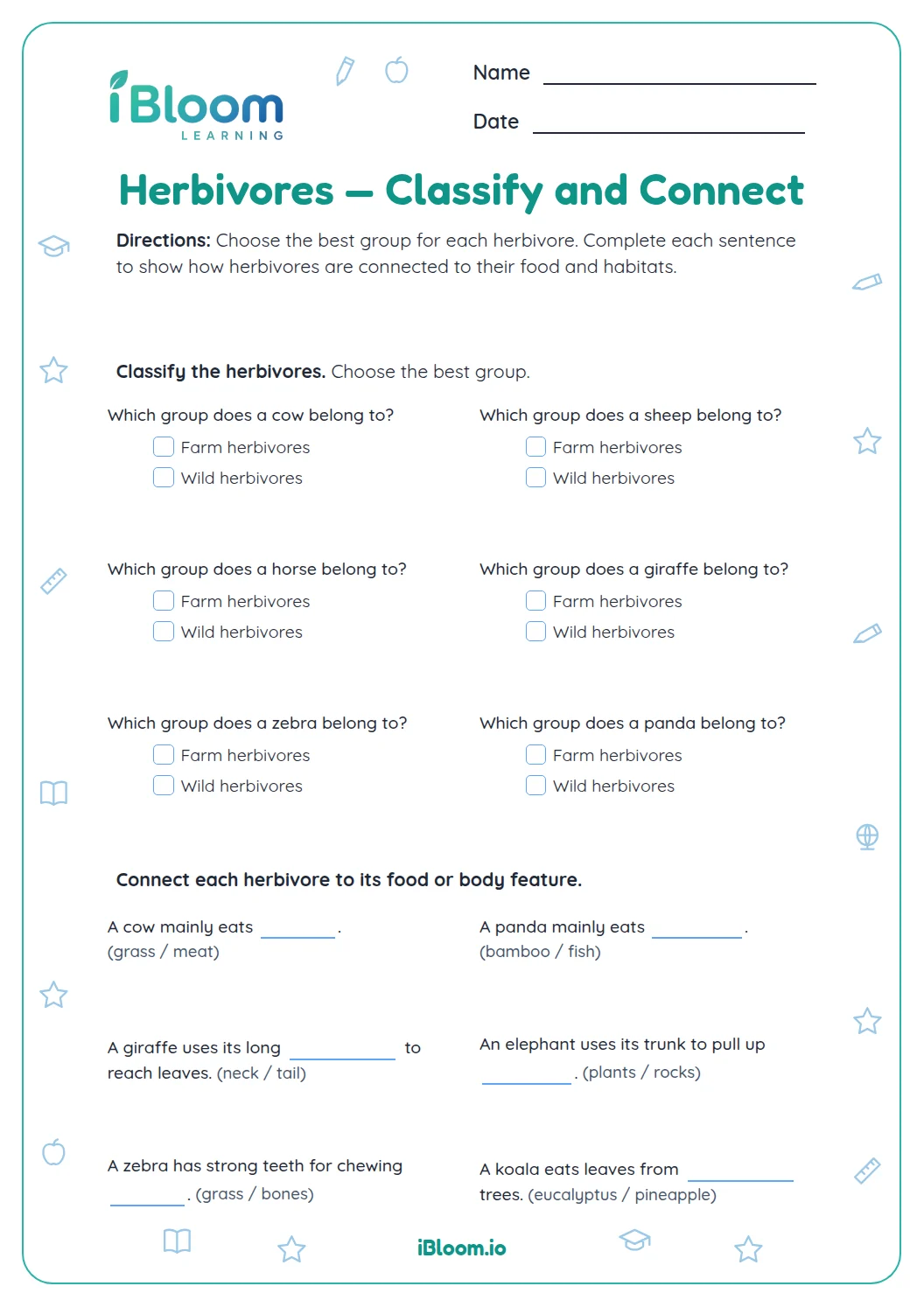
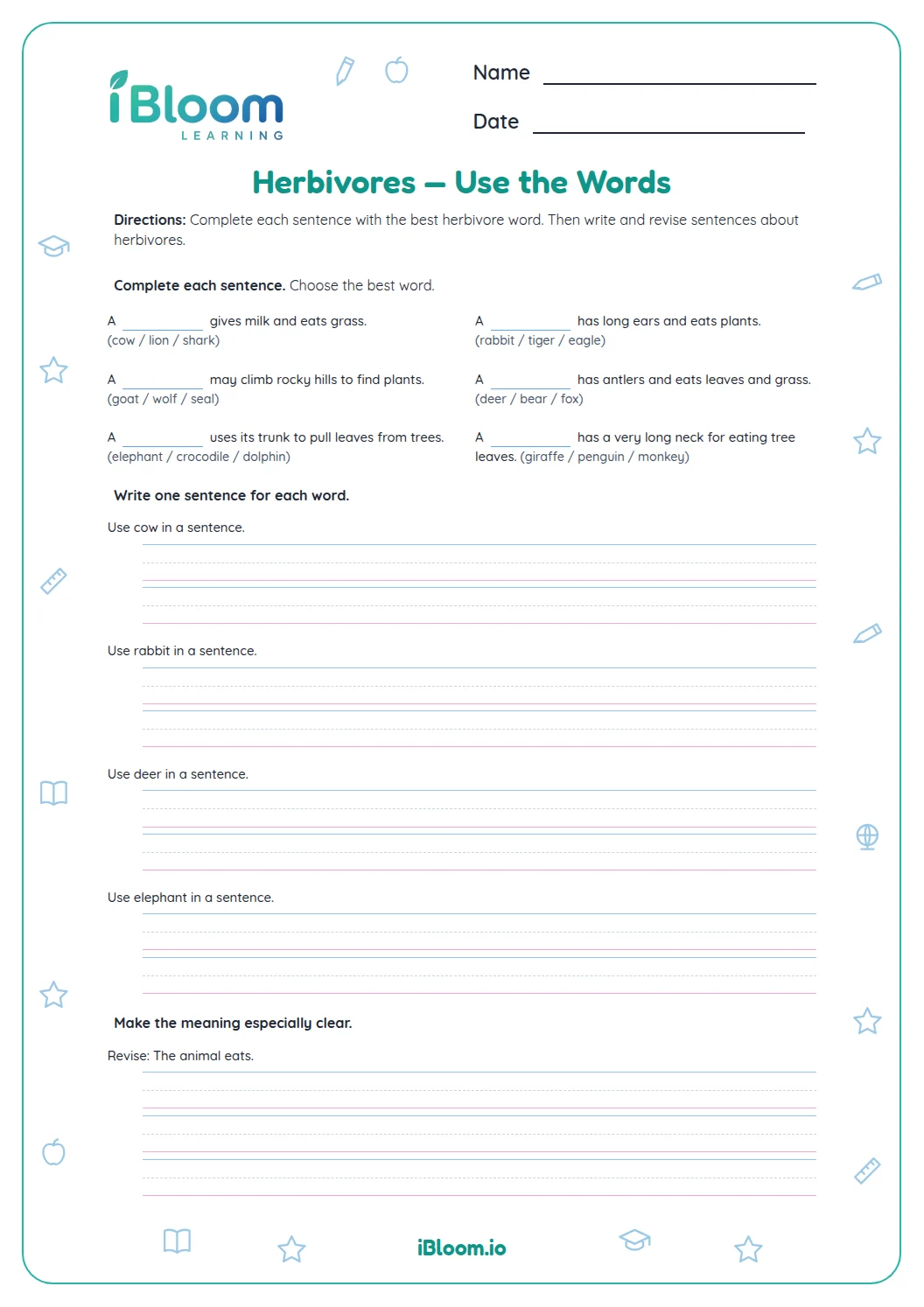
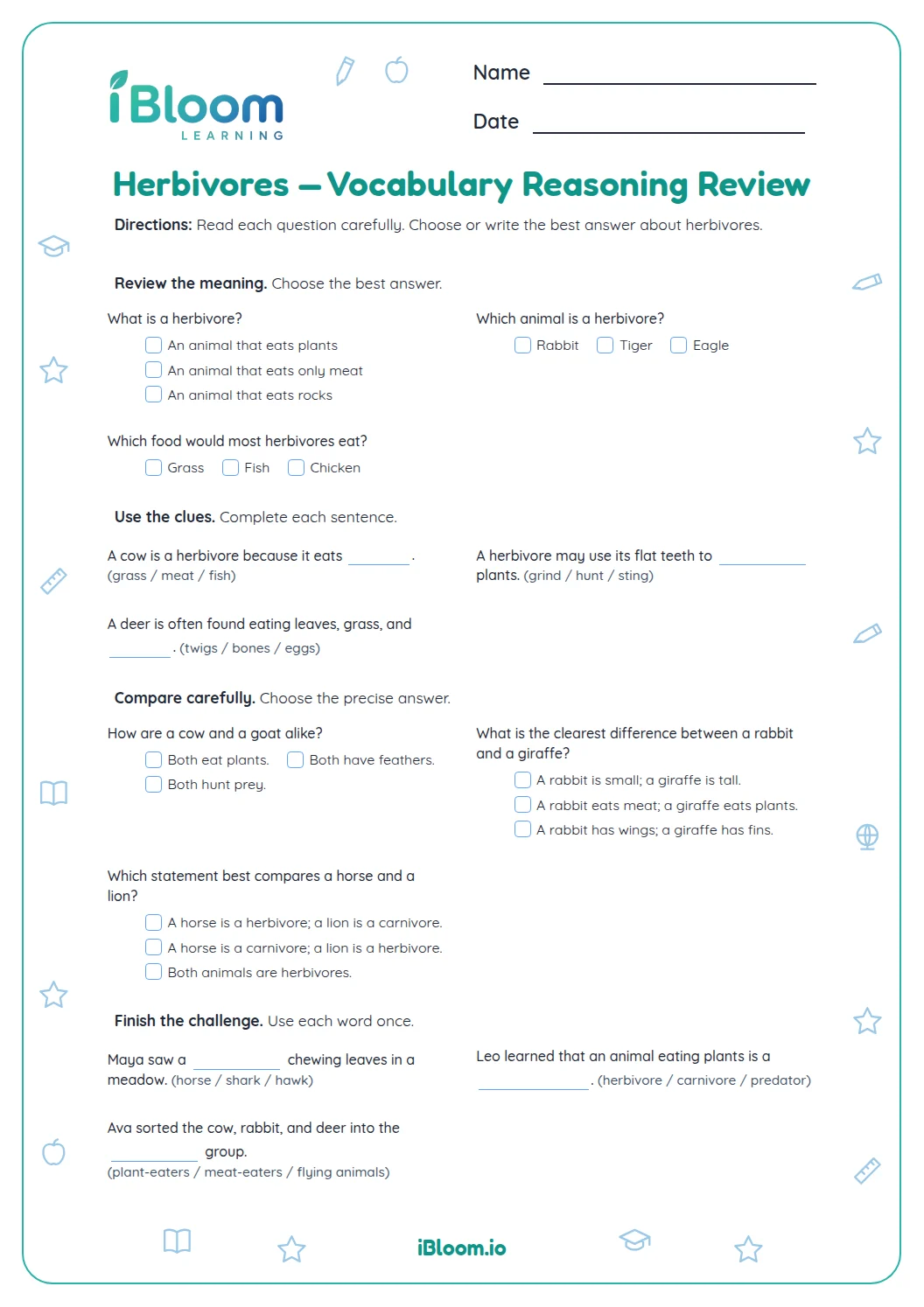
This Grade 4 printable pairs a herbivore word search with context-clue practice. Children find nine terms, then use clues about animal diets, feeding, and group behavior to apply the vocabulary. The answer key lists the search words and sentence responses.
Aligned to CCSS L.4.4.a
How do context clues help?
Look at the words around an unfamiliar term. They may explain what an animal eats or how it finds food. A grazer feeds on low plants; a browser nibbles leaves and shoots on shrubs or trees.
What will learners practice?
Part A is a word search with nine herbivore terms. In Part B, each sentence supplies a clue that helps identify a term or its meaning.
- Part A: find and circle nine words.
- Part B: complete or answer 13 vocabulary clues.
How can a clue point to a word?
In “The giraffe reached into a tree to eat leaves,” reaching into a tree and eating leaves point to browser. A grazer, by contrast, feeds on low-growing plants.
- 1The giraffe reached into a tree to eat leaves. It was a ___.
- 2The tree leaves are the clue.
- 3Answer: browser
How to use this worksheet
- 1Read the directions and complete Part A before moving on.
- 2Read each sentence or expression fully before choosing or calculating.
- 3Mark the clue, factor, or operation that supports your answer.
- 4For written work, reread the response and check that it answers the prompt.
- 5Use the separate answer key to check each response and revisit any missed step.
Common mistakes and quick fixes
The mistake
Answering from one familiar word or number without reading the full prompt.
The fix
Read the whole item and identify the clue or operation it asks you to use.
The mistake
Stopping after a first step when the item needs more reasoning.
The fix
Check whether the prompt asks for a meaning, a greatest value, or a final result.
The mistake
Copying an answer without checking that it fits the sentence or calculation.
The fix
Read the completed response again and compare it with the original question.
Common Core alignment
This worksheet practices the following Common Core standard.
Use sentence context to identify meanings of herbivore vocabulary.
On this sheet: The word search introduces nine terms, and the sentence clues use context to identify their meanings.
Show the official wordingHide the official wording
Use context (e.g., definitions, examples, or restatements in text) as a clue to the meaning of a word or phrase.
What to practice next
Make more practice
Further reading
Questions parents and teachers ask
What is an herbivore?
An herbivore is an animal that eats plants. Deer, cows, and many other animals are herbivores. On this worksheet, the word appears in a word search and in a clue sentence about an animal eating leaves and grass.
How is a browser different from a grazer?
A browser nibbles leaves, shoots, or twigs from shrubs and trees. A grazer feeds on low-growing plants such as grass. Both are herbivores, but the words describe different ways of finding food. The worksheet uses tree leaves and short grass as clues to tell the terms apart.
What is a ruminant?
A ruminant is an animal that brings partly digested food back to its mouth and chews it again. Cows, sheep, and goats are familiar examples. The food chewed again is called cud, another term learners find and use on this page.
How do context clues help with an unfamiliar word?
Read the words around the unfamiliar word and look for a detail that explains it. A sentence about reaching into a tree for leaves points to browser. Then reread the whole sentence with the word to see if the meaning fits.
What is included in the printable?
The printable has two worksheet pages and two answer-key pages. Part A is a nine-word herbivore search, and Part B has 13 short vocabulary clues. The key lists the search words and the correct responses for each clue question.