


About this worksheet
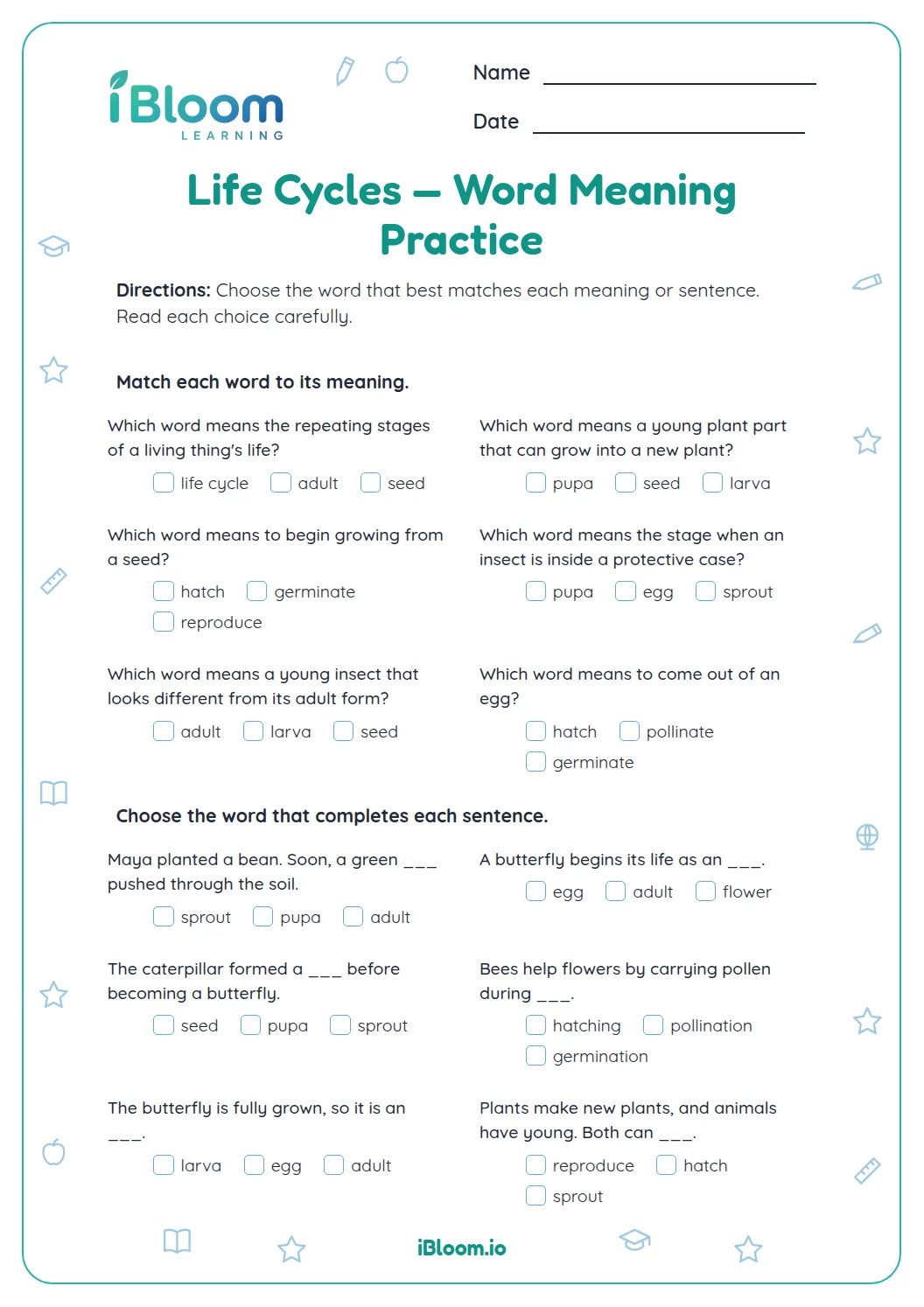
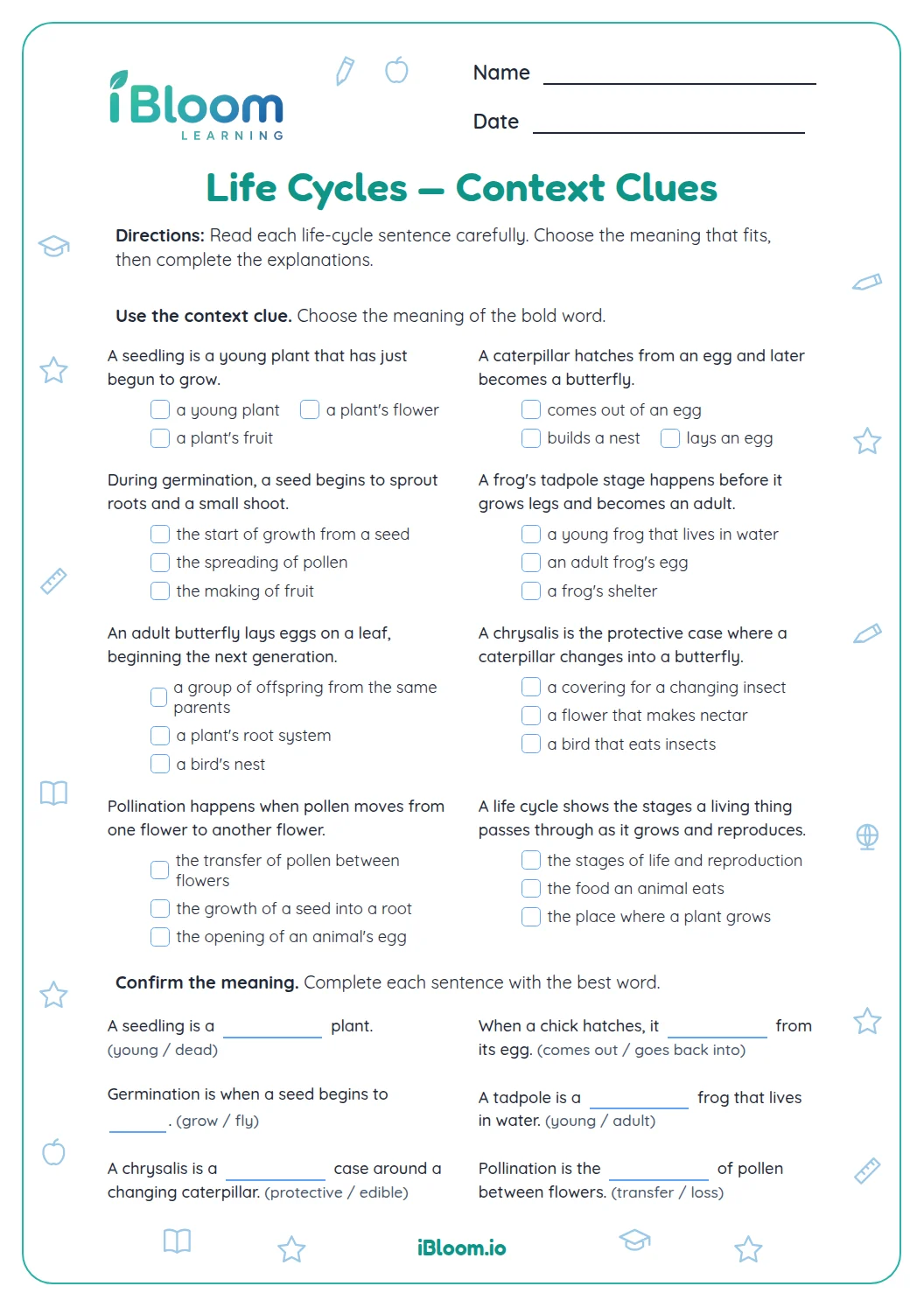
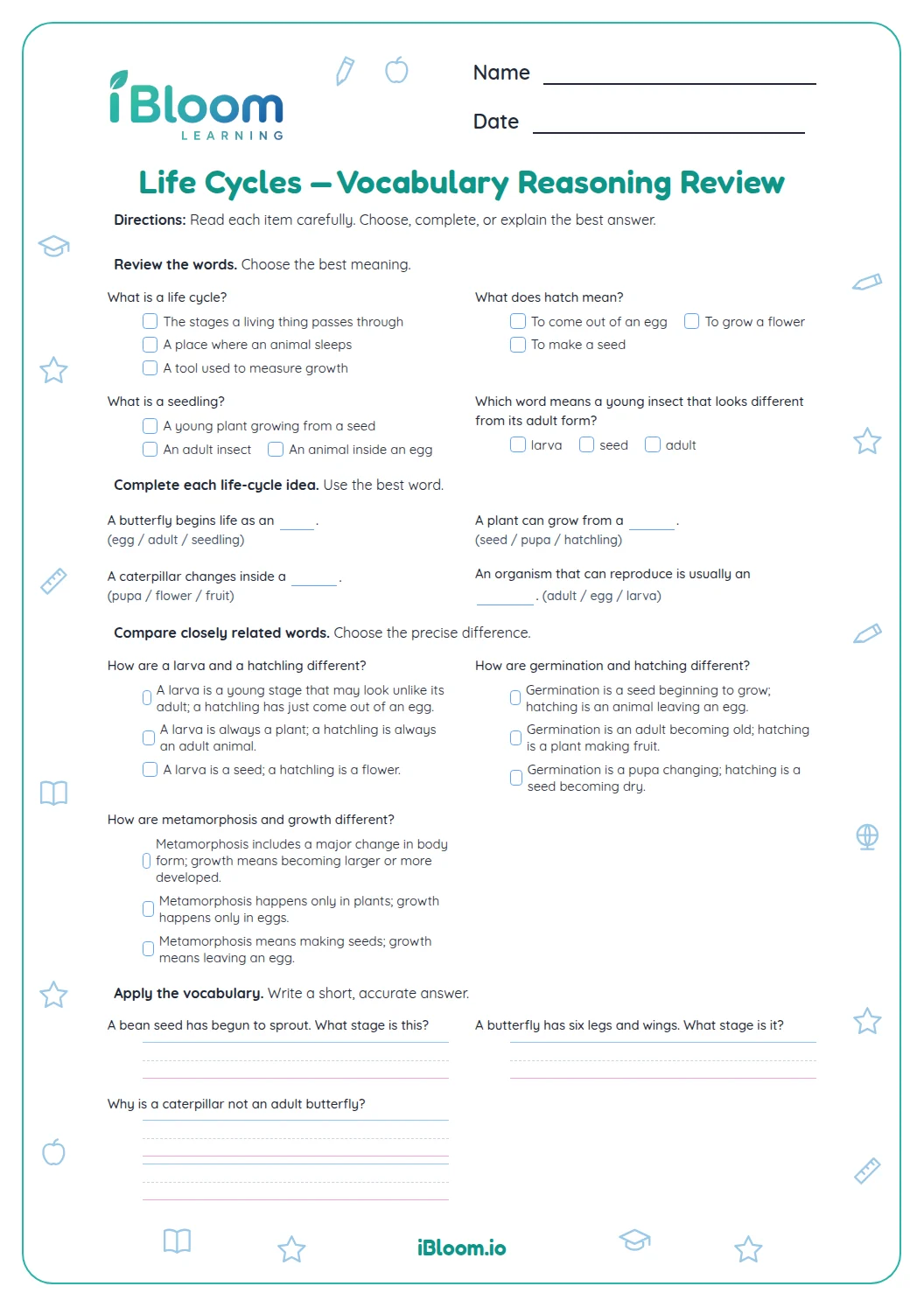
This Grade 4 vocabulary page pairs a life-cycle word search with sentence completion. Learners locate eight terms, including egg, larva, pupa, sprout, pollen, and roots, then use context to apply vocabulary to plant and animal growth. The activity supports CCSS L.4.4.a: using context clues to clarify word meaning. A separate answer key lists the puzzle words and sentence answers.
Aligned to L.4.4.a
What should learners do in the word search?
Scan for each listed word, checking rows and nearby letters rather than guessing from a familiar pattern. The puzzle includes eight terms that appear again in the sentence practice. Finding them first gives learners a quick preview of the vocabulary.
- 1Look for the letters E-G-G in order.
- 2Circle the complete word, not a partial match.
- 3Then use the sentence clues to connect terms to their meanings.
How do sentence clues narrow down a word?
Look at the action or description in the sentence. “A young frog with a tail and gills” points to tadpole; “the resting stage inside a butterfly’s case” points to pupa. The surrounding words show which life-cycle term fits.
Why do related words need careful use?
A seed and a sprout are connected but name different things: the seed is the starting structure, while a sprout is a young plant beginning to grow. Similarly, pupa names a stage, while metamorphosis names a process of change.
How to complete the vocabulary page
- 1Read the word list before searching.
- 2Check one row at a time and circle each full word.
- 3Read every sentence for its meaning clue.
- 4Say the possible term aloud in the blank to check that the sentence makes sense.
- 5Use the answer key to review spelling and meaning.
Life-cycle vocabulary mix-ups
The mistake
Using pupa for the butterfly’s caterpillar stage.
The fix
A caterpillar is the larva; pupa is the resting stage that follows.
The mistake
Using seed and sprout as if they name the same stage.
The fix
A seed can begin growing; a sprout is the young plant that emerges.
The mistake
Calling pollen pollination.
The fix
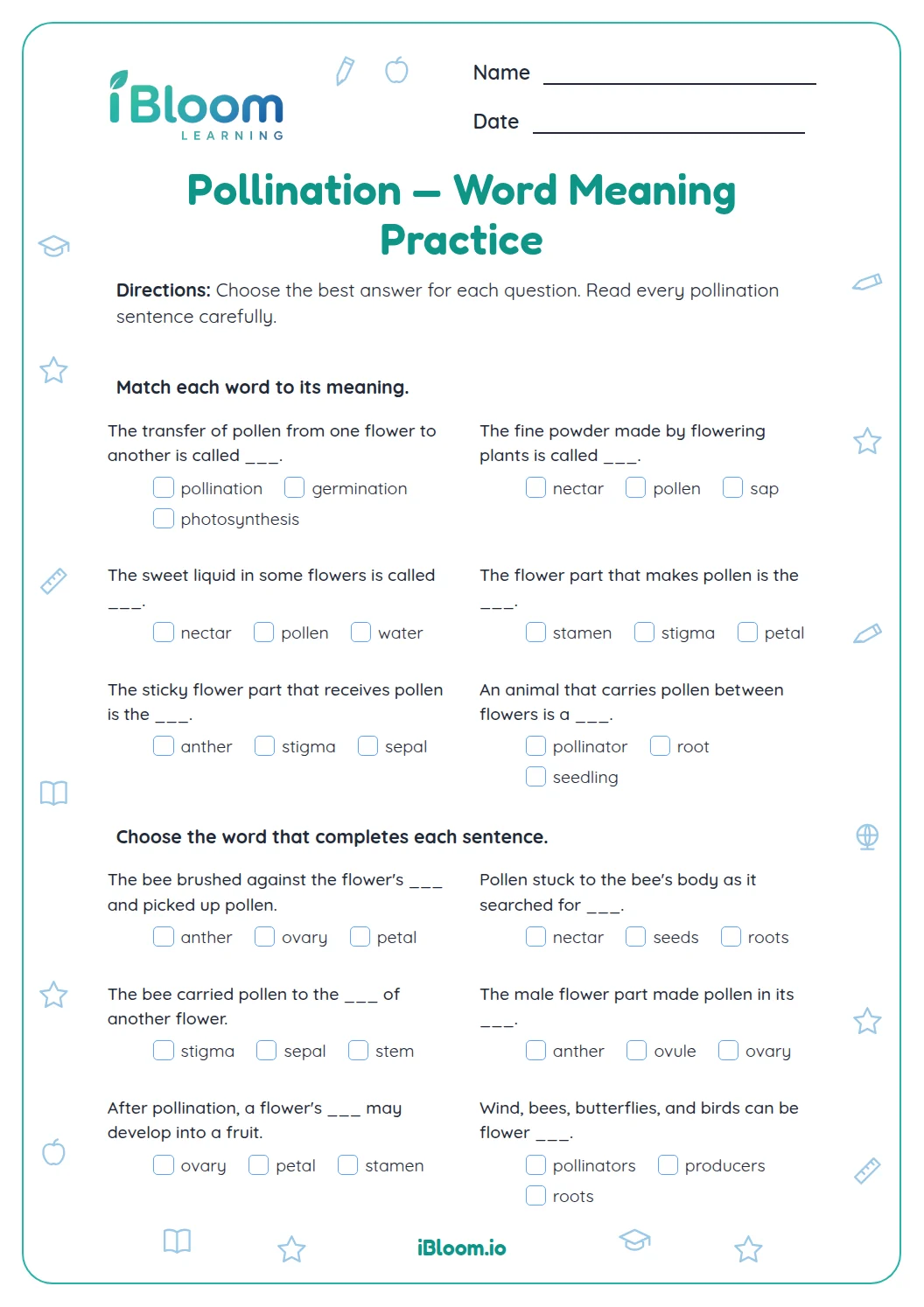
Pollen is the powder moved between flowers; pollination is the transfer process.
Common Core alignment
This sheet gives focused practice with the standard below.
Use sentence context to clarify the meaning of life-cycle vocabulary.
On this sheet: Sentence completion prompts use context to select accurate life-cycle vocabulary.
Show the official wordingHide the official wording
Use context (e.g., definitions, examples, or restatements in text) as a clue to the meaning of a word or phrase.
What to practice next
Make more practice
Further reading
Questions parents and teachers ask
Which words are in the puzzle?
The puzzle asks learners to find egg, seed, larva, pupa, adult, sprout, pollen, and roots. The sentence section then uses those words and related terms such as caterpillar, tadpole, cycle, metamorphosis, and pollination. The puzzle words are printed in the word list beside the grid, and each has a matching path in the letters.
What is the difference between a larva and a pupa?
Someone refers to an unnamed person in a statement, as in “Someone left a note.” Anyone often appears in a question asking whether a person is available or willing. On this sheet, learners use the sentence context to decide whether a person or a thing is meant and whether the sentence refers to one, all, or none.
How can a child use sentence context?
Read the whole sentence and notice the definition or example hidden in it. For example, “a young frog with a tail and gills” describes a tadpole, even if the learner does not know the word at first. The butterfly is inside its case during the pupa stage.
Does the worksheet include plant life cycles too?
Yes. Several prompts cover seeds, sprouts, roots, and pollen. The other sentences use animal examples such as butterflies and frogs, so learners meet vocabulary across different life cycles. The description of a fully grown living thing signals adult. In the butterfly example, the adult is the stage that can lay eggs and begin another cycle.
What does the answer key show?
The separate answer key lists the terms to find and the correct word for each sentence. Learners can check spelling as well as whether they matched the sentence clue to the right stage or process. A seed can begin to grow, and the small plant that emerges is a sprout.