



About this worksheet
This printable Grade 4 vocabulary sheet pairs a word search with focused water-cycle word meanings. Learners first locate ten terms, including evaporation, condensation, precipitation, and groundwater. They then choose terms that fit clear definitions and connect processes in the cycle. The answer key supports a quick review of both the word grid and the meaning questions.
Which terms should learners find first?
The grid contains ten water-cycle terms: evaporation, condensation, precipitation, collection, groundwater, runoff, vapor, cloud, droplet, and cycle. Finding a word lets learners notice its spelling before applying its meaning.
How does the meaning section work?
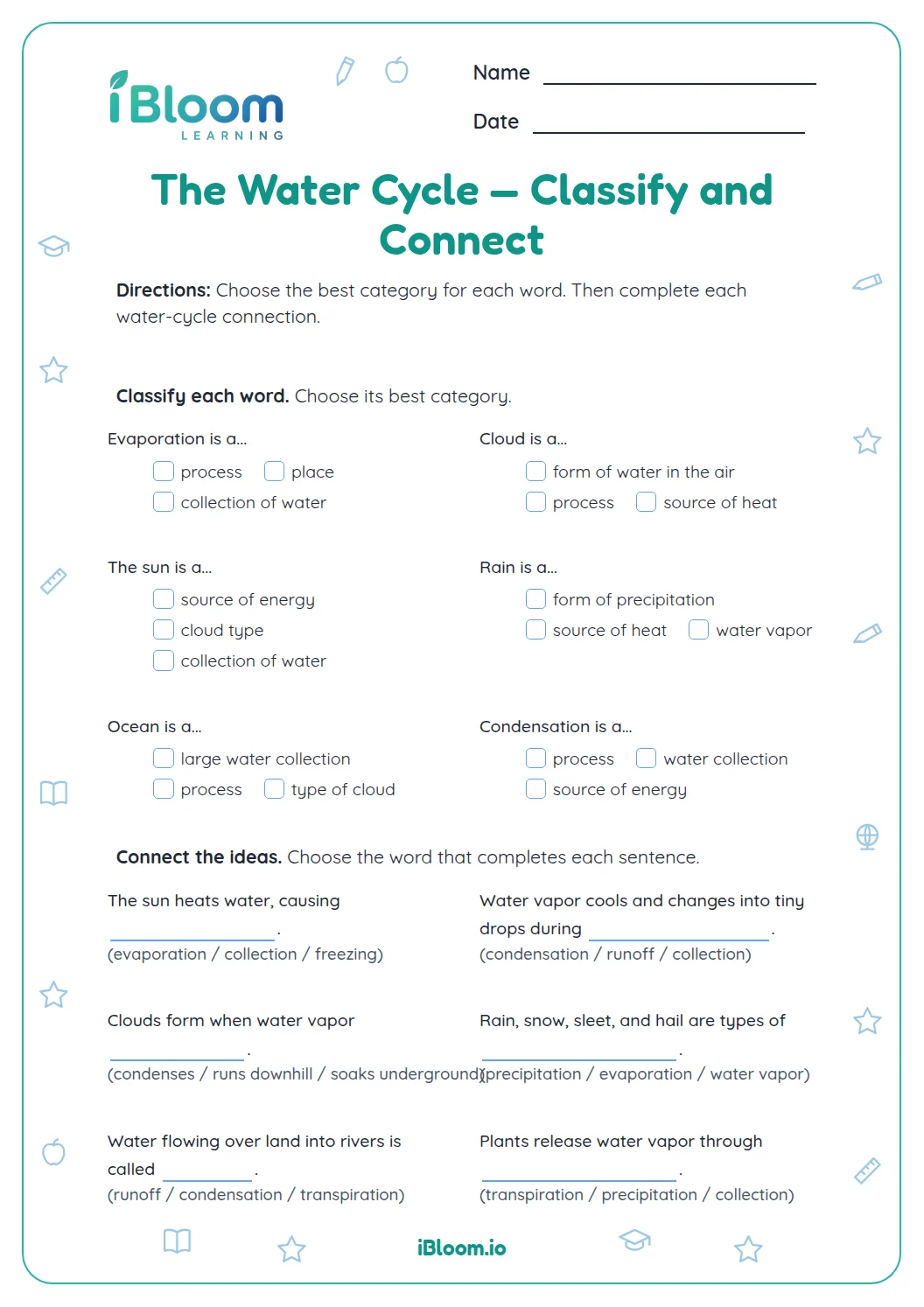
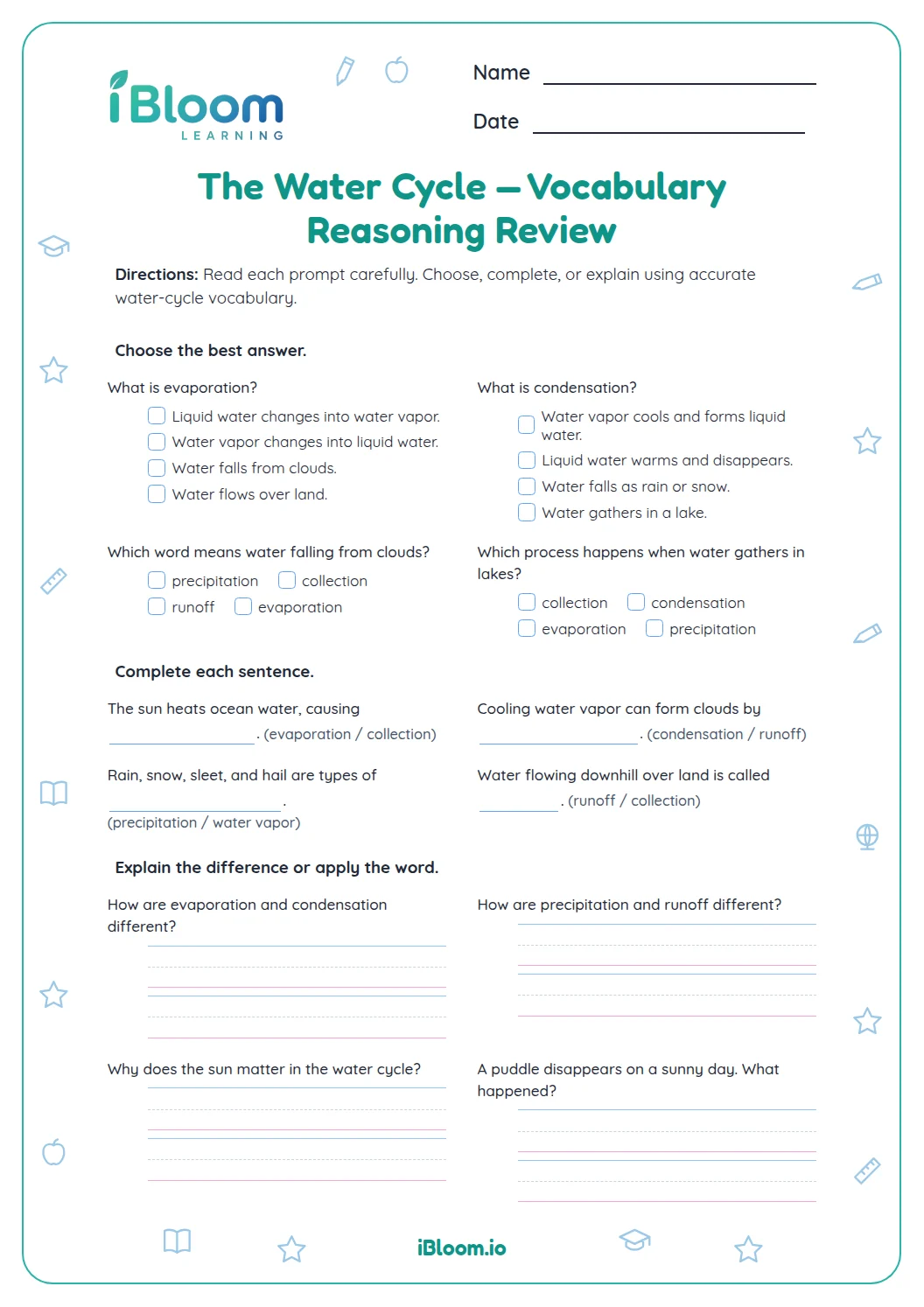
Each item gives a definition or a simple water-cycle relationship. For example, water vapor cooling into tiny liquid drops describes condensation. The answer choices contrast related terms so careful reading matters.
How can the vocabulary connect to science?
Ask children to explain where the term fits in the repeating movement of water. The worksheet emphasizes the meaning of each word, so learners can use the vocabulary accurately when describing a process.
How to use this worksheet
- 1Scan the grid for a familiar beginning or ending.
- 2Mark each found term on the word list.
- 3Read each definition from beginning to end.
- 4Compare the choices and select the word with the matching meaning.
- 5Review the key and explain one process aloud.
Common mistakes and quick fixes
The mistake
Mixing up evaporation and condensation.
The fix
Evaporation changes liquid water into vapor; condensation forms liquid drops from vapor.
The mistake
Treating precipitation as only rain.
The fix
Remember that precipitation can also include snow, sleet, or hail.
The mistake
Confusing groundwater with runoff.
The fix
Groundwater is below Earth’s surface; runoff flows over the land.
What to practice next
Make more practice
Further reading
Questions parents and teachers ask
Which words are in the water-cycle grid?
The ten terms are evaporation, condensation, precipitation, collection, groundwater, runoff, vapor, cloud, droplet, and cycle. The same vocabulary appears in the meaning questions, so learners can use the list to review spelling while they work through the remaining clues.
What does evaporation mean?
Evaporation is the process in which liquid water changes into water vapor. One worksheet clue describes water changing from liquid to gas and rising into the air. Learners distinguish this process from condensation, when vapor cools and forms liquid drops.
How are precipitation and collection different?
Precipitation is water that falls from clouds as rain, snow, sleet, or hail. Collection describes water gathering in places such as lakes and rivers. The worksheet uses separate clues for these terms so learners practice the difference in meaning.
What is the difference between runoff and groundwater?
Runoff flows over land toward streams and other bodies of water. Groundwater is water held beneath Earth’s surface. Two worksheet clues ask learners to identify these terms from their locations and movement, then the key confirms the distinction.
Can children complete the word search first?
Yes. The first item is the word search, followed by vocabulary clues. Finding the terms first helps learners see each spelling before applying its meaning. The key can be used after the full sheet to check both the grid and the responses.
Does the printable include an answer key?
Yes. A separate key gives the expected response to all 15 vocabulary clues and confirms the ten words in the search. Use it after the learner has tried each item, then revisit any term whose meaning or spelling needs another look.