
About this worksheet
This Grade 4 printable combines a word search with context-clue practice for properties of matter. Students find eight terms in a letter grid, then use short sentences about solids, liquids, gases, mass, volume, shape, and texture to select or write the word that fits. The sentence clues give a reason for each answer, such as a liquid taking the shape of its container. The page practices CCSS L.4.4.a and includes a separate answer key.
Aligned to L.4.4.a
Which matter words appear in the puzzle?
Part A is a word search for eight terms used again in the sentence work. Encourage students to cross off each word on the list as they find it.
How can a sentence point to the right word?
A clue may describe what a substance does or what a tool measures. In question 2, “keeps its own shape” points to solid.
- 1A frozen puddle keeps its own shape. It is a ___. → solid
- 2A balance measures how much matter an object has: its ___. → mass
How should students finish each sentence?
Read the whole sentence before writing. Check that the selected word fits both the clue and the science idea.
How can the answer key support practice?
Compare each choice and written word with the separate key. For a missed item, reread the clue and say what it tells about the material.
How to use this worksheet
- 1Scan the word list and find each term in the grid.
- 2Cross off a word only after checking every letter.
- 3Read each sentence all the way through.
- 4Underline the clue that describes a state or property.
- 5Choose or write the term that matches the clue.
- 6Use the key to revisit any answer that does not fit the sentence.
Common mistakes and quick fixes
The mistake
Mixing up mass and volume.
The fix
Mass tells how much matter; volume tells how much space an object takes up.
The mistake
Calling a liquid a gas because both take container shapes.
The fix
A liquid flows but keeps a set amount; a gas spreads to fill available space.
The mistake
Using shape when the sentence asks how a surface feels.
The fix
Texture describes a surface feel; shape describes its outline.
Common Core alignment
This practice connects the listed standard to the skill on the page.
Use nearby definitions and examples to determine a word meaning.
On this sheet: Part B uses sentence clues to select and complete matter vocabulary.
Show the official wordingHide the official wording
Use context (e.g., definitions, examples, or restatements in text) as a clue to the meaning of a word or phrase.
What to practice next
Make more practice
Further reading
Questions parents and teachers ask
What words are in the word search?
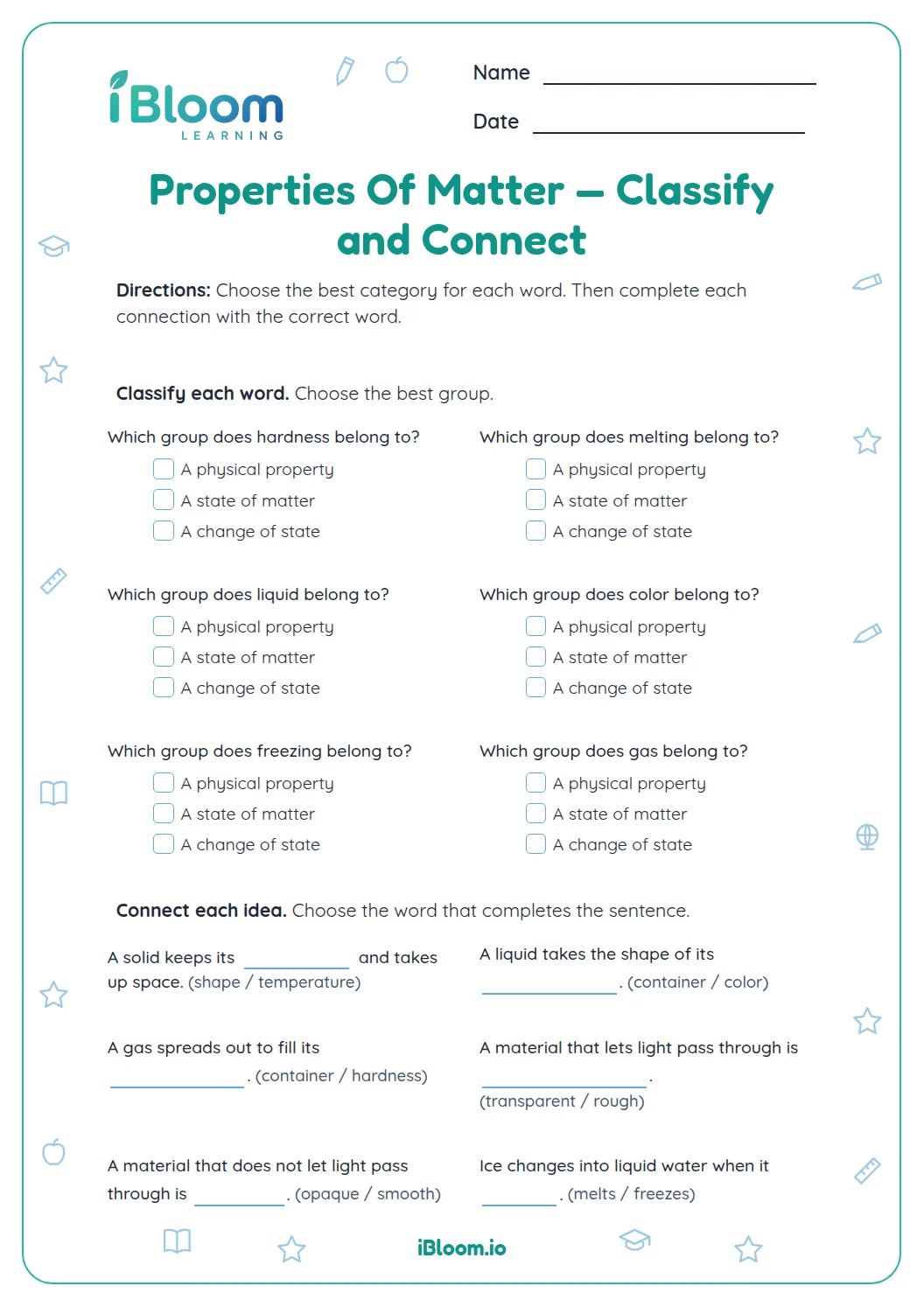
The grid includes solid, liquid, gas, mass, volume, texture, shape, and matter. Students locate each term, then use the vocabulary in sentence questions. The key lists the words so an adult can check the completed puzzle and review terms that were hard to find.
How do sentence clues help?
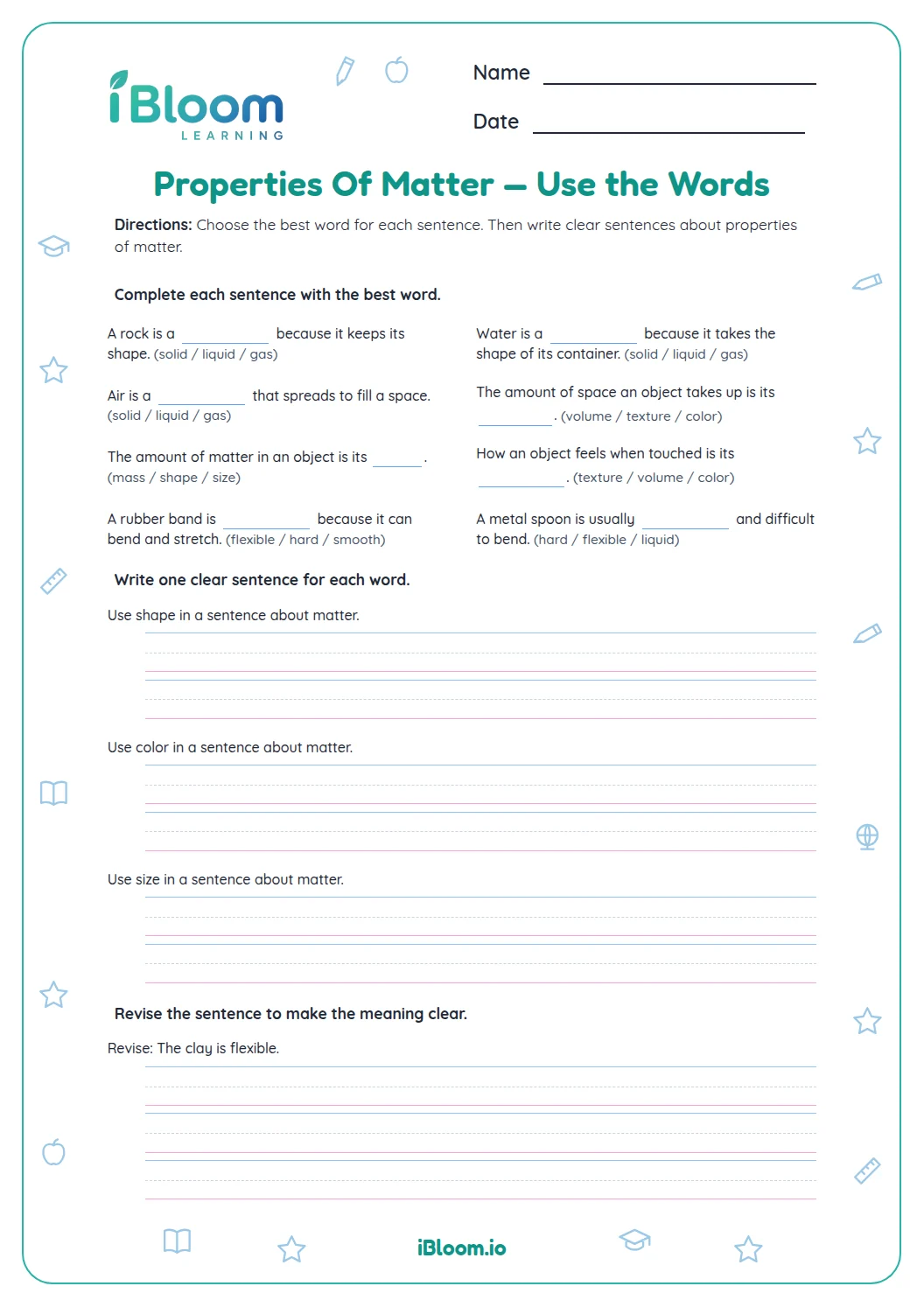
The sentences describe an object or material so students can infer the best vocabulary word. Something that keeps its own shape is a solid, while juice that flows and takes a cup’s shape is a liquid. These details point toward one answer.
How many questions are on the worksheet?
There are 16 questions: one word-search activity, seven choice questions, and eight sentences to complete. Students first locate terms, then use them to describe matter and its properties. The questions move from recognition to applying vocabulary in sentence clues during independent practice.
What is the difference between mass and volume?
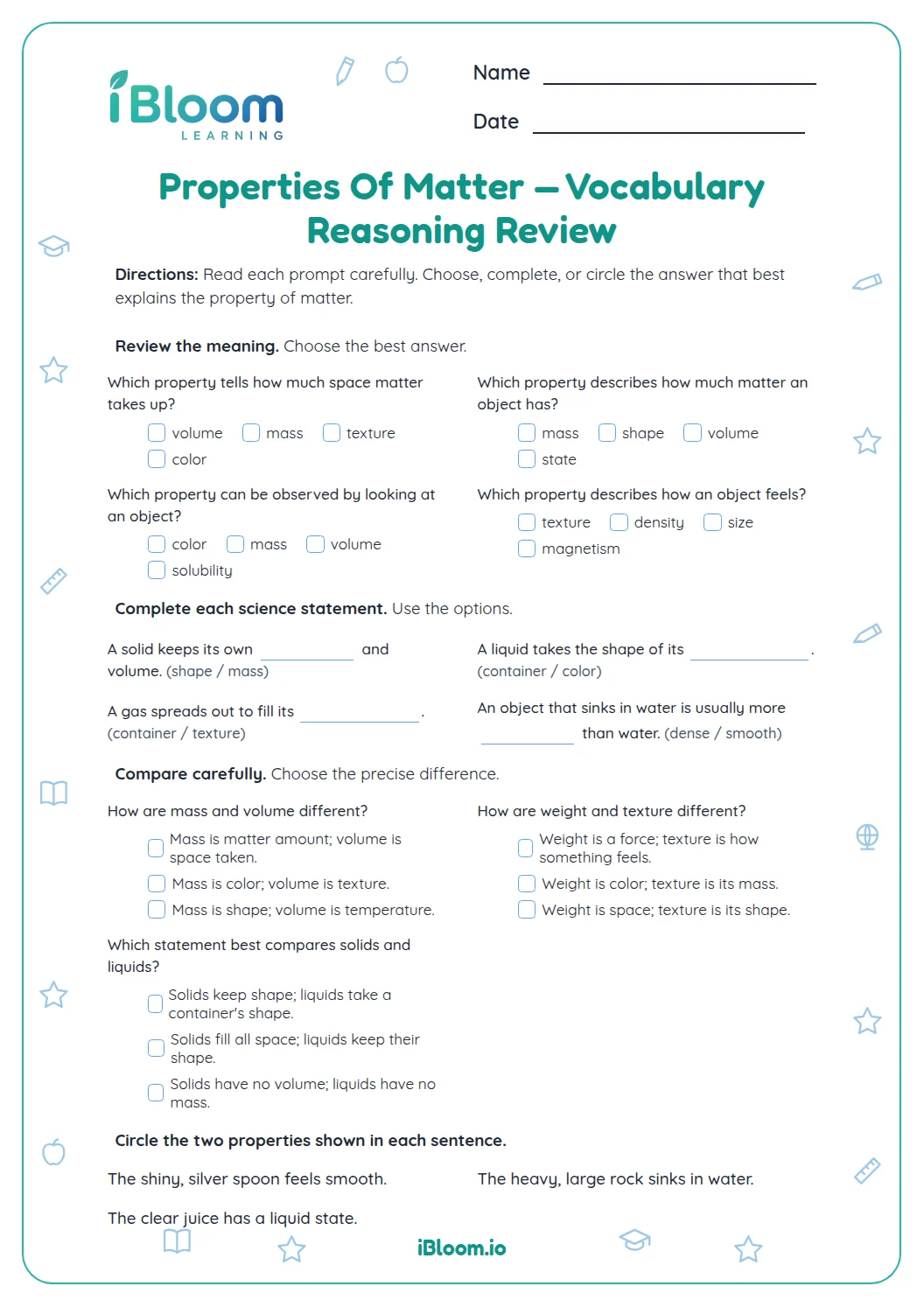
Mass tells how much matter an object has. Volume tells how much space it takes up. The worksheet uses a balance as a clue for mass and space in a box as a clue for volume, making the two terms easier to distinguish.
Can more than one word describe an object?
In everyday language, an object can have many properties. Each worksheet sentence points to one target through a specific clue, such as keeping its shape for solid or cubic centimeters for volume. Rereading the clue helps students choose the intended word.