



About this worksheet
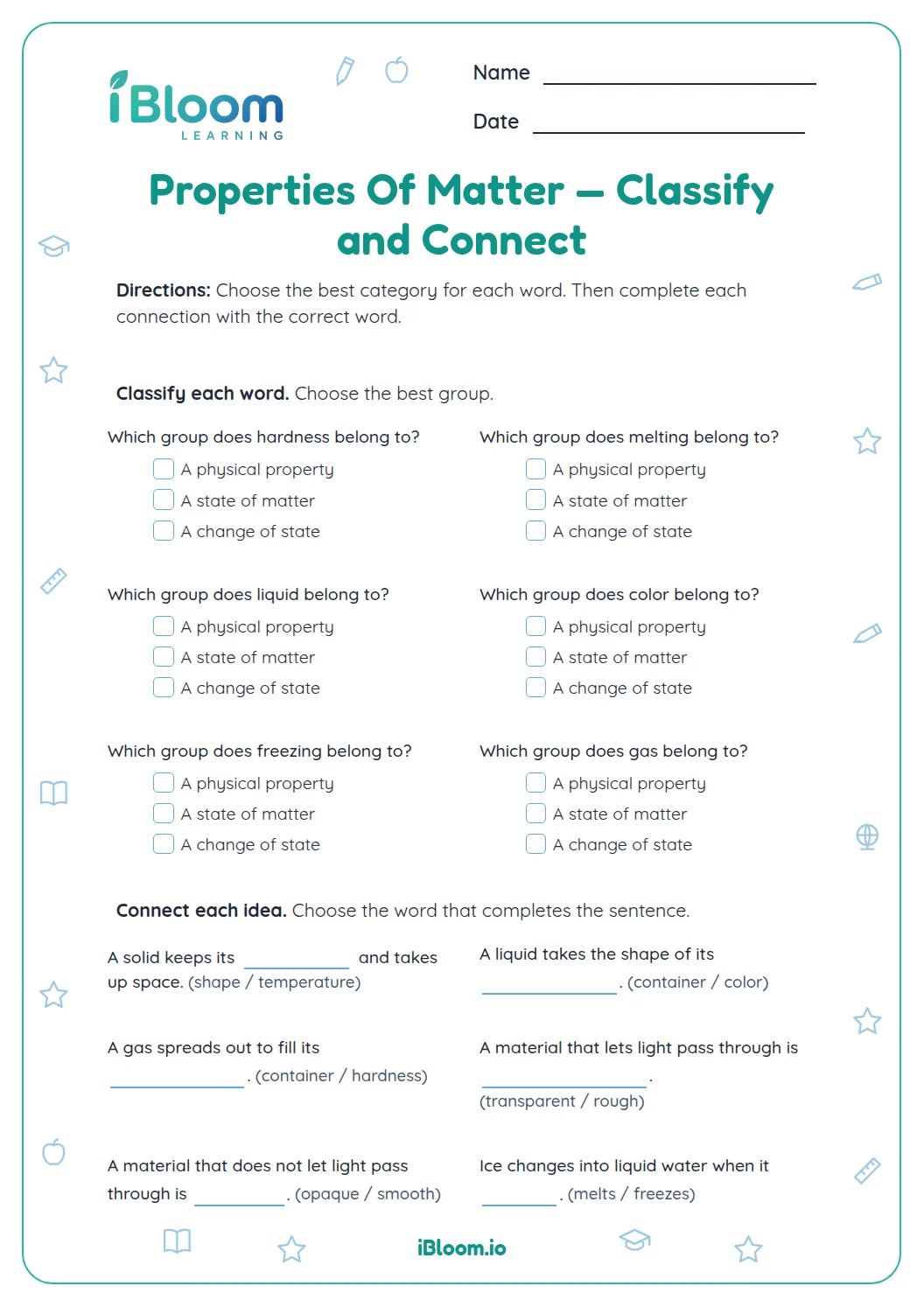
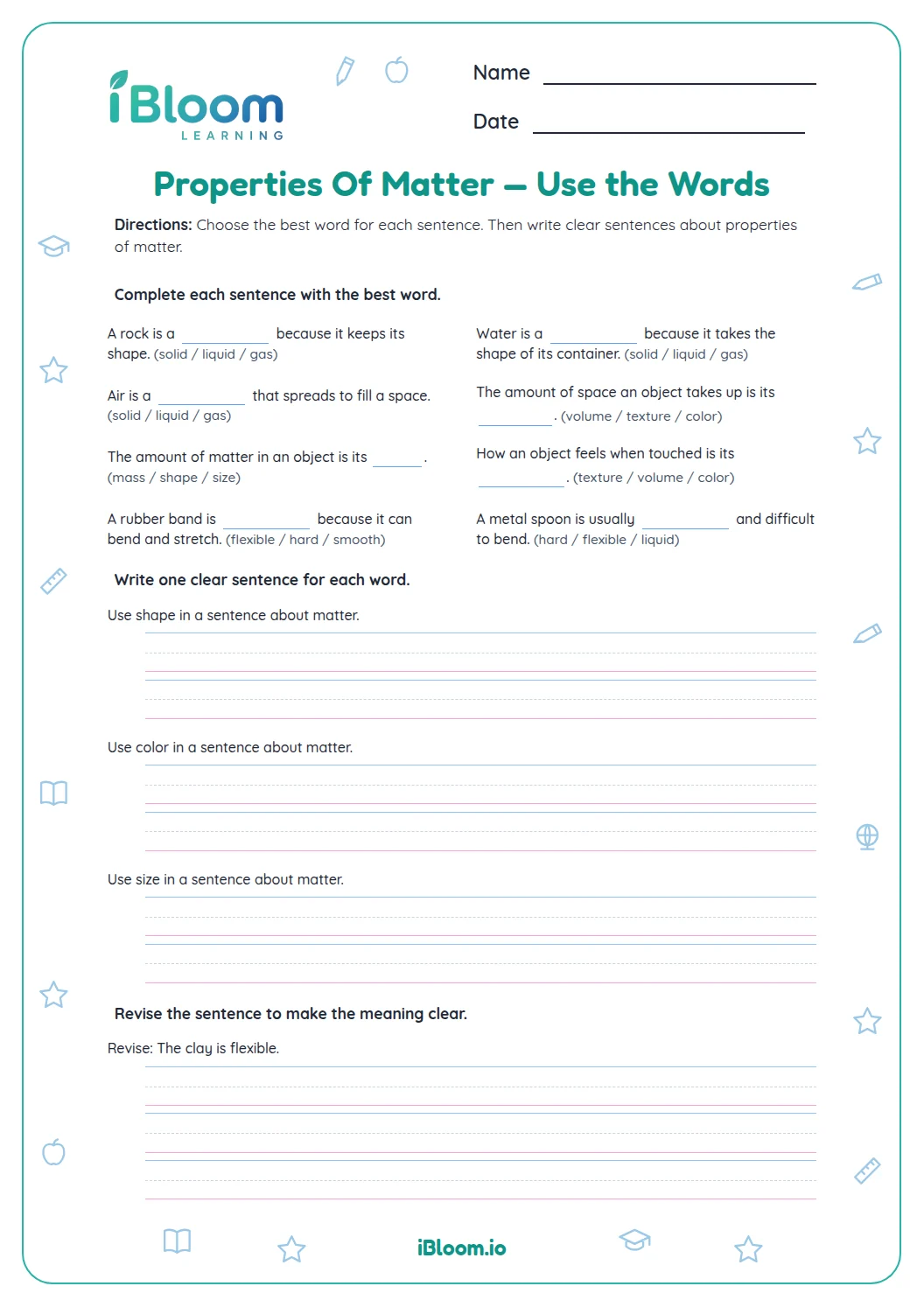
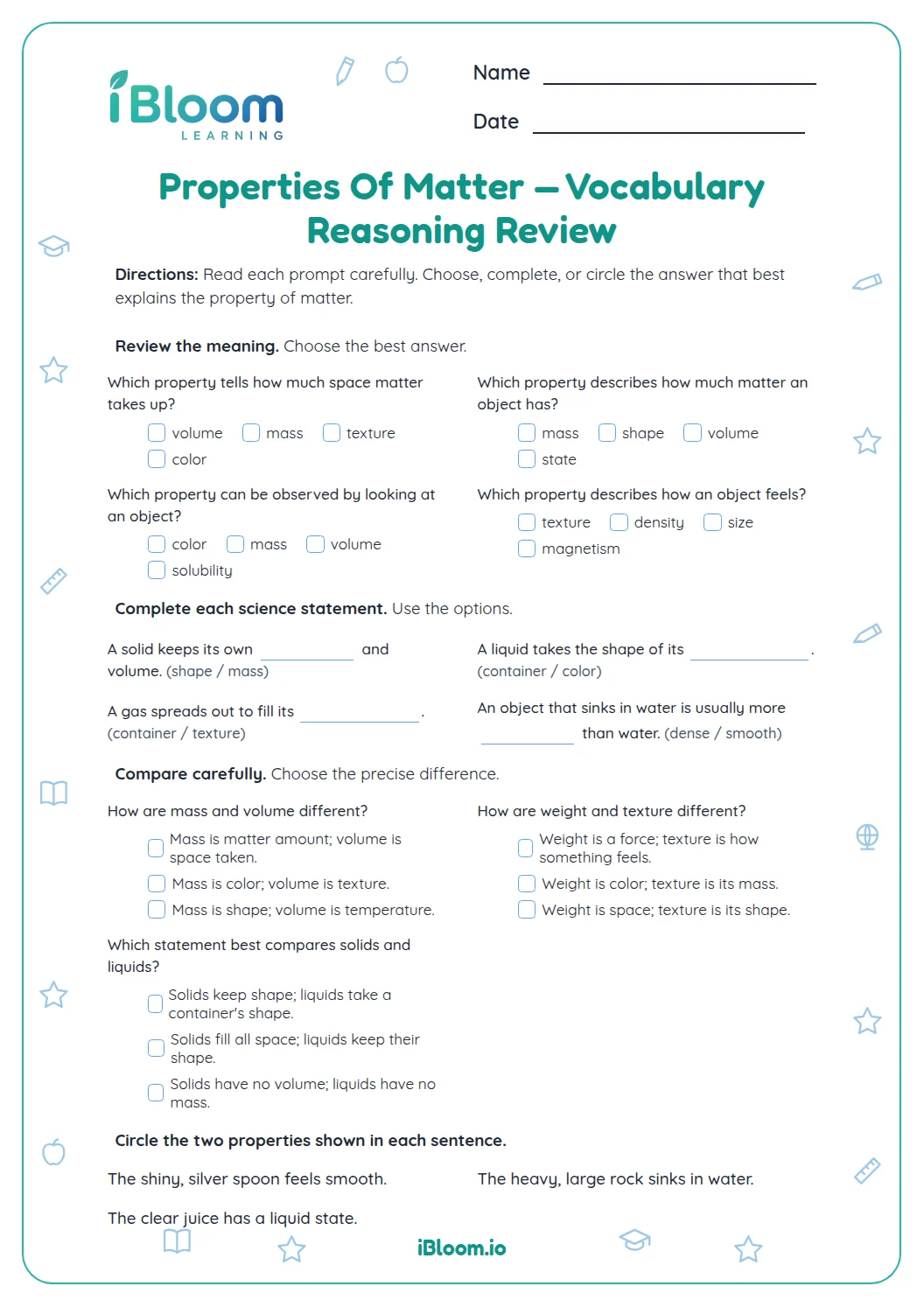
This Grade 4 vocabulary worksheet builds meaning for words used to describe matter, including flexible, rough, transparent, magnetic, and volume. Part A matches six words to definitions. Part B uses context clues and examples to apply vocabulary to states of matter and a simple magnet test. There are 14 questions across two worksheet pages, with a separate two-page answer key. CCSS L.4.4.a is practiced through examples and context clues that reveal word meaning.
Aligned to L.4.4.a
Which matter-property words appear?
Part A connects six terms to definitions. Part B applies context clues and examples to transparent glass, flexible clay, states of matter, and a magnet test.
- Part A: 6 definition choices
- Part B: 8 context and application questions
How do context clues reveal a word’s meaning?
A sentence can give an example that explains an unfamiliar word. If Maya bends clay into a coil, that action is a clue that the clay is flexible. In “We can see juice through clear glass,” seeing through the glass points to transparent.
- 1Maya bends clay into a coil. The clay is ___.
- 2The action bends gives the clue: the clay is able to bend.
How do properties help describe states of matter?
A solid keeps its shape and volume. A liquid keeps its volume but takes the shape of its container. The worksheet asks students to apply these ideas to a wooden block and water in a cup.
How can a student test for magnetism?
Bring a magnet near the object and observe whether it is attracted. A test gives evidence about that object; the word magnetic describes the property. Do not assume that every metal is attracted to a magnet.
Steps for learning the property words
- 1Read the definition or example carefully.
- 2Underline the clue that points to a property word.
- 3Try the word in the sentence and check whether its meaning fits.
- 4For solid or liquid, consider whether it keeps its shape or takes a container’s shape.
- 5For magnetism, use the test described in the final question.
- 6Check responses with the answer key and explain the clue aloud.
Matter vocabulary mix-ups
The mistake
Using mass when a question asks how much space an object takes up.
The fix
Volume is the space an object occupies; mass describes how much matter it has.
The mistake
Assuming every metal object is magnetic.
The fix
Test the object with a magnet; some metals are not attracted to one.
The mistake
Calling water a solid because it has a fixed amount.
The fix
A liquid can keep its volume while changing shape to fit its container.
Curriculum alignment
Context examples on the worksheet help students determine what each property word means.
Use context clues to determine word meaning.
On this sheet: The worksheet directly practices this grade-level skill through sentence and context-based application.
Show the official wordingHide the official wording
Use context (e.g., definitions, examples, or restatements in text) as a clue to the meaning of a word or phrase.
What to practice next
Make more practice
Further reading
Questions parents and teachers ask
Which properties of matter does the worksheet cover?
The questions use flexible, rough, transparent, magnetic, and volume, along with solid and liquid. Part A matches definitions; Part B uses clues such as bending clay or seeing through glass and applies the words to familiar objects and states of matter.
How do context clues help with flexible?
The nearby action or example shows what the word means. In “Maya bends clay into a coil,” bending without breaking suggests that the clay is flexible. Part B uses similar sentence clues so students connect the vocabulary word with evidence in context.
What is volume?
Volume is the amount of space an object or material takes up. The worksheet distinguishes volume from mass by asking which word describes space. A solid keeps its volume, and a liquid can keep its volume while changing shape to fit its container.
How can students test whether an object is magnetic?
Bring a magnet near the object and observe whether it is attracted. That test is the correct application in the final question. It gives evidence about the object’s magnetic property, instead of relying on appearance or assuming that every metal spoon is attracted to a magnet.
How many questions and pages are in the printable?
There are 14 questions in two parts, printed on two worksheet pages. The separate answer key also uses two pages and lists the expected choices for definitions, context clues, states of matter, and the final magnet-test application. Students can review each word group before checking.