




About this worksheet
This Grade 4 worksheet pairs the old sheet’s geology meaning practice with a seven-word search. Students find rock, mineral, soil, fossil, layer, magma, and lava, match seven definitions, and choose terms for six geology contexts. A separate answer key lists the search words and answers. The definition and context items practice using definitions and examples as clues to word meaning.
Aligned to L.4.4a
How does the search lead into word meaning?
Finding each term gives students a chance to notice its spelling. The clues that follow connect geology words with definitions and familiar contexts.
How can a location clue distinguish two words?
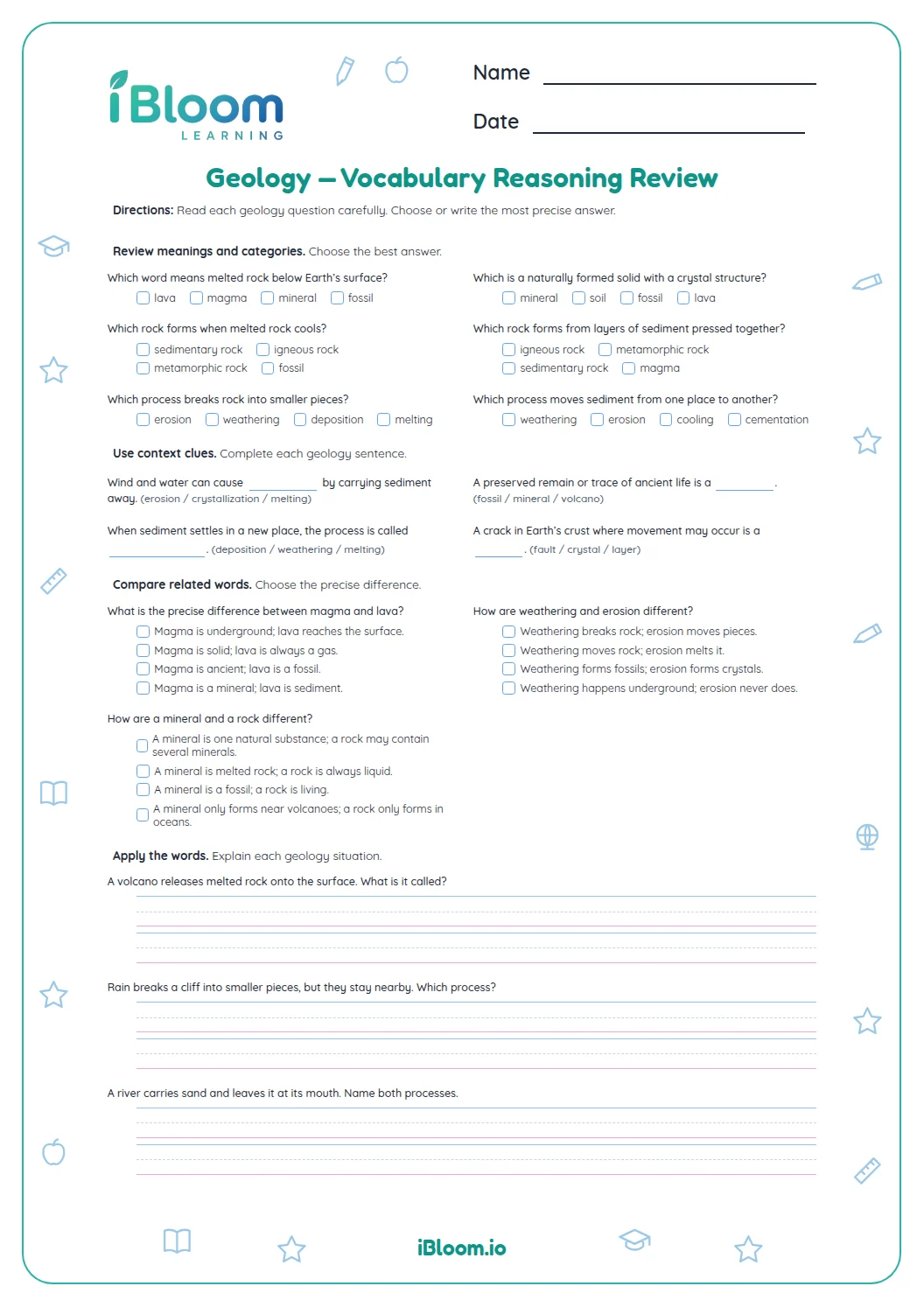
Magma is melted rock below Earth’s surface; lava is at the surface. Use the location clue in the sentence to choose the right term.
- 1Clue: hot melted rock below Earth’s surface
- 2Compare: magma is below; lava is at the surface.
- 3Answer: magma
What is on the worksheet?
Part A has one word search with seven terms. Part B has 13 definition and context completions. The answer key lists the search words and responses.
How to use this worksheet
- 1Scan the grid for each listed geology term.
- 2Check every letter before circling a word.
- 3Read a definition clue closely.
- 4Use context to distinguish related terms.
- 5Compare each completion with the answer key.
Common mistakes and quick fixes
The mistake
Finding only the first few letters of a search word.
The fix
Check every letter in order before circling it.
The mistake
Mixing up rock and mineral as if they mean exactly the same thing.
The fix
Remember that a rock can be made of one or more minerals.
The mistake
Giving a word without answering the relationship question.
The fix
Use the key term in a sentence that explains how the ideas connect.
Language alignment
Use definitions and examples to identify geology terms in context.
On this sheet: Students match terms to definitions and use context examples to identify geology vocabulary.
Show the official wordingHide the official wording
Use context (e.g., definitions, examples, or restatements in text) as a clue to the meaning of a word or phrase.
What to practice next
Make more practice
Further reading
Questions parents and teachers ask
Which geology words are in the search?
The grid contains rock, mineral, soil, fossil, layer, magma, and lava. Students then complete 13 definitions and geology contexts using the same vocabulary. The answer key lists the search words and gives the intended term for each clue.
How many items are on the worksheet?
There are 14 items: one word search and 13 meaning completions. The worksheet and answer key are separate printables. Students can check a term’s spelling in the grid before using it in a definition or example. Check one term at a time, then discuss the clue words that point to its meaning.
How are magma and lava different?
Magma is melted rock below Earth’s surface. When it reaches the surface, it is called lava. The worksheet uses the location clue to help students choose the correct term in a sentence and confirms the distinction in the answer key.
What is the difference between a rock and a mineral?
A mineral is a naturally occurring solid with a definite composition. A rock is made of one or more minerals. One completion asks students to name the materials that can make up a rock, helping connect the two terms.
Can students use a different answer than the key?
The definition clues call for the geology word that matches the description. The answer key gives the intended term. If a student offers an accurate alternative for a context completion, compare it with the wording of the clue and discuss why it fits.