


About this worksheet
This Grade 4 water-cycle vocabulary worksheet has 14 concise questions. Learners identify evaporation, condensation, precipitation, runoff, groundwater, and related terms from definitions and sentence clues. The separate answer key supports checking. It practices Common Core L.4.4a.
Aligned to L.4.4a
Which water-cycle terms are hidden?
Part A lists eight terms, including evaporation, groundwater, and precipitation. Find each in the grid before using the terms in the next parts.
How do definitions identify each process?
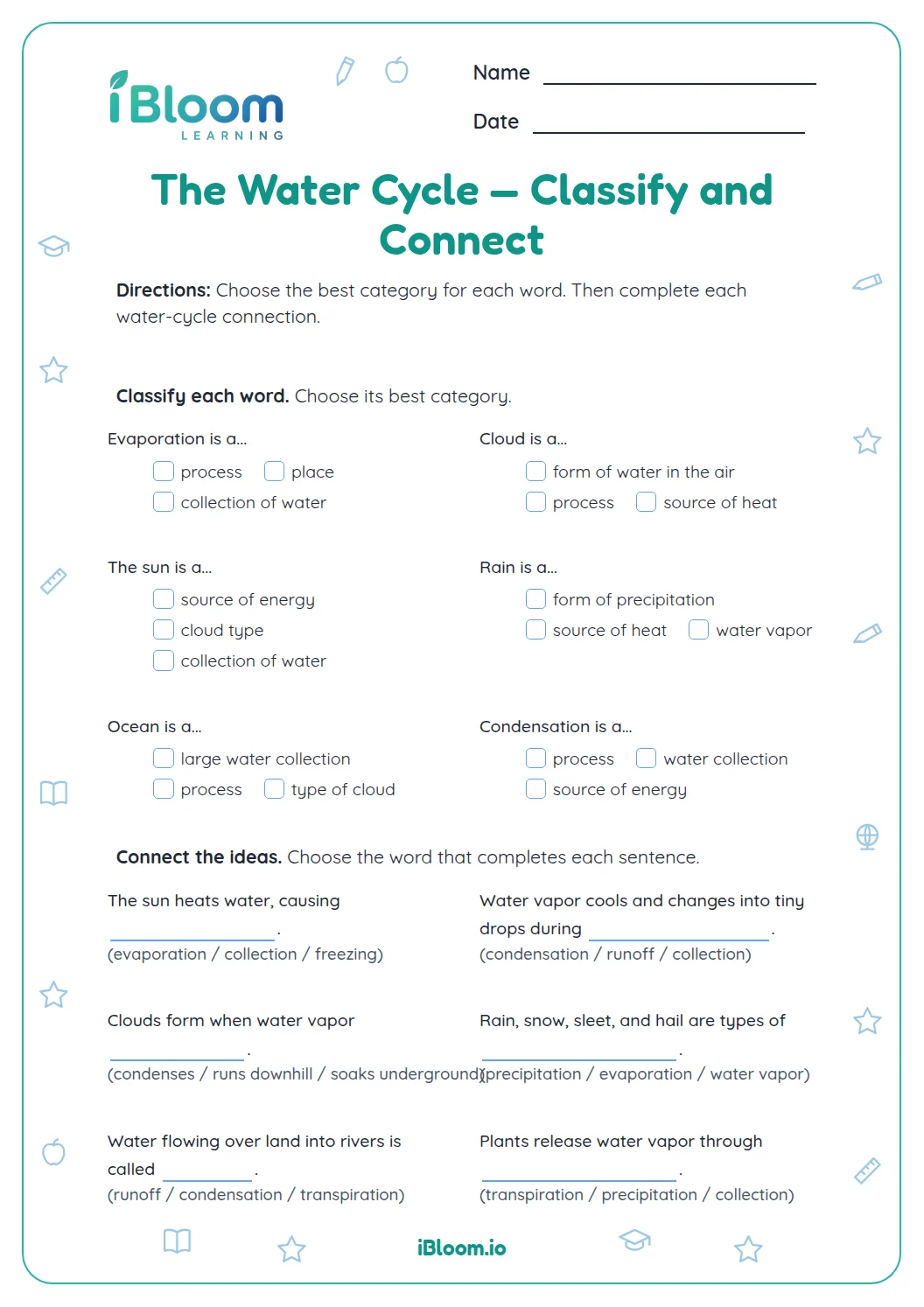
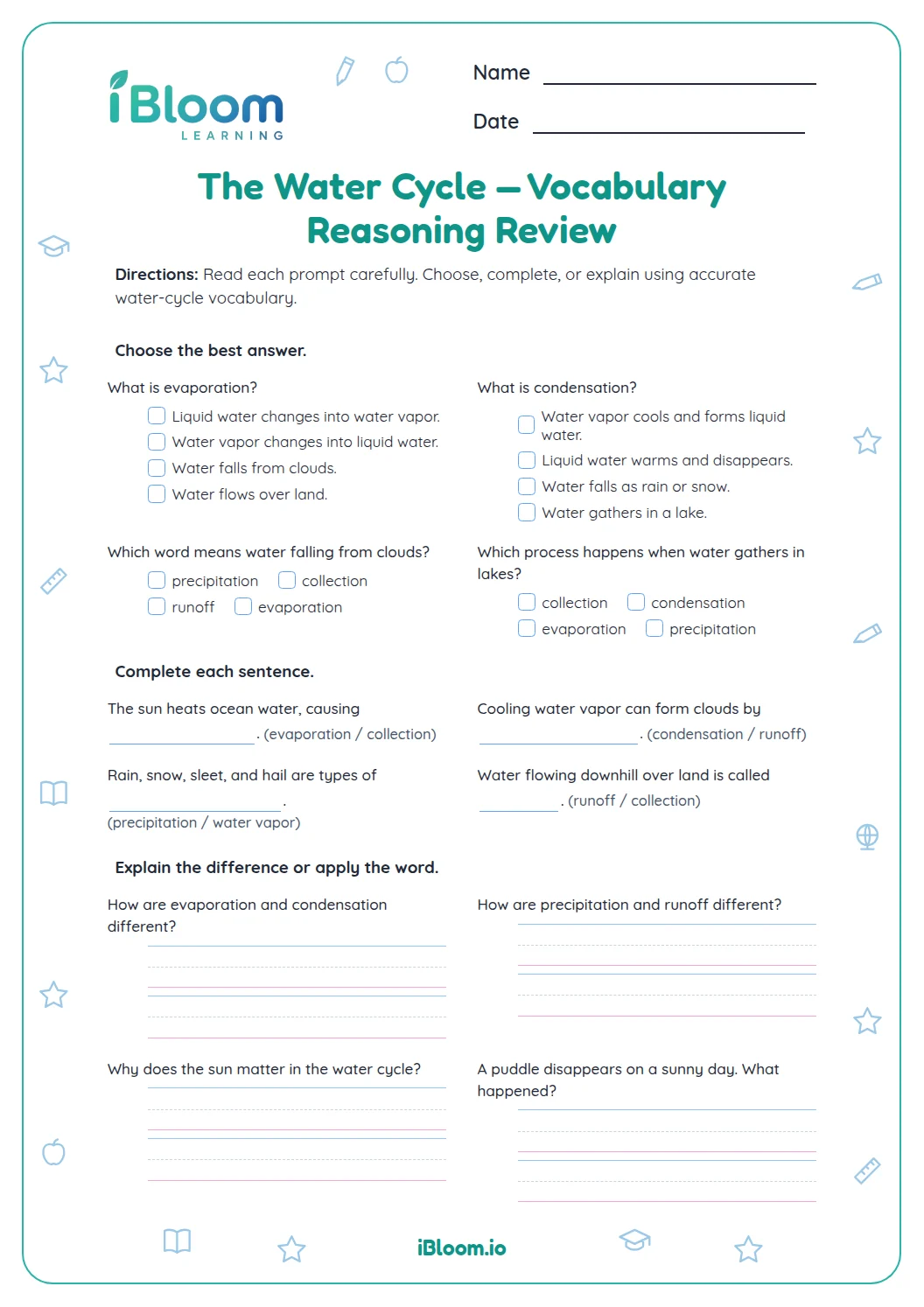
Part B gives concise descriptions. For example, liquid water changing into gas is evaporation; vapor cooling into droplets is condensation.
How do sentence clues help?
Part C places terms in familiar water-cycle events. Notice what the water is doing and whether it is changing state, falling, flowing, or gathering.
How to use this worksheet
- 1Mark every term in the word search.
- 2Read each definition carefully.
- 3Notice whether water is changing, falling, flowing, or gathering.
- 4Choose the term that matches the complete clue.
- 5Check responses with the separate key.
Common mistakes and quick fixes
The mistake
Mixing up evaporation and condensation.
The fix
Evaporation changes liquid to gas; condensation forms liquid droplets as vapor cools.
The mistake
Calling all moving water runoff.
The fix
Runoff flows over land; groundwater is stored below the surface.
The mistake
Confusing collection with precipitation.
The fix
Precipitation falls from clouds; collection is water gathering in bodies such as lakes.
Common Core alignment
The context questions practice L.4.4a by using sentence clues to identify water-cycle terms.
Use context clues to determine a word’s meaning.
On this sheet: Learners use sentence context to identify water-cycle terms and explain their meaning.
Show the official wordingHide the official wording
Use context (e.g., definitions, examples, or restatements in text) as a clue to the meaning of a word or phrase.
What to practice next
Further reading
Questions parents and teachers ask
What terms are in the word search?
The eight terms are evaporation, condensation, precipitation, collection, runoff, groundwater, cloud, and river. Learners mark them in Part A, then answer 13 definition and context questions using water-cycle vocabulary. The learner can point to the clue and explain how it supports the chosen term. Read the full clue, then connect its detail to the word that names the process or place.
What is evaporation?
Evaporation is liquid water changing into water vapor, or gas. The worksheet describes this change and asks learners to choose the matching process. The learner can point to the clue and explain how it supports the chosen term. Read the full clue, then connect its detail to the word that names the process or place.
How is condensation different from precipitation?
Condensation forms tiny liquid droplets as water vapor cools. Precipitation is water that falls from clouds as rain, snow, sleet, or hail. The clues distinguish these processes. The learner can point to the clue and explain how it supports the chosen term. Read the full clue, then connect its detail to the word that names the process or place.
What is runoff?
Runoff is water that flows over land. One question describes rainwater moving downhill across a field; learners use that context to identify the term. The learner can point to the clue and explain how it supports the chosen term. Read the full clue, then connect its detail to the word that names the process or place.
Is the answer key included?
Yes. The separate key lists the search terms and gives the expected answer to each of the 13 vocabulary questions. Learners can compare their choices after completing the worksheet. The learner can point to the clue and explain how it supports the chosen term. Read the full clue, then connect its detail to the word that names the process or place.