

About this worksheet
This Grade 4 vocabulary printable builds a small sound-word set through a word search, meaning questions, and short contexts. Students find eight terms, connect words such as pitch, echo, and vibrate to their meanings, then apply them in situations about instruments, voices, and everyday sounds. A separate answer key is included.
What does the worksheet practice?
Work through the three parts in order: first identify the skill, then use it in context, and finish independently. The answer key accepts clear responses that follow each direction.
- 1A repeated sound heard after the original stops.
- 2Answer: echo
How can students approach each question?
Read the whole sentence before choosing or writing. Check what the question asks, then reread your response to make sure it fits.
How can students review their answers?
Complete a part before checking its answers. For open responses, compare the idea and required details rather than expecting the sample wording exactly.
How to use this worksheet
- 1Read the directions at the top of the sheet.
- 2Complete Part A, then move through Parts B and C.
- 3Reread each response to check that it answers the prompt.
- 4Compare your work with the separate key.
- 5For a written response, check that it includes the requested detail.
Common mistakes and quick fixes
The mistake
Mixing up pitch and volume
The fix
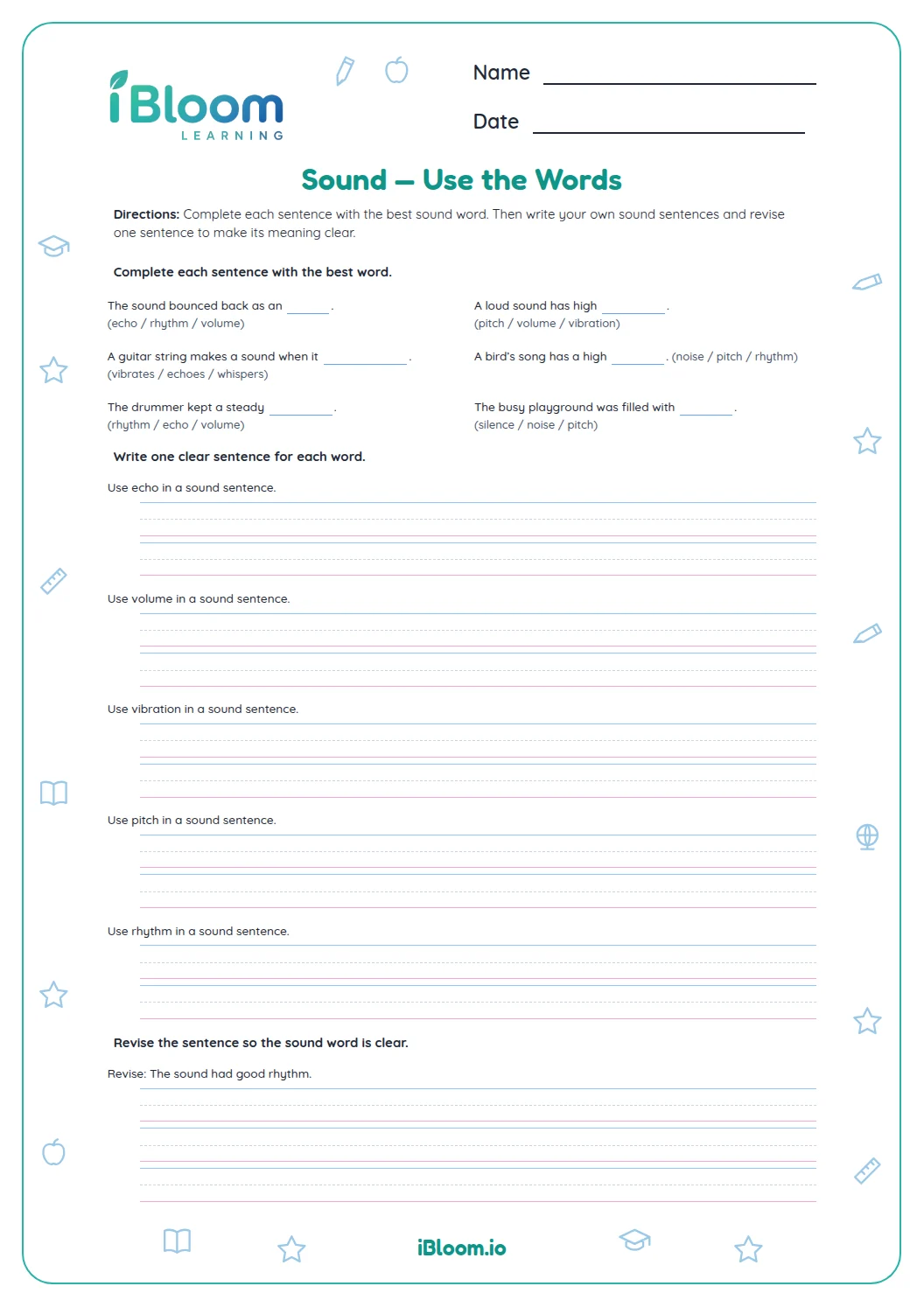
Pitch describes high or low; volume describes loud or soft.
The mistake
Calling every repeated sound a rhythm
The fix
An echo repeats after the original sound stops.
The mistake
Using vibrate as a noun for a sound
The fix
Vibrate names the quick back-and-forth motion that can make sound.
What to practice next
Make more practice
Questions parents and teachers ask
What does this worksheet help students practice?
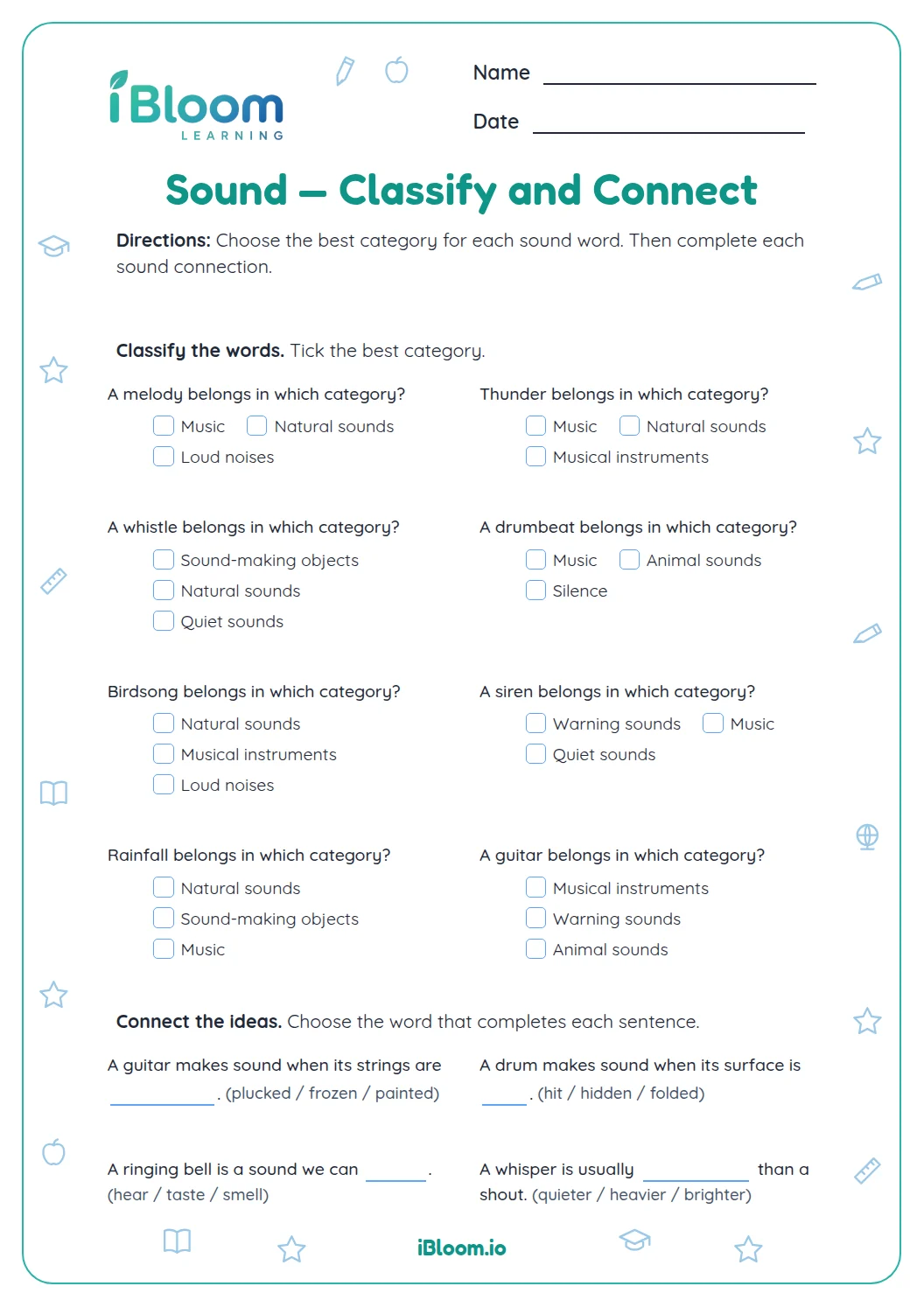
This 16-question vocabulary sheet starts with a search for eight sound words, then asks students to connect each word with its meaning and use it in a situation. The separate key lists the search words and answers. Students can review how terms such as echo, pitch, and volume differ.
How should I use the answer key?
Have the student finish a part before looking at its answers. For questions with more than one possible response, use the sample to check that the response follows the prompt and includes the requested information. The key is printed separately from the student sheet.
How long does this printable take?
Plan for about 15 minutes, with extra time if the student writes carefully or talks through each choice. The sheet has 16 questions in three parts. Pause after a part to review the approach, then use the key to check the completed work.
Can students complete it independently?
Students who know the skill can work through the directions on their own. An adult can read prompts aloud or discuss one example first, then let the student complete the remaining questions and check answers using the separate key.
What should I do with an open-ended answer?
Compare it with the direction rather than requiring the exact sample wording. A good response answers the prompt and includes the detail the question requests. If it misses one part, ask the student to reread the prompt and revise.