
About this worksheet
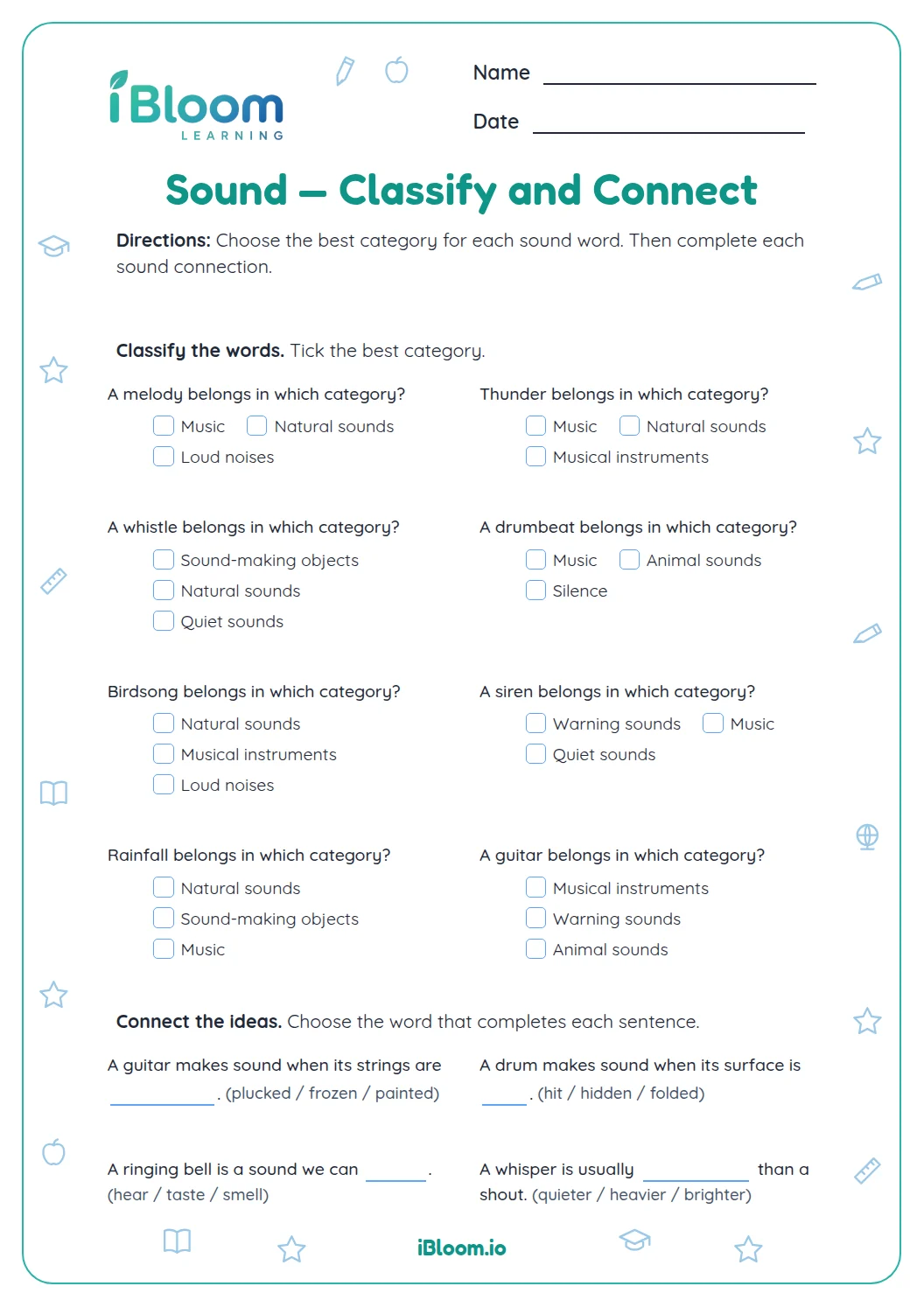
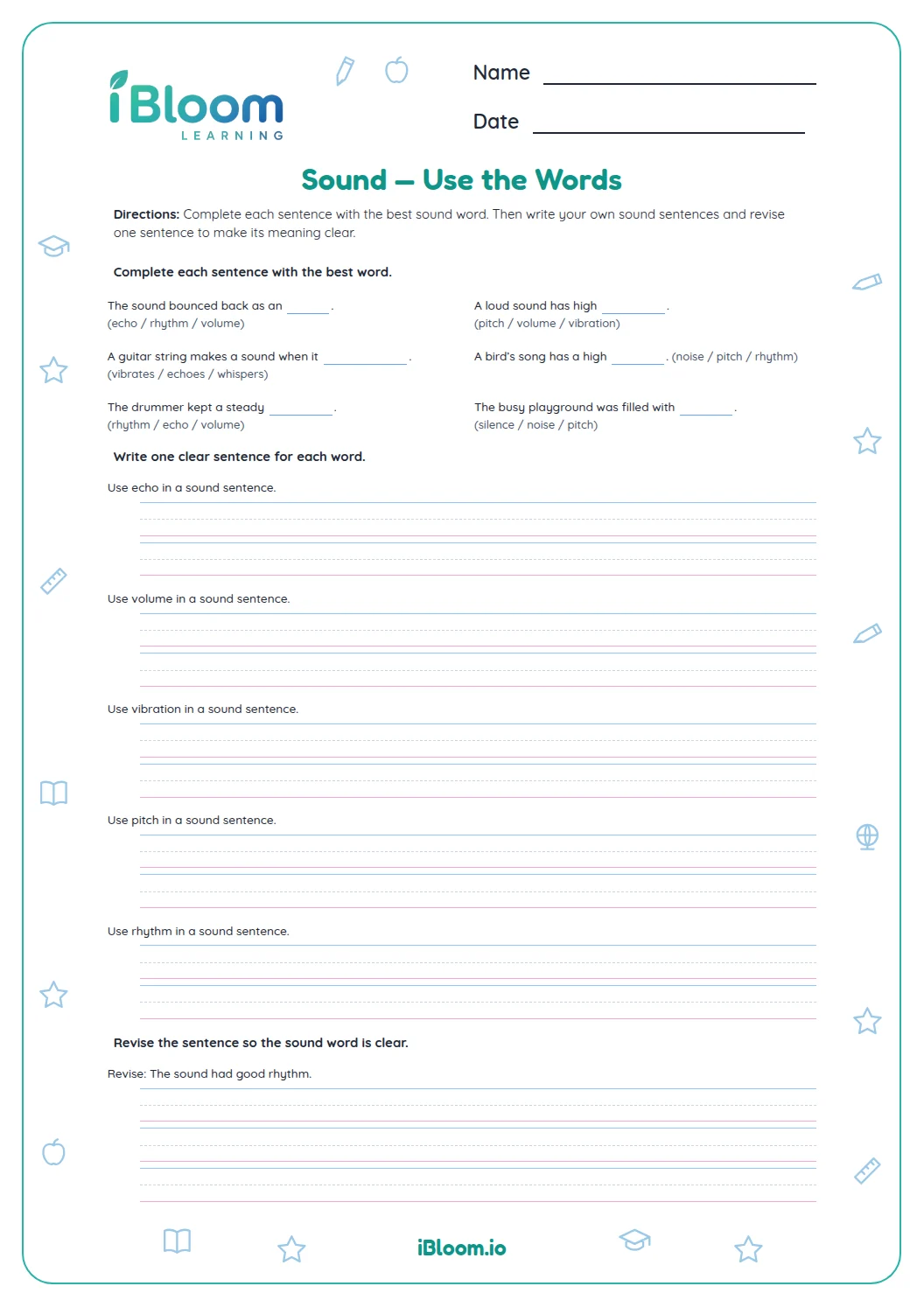
This Grade 4 vocabulary worksheet focuses on sound words such as pitch, volume, vibration and echo. Learners find eight terms in a grid, complete seven sentences using context clues, and answer six sound-situation choices. The practice aligns with Common Core L.4.4.a, and the answer key lists the puzzle words and responses.
Aligned to L.4.4.a
How do context clues help with sound words?
A sentence often gives a clue through an example or explanation. If a sentence says a high or low sound has a certain quality, that clue points to pitch; loud or soft points to volume.
Question 10 asks which word names whether a sound is high or low. Pitch describes that quality, while volume describes loudness. The answer is pitch.
- 1Clue: high or low sound
- 2Word: pitch
- 3Volume describes loud or soft sound.
What is included in the sound word search?
The puzzle contains eight terms: vibration, pitch, volume, echo, source, medium, detect and absorb. The next questions use those terms in sentence clues and simple sound situations.
How to use this worksheet
- 1Find a word in the grid and mark it once.
- 2Read the full sentence around each blank.
- 3Use clues about high or low, loud or soft, a material, or an action.
- 4For each choice question, rule out words that do not fit the clue.
- 5Read your answer in the sentence to check that it makes sense.
Common mistakes and quick fixes
The mistake
Confusing pitch and volume
The fix
Pitch describes high or low; volume describes loud or soft. Match the word to the exact clue.
The mistake
Using echo for any sound
The fix
An echo is a sound heard again after it bounces back. Look for a clue about a return or reflection.
The mistake
Choosing a word from memory without checking context
The fix
Read the whole sentence and use its example or definition clue before selecting a term.
Common Core alignment
This worksheet gives learners practice with the standard below.
Use sentence clues to determine precise meanings of sound vocabulary.
On this sheet: Use sentence clues to determine precise meanings of sound vocabulary.
Show the official wordingHide the official wording
Use context (e.g., definitions, examples, or restatements in text) as a clue to the meaning of a word or phrase.
What to practice next
Make more practice
Further reading
Questions parents and teachers ask
Which sound words are hidden in the puzzle?
The grid contains eight terms: vibration, pitch, volume, echo, source, medium, detect and absorb. Mark each word as you find it, then use the seven sentence blanks and six reasoning questions to practice their meanings. The grid places each word horizontally from left to right.
What is the difference between pitch and volume?
Pitch describes whether a sound is high or low. Volume describes whether it is loud or soft. The worksheet uses both clues, so read for the quality named instead of choosing a familiar word automatically. The questions use these meanings in different contexts.
What does a sound source do?
A sound source is where a sound begins. In this worksheet, learners complete a sentence about a vibrating source and then apply sound words to situations such as a drum, speaker or bell. The vibrating object begins the sound.
What does absorb mean here?
To absorb sound is to take it in. The worksheet asks learners to use the word for materials such as a soft curtain or wool rug, and to distinguish absorbing sound from making an echo. A soft material takes in some sound energy.
How many questions are on the page?
There are 14 questions: one word search, seven context sentences with a missing sound word, and six choices about sound situations. The answer key lists the puzzle words and the intended vocabulary responses. Each question has one best vocabulary response.