



About this worksheet
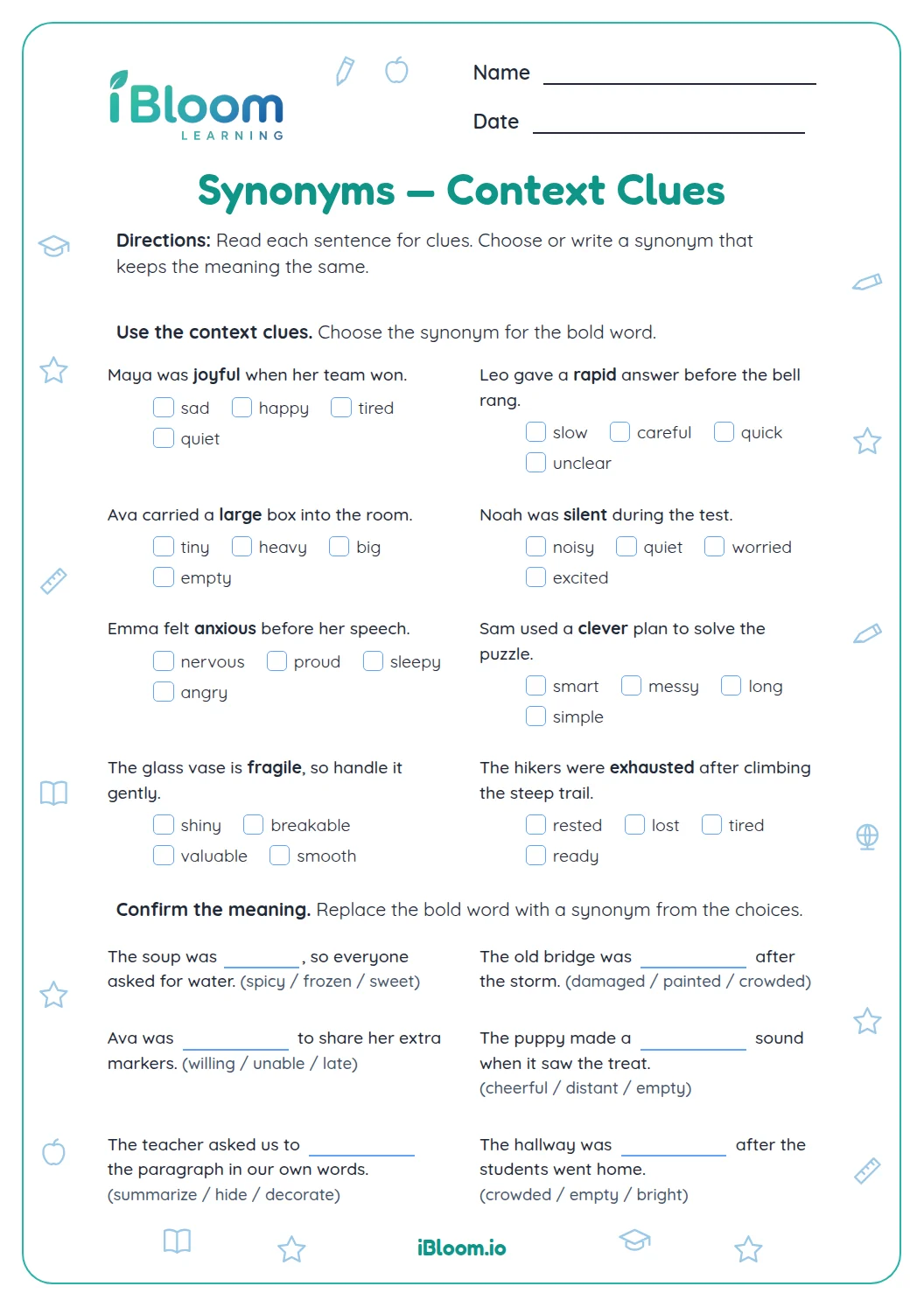
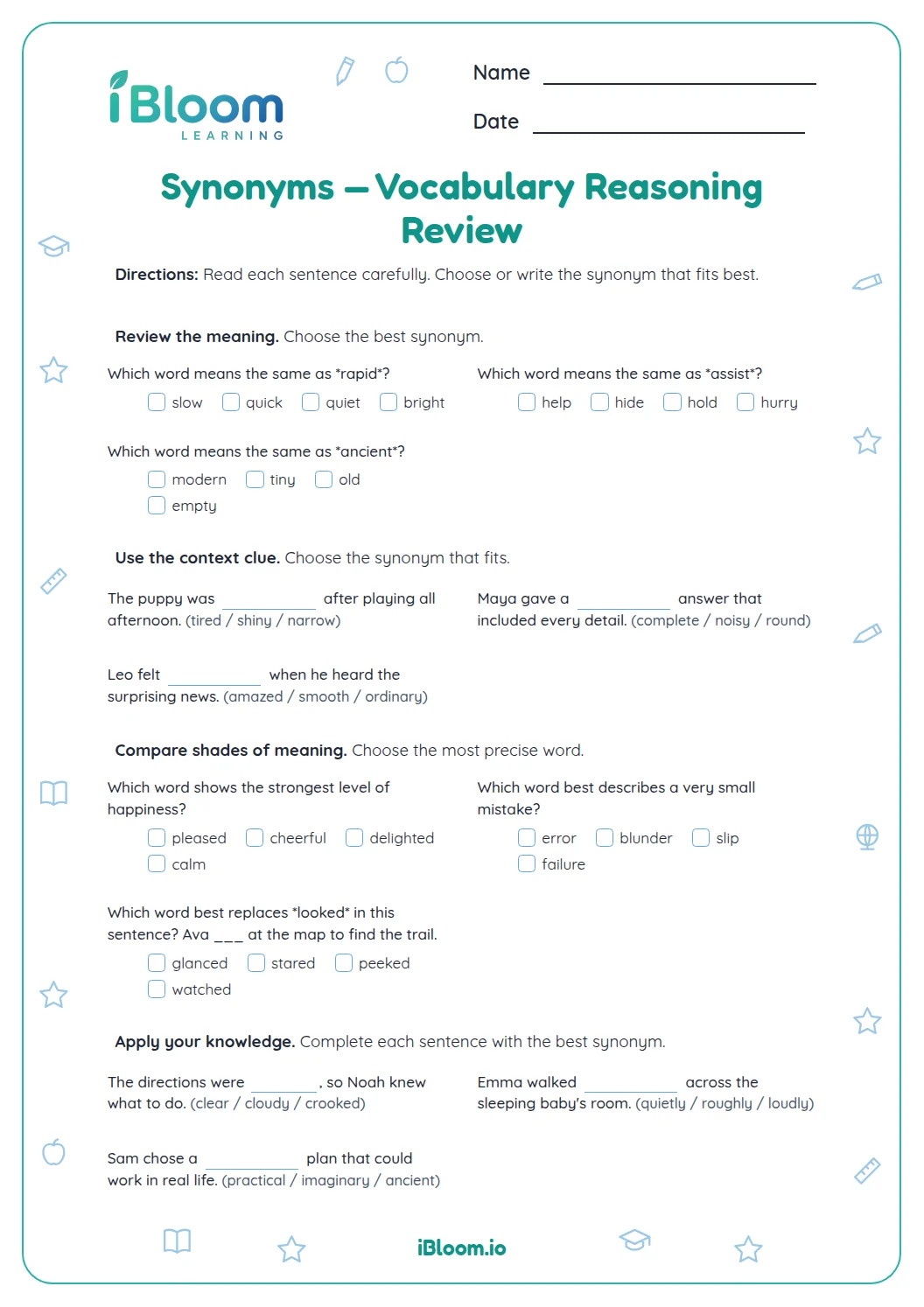
This Grade 5 synonyms worksheet moves from choosing a context-appropriate synonym to using synonyms in original sentences and revising vague language. Fourteen questions give learners practice noticing shades of meaning, writing complete sentences, and choosing more precise words. An answer key includes sample responses for open-ended items.
Aligned to L.5.5c
How do learners choose a close synonym?
Read the whole sentence, substitute each choice, and check that the idea still makes sense. For “The hikers were tired,” weary fits the context and keeps the meaning.
How can a synonym sharpen a sentence?
Use a word that carries the intended detail. Replacing nice with beautiful gives a reader a clearer picture while keeping the sentence positive.
How should open answers be checked?
Look for a complete sentence and a word used with its correct meaning. Answers can vary; the key supplies examples rather than the only possible sentence. A response may use another synonym when it preserves the idea and fits naturally.
How to use this worksheet
- 1Read the sentence before looking at the choices.
- 2Try each option in the sentence and compare the meaning.
- 3For the writing items, make a complete sentence that shows the target word.
- 4For revision, keep the original idea while choosing a more exact word.
- 5Use the sample answers to discuss other accurate responses.
Common mistakes and quick fixes
The mistake
Choosing a synonym that is related but changes the idea.
The fix
Substitute it into the sentence and check whether the original meaning remains.
The mistake
Using a word without showing what it means.
The fix
Add enough context in a complete sentence to make the meaning clear.
The mistake
Replacing a vague word with a synonym that is still vague.
The fix
Ask what specific image or quality the sentence should communicate.
Common Core alignment
This page gives learners focused practice with the language and writing skill named on the sheet.
Use synonym relationships to understand and select words with close meanings.
On this sheet: Part A asks learners to choose a synonym that fits each sentence; Parts B and C use synonyms in original and revised sentences.
Show the official wordingHide the official wording
Use the relationship between particular words (e.g., synonyms, antonyms, homographs) to better understand each of the words.
What to practice next
Make more practice
Further reading
Questions parents and teachers ask
How many questions are on this synonyms worksheet?
There are 14 questions. Thirteen ask learners to choose a close synonym in a sentence, and one asks them to use a target word and revise a general sentence. The answer key gives the choice answers and a sample response for the writing prompt.
What counts as a correct sentence answer?
A correct answer uses the target synonym with its intended meaning in a complete sentence. For example, “The enormous whale surfaced beside the boat” shows that enormous means very large. The answer key gives a sample, and another clear sentence can work.
Should a synonym always mean exactly the same thing?
Synonyms have close meanings, but they can carry different shades of meaning. “Tired” and “weary” are close, while “cheerful” changes the sentence. Learners should test a choice in context and keep the original idea. Read the sentence aloud with the new word to check whether the idea still sounds natural.
How can an adult support the revision questions?
Ask what the sentence means first, then invite the learner to replace the general word with one that gives a more exact picture. “The garden was beautiful” is one possibility for “The garden was nice.” Other accurate choices are welcome.
Is an answer key included?
Yes. The separate answer key gives answers for all 14 items, including a sample for the written application. Since that response invites original wording, compare it with the prompt’s meaning instead of requiring the sample sentence word for word.