




About this worksheet
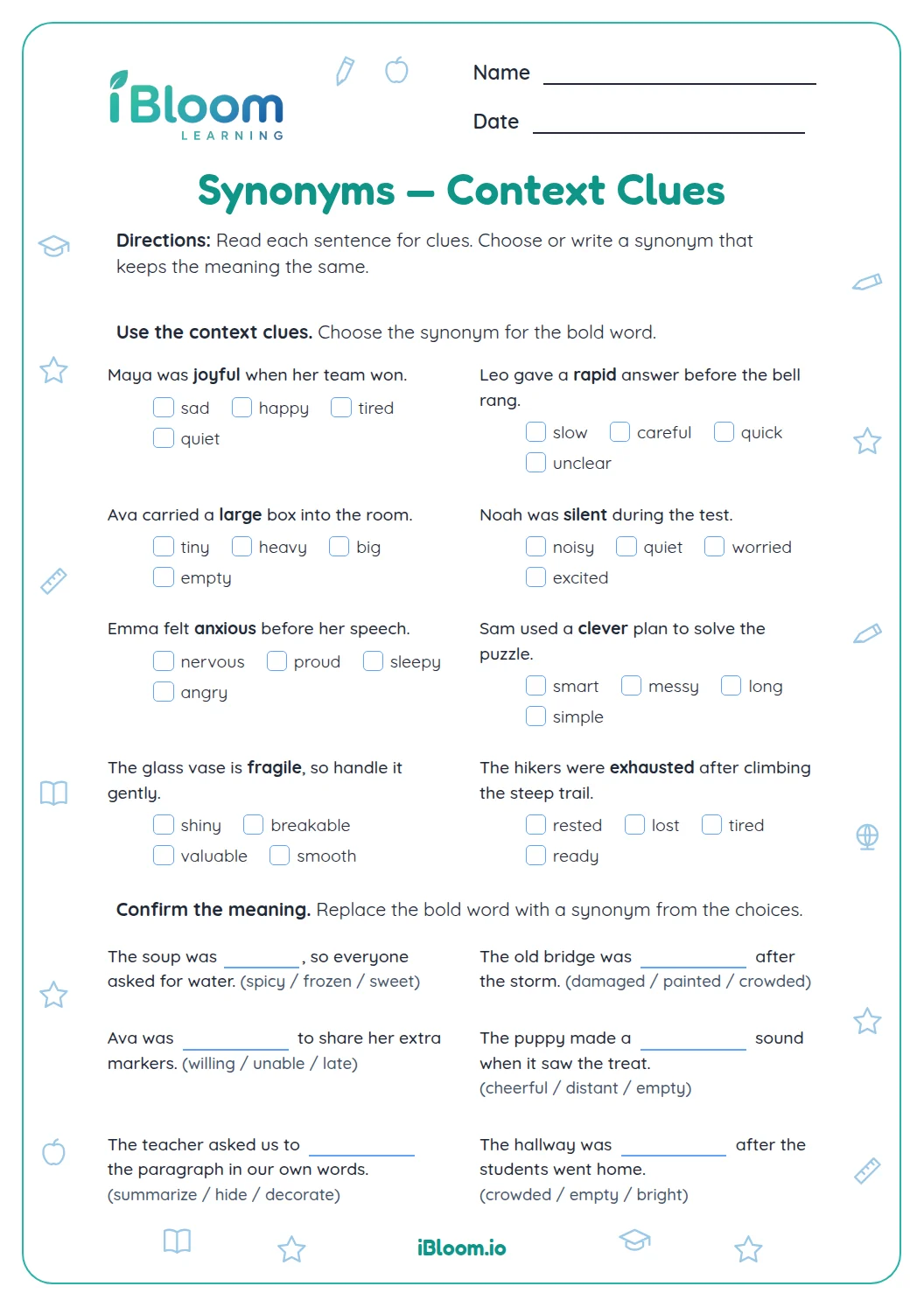
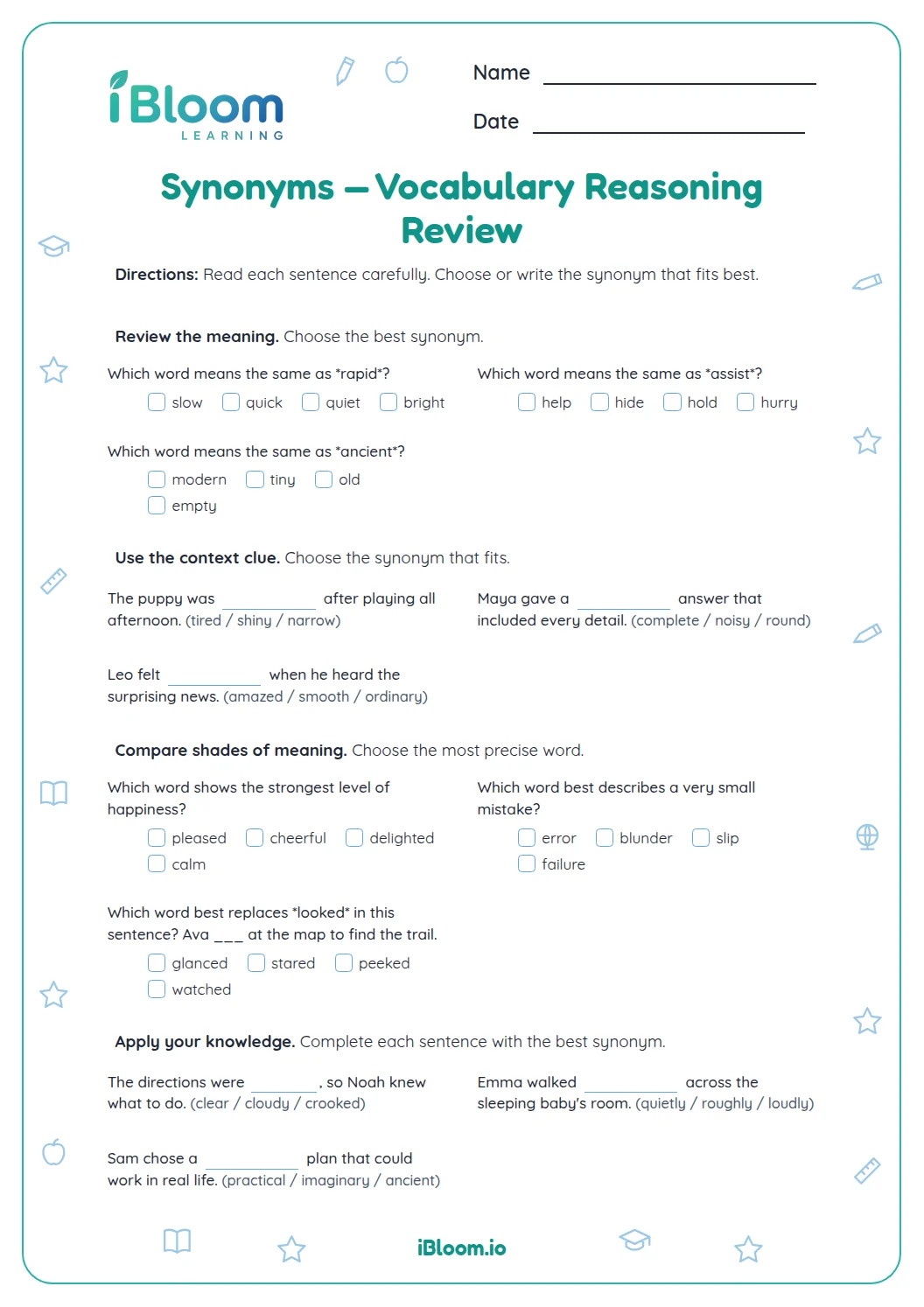
This free Grade 5 worksheet helps learners compare synonyms and use context to choose words with similar meanings. Fourteen questions include multiple-choice pairs, short fill-ins and a written response. Several items place a target word in a sentence so children can check whether a replacement keeps the original idea. The practice supports CCSS L.5.5.c on using word relationships to understand meaning.
Aligned to L.5.5.c
How do synonyms help explain a word?
Synonyms have similar meanings, though they may not fit every sentence in exactly the same way. Glad and happy are close in meaning, and huge is close to enormous. Compare the whole sentence before choosing a replacement.
Question 3 asks for a word close to observe. Notice fits because both can mean to look carefully.
- 1Sentence: The path was narrow.
- 2Choices: wide, thin, rough
- 3Thin is closest to narrow here
- 4Check: “The path was thin” keeps the idea of little width.
Why read the whole sentence?
Context helps children select the synonym that fits the intended meaning. A word may have more than one related word, but a replacement should preserve the sentence’s idea. Questions 10, 11 and 13 invite this kind of careful comparison.
What kinds of synonym practice are included?
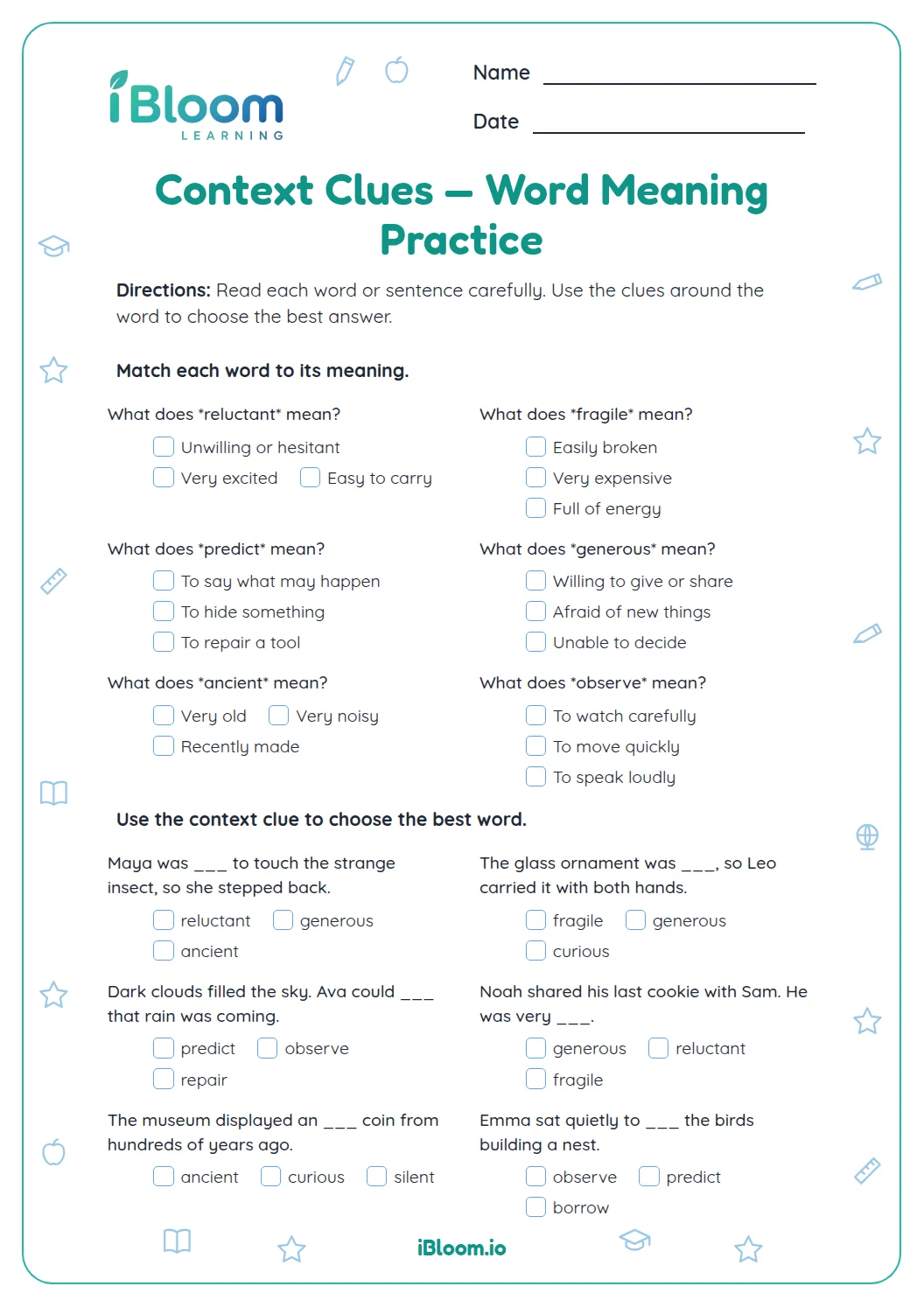
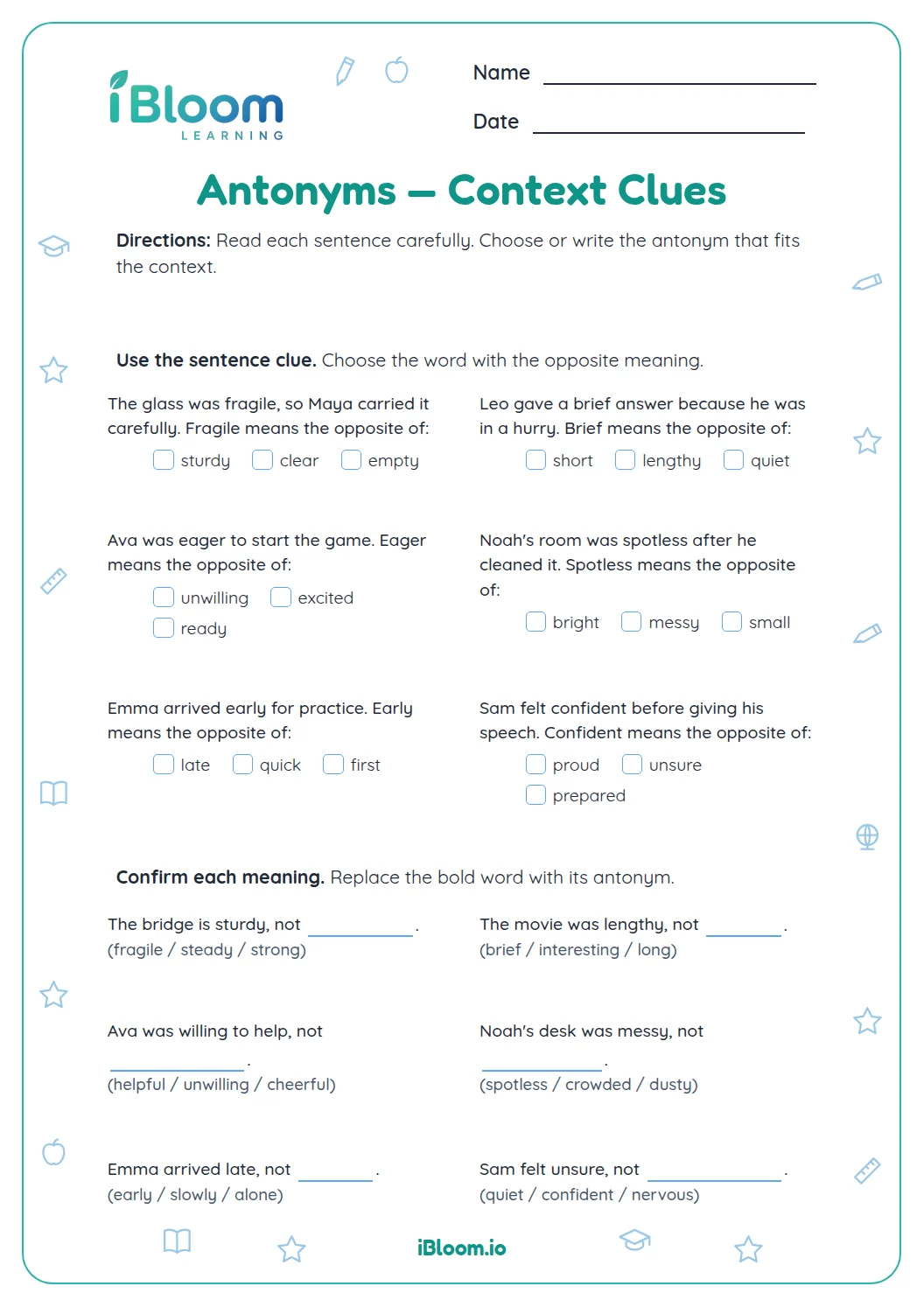
The 14 items mix multiple-choice selections, short fill-ins and one written response. Some words are presented alone; others appear in a sentence so children can test whether a replacement makes sense.
How to use this worksheet
- 1Read the target word and say a meaning you already know.
- 2For choices, compare each word directly with the target.
- 3When a sentence is included, substitute the candidate and reread it.
- 4For the open response, write a synonym that preserves the sentence’s idea.
- 5Check the key and discuss any word whose meaning changes by context.
Common mistakes and quick fixes
The mistake
Choosing a related word that has a different meaning.
The fix
Check whether the choice means nearly the same thing as the target.
The mistake
Using a synonym that does not fit the sentence.
The fix
Replace the target word and reread the whole sentence.
The mistake
Treating close synonyms as identical in every use.
The fix
Notice the shades of meaning and choose the word that fits best.
Common Core alignment
This worksheet gives children practice with the Common Core skill named below.
Use synonym relationships to understand shades of word meaning.
On this sheet: Learners choose synonyms and use context to replace words while preserving meaning.
Show the official wordingHide the official wording
Use the relationship between particular words (e.g., synonyms, antonyms, homographs) to better understand each of the words.
What to practice next
Make more practice
Further reading
Questions parents and teachers ask
What is a synonym?
A synonym is a word with the same or a very similar meaning as another word. Glad and happy are synonyms in many sentences. Their meanings are close, although sentence context can affect which word sounds like the best replacement.
Do synonyms always mean exactly the same thing?
Not always. Synonyms can have slightly different shades or uses. Huge and enormous are close, but a writer may choose one for sound or emphasis. Read the whole sentence and ask whether the replacement keeps the original idea. Check the word in context to make sure the replacement keeps the intended meaning.
How can context help choose a synonym?
Read the sentence and identify what the target word tells you. In “The path was narrow,” the word thin is closer than wide because it keeps the idea of limited width. Sentence clues make a synonym choice more precise. Check the word in context to make sure the replacement keeps the intended meaning.
What is a synonym for “ancient”?
Old is a synonym for ancient in many contexts. Ancient usually describes something from a very long time ago, while old can describe many ages. The worksheet asks learners to provide a close meaning and think about that relationship. Check the word in context to make sure the replacement keeps the intended meaning.
How many questions are included?
There are 14 questions: eight multiple-choice items, five fill-in answers and one written response. The separate answer key lists the expected choices and offers a sample synonym for the open-ended prompt. Encourage your child to explain why a synonym fits, especially when a target word appears in a sentence.