





About this worksheet
This free Grade 5 vocabulary worksheet connects synonym meanings in three ways. Part A uses a six-word bank to solve a crossword with the words assist, brief, cautious, scarce, sturdy, and vivid. Part B asks students to classify six pairs as synonyms or antonyms. Part C returns to the same vocabulary in six sentences, where children choose a replacement word that preserves the meaning. The 18 questions practice Common Core L.5.5.c by using relationships between words to understand them. A separate answer key shows the completed grid and the correct choices.
Aligned to L.5.5.c
How does the word bank help with this crossword?
The bank lists assist, brief, cautious, scarce, sturdy, and vivid. Each clue points to one word, so students can focus on its meaning and then check the spelling against the crossing letters. Every bank word is used once.
Start with a clue the child can explain. Write one letter in each square and use its crossings to check another answer. A word that fits the number of squares still needs to match the clue.
How do students tell synonyms from antonyms?
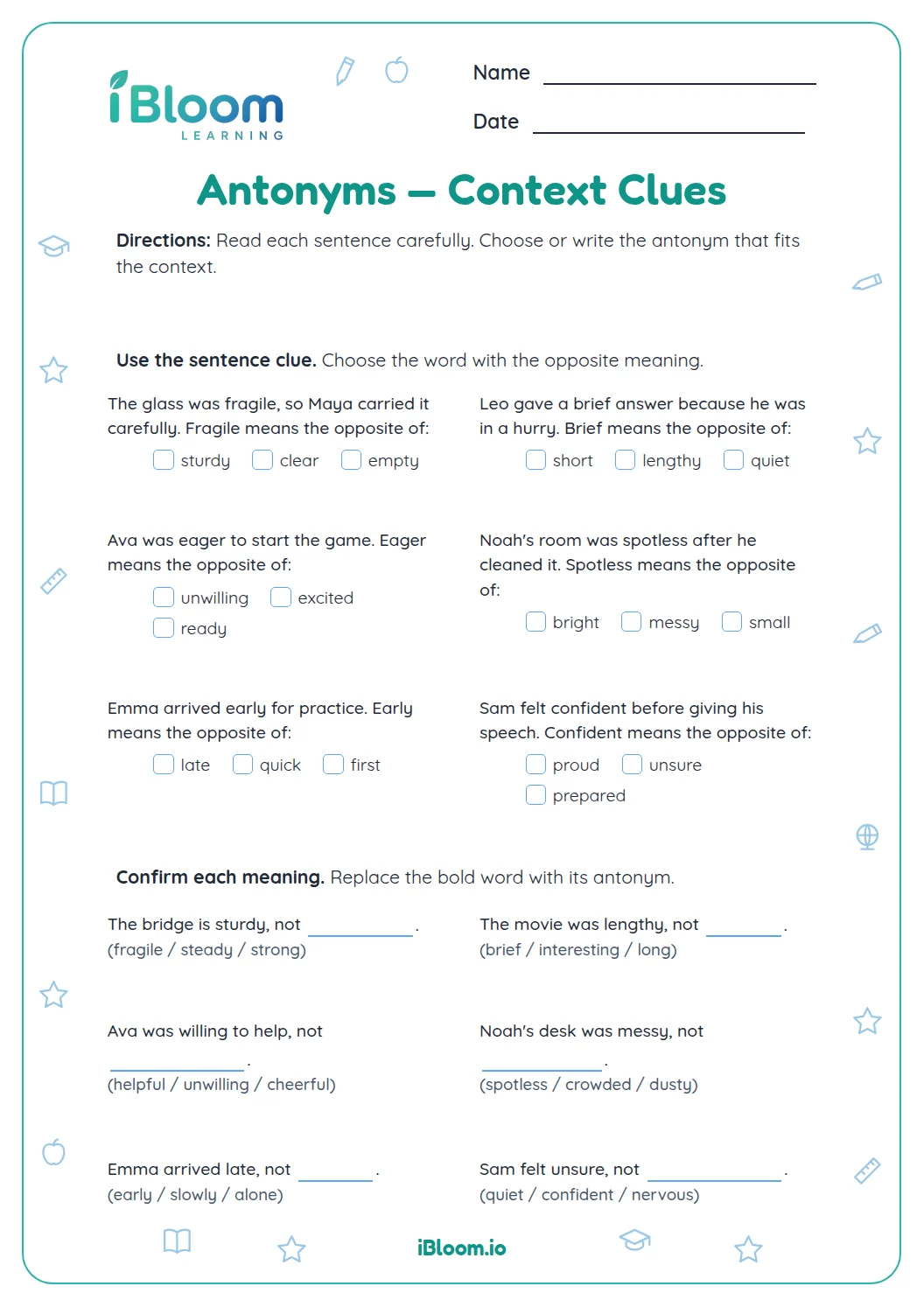
In Part B, cautious and careful point in the same direction, while scarce and plentiful point in opposite directions. Classifying the pair requires thinking about both words. “Scarce” means there is little available; “plentiful” means there is a lot.
The six pairs reuse crossword words so students can test the meaning they just connected to a clue. Children write S for synonyms or A for antonyms; the directions define both letters.
Can a synonym replace a word in every sentence?
Use the sentence to decide whether a replacement keeps the intended meaning. In “The guide gave a BRIEF talk,” short describes the talk’s length. A synonym that works in one context may not work in every other use of a word.
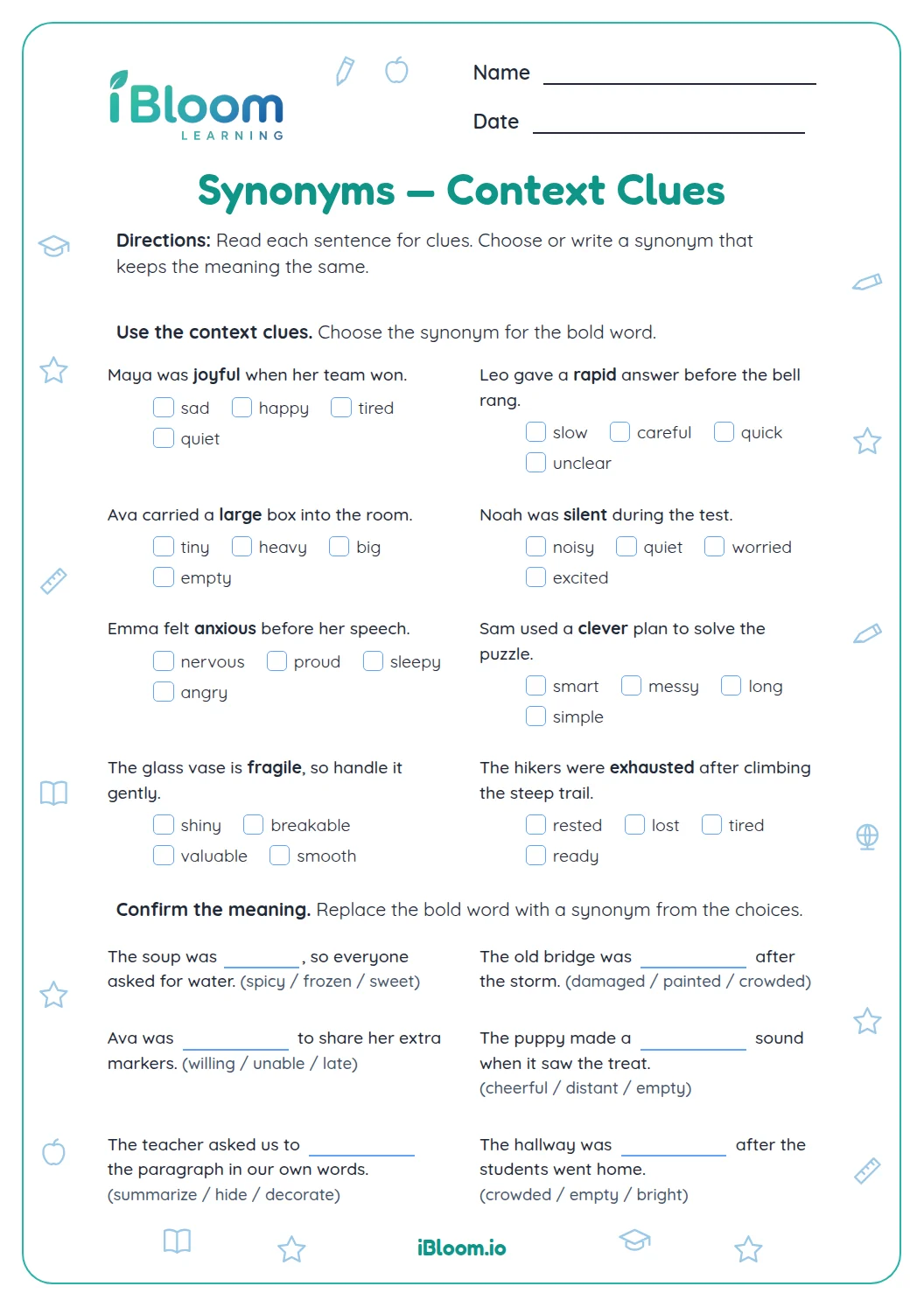
Part C asks for replacements for brief, assist, scarce, vivid, sturdy, and cautious. Read the sentence again with the chosen word. This checks that the relationship makes sense beyond the crossword.
- 1The guide gave a BRIEF talk.
- 2Brief means short in length or time.
- 3The guide gave a short talk.
- 4Answer: short
How to use this worksheet
- 1Read the word bank and ask the child to explain any familiar words.
- 2Solve the crossword clues, using each bank word once and checking crossing letters.
- 3For Part B, say what each word means before writing S for synonyms or A for antonyms.
- 4Read each Part C sentence aloud with the selected replacement word.
- 5Check the completed grid and choices, then ask for one new sentence using a crossword word.
Mistakes to notice and fix
The mistake
Choosing a word only because it fits the squares.
The fix
Match its meaning to the clue, then check the crossing letters.
The mistake
Calling scarce and plentiful synonyms because both describe amounts.
The fix
Compare the amounts: scarce means little is available; plentiful means a lot is available.
The mistake
Replacing brief with a word that changes the talk’s meaning.
The fix
Try each choice in the sentence. “Short” preserves the idea of a talk that takes little time.
Common Core alignment
Use synonyms and antonyms to understand words in a crossword, pairs, and sentences.
On this sheet: Children connect six words to synonym clues, classify word pairs, and choose equivalent meanings in context.
Show the official wordingHide the official wording
Use the relationship between particular words (e.g., synonyms, antonyms, homographs) to better understand each of the words.
What to practice next
Make more practice
Further reading
Questions parents and teachers ask
Which words are in the crossword?
The six answers are assist, brief, cautious, scarce, sturdy, and vivid. All six appear in the printed word bank, and each is used once. Children connect a definition or synonym phrase with the appropriate word, then use the number of squares and the crossing letters to check their spelling.
Does every question ask for a synonym?
Part A asks for words that match synonym clues, and Part C asks for replacements that preserve sentence meaning. Part B includes both synonyms and antonyms. That contrast helps children decide whether two words point toward a similar meaning or opposite meanings, rather than marking every pair the same way.
Why include a word bank for Grade 5?
The bank makes each crossword answer definite and keeps the focus on word relationships. Children still need to understand the clues and place each word correctly. After completing the grid, ask them to cover the bank and explain two words in their own sentences before checking the later questions.
What if another synonym fits a crossword clue?
Use the printed word bank to select the intended answer. A clue can have several synonyms in ordinary language, but this puzzle uses each of its six bank words once. Check both the letter count and the crossings. You can discuss other valid synonyms after the grid is complete.
How should I use the answer key?
Check the crossword letters first, then review the pair classifications and sentence choices. If an answer differs, ask the child to explain the meaning before showing the key. For a sentence item, read it again with the selected word and decide whether the original idea has stayed the same.