



About this worksheet
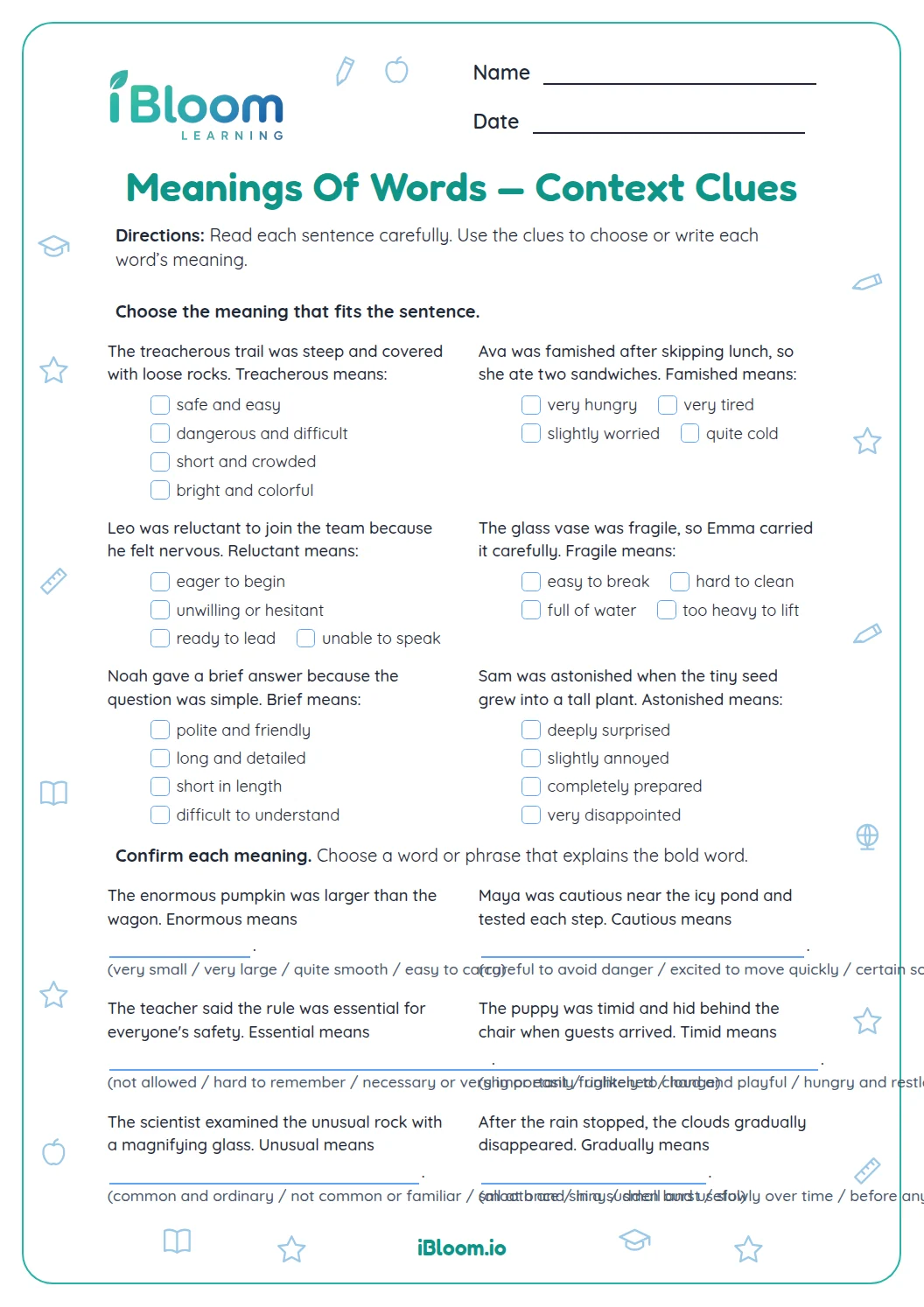
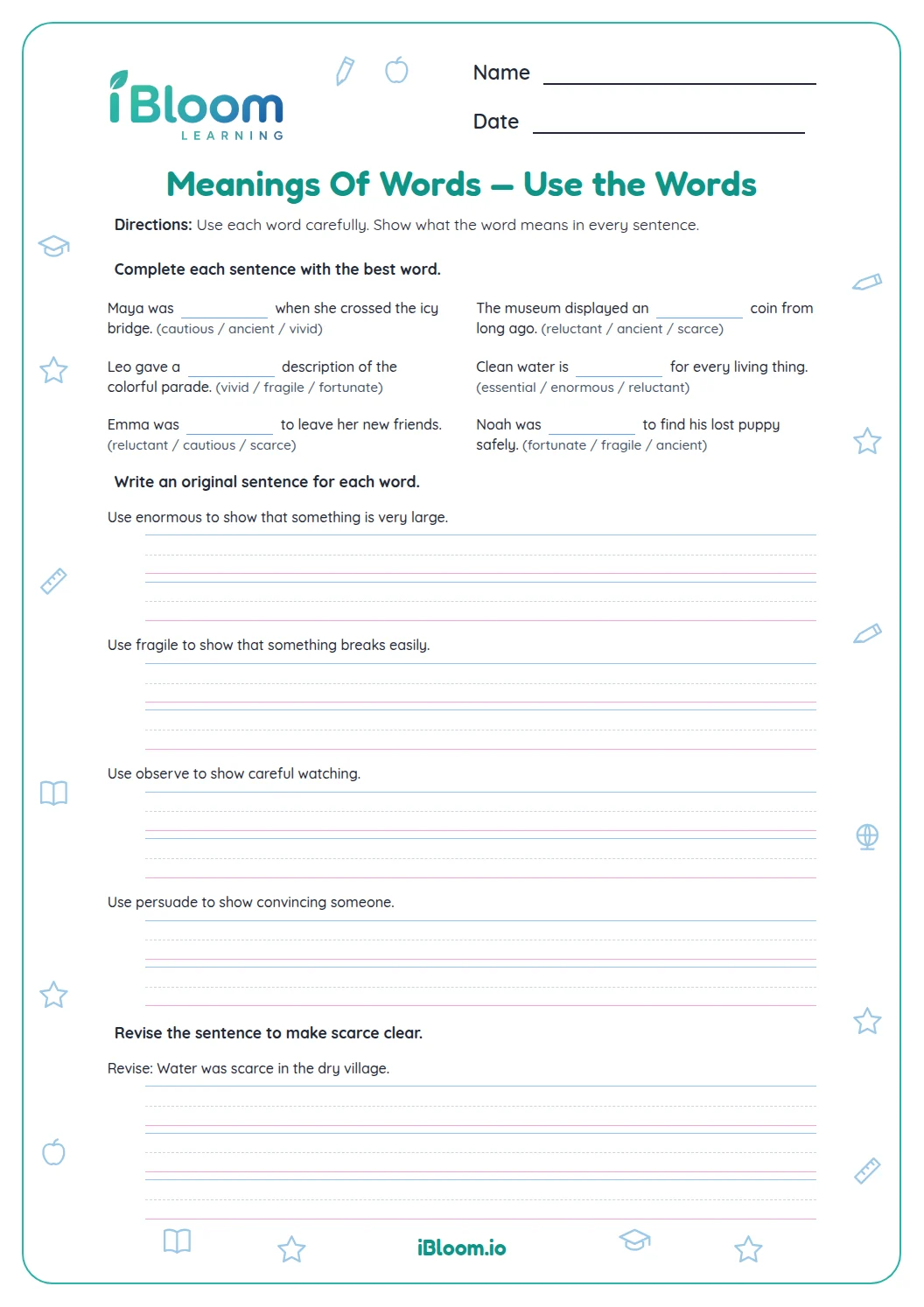
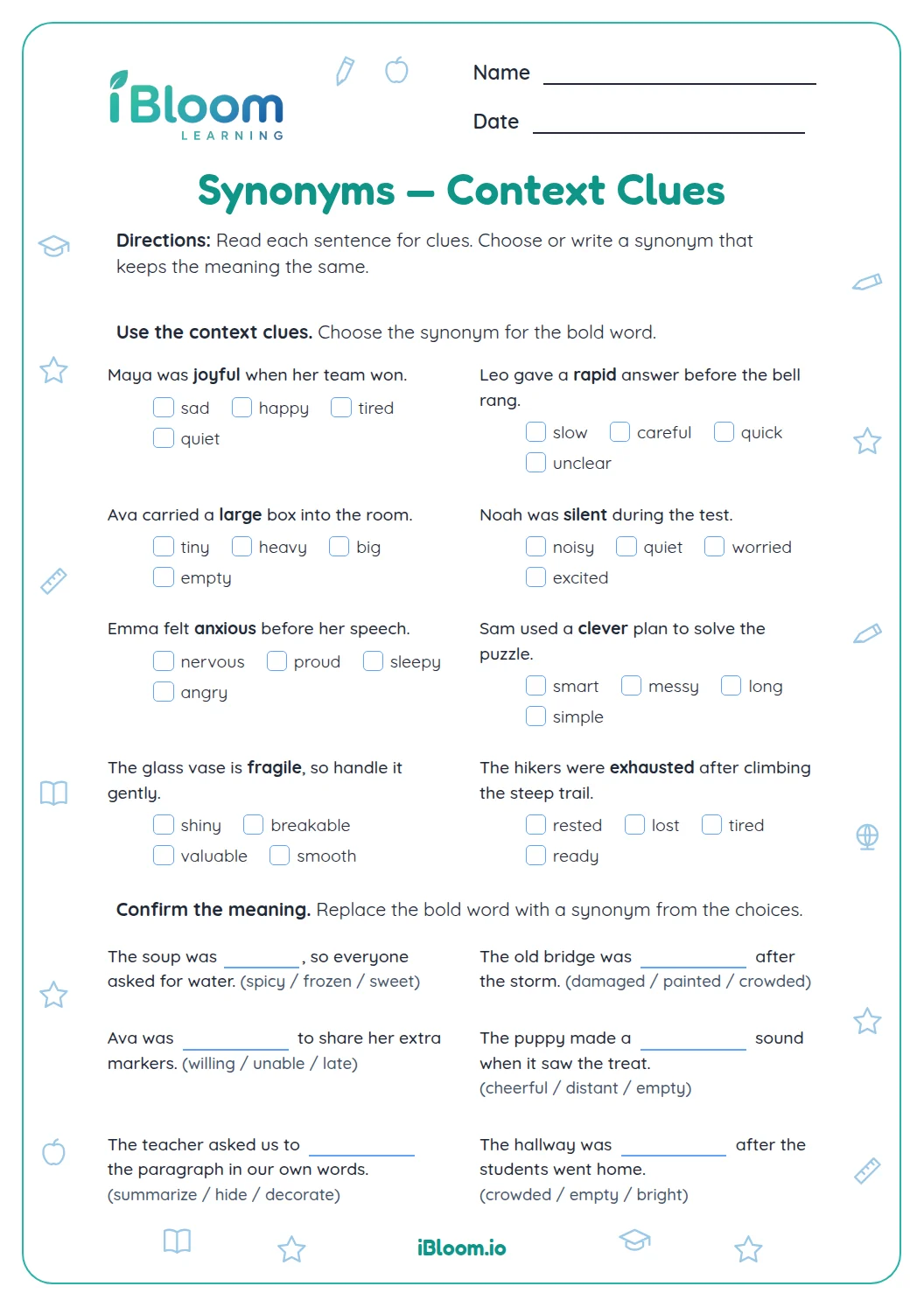
This Grade 5 context-clues worksheet gives readers 16 sentences with meaningful details around a target word. Learners infer what each word means, then check that their meaning fits the whole sentence. The two parts move from direct clues to more nuanced context, and a separate answer key supports review.
Aligned to L.5.4a
How can sentence details reveal a word’s meaning?
A reader can use nearby actions, results, examples, or contrasts to infer a word. After suggesting a meaning, reread the full sentence to see whether it still makes sense.
What will learners do on this page?
The 16 prompts ask learners to complete or explain a meaning using sentence context. Part A starts with direct clues; Part B asks readers to use less explicit clues.
How can a learner check an inference?
For “Loose rocks made the treacherous trail ___ to cross,” the detail “loose rocks” suggests danger. “Dangerous” fits the sentence and gives a coherent meaning for treacherous.
How to use this worksheet
- 1Read the whole sentence before deciding what the target word means.
- 2Notice the detail that points to the meaning, such as a result or example.
- 3Try a possible meaning in place of the target word.
- 4Reread the sentence to check that it still makes sense.
Common mistakes and quick fixes
The mistake
Guessing from the first familiar meaning.
The fix
Test the meaning in the complete sentence.
The mistake
Choosing a nearby word that does not explain the target.
The fix
Find the detail that actually supports the inference.
The mistake
Giving a broad meaning when the sentence signals a precise one.
The fix
Use the strongest clue and make the meaning as exact as the context allows.
Curriculum alignment
This worksheet practices the stated skill through focused questions.
Use context to determine a word’s meaning.
On this sheet: Each item asks the learner to infer a word meaning or identify the clue that supports it.
Show the official wordingHide the official wording
Use context (e.g., cause/effect relationships and comparisons in text) as a clue to the meaning of a word or phrase.
What to practice next
Make more practice
Further reading
Questions parents and teachers ask
Which clues help with the word treacherous?
The sentence says loose rocks made the trail treacherous to cross. That detail suggests the trail is dangerous. A good answer uses the clue and also fits the sentence when substituted for the target word. Ask the learner to point to the specific sentence detail that supports the inferred meaning, then reread the sentence.
Why read the whole sentence?
The target word may be unfamiliar, but an action, result, example, or contrast elsewhere in the sentence can point to its meaning. Reading only the nearby word can miss how the details work together. Ask the learner to point to the specific sentence detail that supports the inferred meaning, then reread the sentence.
What does Part B add?
Part B continues the same meaning-in-context skill with a new set of words and sentence clues. It includes clues that ask readers to connect details, such as directions that leave out information or an argument that grows heated. Ask the learner to point to the specific sentence detail that supports the inferred meaning, then reread the sentence.
How should a child handle a different synonym?
A child can give a synonym or short phrase that matches the intended meaning and fits the sentence. For instance, “unwilling” expresses reluctant in the audience sentence. Ask the learner to explain which sentence detail supports the answer. Ask the learner to point to the specific sentence detail that supports the inferred meaning, then reread the sentence.
When should we check the key?
Complete the 16 questions first, then use the separate answer key to review uncertain answers. If an answer differs, reread its sentence and decide whether the meaning works in the full context before changing it. Ask the learner to point to the specific sentence detail that supports the inferred meaning, then reread the sentence.