




About this worksheet
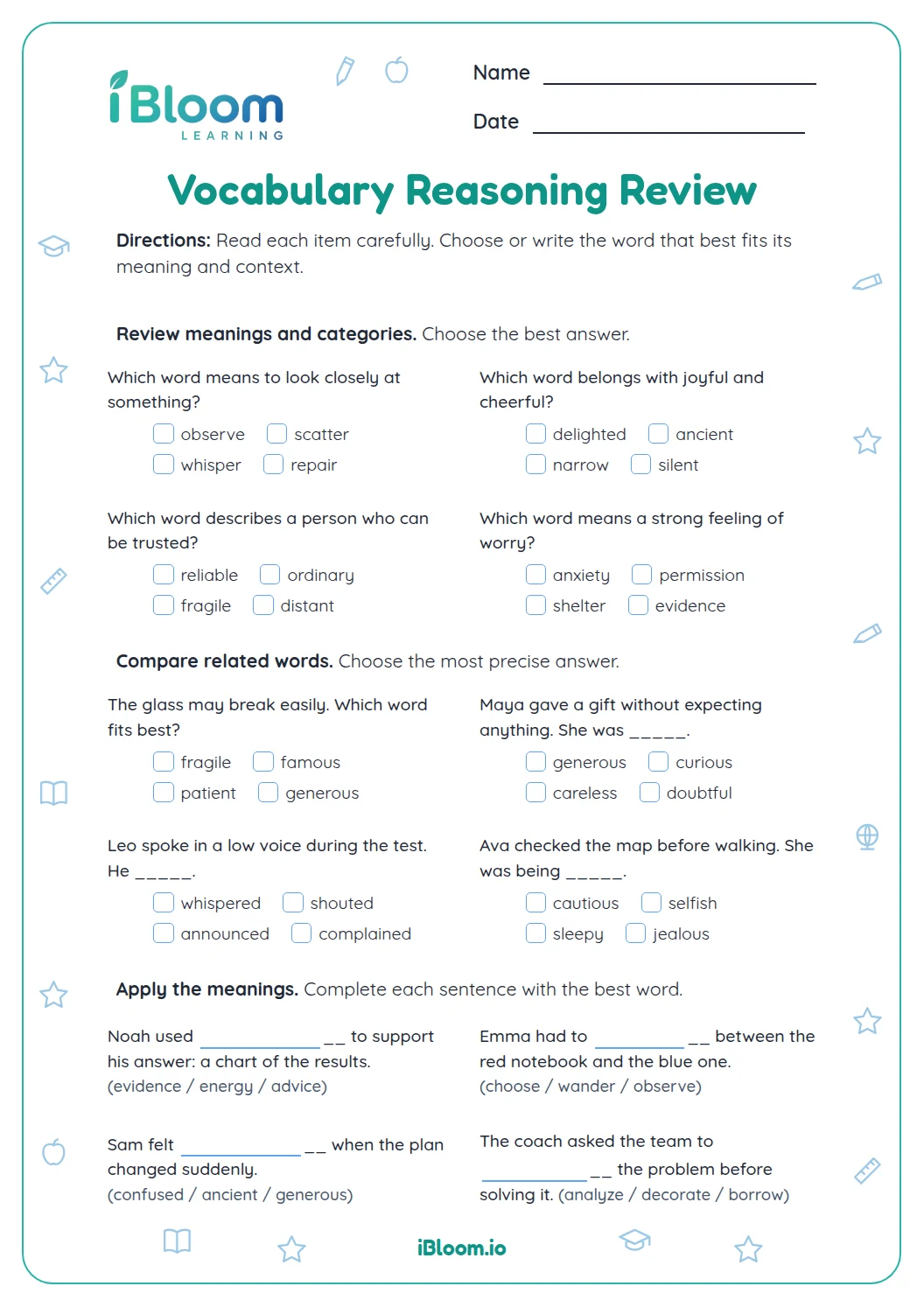
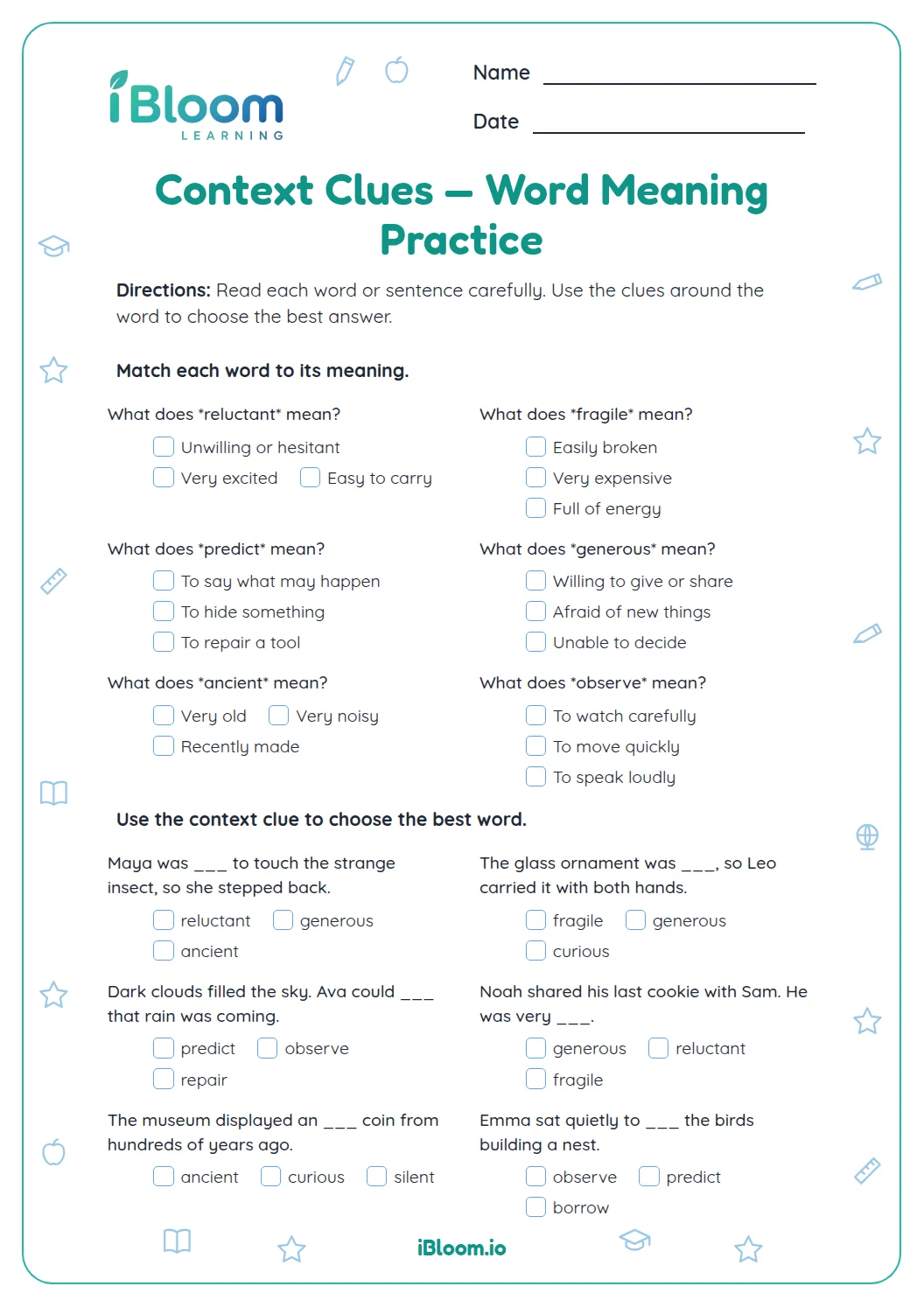
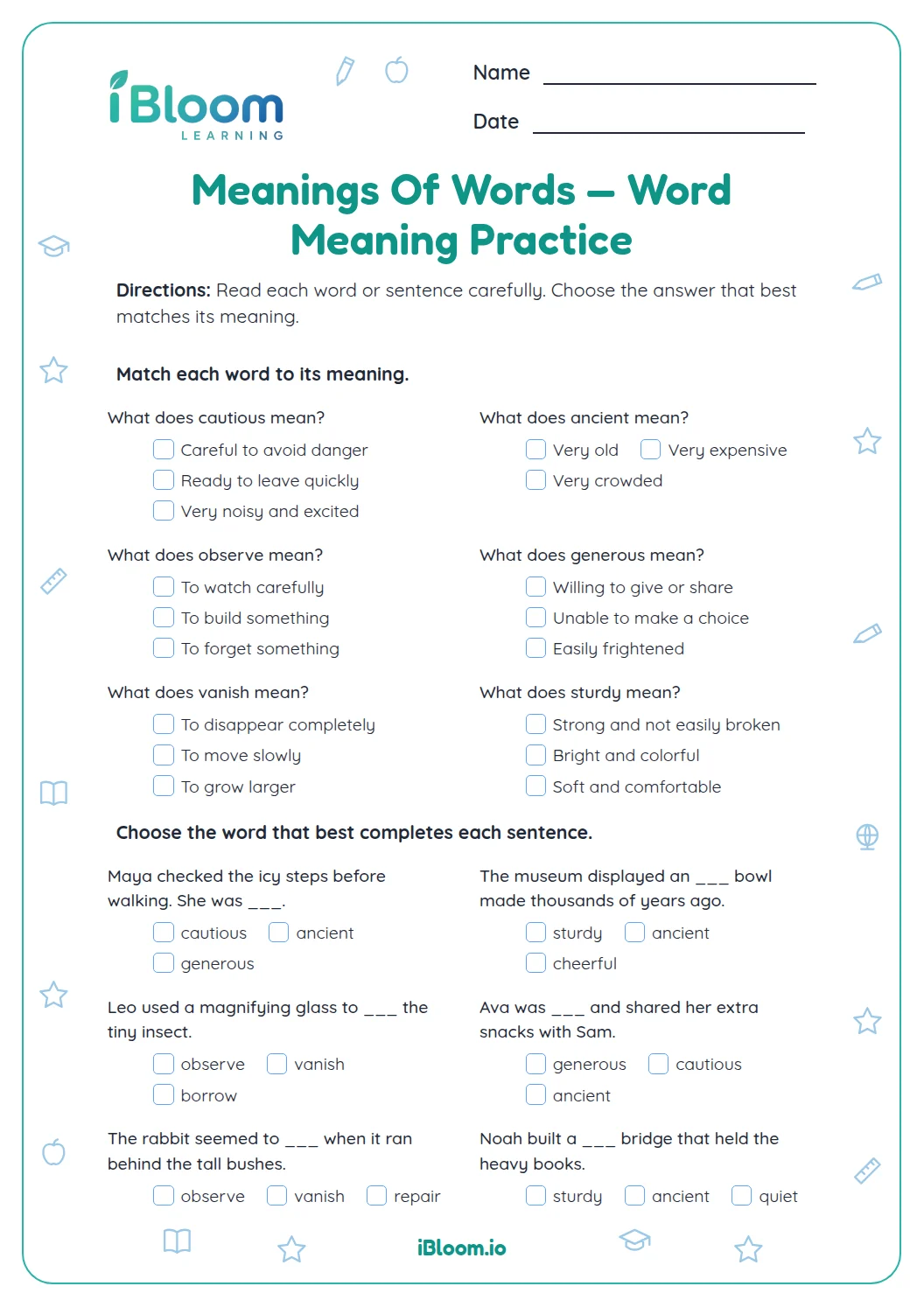
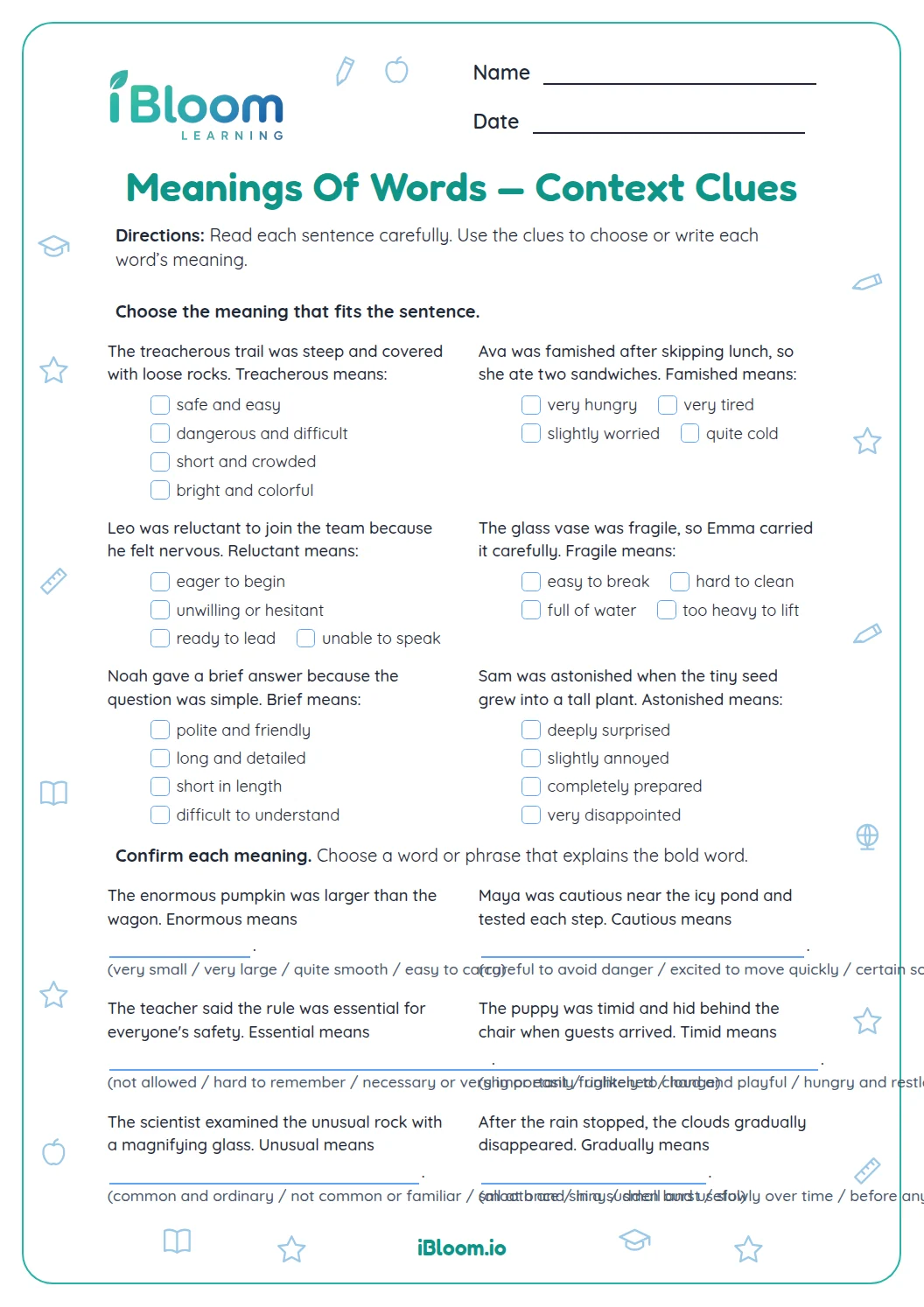
This free printable Grade 5 vocabulary worksheet gives students 14 ways to apply word meanings. They use sentence details to infer meanings for words such as fragile and postpone, then supply precise words that fit related phrases. The practice focuses on context clues and checking that a meaning works in context. The separate answer key supports review.
Aligned to L.5.4a
How can a sentence help with an unfamiliar word?
A context clue is information around a word that points toward its meaning. The clue may name a cause, describe an example, or show what happens next. Read the whole sentence before choosing a definition, then try the meaning in place of the word.
Part A uses sentence clues for words such as fragile, fertile, and postpone. Each sentence includes a detail that helps narrow the meaning.
How do related uses help you apply a meaning?
Part B gives two short uses of a word idea and asks which choice fits both. Check each option in both phrases, not just the first one.
- 1The trail was steep, so the hikers climbed slowly up the sharp slope.
- 2The words climbed and sharp slope suggest a steep trail rises sharply.
- 3Answer: rising sharply.
How can you check a word choice?
Substitute the choice back into the sentence or phrase. A close synonym should preserve the sentence’s meaning. For questions 9–14, keep looking if a choice only fits one of the two uses.
How to use this worksheet
- 1Read the complete sentence or both phrases.
- 2Underline words that explain, contrast with, or illustrate the target meaning.
- 3Predict a meaning before reading the answer choices.
- 4Try each choice in the original sentence.
- 5For questions 9–14, test each choice in both phrases.
- 6Use the answer key to talk through the clue that supports each answer.
Common mistakes and quick fixes
The mistake
Choosing a familiar meaning that does not fit the sentence.
The fix
Substitute the definition into the full sentence and reread it.
The mistake
Using one nearby word as the only clue.
The fix
Read the whole sentence; more than one detail may support the meaning.
The mistake
Choosing a word that fits only one of the two phrases in questions 9–14.
The fix
Test the word in both phrases before writing it.
Common Core alignment
Students use sentence-level context to clarify word meanings and then apply precise vocabulary.
Use sentence clues such as cause and description to infer a word meaning.
On this sheet: Part A uses surrounding details to infer what each target word means.
Show the official wordingHide the official wording
Use context (e.g., cause/effect relationships and comparisons in text) as a clue to the meaning of a word or phrase.
What to practice next
Make more practice
Further reading
Questions parents and teachers ask
How do context clues help with word meanings?
Context clues are details around a word that help readers infer what it means. In the first question, hikers climb slowly up a sharp slope, clues that show steep means rising sharply. Read the sentence as a whole and check that the chosen meaning fits.
What types of words appear on this sheet?
The sentence section practices words such as steep, relief, fragile, brief, fertile, silent, glanced, and postpone. Each word has a clue in its sentence. The final section asks students to supply precise words for shared ideas in two related phrases.
Should students use a dictionary for these questions?
They can use a dictionary after trying the context first, but the worksheet is designed for reasoning from the sentence and phrase clues. Ask the student to explain which nearby detail points to the meaning before checking any reference source.
How does this worksheet ask students to apply a meaning?
Six questions give two short phrases with a shared idea and ask students to choose a precise word that fits both. For example, “a quiet room” and “a quiet voice” point to calm. Students should test each choice in both phrases before selecting it.
Why can more than one word seem close?
Several words can be related, but the best answer must match the specific clue or both phrases. In Part A, read the sentence with each choice substituted. In Part B, check the answer in each use, then choose the one that preserves both meanings.
How long should Grade 5 students spend on the page?
About 20 to 25 minutes is a reasonable plan for the 14 questions. Students first select meanings from context, then choose words that fit shared phrases. Allow extra time for students to explain the clue that helped them decide.