




About this worksheet
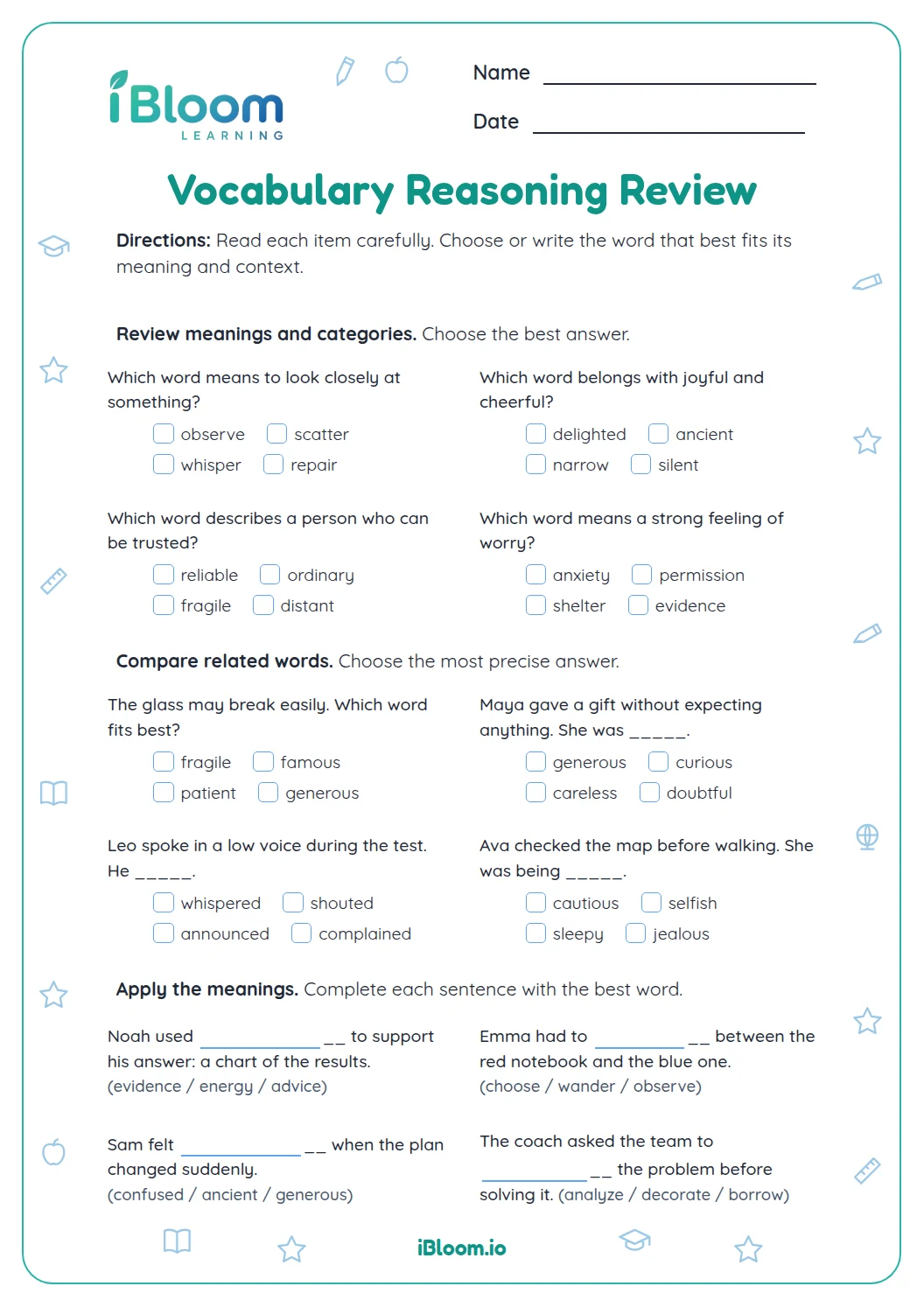
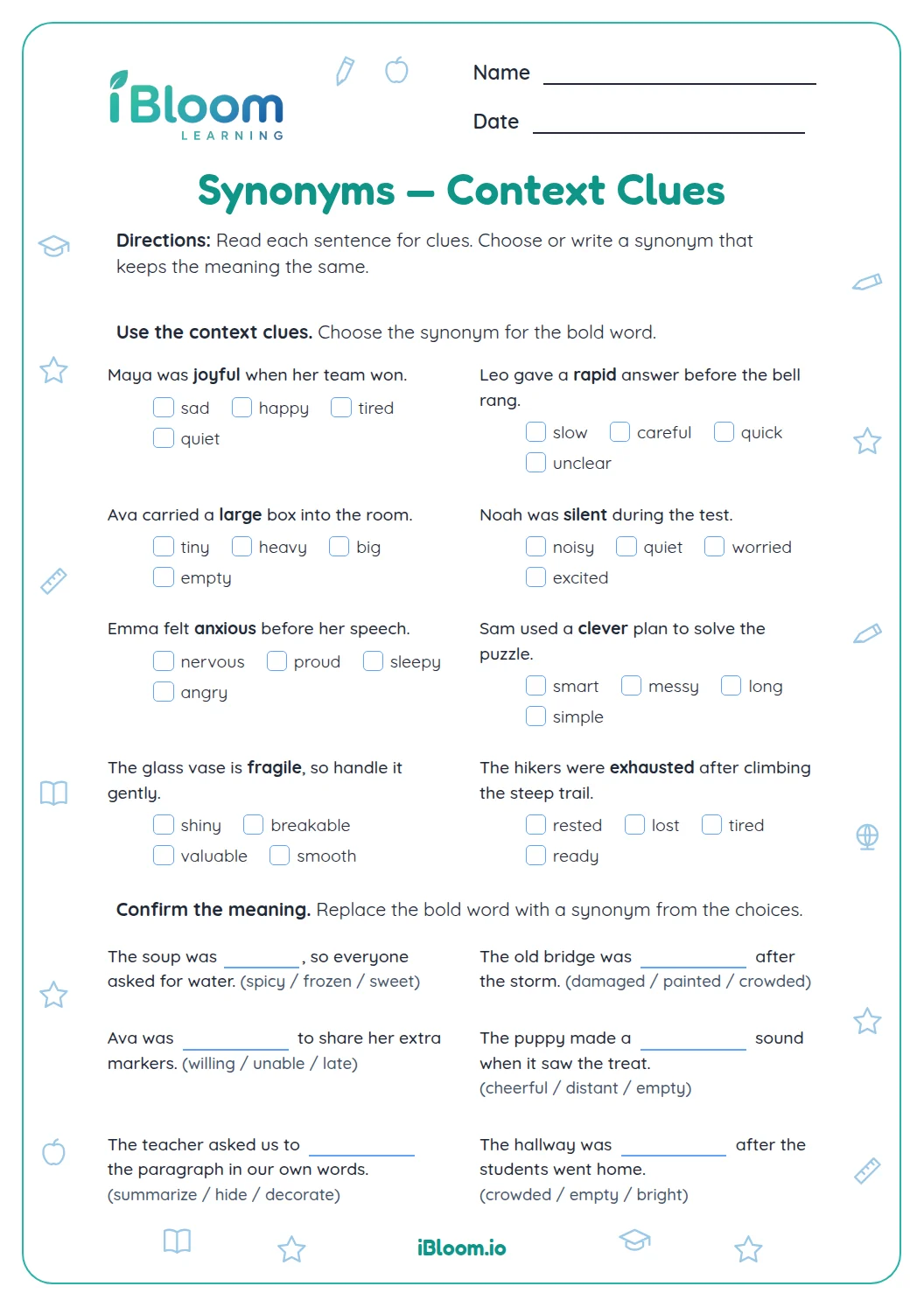
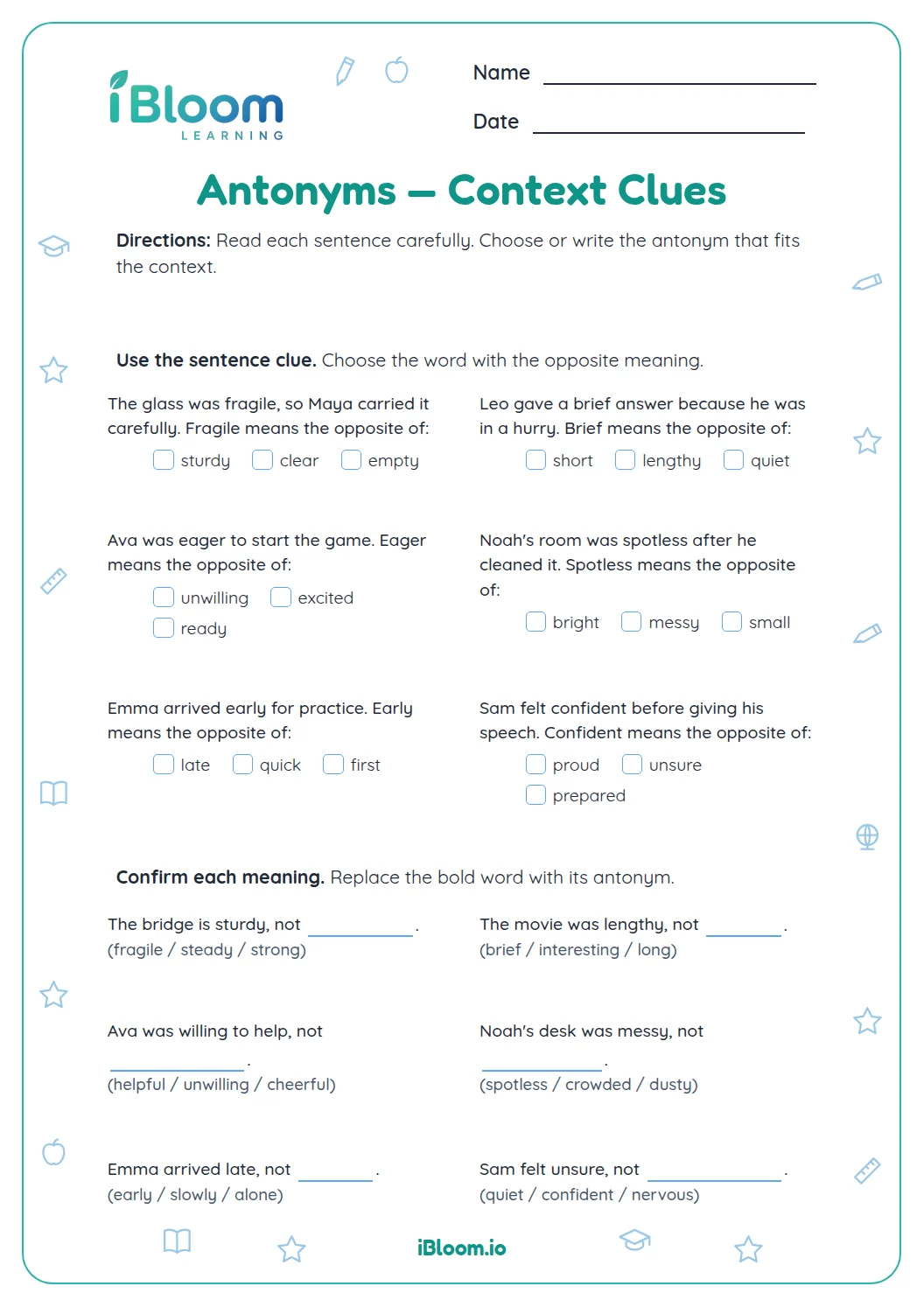
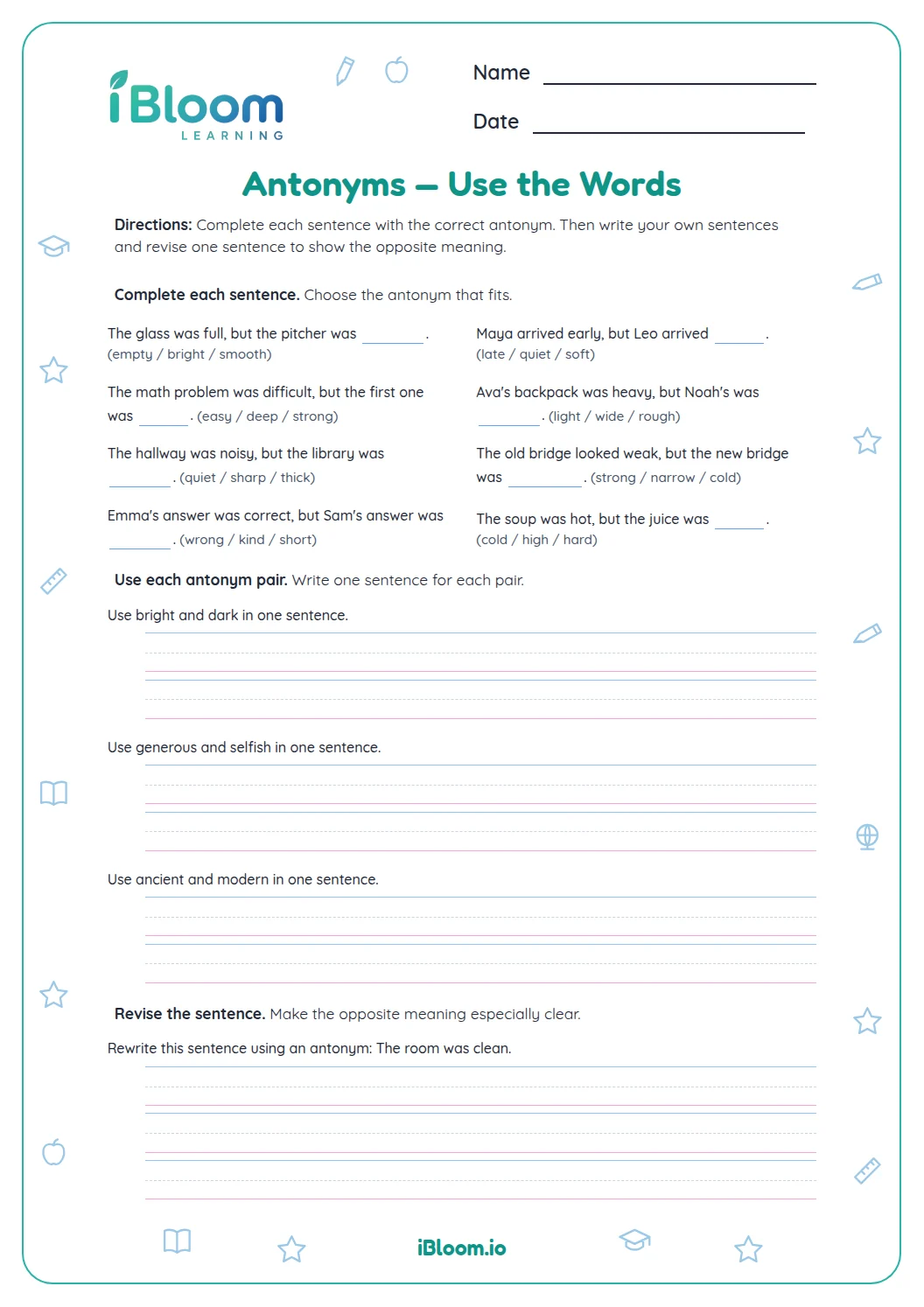
This Grade 5 vocabulary printable asks learners to classify and connect words by meaning. Across 16 multiple-choice questions, children identify synonyms and antonyms, sort examples into categories, and complete relationships such as author to book. Each choice set has one best answer. The worksheet supports CCSS L.5.5c, using relationships among words to understand their meanings.
Aligned to L.5.5c
How can words be classified and connected?
A synonym has a similar meaning, while an antonym has an opposite meaning. Categories group words that share a feature. Analogies connect pairs through a relationship such as creator and creation.
- 1Cautious means careful.
- 2Careless means not careful.
- 3The prompt asks for an antonym.
- 4Answer: careless
What makes a category answer fit?
Check every example against the group name. A category is useful only when each listed item belongs in it.
What will learners find here?
The 16 questions include synonyms, antonyms, categories, and analogies. The last section asks learners to use the relationship precisely.
How to use this worksheet
- 1Read the relationship named in the question.
- 2Say each option with the target word and test whether it matches.
- 3For a category, ask what all listed examples have in common.
- 4For an analogy, describe the first pair before choosing the second pair.
- 5Review the answer key and explain one clue for each missed item.
Common mistakes and quick fixes
The mistake
Choosing a synonym when the question asks for an antonym.
The fix
Check the relationship word in the prompt first: synonyms are similar, while antonyms have opposite meanings.
The mistake
Choosing a category that fits only one example.
The fix
Test the category against every item in the list; each example must belong to the same group.
The mistake
Completing an analogy by topic instead of relationship.
The fix
State how the first pair connects, then find a second pair with that same connection.
Common Core alignment
This worksheet gives focused practice with the listed grade-level skill.
Use word relationships to distinguish and connect meanings.
On this sheet: The questions directly practice this skill throughout the worksheet.
Show the official wordingHide the official wording
Use the relationship between particular words (e.g., synonyms, antonyms, homographs) to better understand each of the words.
What to practice next
Make more practice
Further reading
Questions parents and teachers ask
What word relationships does the worksheet practice?
The 16 questions cover synonyms, antonyms, category membership, and analogies. Learners use the relationship named in the prompt to choose the best answer. For example, they distinguish a word with a similar meaning from one with an opposite meaning. This gives one more specific example.
How can a learner tell a synonym from an antonym?
Synonyms have similar meanings, such as rapid and swift. Antonyms have opposite meanings, such as expand and shrink. Reading the direction word carefully before comparing choices helps the learner select the relationship the question asks for. This gives one more specific example.
What does classify mean in the category questions?
To classify is to sort examples into a group they all belong to. A botanist is a scientist, while granite, marble, and slate are rocks. A correct category must fit every example in the prompt, not just one of them.
How should children solve an analogy?
First describe how the first pair connects. An author creates a book, and a composer creates a song. Looking for the same relationship helps avoid choosing an answer that is related to the topic but does not complete the analogy.
Is an answer key included?
Yes. The separate key gives one best answer for each of the 16 questions. For extra discussion, ask the learner to explain why the chosen word fits and why a nearby choice does not show the stated synonym, antonym, category, or connection for this worksheet.