




About this worksheet
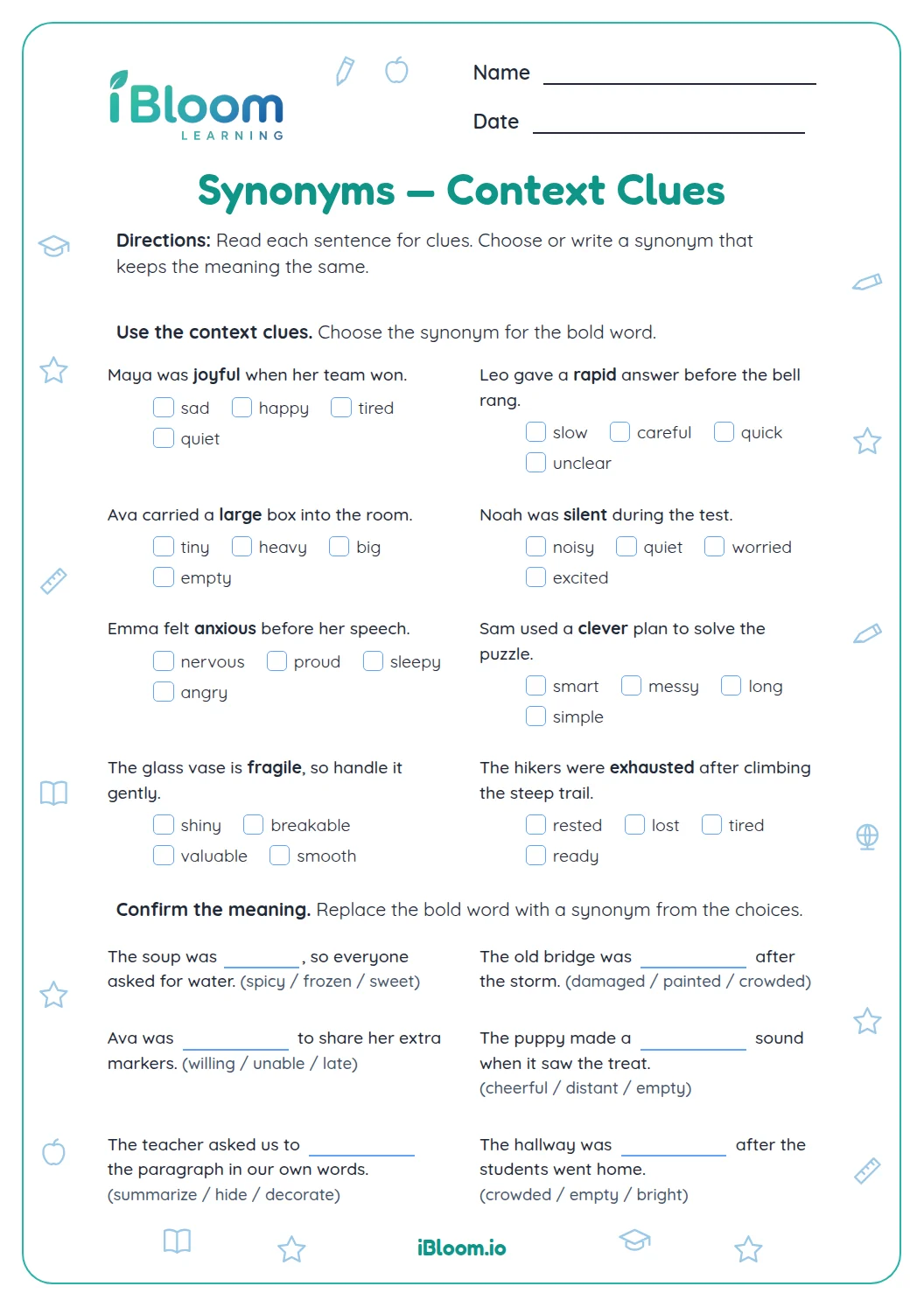
This Grade 5 synonym worksheet builds vocabulary reasoning through close-meaning choices, sentence substitutions, and a six-word crossword. Students first compare familiar word meanings, then test synonyms inside a sentence so the replacement keeps the original idea. The final clues ask students to retrieve related words independently. The page includes 18 questions, a separate answer key, and alignment to Common Core Language standard L.5.5.c on using word relationships to understand words.
Aligned to L.5.5.c
How can a synonym keep a sentence meaning?
A synonym has a meaning close to another word. The best replacement also fits the sentence: “The room was silent” can become “The room was quiet.”
- 1The trail was narrow.
- 2Try a close-meaning replacement: slender.
- 3“The trail was slender” keeps the idea of little width.
What kinds of questions are on the sheet?
Part C contains six short crossword clues, including “A synonym for fast.”
- Part A: 6 synonym choices
- Part B: 6 context-based substitutions
- Part C: 6 crossword clues
How can a student check a synonym choice?
Read the original and replacement sentences aloud. If the meaning changes sharply or the replacement sounds wrong in the sentence, try another related word.
How to use this worksheet
- 1Read all answer choices before choosing a close meaning.
- 2For each sentence, replace the target word and reread the whole sentence.
- 3Use the crossword clue first; then check that each answer fits the crossing pattern.
- 4Compare answers with the key and discuss any word that changes the sentence meaning.
Common mistakes and quick fixes
The mistake
Choosing a word from the same topic instead of a synonym.
The fix
Ask whether the words have similar meanings, not just whether they describe the same topic.
The mistake
Using a synonym that does not fit the sentence.
The fix
Read the replacement in the full sentence and check that the original idea remains.
The mistake
Filling a crossword answer from only its first letter.
The fix
Reread the clue and verify the complete word fits the crossings.
Common Core alignment
This worksheet gives students direct practice with a grade-level Common Core skill.
Use word relationships such as synonyms to understand words.
On this sheet: All three parts use synonym relationships to compare, substitute, or retrieve words.
Show the official wordingHide the official wording
Use the relationship between particular words (e.g., synonyms, antonyms, homographs) to better understand each of the words.
What to practice next
Make more practice
Further reading
Questions parents and teachers ask
How many questions are on this worksheet?
There are 18 questions in three parts. Students answer six multiple-choice synonym questions, write six sentence substitutions, and solve six crossword clues. The separate key lists the expected word for each item. Students can compare each response with its sentence or clue, then explain how the replacement keeps a similar meaning.
What does a synonym mean?
A synonym is a word with a similar meaning to another word. Words are not always interchangeable in every sentence, so students check each possible synonym against the surrounding words and the idea the sentence expresses. For instance, brief and short are close in meaning, while late and bright describe different ideas.
How does the crossword part work?
Each of the six crossword clues names a word and asks for a synonym. Students write the related word in the puzzle, checking that it fits the crossing entries. For example, “A synonym for fast” leads to quick. The crossings provide a second check: a possible synonym must match both its clue and the intersecting words.
Can more than one answer work in Part B?
Some sentences may allow other sensible synonyms, but the key gives one clear expected answer for each blank. If a student writes another word, read the completed sentence together and check whether it preserves the original meaning and fits naturally.
How long should the worksheet take?
Plan for about 25 minutes for all 18 questions. Students may need additional time to complete the crossword neatly or talk through why one synonym fits a sentence better than another. The estimate allows time for students to reread sentence substitutions and complete the crossing puzzle carefully.