

About this worksheet
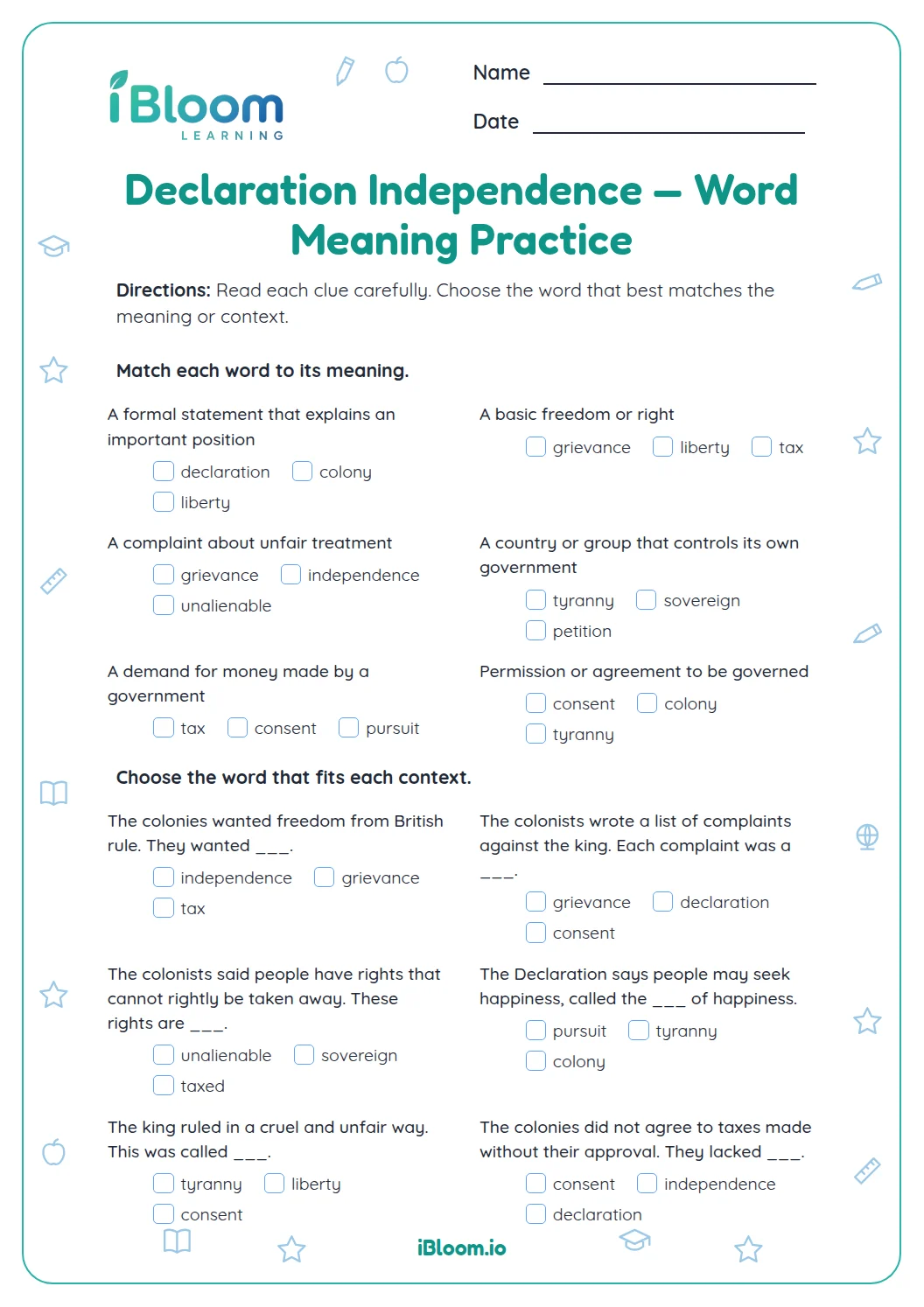
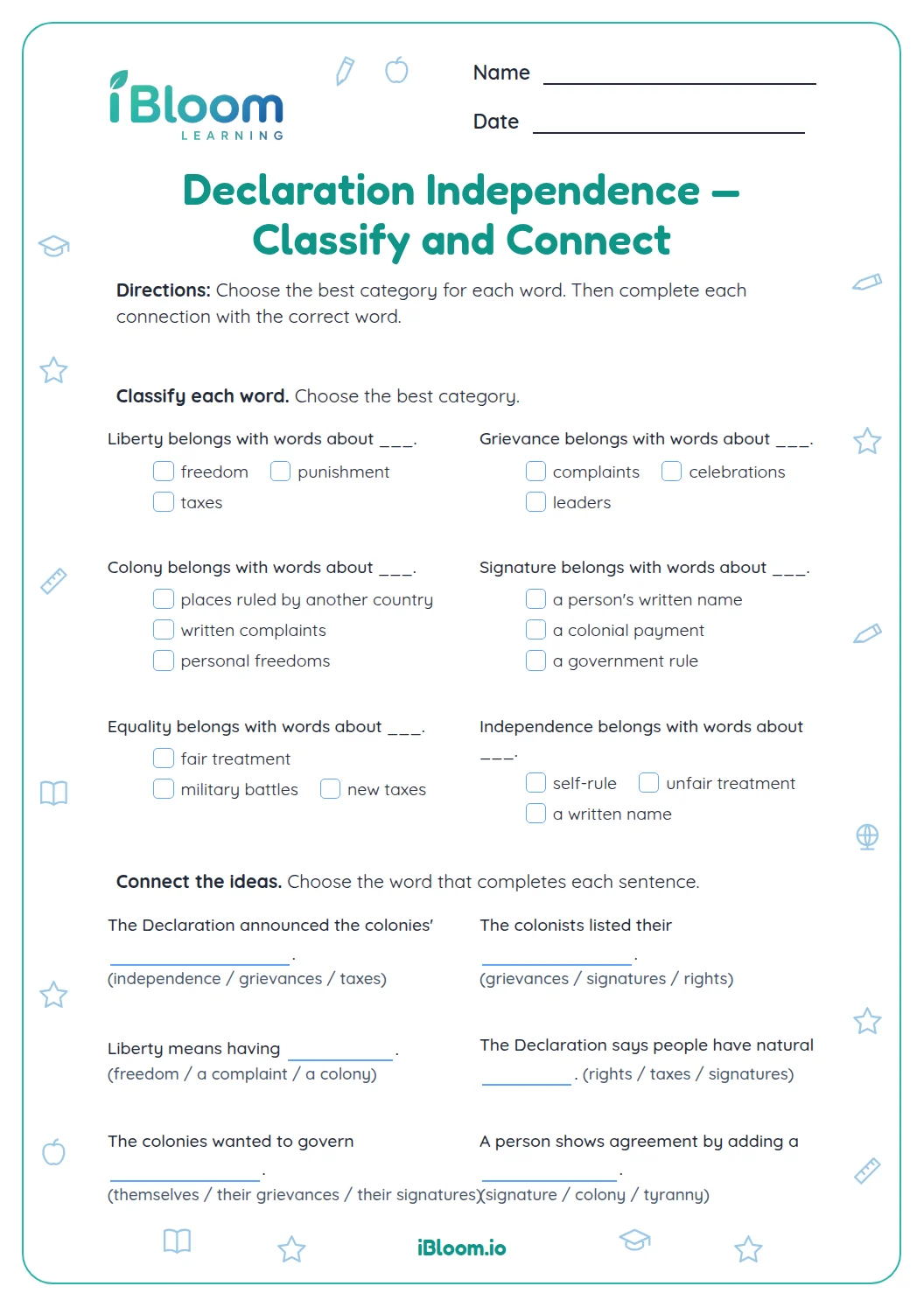
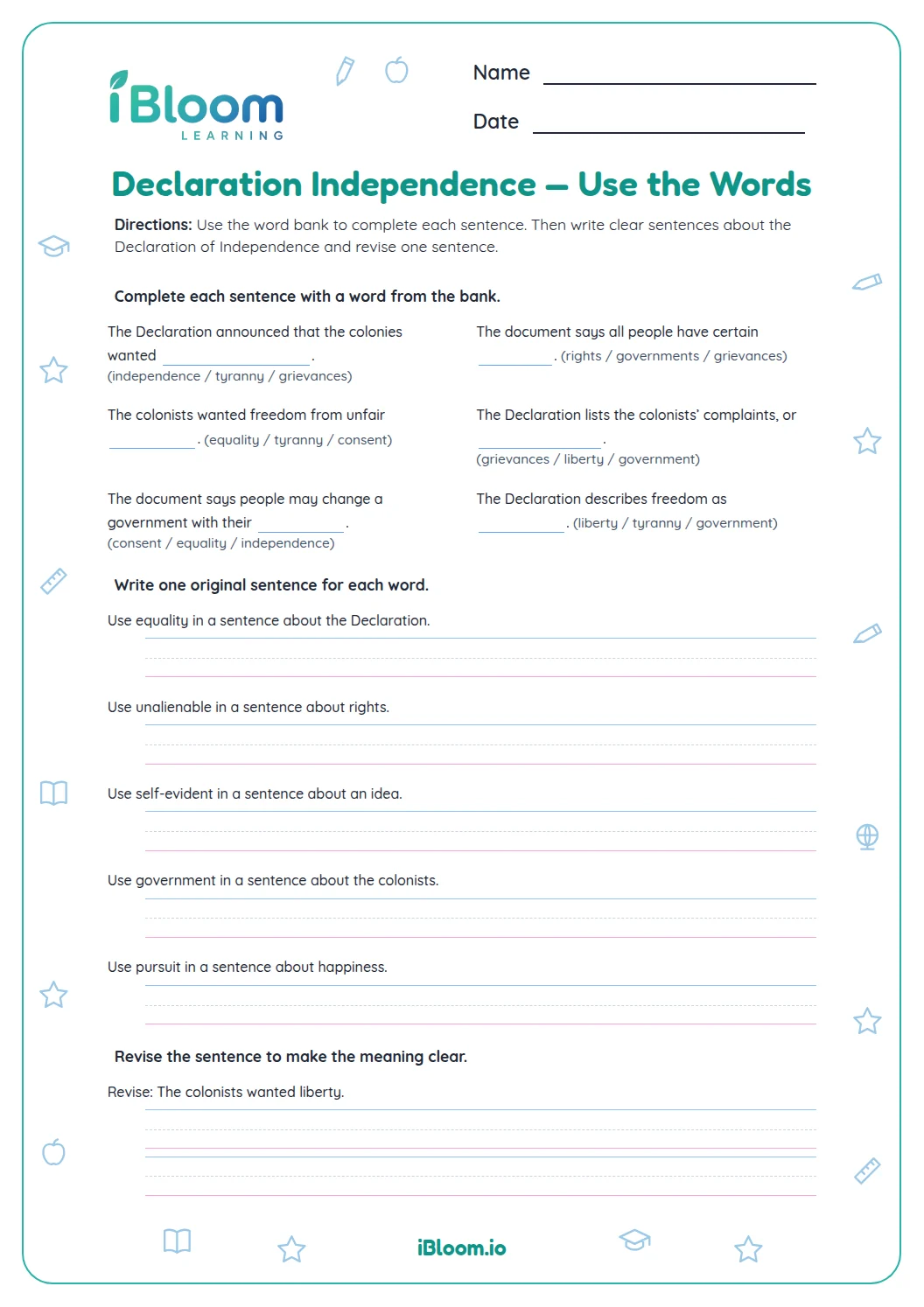
This Grade 5 worksheet builds context-clue skills with vocabulary from the Declaration of Independence. Students choose meanings for words such as liberty, grievances, and consent, then complete sentences using a fitting phrase. The 14 questions are grouped into two parts, with a separate answer key. The sheet practices Common Core ELA standard L.5.4a: using context, including cause-and-effect relationships, to determine word or phrase meaning.
Aligned to L.5.4a
How do context clues help with historical vocabulary?
Words in founding-era texts can be unfamiliar. The surrounding sentence often restates an idea or gives an example that points to a meaning. Students can test a choice by replacing the target word with it and rereading the sentence.
What will students practice here?
Questions 1–6 use complete sentence context to choose a meaning. Questions 7–14 complete a sentence with a phrase that fits. Terms include liberty, grievances, consent, and despotism.
How can a student check an answer?
Look for the clue phrase and test the answer in the sentence.
- 1The colonists wanted liberty, so they hoped to govern themselves.
- 2The clue is “govern themselves.”
- 3Freedom fits that idea.
- 4Answer: freedom
How to use this worksheet
- 1Read the entire sentence before looking at choices.
- 2Underline or say the clue phrase in your own words.
- 3Try each choice in place of the target word.
- 4For a completion, reread the whole sentence with the phrase inserted.
Common mistakes and quick fixes
The mistake
Choosing a familiar meaning without checking the sentence.
The fix
Point to the words that connect the target word to its meaning.
The mistake
Treating grievances as objects rather than complaints.
The fix
Reread the list of unfair laws and taxes for the clue.
The mistake
Choosing a phrase that fits one word but not the whole sentence.
The fix
Insert the phrase and read the sentence aloud.
Common Core alignment
Use context clues to determine the meaning of a word or phrase.
On this sheet: Students use historical sentence context to infer meanings of words and phrases.
Show the official wordingHide the official wording
Use context (e.g., cause/effect relationships and comparisons in text) as a clue to the meaning of a word or phrase.
What to practice next
Make more practice
Further reading
Questions parents and teachers ask
What does context clue mean?
A context clue is a nearby word, phrase, or sentence idea that helps readers work out an unfamiliar word. In this sheet, “govern themselves” points to liberty as freedom. Students can reread the sentence with the choice inserted to check that the meaning fits.
What is the difference between liberty and consent?
Liberty means freedom. Consent means agreement or permission. The worksheet uses different sentence clues for each term, helping students connect the word to its meaning rather than treating related historical ideas as interchangeable. The answer key supplies a concise phrase for every item.
Why use historical vocabulary?
Terms such as grievances and unalienable appear in discussions of the Declaration of Independence. Reading clues around each term helps students interpret the idea from its context. The questions include both direct meaning choices and short sentence completions to practice that reading habit.
How should students check a choice?
Students can substitute a choice into the sentence and reread it. A good choice keeps the sentence’s meaning, including details about unfair laws, self-government, or receiving power. If the sentence becomes confusing, they should return to the clue and reconsider.
Does the answer key include every item?
Yes. The separate answer key gives the intended word or phrase for all fourteen questions, including sentence-completion items. Students can use it to check a response and then point back to the clue that supports the answer. Ask the learner to explain the clue they used.