


About this worksheet
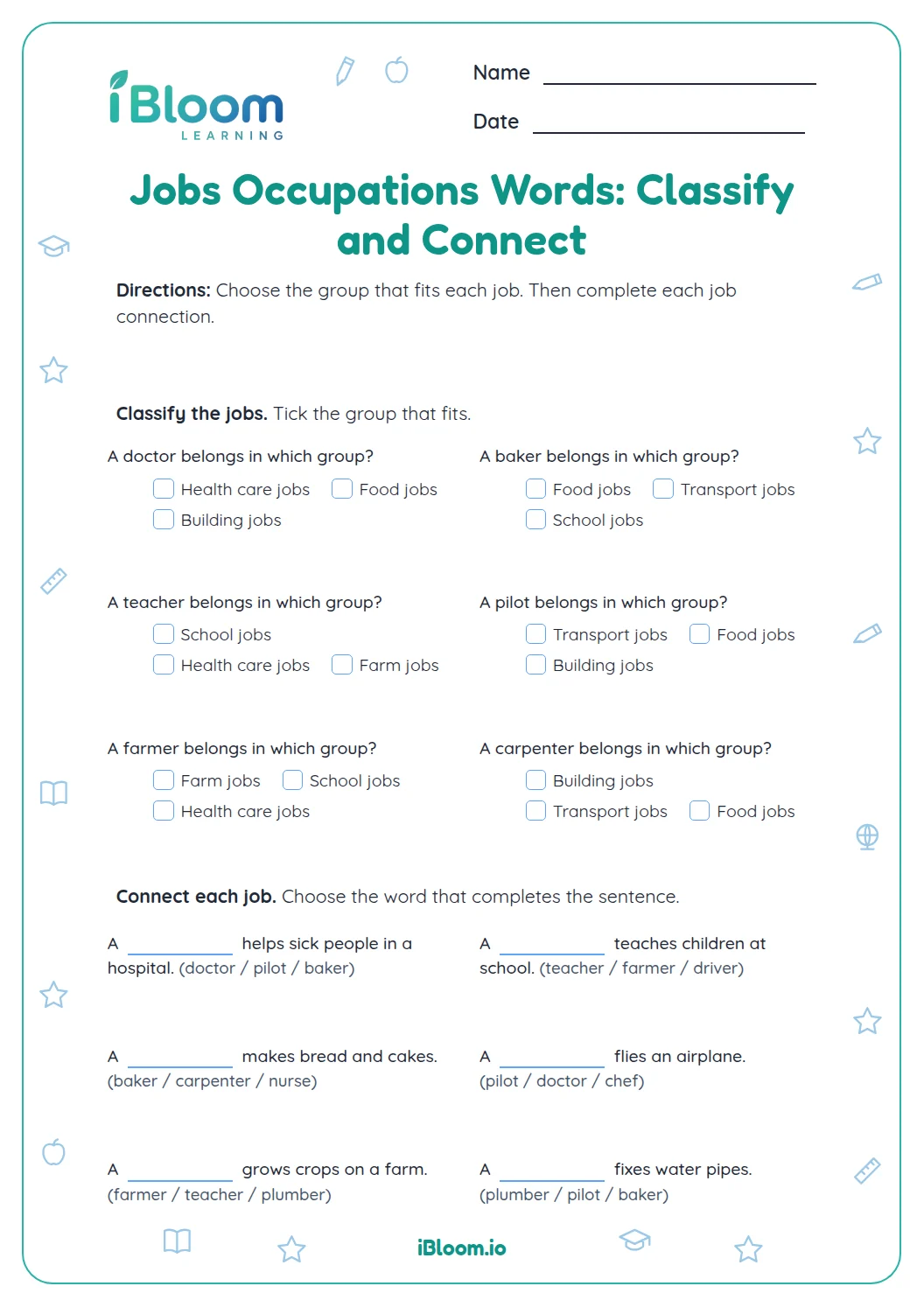
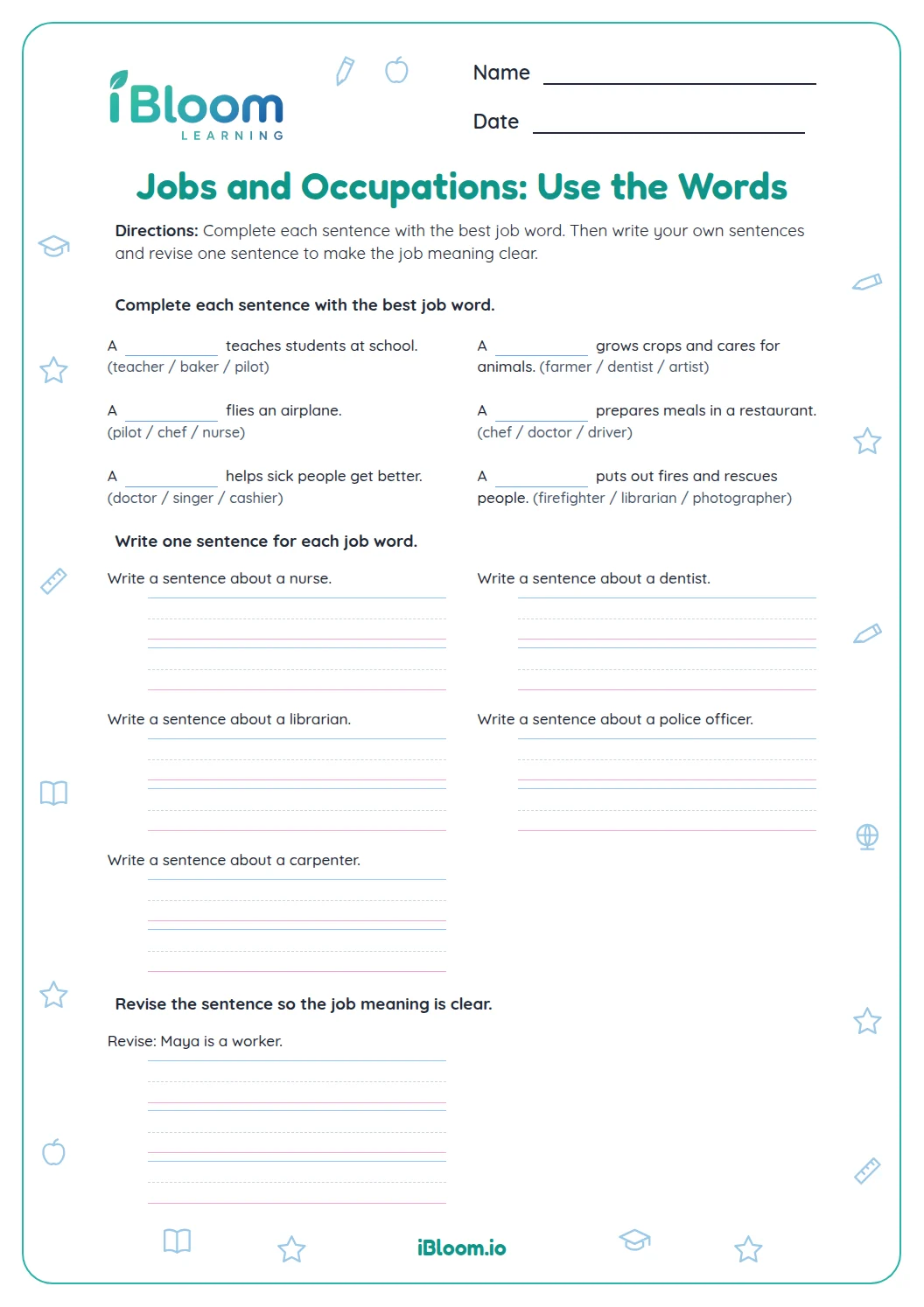
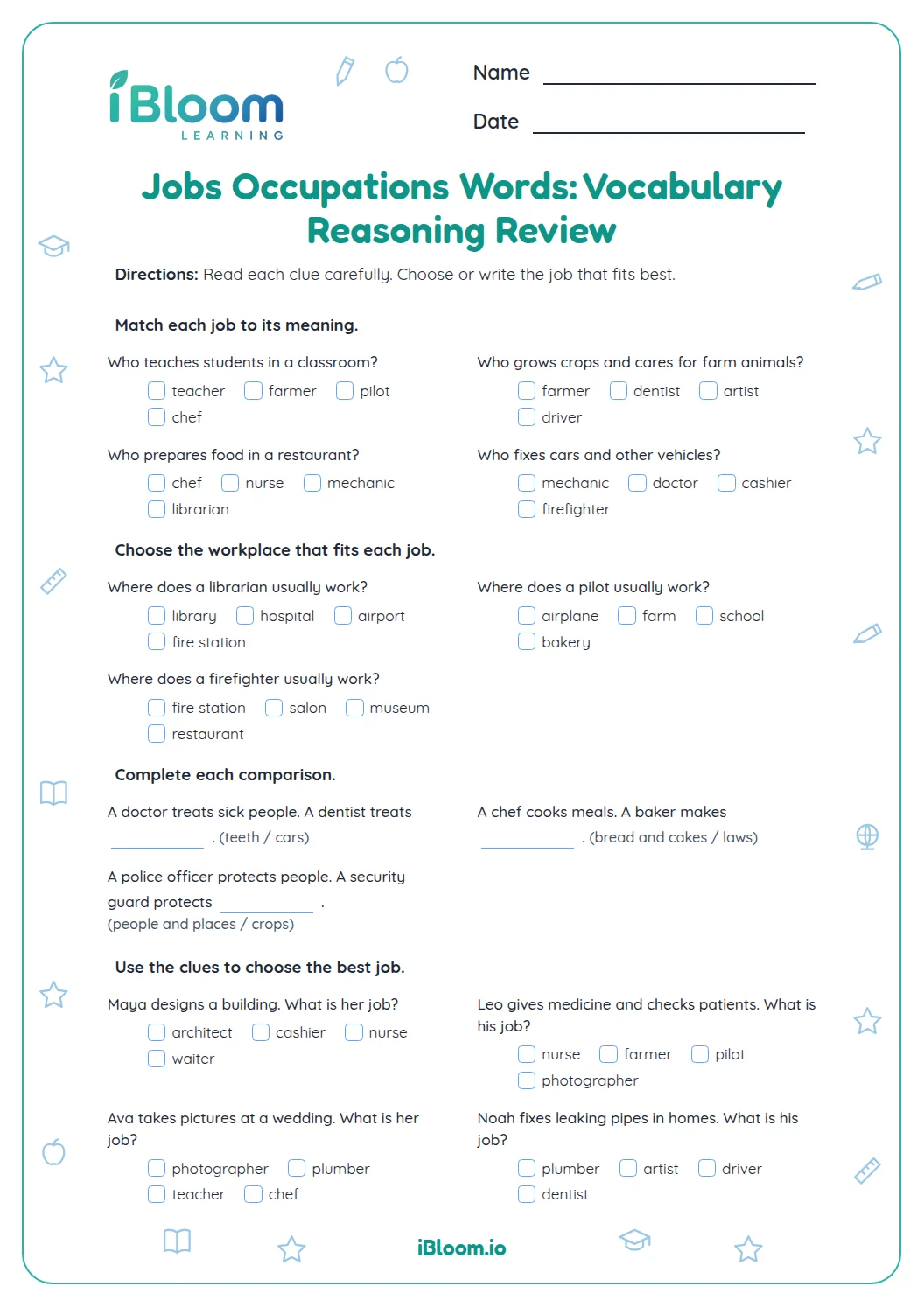
This printable vocabulary worksheet gives learners 14 questions about jobs and occupations. Part A matches a worker’s task to a job word. Part B completes short clues with an occupation or a work-related word. Learners use sentence context to determine word meaning, practicing CCSS L.1.4.a. An answer key is included.
Aligned to L.1.4.a
How do job clues reveal an occupation?
Part A gives a task and asks which occupation matches. Look for the work detail: caring for teeth points to dentist, while cooking meals points to chef.
- 1A worker cares for teeth.
- 2The task is caring for teeth.
- 3Choose dentist.
How do you complete a job-word clue?
Part B gives a short sentence with a missing work or job word. Read the whole clue and think about the task or place it describes. For example, a pilot flies an airplane.
How can you tell similar occupations apart?
Compare the work named in the sentence. A veterinarian cares for animals, while a doctor cares for people; the task helps distinguish the job words.
How can you use this worksheet?
- 1Read the full clue before choosing a job.
- 2Notice the task or place described.
- 3For Part A, choose the occupation that matches the work.
- 4For Part B, write the missing job word.
- 5Use the answer key to check all 14 responses.
What mistakes can learners check?
The mistake
Choosing a job because it sounds familiar.
The fix
Look for the task in the clue and match the work to the occupation.
The mistake
Mixing up a veterinarian and a doctor.
The fix
A veterinarian cares for animals; a doctor treats people.
The mistake
Writing a related word that does not complete the clue.
The fix
Reread the whole sentence and check that the word names the worker, task, or place requested.
Curriculum alignment
This page gives learners focused practice with the stated skill.
Use sentence context to help determine the meaning of job words.
On this sheet:
Show the official wordingHide the official wording
Use sentence-level context as a clue to the meaning of a word or phrase.
What to practice next
Make more practice
Further reading
Questions parents and teachers ask
What job words do learners practice?
The clues include doctor, chef, farmer, teacher, firefighter, dentist, mechanic, mail carrier, veterinarian, builder, pilot, baker, zookeeper, and police officer. Each word connects to a familiar task or setting, such as repairing an engine or caring for sick animals.
How many questions are included?
There are 14 items in two parts. Seven multiple-choice clues ask learners to match a worker’s task to an occupation. Seven sentence blanks ask for a missing job, task, or place word, and the answer key gives a response for each.
How can a learner distinguish a doctor from a veterinarian?
Read whom the worker helps. A doctor cares for people, while a veterinarian cares for animals. A clue about a sick pet points to veterinarian; a clue about a sick child points to doctor. The task in the sentence helps determine the word.
Does the answer key include open-ended examples?
The key lists a response for every blank and a correct occupation for each choice. Some sentences could be completed in other sensible ways, but learners should use the key to check that their word fits the task or place described in the sentence.
What does “occupation” mean?
An occupation is a kind of work or job a person does. This worksheet pairs occupation words with familiar details, such as a teacher helping children learn, a mechanic repairing a car, or a baker making bread in an oven.