7 Screen-Free Learning Activities for Kids
Seven low-preparation screen-free activities for reading, maths, storytelling, nature, building, and creative thinking, plus a free printable.
Free printable worksheet
Free screen-free adventure worksheet
The printable turns this guide into a small, repeatable routine. A child chooses one of the seven activities, works for about 15 minutes, records what was made or learned, and names one next step. The final three boxes check whether the child started, persisted, and explained the thinking.
- Free PDF download
- Ready to print
Free to print and use at home or in class. How to use this worksheet
Screen-free learning does not need to mean a full day without technology. It means choosing a short period when the child reads, builds, sorts, draws, moves, talks, or writes without a device directing every step. The adult supplies a clear invitation; the child does the thinking.
The seven no-screen learning activities below use ordinary materials and work across home, classroom, homeschool, and after-school routines. Each one has a specific learning purpose, an easy way to adjust the challenge, and a question that reveals what the child understood.
Free screen-free adventure worksheet
The printable turns this guide into a small, repeatable routine. A child chooses one of the seven activities, works for about 15 minutes, records what was made or learned, and names one next step. The final three boxes check whether the child started, persisted, and explained the thinking.
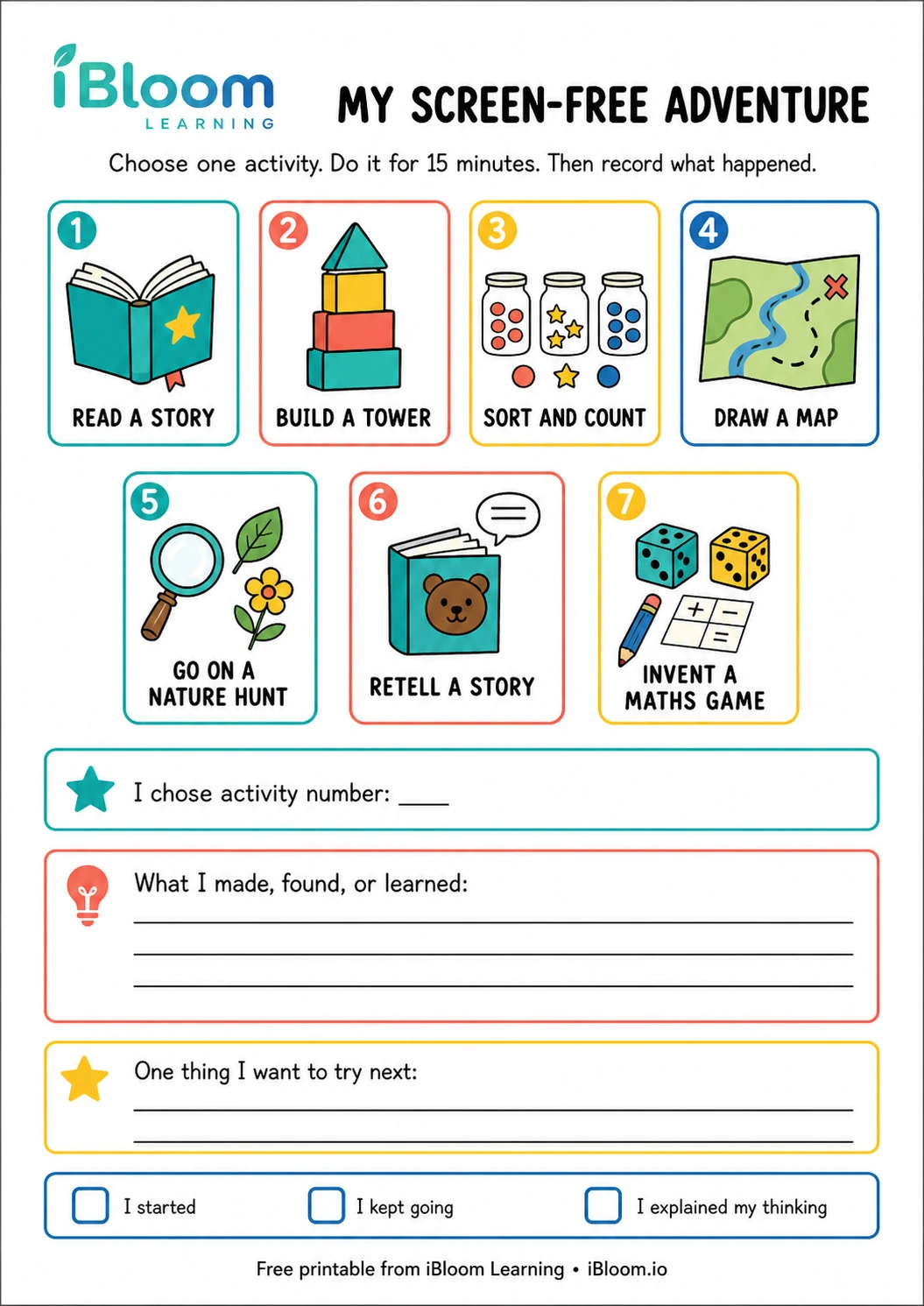
Download the free My Screen-Free Adventure worksheet PDF
Print one page and reuse the activity ideas with a notebook on later days. The response is intentionally open-ended, so there is no answer key. The evidence is the child’s object, explanation, drawing, test, or written reflection.
You can also choose a ready-made page from the free printable worksheet library or read the complete guide to worksheets for kids.
What counts as a no-screen learning activity?
A screen-free activity has an observable child action. “Learn about plants” is too broad. “Sort six leaves by edge shape and explain one group” is usable. The best activities combine two or more of these actions:
- handle or arrange real objects;
- read, retell, or listen;
- count, compare, estimate, or measure;
- draw, label, map, or write;
- move, build, test, or revise;
- explain a choice to another person.
The American Academy of Pediatrics now encourages families to think beyond a single screen-time number. Its 5 Cs of Media Use ask adults to consider the child, the content, how media is used for calm, what it may be crowding out, and family communication. A short offline activity is useful because it protects time for reading, movement, play, sleep, and connection; it is not a punishment for using a screen.
Seven no-screen learning activities for kids
1. Build a story basket
Put five familiar objects in a basket: a spoon, toy animal, ribbon, key, and paper cup, for example. The child chooses three and tells a story that connects them. A younger learner can tell three sentences: who, where, and what happened. An older learner can add a problem, an attempt, and an ending.
Learning focus: oral language, sequencing, vocabulary, and narrative structure.
Make it easier: let the child describe one object before inventing the story.
Add challenge: ask for one time word such as first, later, or finally, then have the child write the best sentence.
Ask afterward: “Which object changed what happened in your story?”
2. Sort, count, and defend the rule
Collect 15 to 25 safe household objects such as buttons, bottle tops, craft sticks, socks, or blocks. The child sorts them into groups and labels the rule: colour, size, shape, material, use, or another property. Mix the objects and ask for a second sort.
Counting matters, but explaining the rule is the stronger thinking task. Two children may create different groups and both be correct if they can justify their choices.
Learning focus: classification, counting, comparison, flexible thinking, and mathematical language.
Make it easier: offer two sorting mats labelled “same” and “different”.
Add challenge: make a tally table and answer, “How many more are in the largest group than the smallest?”
Ask afterward: “Could one object belong in two groups? Why?”
3. Draw a map from memory
After a walk through one room, the garden, or a familiar route, ask the child to draw a simple map. Start with a landmark, add two or three positions, and draw a route between them. The page does not need accurate scale. It should help another person understand where things are.
Use location words naturally: beside, behind, between, opposite, near, and farther. For Class 2 or Class 3, add a key with three symbols and write two directions.
Learning focus: spatial reasoning, observation, position words, symbols, and explanatory writing.
Make it easier: draw the starting point together.
Add challenge: hide a paper star and write directions that another person can follow.
Ask afterward: “Which landmark would help someone who has never been here?”
4. Run a five-minute nature hunt
Give the child a narrow search rather than “go outside and explore.” Try: find something smooth, something with a pattern, two different leaf edges, evidence that an animal has visited, or three shades of one colour. Observe living things without picking or disturbing them.
Back indoors, the child can sketch one item, label two features, and record a question. If outdoor access is limited, use a window view, safe natural objects already collected, or photographs printed on paper.
Learning focus: close observation, descriptive language, comparison, and scientific questioning.
Make it easier: search for one property at a time.
Add challenge: group findings, propose a reason for the difference, and note what evidence would test the idea.
Ask afterward: “What did you notice only after looking twice?”
5. Invent a maths game with dice or cards
Use number cards, two dice, or handmade paper squares. Decide on one operation and one win condition. For early learners, turn two cards and build the larger number with counters. For Class 1, add or subtract within 20. For Classes 3 to 5, multiply, compare fractions, or create a target-number challenge.
Ask the child to test the game for three rounds. If one player always wins or a rule is confusing, revise it. Designing a fair game makes the mathematics visible.
Learning focus: number fluency, probability language, rule writing, and problem solving.
Make it easier: provide the operation and let the child choose only the scoring rule.
Add challenge: calculate whether each player has an equal chance of winning.
Ask afterward: “Which rule did you change after testing?”
6. Read, cover, and retell
Read a short passage, poem, or picture-book page together. Cover the text and ask the child to retell the most important part without repeating every detail. Uncover the page to check what was missed or confused.
For a beginning reader, use one sentence and ask who or what it is about. For an older reader, ask for the main idea and two supporting details. The purpose is retrieval and meaning, not perfect memorisation.
Learning focus: listening or reading comprehension, recall, main idea, and sequence.
Make it easier: offer three picture or word cues.
Add challenge: retell from another character’s point of view or write a one-sentence summary.
Ask afterward: “Which detail helped you remember the main idea?”
For more structured follow-up, browse English worksheets by grade and skill.
7. Test a paper-building challenge
Give the child four sheets of scrap paper and a small object such as an eraser. The task is to build a bridge that holds the object between two books. The paper may be folded, rolled, or layered, but no extra support is allowed.
Let the first design fail. Ask what bent, slipped, or collapsed; then change one feature and test again. A before-and-after sketch makes the revision easier to discuss.
Learning focus: planning, measurement, cause and effect, persistence, and design thinking.
Make it easier: demonstrate one strong fold, then let the child continue.
Add challenge: increase the span or predict how many identical objects the bridge will hold.
Ask afterward: “What evidence shows the second design was stronger?”
A 20-minute screen-free routine that is realistic
Long, elaborate plans often fail on busy days. Try this sequence instead:
- Choose for one minute. Offer two activities, not seven.
- Prepare for two minutes. Collect only the materials needed.
- Work for twelve minutes. Let the child handle the main decisions.
- Explain for three minutes. Ask one of the questions in this guide.
- Reset for two minutes. Put materials away and save one piece of evidence.
Stop while the child can still name what happened. A second short session on another day is often more useful than extending the first until it becomes a struggle.
The AAP’s updated Family Media Plan includes screen-free zones and times as one part of a broader family plan. That framing helps adults set predictable boundaries without treating every digital activity as equal or turning device removal into a threat.
How to choose the right activity by age
For LKG, UKG, Pre-K, and kindergarten, keep instructions to one or two actions. Use large objects, oral answers, movement, and drawing. Ten focused minutes may be enough.
For Grades or Classes 1 and 2, add a record: one label, number sentence, tally, direction, or complete sentence. The adult can write down an explanation that the child gives aloud.
For Grades or Classes 3 to 5, ask the learner to plan, compare attempts, justify a rule, or revise the work. The extra challenge should deepen the thinking, not simply increase the number of questions.
Common problems and quick fixes
| Problem | Useful adjustment |
|---|---|
| The child says “I’m bored” before starting | Offer two concrete choices and begin with five minutes. |
| Materials take longer than the activity | Keep a small offline box with paper, cards, dice, pencils, and counters. |
| The adult takes over | Ask a question, then wait ten seconds before helping. |
| The task feels like extra homework | Use stories, construction, movement, or the child’s interests as the starting point. |
| Siblings need different levels | Keep the same activity but change the required record or explanation. |
| The child wants the screen back immediately | Agree on the end time before starting and use a visible kitchen timer. |
If schoolwork already causes tension, pair one achievable offline task with the strategies in 7 ways to reduce homework stress.
How to know whether the activity taught anything
Do not judge success by how decorative the finished page looks. Listen for evidence:
- the child used a new word accurately;
- a second sort followed a different rule;
- the map helped another person find a place;
- the retell kept the main idea;
- a game rule was revised after testing;
- a bridge design changed for a stated reason;
- the child began with less adult prompting the next time.
Save one example or write one sentence about the observation. That small record gives the next session a useful starting point.
Frequently asked questions
Do no-screen activities need to be educational every minute?
No. Free play, rest, conversation, and outdoor time have value without a written objective. Use the activities here when you want a short learning invitation, not as a way to turn all offline time into schoolwork.
Are printable worksheets considered screen-free learning?
Yes, once printed. A good worksheet can focus attention and provide a place to record thinking. It works best alongside talk, objects, drawing, or movement rather than as a stack of repetitive pages.
How often should children do these activities?
Start with two or three short sessions a week. Consistency matters more than duration. Repeat a favourite activity with one changed rule so the child uses the same skill in a new way.
What if I do not have special learning materials?
Use paper, pencils, books, cups, socks, bottle tops, leaves, dice, and safe recycled materials. The learning comes from the child’s choices and explanations, not from an expensive kit.
Should adults ban screens before offering these activities?
A predictable family routine is usually clearer than a sudden ban. Decide when devices are useful, when they are put away, and what other activities need protected time. The AAP’s 5 Cs and Family Media Plan can support that discussion.
Which activity should we try first?
Choose the one with the least preparation and the best match to the child’s current interest. If the child likes stories, begin with the basket or retell. If the child likes building, begin with the paper bridge. A successful first attempt makes the next invitation easier.
Turn several of these activities into a short choice-and-progress routine with the free Home Learning Quest board.