Worksheets for Kids: Free, Printable and Interactive Guide
Choose a useful worksheet by age, subject, and purpose, compare print with interactive practice, and reach real iBloom activities.
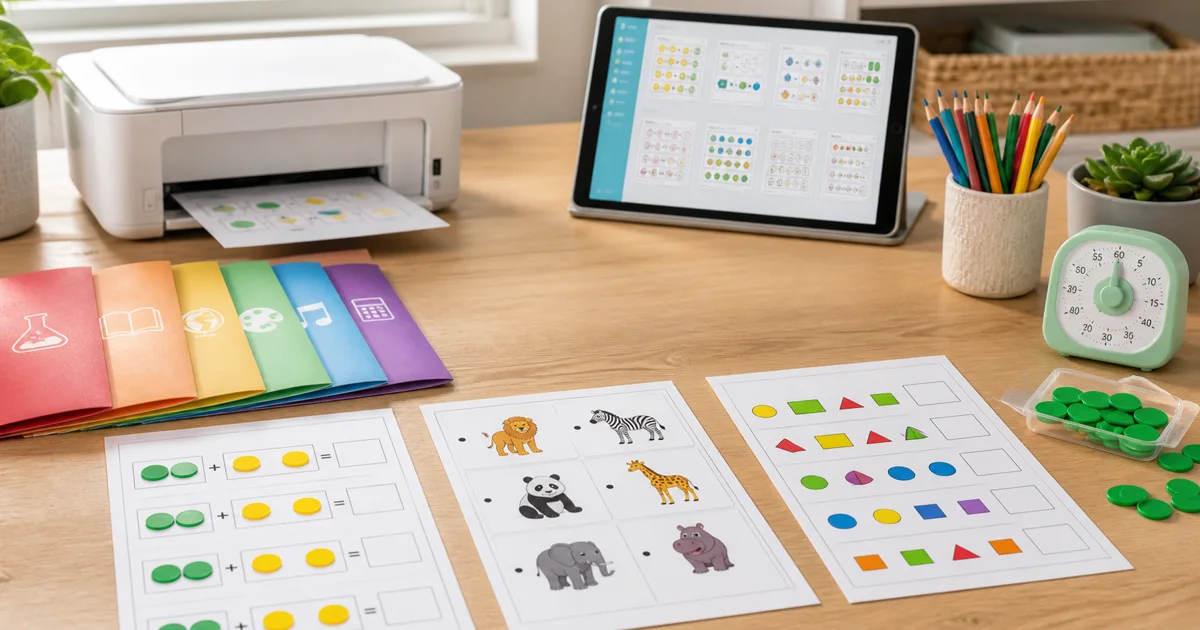
Parents usually search for worksheets when they need something concrete: ten minutes of addition practice, a phonics page for a child who mixes two sounds, a reading activity for the weekend, or work that can travel without a device. The useful worksheet is not the one with the most questions. It is the one that matches the next learning step and produces information you can act on.
This guide explains how to choose printable and interactive worksheets for Pre-K through Grade/Class 5, use them without creating busywork, and reach real iBloom activities by subject and skill.
The multi-grade English worksheet page shows how iBloom organises a ranking-focused practice route by subject, readiness, and level. Use it as a starting point, then apply the selection checks below.
Begin with one sentence about the goal
Before opening a worksheet library, complete this sentence: “By the end of this activity, the child will be able to…” A useful answer is observable: read ten short-vowel words, add within 20 using a number line, identify the main idea in one paragraph, or use capital letters at the start of sentences.
“Do more math” is too broad. “Finish three pages” describes output, not learning. A precise goal helps you reject attractive pages that practise the wrong thing.
If you do not know the next step, look at recent classwork or ask the child to attempt two sample questions. Choose a skill they can nearly complete with a small prompt. Material far below the current level becomes mechanical; material far above it measures frustration.
Choose by skill before choosing by grade
Grade labels are useful filters, but curricula and school sequences differ. A Class 2 child may be secure in two-digit addition and still need focused work with a phonics pattern. Select the actual skill first, then confirm that the language, number range, and presentation fit the learner.
For Pre-K, favour short, adult-supported activities involving matching, tracing, counting objects, shapes, vocabulary, and fine-motor control. Kindergarten, LKG, and UKG work may include letter-sound relationships, early blending, number sense, patterns, and simple comparisons.
Grade/Class 1 and 2 often need explicit practice in decoding, sentence construction, place value, addition, subtraction, measurement, and early problem solving. Grades/Classes 3 to 5 add multiplication, division, fractions, multi-step problems, grammar, vocabulary, and comprehension that requires evidence from a text.
Open the free printable worksheet library and narrow the results instead of downloading a mixed packet. For a more tailored check, use assessments after the child has been taught the skill.
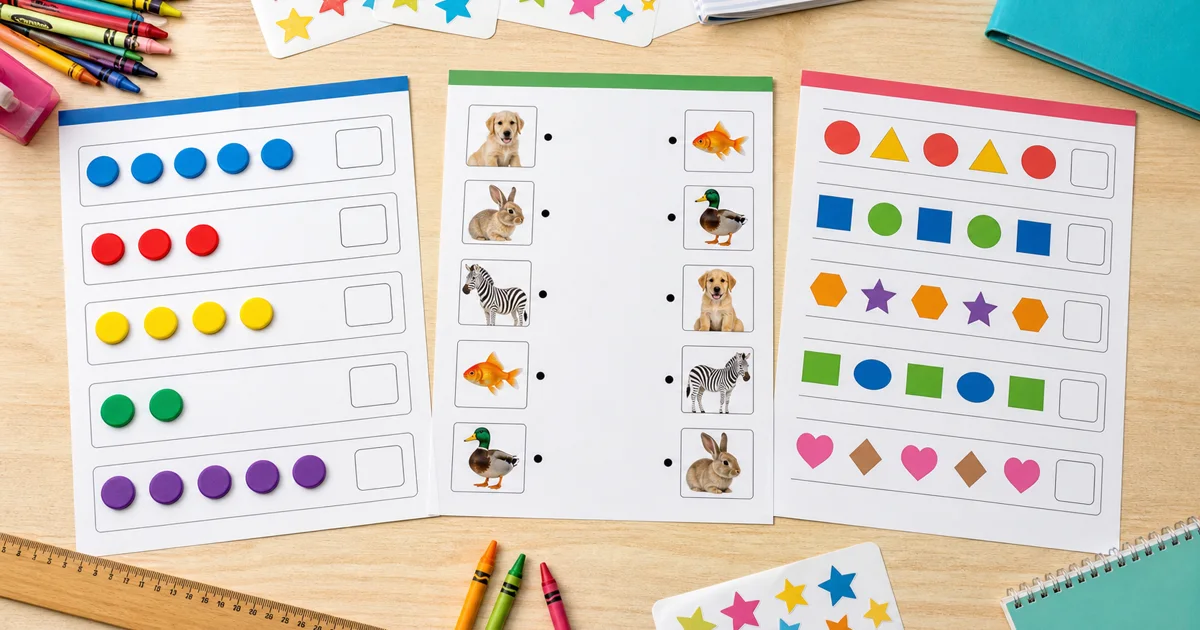
Match the page to the purpose
The same worksheet can be helpful in one situation and unhelpful in another. Decide what role it will play.
Guided practice comes immediately after teaching. An adult models the first item, thinks aloud, and gradually reduces help. The page should contain consistent examples of the new skill.
Independent practice checks whether the learner can use a familiar method alone. Directions and layout must be especially clear because adult prompting would change what is being measured.
Review mixes material learned on earlier days. It should be short enough that you can identify which skill caused an error.
Assessment samples learning without teaching during the attempt. Use it sparingly and interpret mistakes carefully.
Enrichment invites a new application, puzzle, or open response. A page is not enrichment merely because it is one grade harder.
Write the purpose at the top before beginning. “This is practice, so I can help” feels very different from “Try this independently so we can see what to review.”
Inspect a worksheet before handing it over
Read every direction and solve a representative item. Check that the answer key, if present, matches the questions. Look for ambiguous pictures, clipped text, tiny print, cultural assumptions, and items requiring a skill that was not stated.
A strong page has a clear title, one main objective, a worked example when needed, enough room to write, and a sensible progression. Decorative characters should not cover instructions or compete with the task. Repeated items should add practice, not simply fill space.
The What Works Clearinghouse publishes practice guides for educators that connect instructional choices to reviewed evidence. Use them to check whether a worksheet supports the teaching approach rather than substituting for it.
Estimate the time honestly. If the child can demonstrate the skill in eight questions, forty similar questions may measure endurance rather than understanding. Print only the pages you plan to use; a huge packet can make a small learning problem feel overwhelming.
For math, confirm whether pictures and number models support the intended strategy. For reading, make sure the passage is readable and the questions actually require evidence from it. For grammar, check that examples are complete and that more than one defensible answer has not been treated as wrong.
Know when print is the better format
Printable worksheets are valuable for handwriting, drawing a number model, underlining text evidence, showing multi-step calculations, and working offline. A parent or teacher can annotate the exact point where thinking changed.
Print is also useful when a child needs to slow down. Moving counters, drawing a bar model, or crossing out impossible answers creates visible reasoning. Keep a pencil, eraser, coloured pencil, and a few simple manipulatives nearby so the page is not treated as a closed-book test.
Do not require printing when it adds no value. A child who only needs quick multiplication retrieval may benefit from an interactive activity with immediate feedback. Choose the medium from the learning process, not from the assumption that paper is always serious and screens are always play.
Know when interactive practice earns its place
Interactive worksheets can give immediate correctness feedback, save progress, read instructions aloud, and present the next question without exposing a full page. They can be especially useful for short retrieval sessions or for learners motivated by a clear progress indicator.
The adult should still observe occasionally. Rapid tapping, repeated guessing, or selecting from visible options may produce completion without recall. After a digital round, ask the child to explain one item or solve a related example on paper.
Explore interactive digital worksheets when feedback and progress tracking will help. Use SpellBee when the specific goal is spelling and vocabulary retrieval. Technology is doing useful work when it supports the objective and makes thinking visible—not merely because an animation appears after every answer.
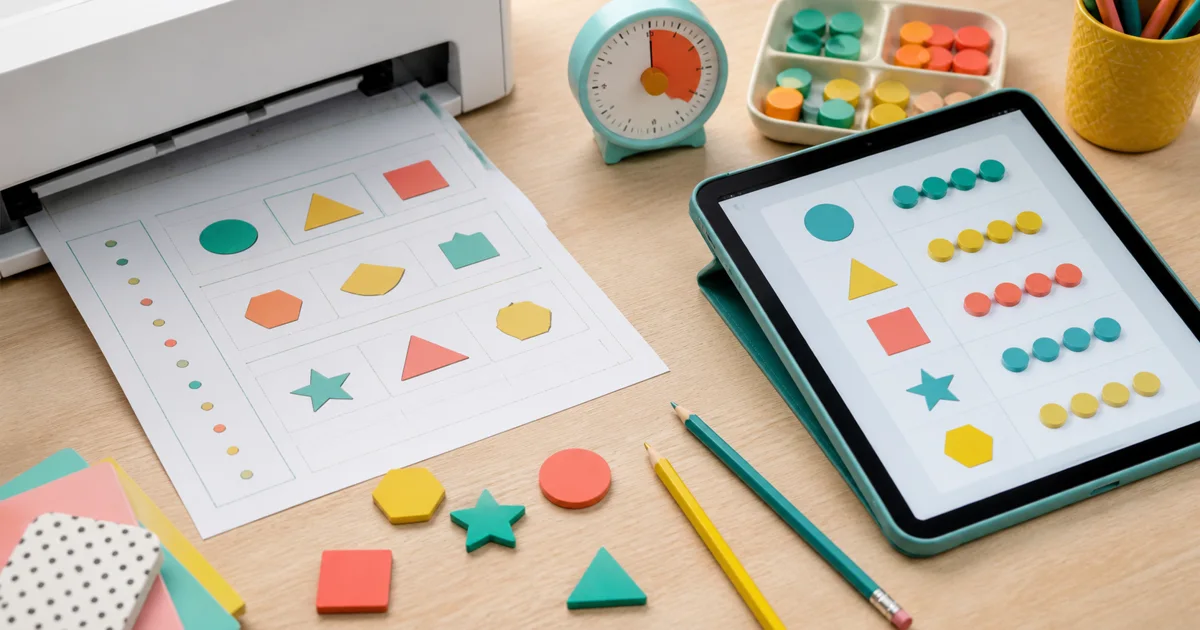
Build a 15-minute routine that children can sustain
Use two minutes to name the goal and review one example. Spend eight to ten minutes on focused practice. Use the final three minutes to review one success, one error, and the next step.
Stop before attention collapses. If a learner understands after six questions, end the page or switch to a practical application. If the first two questions reveal that the concept was never understood, pause the worksheet and teach with objects, pictures, or a clearer example.
A sustainable weekly rhythm might include guided practice on Monday, a short printable on Tuesday, reading or hands-on application on Wednesday, interactive retrieval on Thursday, and a brief review on Friday. Worksheets are one part of the learning week, alongside conversation, books, play, movement, and real tasks.
For Grade 1 planning specifically, use the Grade 1 worksheet guide. It separates math, reading, spelling, and practical routines instead of presenting a generic packet.
Turn wrong answers into the next lesson
Do not mark the whole page and return only a score. Look for the first point where the method stopped making sense. Ask, “Show me what you did here” rather than “Why did you get this wrong?”
Classify the error. A knowledge error means the learner does not yet know a fact or pattern. A strategy error means the chosen method does not fit. A reading error comes from misunderstanding directions or vocabulary. A recording error occurs when correct thinking is written inaccurately. An attention error may be isolated and disappear on a calm retry.
Model one closely related example, then give a fresh item. Avoid correcting every line yourself. The child needs an opportunity to use the revised idea. Save one representative error for later review rather than repeating the entire page the same evening.
An answer key confirms the expected response but cannot diagnose all of this. For open writing, explanations, or drawings, there may be several acceptable answers. Adult judgment remains part of good feedback.
Adapt the activity without removing the learning goal
Accessibility support should reduce an irrelevant barrier while preserving the intended skill. If handwriting hides mathematical understanding, allow number tiles, oral explanation, or an adult scribe. If reading the directions is not the objective, read them aloud. If visual clutter is distracting, cover part of the page and reveal one section at a time.
Other useful adaptations include larger print, extra spacing, fewer questions, a highlighter strip, a multiplication chart during new learning, or short movement breaks. Record the support so you know what the child completed independently.
CAST’s Universal Design for Learning Guidelines provide a practical reference for offering different ways to engage with information and show understanding while keeping the learning goal visible.
Do not quietly increase difficulty as a reward for finishing early. Offer a different application: ask the learner to explain a strategy, write a word problem, find an error in a sample answer, or create two new questions.
Organise completed work without building a paper mountain
Keep a small sample that shows change over time: an initial attempt, one corrected page, and a later independent example. Label each with the date, skill, and level of help. Recycle routine pages once their information has been used.
Digital progress should also be reviewed by skill, not merely time spent or activities completed. If a dashboard shows repeated difficulty, return to a concrete model or shorter guided task. If accuracy is consistently high, check transfer with a new format.
Teachers can use one folder per learning goal or a simple class checklist. Parents can keep a monthly “what I can do now” page selected by the child. The record should make growth visible without turning every worksheet into permanent evidence.
Frequently asked questions
Are free worksheets enough for a complete curriculum?
No. They can provide practice, review, and quick checks, but children also need clear teaching, reading, discussion, hands-on experience, feedback, and cumulative review. Use worksheets inside a broader plan.
How many pages should a child complete each day?
Choose by objective and attention rather than page count. One focused page—or part of one—may be enough. Stop when you have reliable evidence of understanding or when fatigue begins to distort performance.
Should every worksheet have an answer key?
Keys are helpful for fixed-response work, especially for independent checking. They do not replace looking at the child’s method, and open-ended reading or writing tasks may allow multiple reasonable answers.
Can the same worksheet work for Class and Grade labels?
Often, but not automatically. Class 1 and Grade 1 are commonly corresponding labels in India and the United States, yet sequence and vocabulary can differ. Check the actual skill, number range, wording, and school expectations.
What if my child refuses worksheets?
Find out whether the problem is difficulty, volume, unclear directions, visual overload, or prior conflict. Reduce the task, offer a meaningful choice of format, teach the missing skill, and keep the session short. A different activity may serve the objective better that day.
Where should I start in iBloom?
Browse the free worksheet library by subject and grade, choose one visible objective, and preview the activity. New users can follow the iBloom onboarding guide before assigning or saving practice.