Grade 1 Worksheets: Math, English and Reading Practice
Plan a focused Grade 1 or Class 1 week with real math, English, reading, spelling, printable, and interactive practice options.
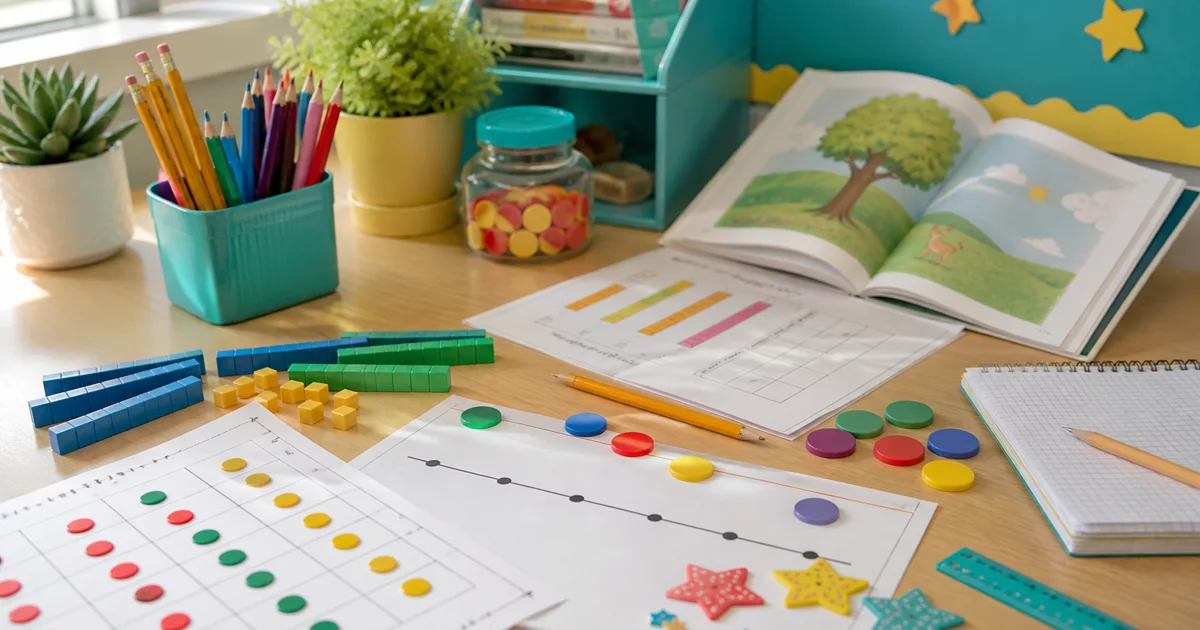
Grade 1 is where many children begin turning spoken ideas and hands-on experiences into written words, number sentences, diagrams, and independent routines. A worksheet can support that transition, but only when it follows clear teaching and asks the learner to show one manageable piece of thinking.
In India, families often use Class 1; in the United States, Grade 1 or first grade is more common. The labels broadly correspond, but entry ages, vocabulary, and curriculum order vary. Use the child’s current skill—not the label alone—to choose practice.
Take a five-minute starting-point check
Before printing a weekly packet, place three small tasks in front of the learner: one familiar item, one item from the current lesson, and one likely next step. For math, that might be counting objects, solving 7 + 5 with counters, and explaining 14 − 6. For reading, it might be decoding a short-vowel word, reading a sentence, and answering a question from a short passage.
Watch what the child does without correcting immediately. Do they understand the directions? Can they begin independently? Do they use fingers, draw, guess, or explain a strategy? The method is more informative than three ticks or crosses.
Select a worksheet where most items match the “current lesson” level. Include a small amount of review and, if the child is ready, one stretch item. If every question requires adult rescue, return to teaching with objects or spoken examples first.
The Grade 1 intermediate math worksheet page groups an existing ranking route around age, subject, and support level. Use it to find nearby practice, then confirm the exact number range and vocabulary before assigning a page.
Build number sense before chasing speed
Grade 1 math should help children see how quantities relate. Counting is not only reciting number names; a child should match one count word to one object, know that the final number tells how many, and recognise that a group remains the same quantity when rearranged.
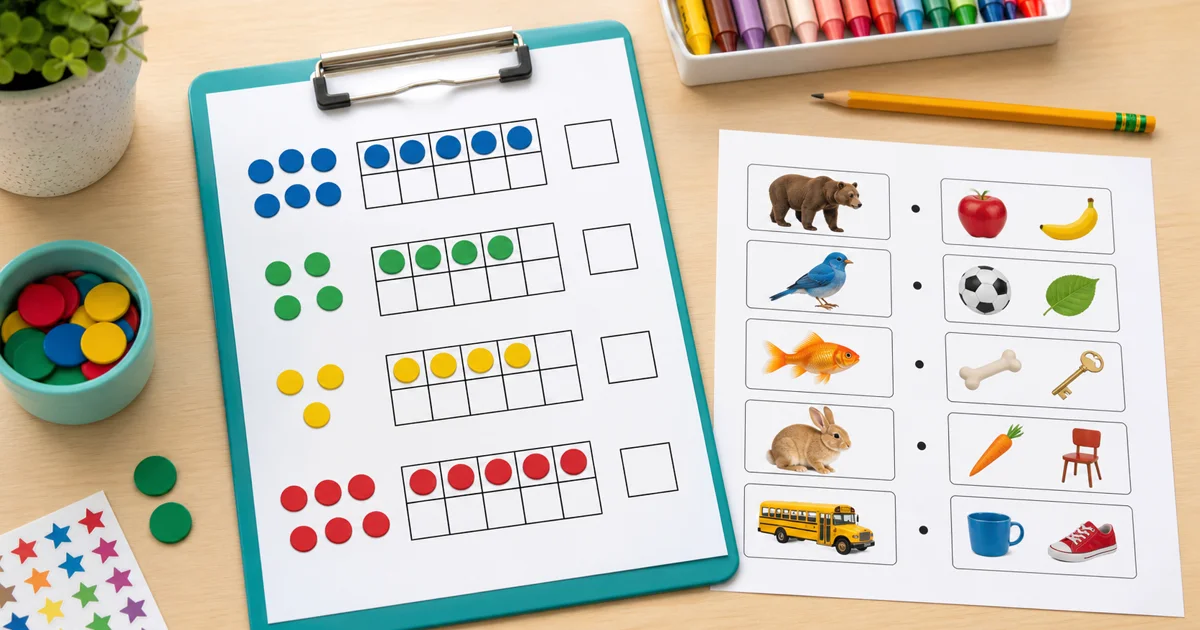
Use ten frames, counters, fingers, base-ten blocks, number lines, and drawings before expecting equations to carry the full idea. Ask, “How do you know?” A learner who sees 8 as 5 and 3 has a foundation for addition strategies. A learner who knows 14 is one ten and four ones is preparing for place value and regrouping.
Choose pages that ask children to represent numbers in more than one way: numeral, word, objects, ten frame, or tens and ones. Avoid timing early number-sense work. Fluency grows from useful relationships and repeated retrieval, not pressure alone.
The What Works Clearinghouse guide to teaching math to young children offers evidence-based recommendations for number, operations, geometry, patterns, measurement, and progress monitoring.
Browse the Grade 1 math worksheet library and narrow to the exact skill. The live library groups addition, number sense, base-ten blocks, comparisons, money, and other topics so families can avoid an unrelated mixed packet.
Teach addition and subtraction as connected ideas
Addition can mean joining groups or finding a total; subtraction can mean taking away, comparing, or finding a missing part. A worksheet that contains only bare equations may not reveal these meanings.
Begin with a short story: “There are six red blocks and four blue blocks. How many altogether?” Let the child build, draw, and then write 6 + 4 = 10. Change the story: “There are ten blocks. Six are red. How many are blue?” Now 10 − 6 = 4 and 6 + 4 = 10 describe the same part-whole relationship.
Useful Grade 1 strategies include counting on from the larger number, making ten, using doubles and near doubles, and relating subtraction to a known addition fact. Ask the learner to choose and explain a strategy before practising a row of equations.
Try a focused page such as adding two single-digit numbers with sums to 20. Preview the number range and wording first. After the page, ask for one new story problem using a completed equation.
Make place value visible
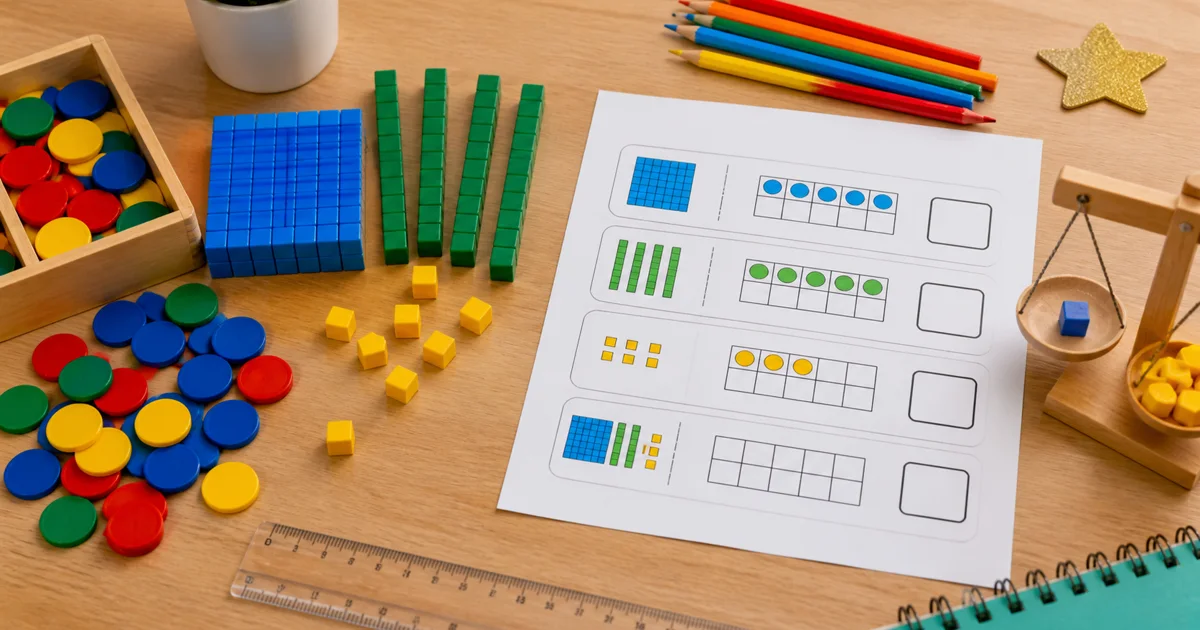
A child may read “34” correctly without understanding that the 3 represents three tens. Bundle sticks into groups of ten, fill ten frames, or use base-ten blocks. Then connect the concrete model to a drawing and finally to the numeral.
Good practice asks children to compose and decompose numbers: 27 is 2 tens and 7 ones, but it can also be 1 ten and 17 ones. Comparing 27 and 32 becomes clearer when the learner looks at tens before ones.
Watch for reversed digits and reversed place-value language. Writing 41 for “fourteen” may involve language and notation, not laziness. Say the number, build it, write it, and read it back. Keep handwriting correction separate when possible so mathematical understanding remains visible.
Include geometry, measurement, data, time, and money
A balanced Grade 1 week is not only arithmetic. Children should describe two- and three-dimensional shapes, compare and measure length, organise simple data, read age-appropriate time displays, and connect money to real situations according to their curriculum.
For geometry, ask about attributes: number of sides, corners, faces, edges, curved surfaces, and whether a shape can roll or stack. Use household objects before a picture-only page. Then try a focused 3D shapes worksheet to connect objects with representations.
For measurement, compare objects directly before introducing standard units. For data, survey family members about fruit or colours, make a tally, and answer questions from the graph. For money, use the currency and coins relevant to the child’s location; an Indian or UAE learner should not be expected to infer unfamiliar US coin values from pictures.
Strengthen phonics and word reading
Grade 1 reading practice should help children connect sounds with letters, blend words, recognise common patterns, and read increasingly fluent sentences. Begin from the phonics sequence used by the school. Random worksheets can introduce patterns before the learner has the necessary sound knowledge.
Ask the child to read the directions and examples aloud when appropriate. For a word sort, say every word and explain unknown vocabulary first; otherwise the activity may test picture recognition rather than decoding.
Useful tasks include matching a word to a picture, building words with letter tiles, changing one sound at a time, sorting by vowel pattern, and finding the target pattern in a sentence. After completing a page, choose two words and write a new sentence.
Use English worksheets for targeted phonics, grammar, and vocabulary practice. For spelling retrieval in a game format, iBloom SpellBee can add variety, but keep reading and writing in the routine.
Reading Rockets’ overview of phonics instruction explains why explicit, systematic sound-letter teaching should connect to real reading rather than remain an isolated worksheet exercise.
Move from reading words to understanding text
Accurate decoding is necessary, but comprehension requires language and thinking. Choose a short passage the child can mostly read, then ask one question about stated information and one question requiring an inference.
“What did Mina carry?” checks retrieval. “Why do you think she packed an umbrella?” asks the child to connect clues. Have the learner point to the words or picture that support the answer. Oral explanation is appropriate when writing would hide reading comprehension.
Before reading, preview only vocabulary necessary to understand the passage. During reading, allow the child time to solve unfamiliar words. After reading, retell the beginning, middle, and end or name the main topic and one detail.
A comprehension worksheet should not contain a passage far harder than the questions. If the adult has to read every sentence, be clear whether the activity is testing listening comprehension rather than independent reading.
Develop sentences without turning writing into copying
First graders need opportunities to say an idea, rehearse it, write it, and reread it. A sentence worksheet can focus on capitals, spacing, punctuation, word order, or adding detail—but should not demand perfection in every area simultaneously.
Use a picture or shared experience as a prompt. Ask the child to say one complete sentence. Count the words on fingers, write, and then check: Does it begin with a capital? Are spaces visible? Is there an ending mark? Does it make sense when read aloud?
Copying a model can teach letter formation and conventions, but original composition reveals whether the child can generate language. Alternate the two. If spelling uncertainty stops writing, help with a few words or provide a small word bank while preserving the child’s sentence.
Plan a realistic Grade 1 week
A useful home plan fits around school and family life. It does not reproduce a full classroom after dinner.
Monday: review a secure math fact relationship and read a familiar book. Tuesday: teach one new idea with objects or examples. Wednesday: complete a short printable connected to that teaching. Thursday: revisit one error in a different form and use a brief interactive activity. Friday: apply the skill in a game, story, cooking task, shop activity, or quick check.
Keep focused worksheet time around ten to fifteen minutes for most learners, with a break or format change when needed. End by asking, “What did you figure out today?” Save one example that shows growth rather than every completed page.
Open interactive digital worksheets when immediate feedback supports the goal, and the broader parent worksheet guide when choosing between formats.
Respond when the worksheet is too easy or too hard
If the child completes every item instantly, first check understanding with an explanation or new example. Then move to application rather than simply adding more rows. Ask the learner to create a question, find two methods, or explain a deliberate mistake.
If the page is too hard, stop after one or two informative attempts. Identify the missing prerequisite, model it with objects or speech, and choose a smaller step. Splitting the same long page does not solve a concept mismatch.
Adapt presentation when the objective remains appropriate. Cover unused sections, enlarge the print, read directions aloud, allow oral answers, or reduce handwriting. Note the support provided so the next activity reflects what the child can do independently.
Review progress by evidence, not volume
Once a week, compare a recent independent example with an earlier attempt. Look for a clearer strategy, more accurate decoding, stronger sentence construction, or less prompting. Record one skill that is secure, one that is developing, and one next teaching step.
Do not interpret a single poor day as regression. Fatigue, unfamiliar wording, and attention can affect a result. Confirm a pattern with another example. Likewise, a perfect repeated page may show memory for that layout rather than transfer; change the numbers, wording, or format.
If you are new to the platform, the iBloom getting-started guide explains how parents and teachers can set up learners and begin a first useful practice session.
Frequently asked questions
Is Class 1 exactly the same as Grade 1?
They are commonly corresponding labels in India and the United States, but ages, terminology, and curriculum order vary by school and country. Match the activity to the taught skill and local expectations.
How long should a Grade 1 worksheet session last?
Often ten to fifteen focused minutes is enough. Stop sooner if the objective is demonstrated or frustration rises. A brief review on another day is usually more useful than extending one tired session.
Should first graders complete worksheets independently?
They can complete familiar practice independently after directions are clear. New material needs modelling and guided examples. Tell the child whether help is allowed so the purpose of the activity is honest.
What if handwriting makes math take too long?
When the objective is mathematical reasoning, allow counters, number tiles, pointing, oral answers, or an adult scribe. Schedule separate short handwriting practice rather than letting letter formation hide number understanding.
Do Grade 1 children need timed math pages?
Not as a default. Build accurate strategies and number relationships first. Brief fluency checks may be used carefully when the child understands the facts, but speed should not replace reasoning or create avoidable anxiety.
How do I know when to move to Grade 2 work?
Look for accurate, independent use of the relevant Grade 1 skill across different examples and after time has passed. Advance by topic rather than moving every subject at once, and continue occasional review of previously difficult ideas.