Gamified Learning for Kids at Home
Turn reading, maths, spelling, and creative practice into short home learning quests with age-based ideas and a free printable activity board.
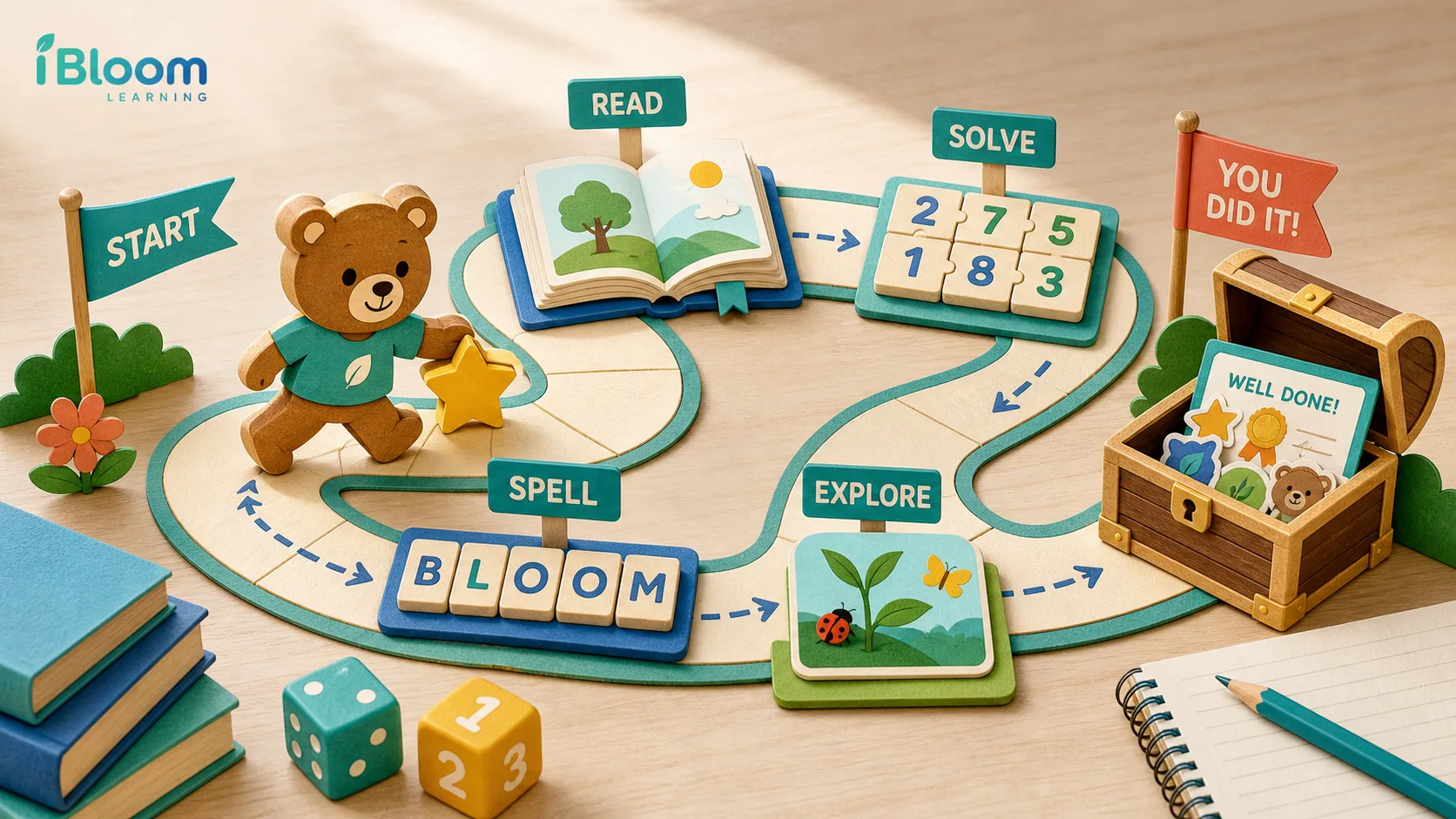
Gamified learning uses selected game elements, such as a goal, choice, progress path, challenge, or feedback, inside a learning task. At home, the best version is small: a child chooses a short quest, completes the academic action, records evidence, and stops. The game structure supports the work without taking over the lesson.
Free Home Learning Quest printable
The Home Learning Quest gives a child nine short activity choices. The learner completes five, colors a star for each one, and records a favorite task, one thing learned, and a next challenge. The mix includes reading, maths, spelling, storytelling, sorting, explaining, observation, error correction, and learner choice.
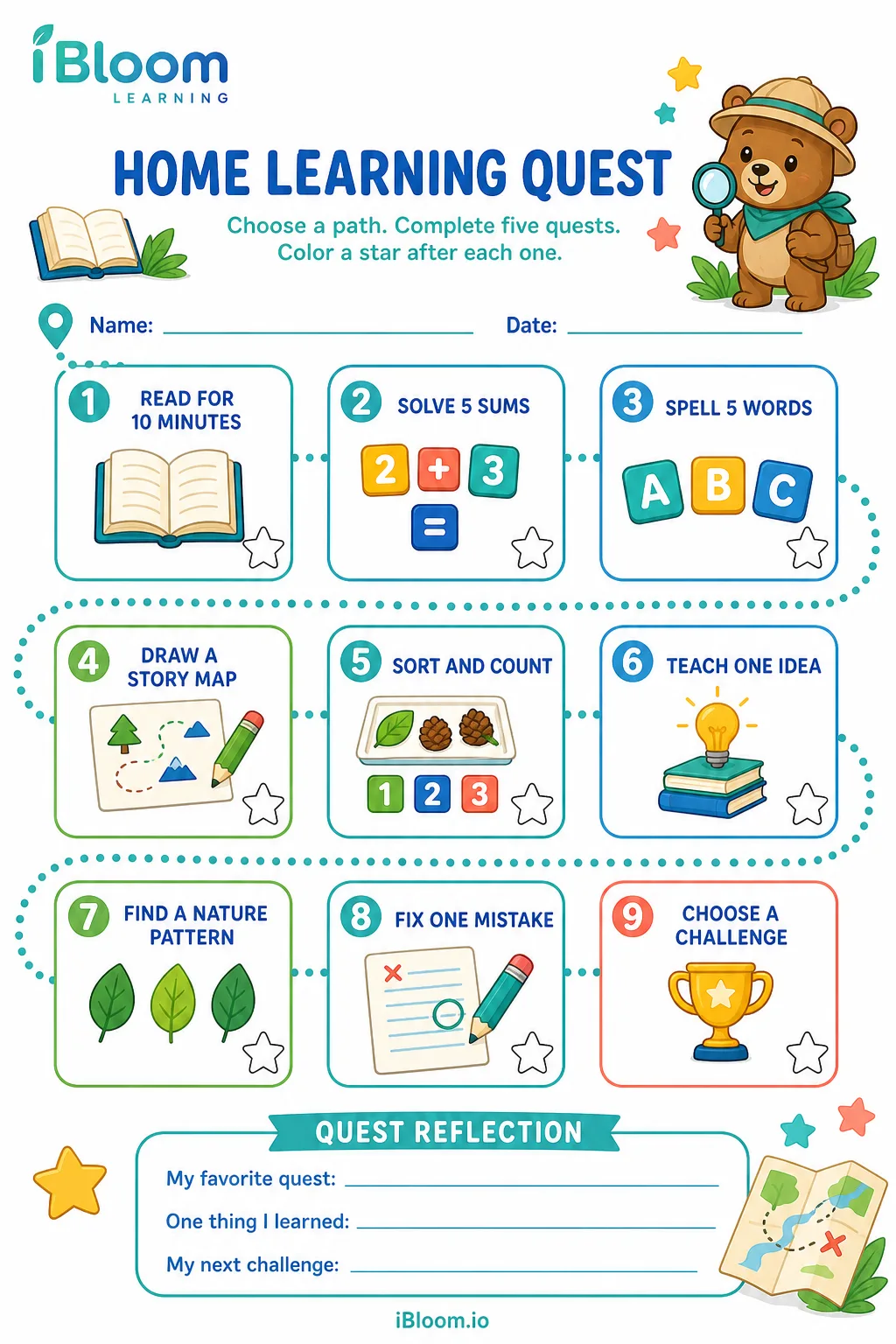
Download the free Home Learning Quest PDF
The board works with books, paper, pencils, counters, and household objects. It has no answer key because each family selects the reading material and problems. Pair it with a page from the free printable worksheet library when a quest needs structured practice.
Gamified learning and game-based learning are different
Game-based learning uses a game as the learning activity. A child may practise addition through a board game or explore vocabulary through a word game. Gamification adds a game element to another task. A reading log can become a map with five stops. A set of maths questions can become three levels with a choice of order.
Research does not support one universal promise about points or badges. A systematic review of gamification in K-12 education found varied designs and outcomes. A systematic review and meta-analysis of game-based learning in early childhood reported preliminary support for cognitive and engagement benefits while noting differences across studies. The design of the activity and the match to the learning goal matter.
At home, you can avoid inflated claims and watch the learner. Does the child read, solve, spell, explain, or build? Can the child show what changed? If the answer is yes, the game structure serves a purpose.
Build a home learning game in five parts
1. Name the learning action
Choose a verb that you can observe: read, count, compare, spell, explain, draw, sort, measure, or revise. “Earn ten stars” names the reward. “Explain two ways to make 20” names the learning.
Write the action on the quest card. Keep it small enough for one sitting. A young learner may match six letter sounds. An older learner may solve four fraction comparisons and explain one.
2. Offer a useful choice
Choice can change the order, material, or response format. The child might choose reading before maths, counters before a drawing, or an oral explanation before a written sentence. Keep the skill stable so the choice does not remove the intended practice.
Two options are enough. A large menu can consume the time set aside for learning.
3. Make progress visible
Use five spaces on a path, three level cards, or one star beside each completed activity. Visible progress helps a child understand the beginning and end of the session.
Do not reset the whole board after one missed answer. A wrong answer belongs inside the task. The child can use the Mistake Detective worksheet to inspect it and continue.
4. Give immediate task feedback
Feedback should tell the child something about the work. A matching card can reveal the correct pair. An answer key can support a check after the attempt. An adult can ask the child to demonstrate a counting strategy.
A sound, animation, or sticker can mark completion, but it cannot explain why an answer works. Keep informational feedback close to the question.
5. End with evidence
Ask the child to save one solved problem, read a sentence aloud, teach the rule, show a model, or write one reflection. The evidence lets you see whether the child completed a learning action rather than moving tokens.
Nine home quests with no special equipment
Read for ten minutes
Let the child choose a book at a suitable level. After reading, ask for one character action, fact, or question. A beginning reader can point to a repeated word or letter pattern.
Solve five sums
Select one focused set, such as addition within 20 or multiplication by 4. The child can choose counters, a number line, or written steps. End with one explanation.
Spell five words
Say each word without showing it. The child writes the word, checks it, and marks the tricky part. The Spelling Bee word practice guide includes grade-based routines and a printable study pack.
Draw a story map
Use three boxes for beginning, middle, and end. The child draws the main event in each box, then tells the story using the pictures.
Sort and count
Sort buttons, blocks, leaves, or toy pieces by one property. Count each group and compare which has more, fewer, or the same number.
Teach one idea
The child explains a rule to a toy, mascot, sibling, or adult. Ask for an example and a non-example. Teaching exposes missing steps without adding a quiz.
Find a nature pattern
Look for repeating colors, shapes, symmetry, leaf arrangements, or number patterns outdoors. Record one observation with a drawing or sentence.
Fix one mistake
Choose a completed task with an error. The child circles the exact point, explains the change, and tries one related problem.
Choose a challenge
Let the child raise the difficulty in a controlled way: add one larger number, use a longer word, read one extra page, or explain the answer in a second form.
For more offline choices, use the seven screen-free learning activities. Those activities can replace any square on the quest board.
Adjust the board by age
Pre-K and kindergarten
Use ten-minute sessions and concrete objects. Count to ten, match uppercase and lowercase letters, retell a familiar story, or sort by color and shape. An adult reads the quest aloud and records the reflection.
Grade or Class 1 and 2
Use five short quests across two or three days. Include reading aloud, addition or subtraction, phonics or spelling, and one creative task. Ask the child to color a star after showing the work.
Grade or Class 3 to 5
Increase the reasoning, not the decoration. Ask for written steps, evidence from a text, two solution methods, or a short explanation of an error. Older learners can design one fair quest for the next week.
Rewards that do not crowd out the goal
Start with progress, choice, and feedback before adding prizes. A star can show that a quest is complete. It does not need to convert into money, sweets, or screen time.
Use rewards that return attention to the activity: choose tomorrow’s book, design the next maths puzzle, pick the order of quests, or select a family game. If the child asks only about the prize, reduce the reward system and make the task shorter or better matched to the learner.
Competition needs care. Compare the child’s current evidence with an earlier attempt instead of ranking siblings. A learner can try to use fewer hints, explain one more step, or correct a repeated spelling pattern.
The confidence-building worksheet guide can help when a child avoids challenge or treats every error as a loss.
A sample three-day plan
Day 1: choose and begin
The child selects reading, spelling, and one creative quest. Set a visible timer for a short session. Color each star after the child shows the related work.
Day 2: practise and explain
Choose maths and “teach one idea.” Use a focused worksheet or five hand-written questions. The child explains one strategy to an adult or toy.
Day 3: review and choose a challenge
Complete “fix one mistake” and one outdoor observation. Fill in the reflection box. The child chooses one task to repeat next week at a new level.
This plan keeps the game small enough to manage. Families who need a steadier schedule can combine it with the daily study routine guide.
Common gamification problems
The child rushes to collect stars
Require evidence before marking a square. The child shows a page, explains a strategy, or completes the reflection. Reduce the number of quests if the session feels hurried.
The game takes longer to prepare than the lesson
Reuse one path or board. Change the task cards with sticky notes. The learning content should take most of the preparation time.
The child chooses only easy tasks
Set one required quest and let the child choose the rest. You can also label options “warm-up,” “practice,” and “challenge,” then ask for one from each group.
A sibling comparison causes conflict
Give each child a separate goal and progress marker. One child may practise letter sounds while another writes a paragraph. They can celebrate completion together without using the same score.
Screens take over the session
Use paper for the quest map and define one digital stop if needed. Close the device after that task. The homework stress guide offers additional ways to reduce friction around timing and workload.
Frequently asked questions
Does gamified learning require an app?
No. A paper path, set of cards, dice, timer, or progress chart can supply the game structure. The academic action matters more than the format.
How many points should a child earn?
Points are optional. Start with five visible spaces or stars that mark completed tasks. Add a scoring system only when it serves a clear purpose and remains easy to explain.
Can gamification help a reluctant learner?
Choice and a clear endpoint can reduce resistance. Match the task to the learner’s current skill and keep the first success within reach. Investigate the cause if avoidance continues.
Should parents use a leaderboard?
Individual progress works better for most home routines. Track the child’s use of strategies, independence, or completed challenges rather than comparing children.
A home learning quest works when the child can describe the reading, maths, spelling, observation, or correction completed along the path. Print the board, choose five squares, and keep the evidence beside the stars.