Mistake-Based Learning Worksheets for Kids
Help children study one error, explain its cause, correct the work, and test the idea again with a free printable Mistake Detective worksheet.
Free printable worksheet
Free mistake-based learning worksheet
The Mistake Detective printable gives one error enough space for a full review. A learner writes the original task and first attempt, chooses a possible cause, explains the mix-up, completes a correction, and tries one nearby question. The final check asks whether the learner can identify and explain the fix.
- Free PDF download
- Ready to print
Free to print and use at home or in class. How to use this worksheet
Mistake-based learning asks a child to study an error, explain its cause, correct the work, and try a nearby problem. A useful worksheet records the thinking between the wrong answer and the new attempt. It does more than place a red mark beside an answer.
Free mistake-based learning worksheet
The Mistake Detective printable gives one error enough space for a full review. A learner writes the original task and first attempt, chooses a possible cause, explains the mix-up, completes a correction, and tries one nearby question. The final check asks whether the learner can identify and explain the fix.
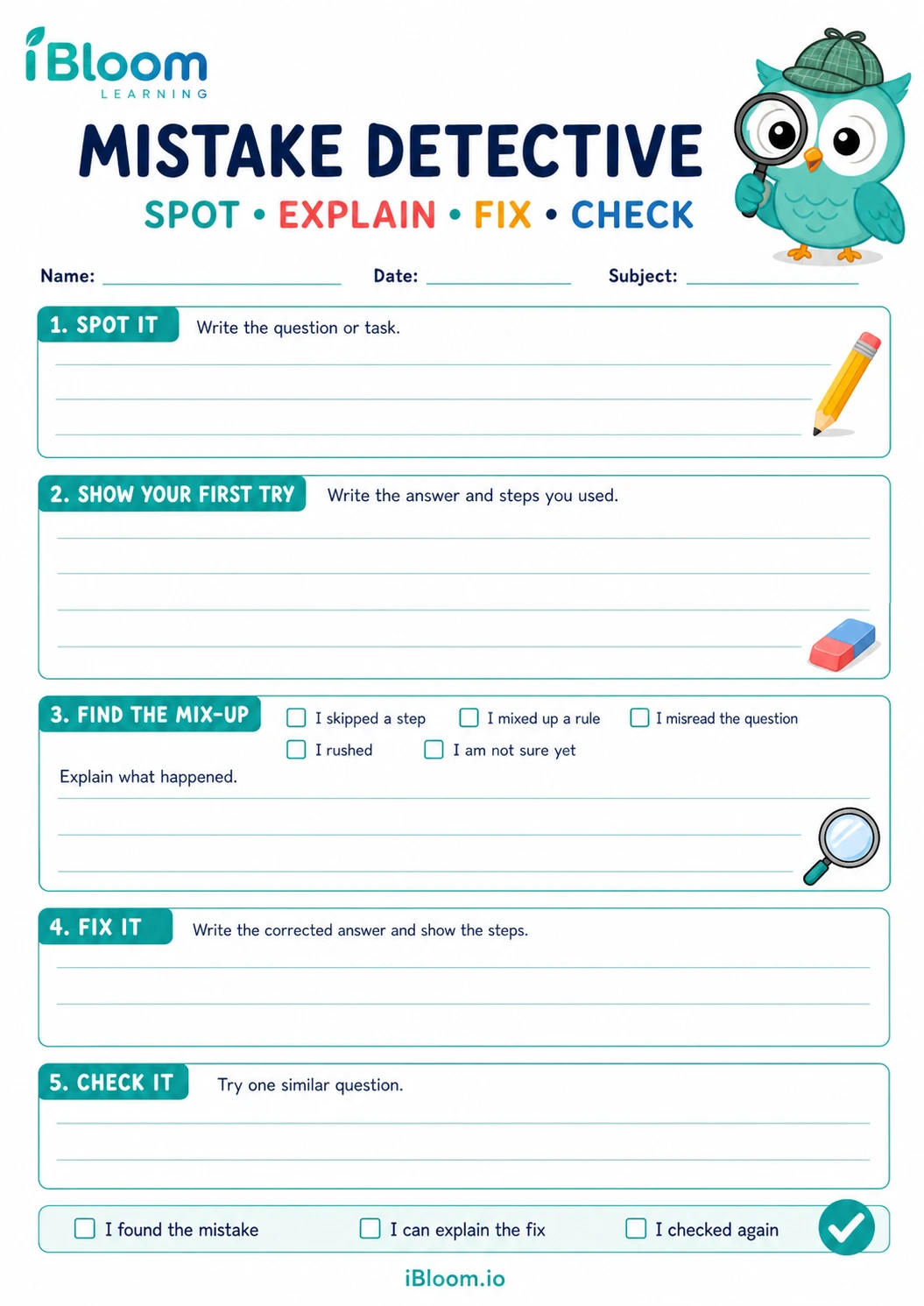
Download the free Mistake Detective worksheet PDF
The page has no answer key because the source task can come from any subject. An adult checks the correction against the original lesson, worked example, textbook, or teacher feedback. For ready-made practice to pair with the page, browse the free printable worksheet library.
What is mistake-based learning?
Children make different kinds of mistakes. A child may misunderstand a concept, choose the wrong operation, skip a step, copy a number, misread a direction, or rush through a familiar task. Those causes need different responses. Another explanation may help with a concept error. A slower check may solve a copying error. More pages of mixed practice can hide the difference.
Researchers who study learning from errors describe several conditions that help: learners need usable feedback, a chance to act on it, and an environment where an error can be examined without embarrassment. Recent experiments on self-explaining feedback also found value in asking learners to explain their problem-solving errors. The explanation is the active part. Copying a corrected answer asks much less of the learner.
A mistake-based learning worksheet turns that research into a short routine: spot, explain, fix, and check.
- Spot the exact place where the work changed course.
- Explain what the learner was thinking at that point.
- Fix the answer and show the new reasoning.
- Check the idea on one similar question.
The routine works across maths, spelling, grammar, reading comprehension, and written work. The prompt changes, but the four actions stay stable.
Use the worksheet without turning the mistake into a lecture
Start with one error that contains useful information. A random typo may need a quick correction. A repeated subtraction regrouping error deserves closer attention. Give the child the original task and a pencil, then ask, “Where did your answer start to differ from the rule or example?”
Wait before offering the fix. The child may find a copied digit, missed word, or wrong sign. If the child cannot locate the point, cover the later steps and compare the work one line at a time. You can also place a correct worked example beside the attempt and ask the child to find the first difference.
Ask for a cause that describes an action. “I am bad at fractions” cannot guide the next attempt. “I added the denominators because I forgot that the pieces must stay the same size” gives you something to teach. The cause belongs to the work, not to the child’s identity.
After the correction, change one feature of the task. A learner who fixes 43 - 18 can try 52 - 27. A learner who corrects childs to children can use children in a new sentence. A learner who misreads “least” can underline the comparison word in a second question. That small transfer check shows whether the child learned a rule or copied a repair.
Three worked examples
Maths: the operation was wrong
Question: Maya has 18 stickers and gives away 7. How many remain?
First answer: 25.
The child explains, “I saw two numbers and added them.” The correction begins with the action in the story. Giving away reduces the group, so 18 - 7 = 11. The nearby check can ask about 16 pencils with 5 given away.
Do not hide the original answer. The contrast between 25 and 11 helps the child connect the story verb to the operation. Our Class 1 subtraction word-problem guide shows how drawings and part-whole models can support that check.
Spelling: the sound was right but the pattern was wrong
First attempt: hoping written as hopping.
The child marks the doubled consonant and compares hop, hopping, hope, and hoping. The correction note might read, “The silent e returns when I remove -ing, so I do not double the p.” The nearby check uses riding or making.
Short word sets work better than a long mixed list during error review. Learners can return to the Spelling Bee practice guide for grade-based word study after they name the pattern.
Writing: the paragraph wandered from the main idea
A child writes about a rainy-day picnic, then adds two sentences about a video game. The child brackets the unrelated sentences, explains why they do not support the topic, and replaces one with a sensory detail about the picnic. The nearby check is a one-sentence summary of the revised paragraph.
The Class 3 paragraph-writing guide provides a five-part plan that makes this type of correction visible before a child rewrites the whole paragraph.
Match the prompt to the child’s age
Pre-K and kindergarten
Use pictures and oral explanations. Place two counted groups beside each other and ask the child to point to where the count changed. An adult can write the explanation. Keep the check concrete: recount with counters, match one letter, or repeat one direction.
Grade or Class 1 and 2
Offer a small list of possible causes, such as “I skipped a word,” “I chose the wrong sign,” or “I forgot a sound.” Ask for one sentence about the fix. One similar task is enough.
Grade or Class 3 to 5
Ask the learner to name the rule, strategy, or evidence used in the correction. Older elementary learners can compare two methods and decide which one makes the error easier to detect. They can also keep a short error log with categories such as concept, direction, calculation, spelling pattern, and checking.
The categories should help the learner choose a response. They should not become a scorecard of failures.
Feedback that keeps the learner thinking
Useful feedback points to the task and leaves a next action for the child. Try language such as:
- “Show me the line where you made your choice.”
- “Which word in the question guided that choice?”
- “Compare this step with the example.”
- “Explain the correction before you erase anything.”
- “Try the same idea with these new numbers.”
Avoid replacing the work with a complete adult solution. Avoid praise that has no information, such as “Good job fixing it.” Name the action instead: “You checked the operation against the story and changed your plan.”
The child may need emotional space before analysis. A tired or upset learner can mark the question and return after a break. The confidence-building worksheet guide offers a small-step routine for a child who avoids a task after an error.
A weekly error-review routine
Collect no more than three errors across the week. Choose one that represents a repeated idea, one that came from a direction or checking problem, and one that the child wants to understand. Review them in a ten-minute session.
For each error, ask the child to complete the four steps, then note the next useful practice. A concept error may lead to a worked example with objects. A direction error may lead to underlining command words. A checking error may lead to an estimate or inverse operation.
Use the complete worksheets-for-kids guide to choose practice with a clear purpose. Twenty new questions do not repair a misunderstanding unless the child can identify the rule and use it.
Common problems and practical fixes
The child erases before explaining
Ask the child to circle the first attempt or copy it into the worksheet. The record lets both of you compare the two methods.
The child says, “I was careless”
Ask what action would have caught the error. The answer might be rereading the final sentence, checking an estimate, touching each counted object, or comparing the answer with the question.
The same mistake returns
Reduce the task. Model one example, solve one together, and let the child try one. If the learner still cannot explain the rule, return to the prerequisite idea. The elementary learning-gaps guide can help you separate missing background knowledge from a checking habit.
The correction becomes punishment
Limit the review to one meaningful error. Let the learner choose which marked task to investigate. Finish with a problem that uses the same idea at a manageable level.
Frequently asked questions
Should every wrong answer go on the worksheet?
No. Choose errors that reveal a concept, strategy, direction, or repeated checking problem. Correct small slips in proportion to their effect.
Can a child use the worksheet without an adult?
Independent learners can complete the reflection, but they still need a reliable source for checking the corrected answer. That source may be an answer key, teacher comment, worked example, or textbook rule.
How long should error analysis take?
Five to ten minutes for one error is enough for most elementary learners. Stop when fatigue replaces thought.
Does the child need to rewrite the whole assignment?
Usually no. Correct the relevant part and complete one transfer task. Rewrite a longer section only when the revision itself is the learning goal.
Mistakes become useful when a child can describe the choice, repair it, and apply the idea again. Keep the page beside completed work and use it as a thinking tool, not a record of blame.