



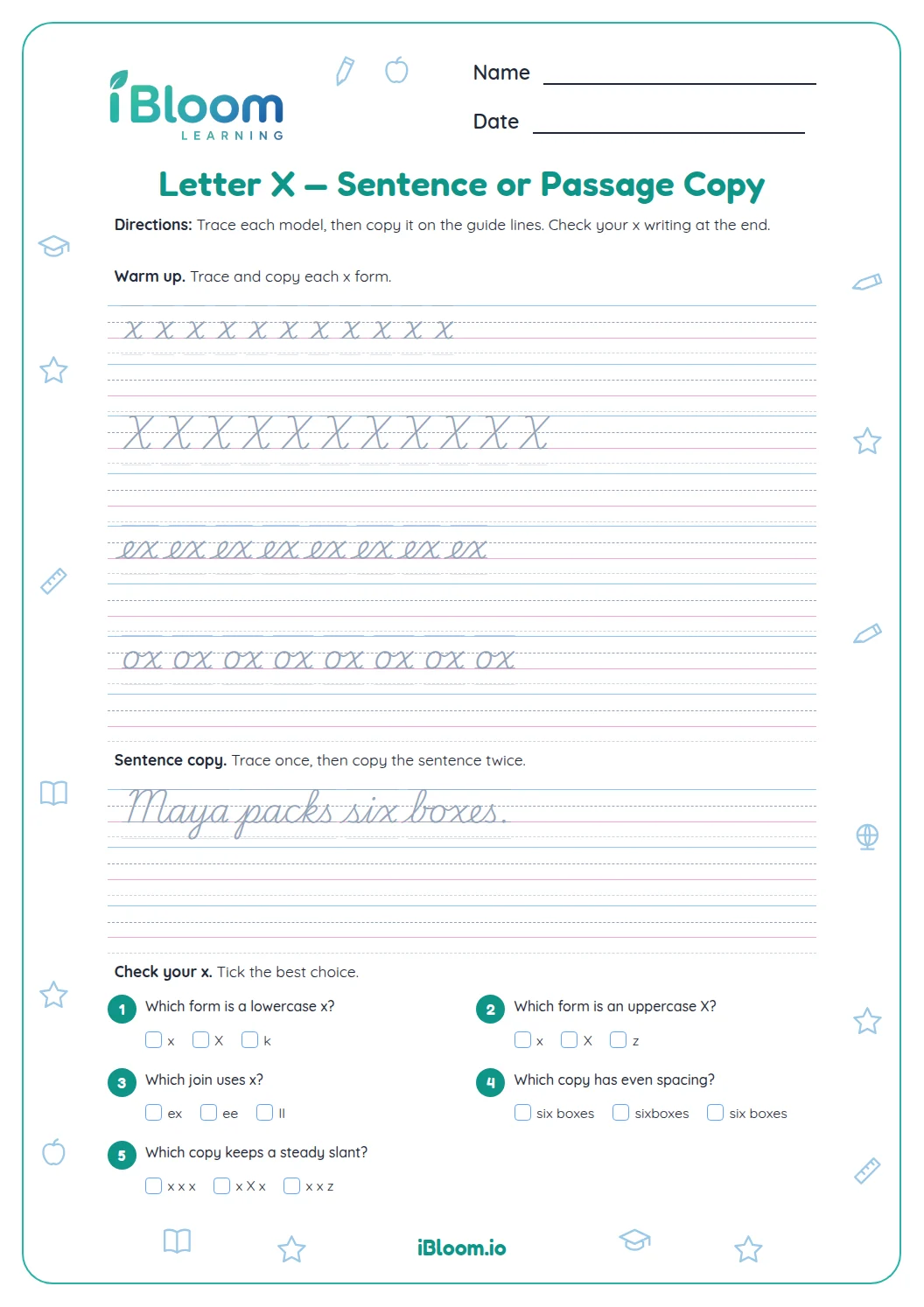
About this worksheet
This free cursive letter W worksheet gives students in Grades 2–5 fourteen practice rows. Students trace and copy capital W and lowercase w, connect w to vowels, then use w in words and a short sentence. The repeated rows add practice with familiar forms such as we, wet, win, wow, way, west, and wind. Each task has a gray row to trace and an empty row for a fresh copy. The model answer key repeats the cursive text for checking.
Which W forms are on the sheet?
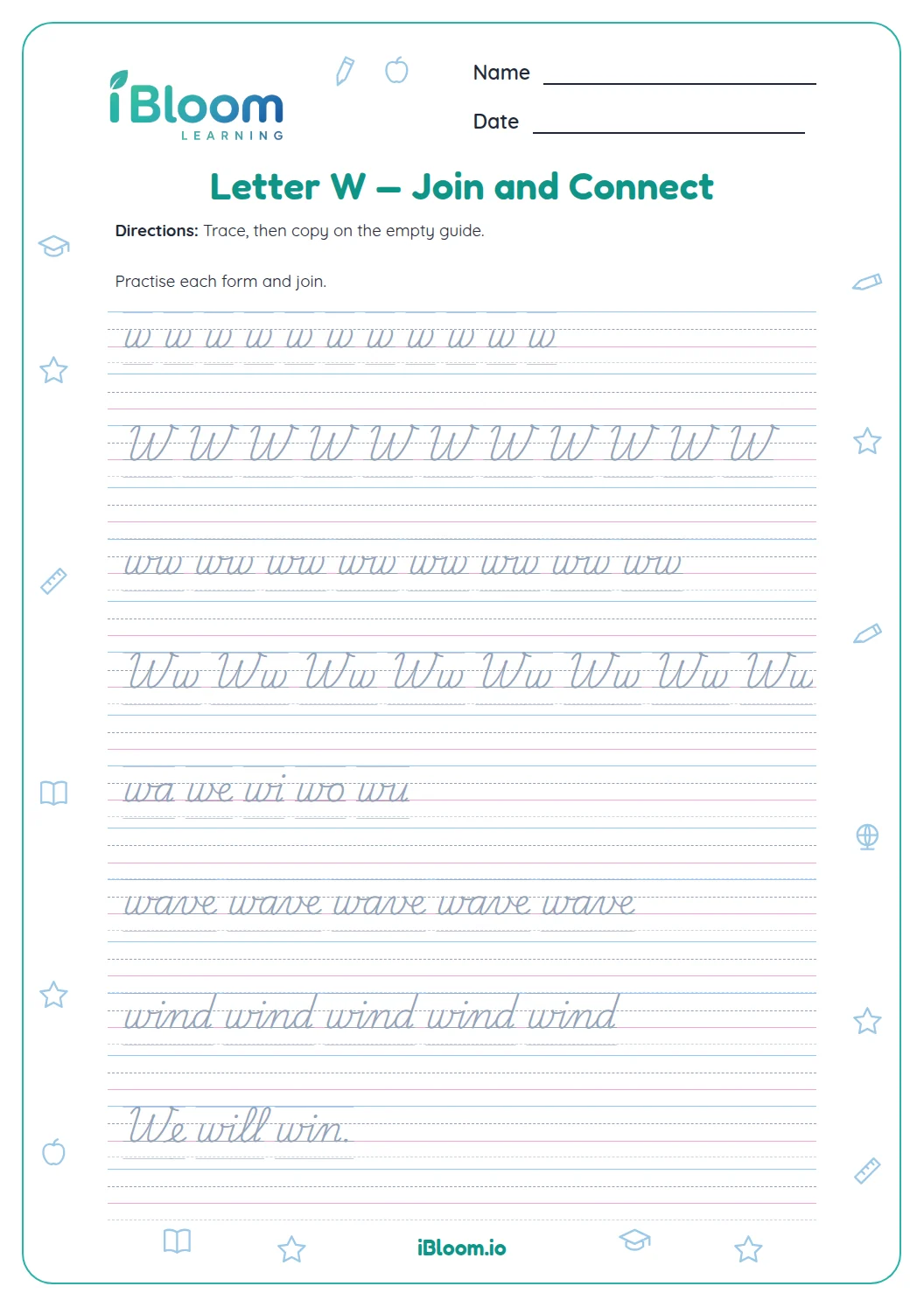
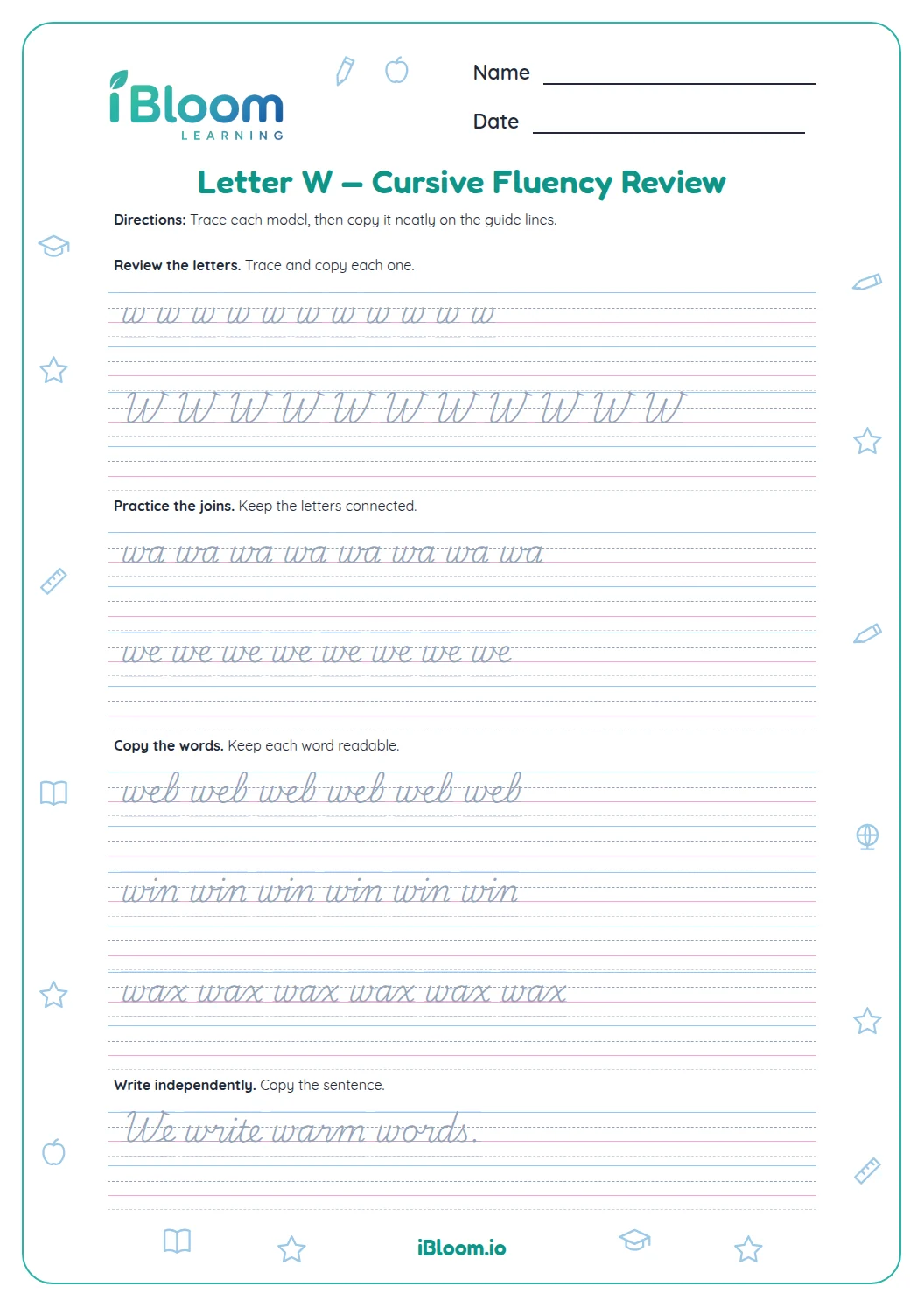
The first row models capital W three times, and the second models lowercase w three times. Later rows return to both forms before practicing wa, we, and wi connections.
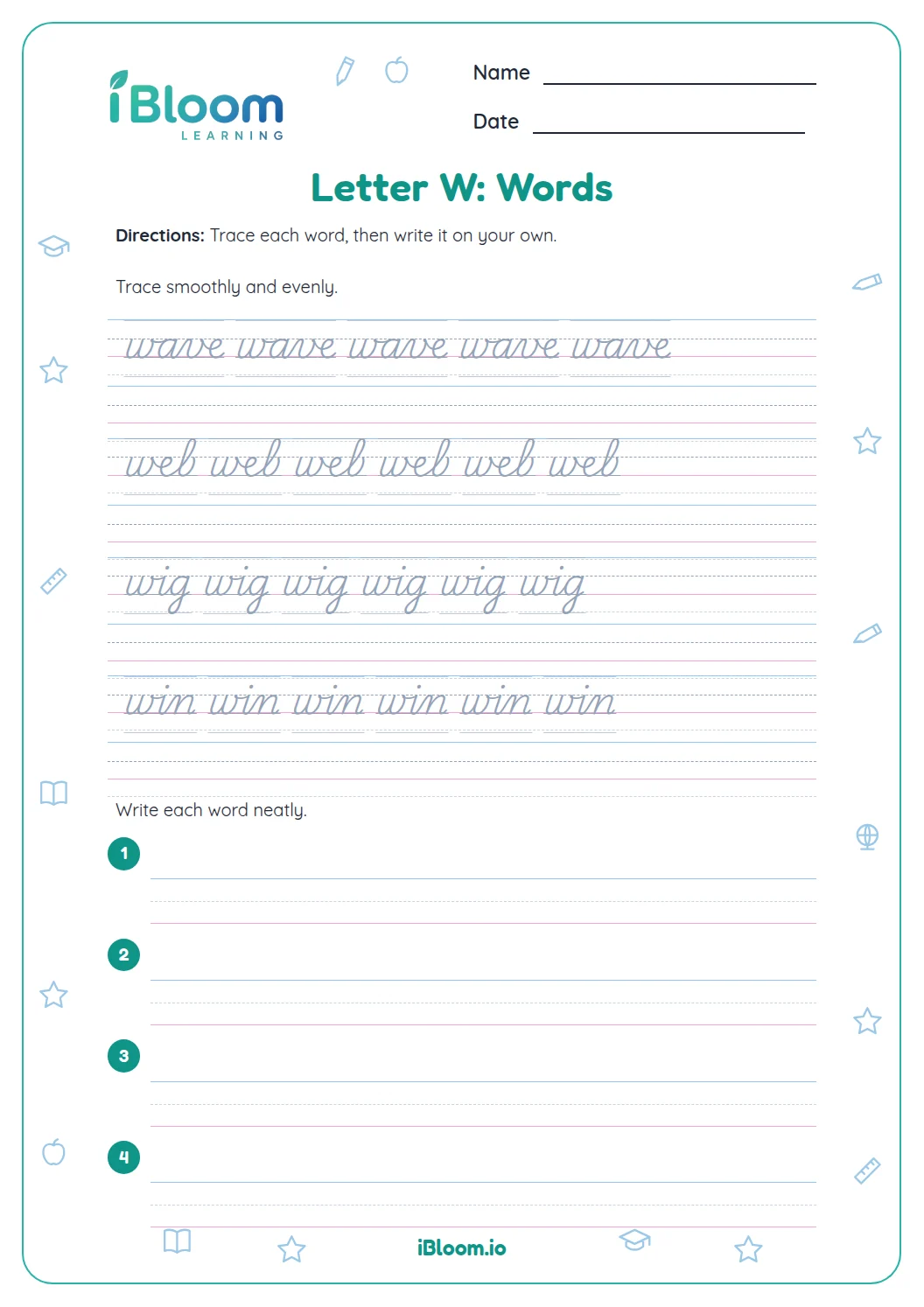
Word practice includes we, wet, win, wow, way, west, and wind, followed by “Wendy will win.” Trace each gray model before copying on the empty row.
How can an adult model the strokes?
Write one slow example next to the child on spare paper, matching the printed cursive form. Let the child watch the direction of the movement, then trace the gray letters. Follow the model’s turns and finish before starting a new letter.
After tracing, ask for a fresh copy on the empty row. Compare that copy with the model for shape and height. Repeat just one unclear letter on spare paper if another attempt would help.
How does w connect to a word?
Use the end of the w as the connection into the next lowercase letter. The we and wi practice isolate that connection before the child writes longer words. Leave a space only when the word has ended.
- 1Trace wet, keeping w, e, and t connected.
- 2Add the t crossbar after forming the word.
- 3Leave a word space, trace wet again, then copy both words on the empty row.
How to use the worksheet
- 1Compare the capital and lowercase models and notice their different heights.
- 2Watch an adult make one slow W and one slow w that match the model.
- 3Trace and copy the first two letter rows, then revisit the W and w models later on the sheet.
- 4Practice we and wi, adding the i dots after forming each group.
- 5Trace and copy each repeated w word and the final sentence; dot i and cross t afterward.
- 6Compare a lowercase w in a word with the isolated w model.
What to watch for
The mistake
Copying capital W at the same small height as lowercase w.
The fix
Compare the two model rows and use the guides to preserve the difference in height.
The mistake
Stopping after the first part of w so it looks like another letter.
The fix
Trace the entire gray form before comparing the completed copy with the model.
The mistake
Leaving a gap between w and e in wet.
The fix
Follow the connection in the join row, then carry the same movement into wet. Leave the gap after the whole word.
What to practice next
Make more practice
Questions parents and teachers ask
Are both uppercase and lowercase W included?
Yes. Part A has a capital W row and a lowercase w row, each with three examples to trace before copying. Later rows use lowercase w in joins and words. Compare the two letter models first so the child can notice their different sizes and shapes.
Why does the sheet include we twice?
The we join appears in Part B as a connection to practice, then returns in Part C as a complete word. The repetition gives children another chance to form the same connection while attending to word spacing. Each gray model is followed by a separate empty copying row.
How can I help with the correct stroke motion?
Demonstrate one slow letter on spare paper while the child watches, using the printed model as your reference. Then let the child trace the gray form and make a fresh copy. Focus feedback on one turn or connection at a time before repeating the whole letter.
When should children dot i and cross t?
After forming the connected group or word, return to add the i dot or t crossbar. The join row and win row need dots, and wet needs a crossbar. Compare the finished word with the model so these small finishing marks are included without breaking the main connection.
What should I check on the model answer key?
Check that the child copied the correct letters and words, kept the w recognizable, and left spaces between words. The key repeats the model text in cursive for comparison. A readable copy may differ slightly from the printed form; choose one specific feature to improve at a time.