
About this worksheet
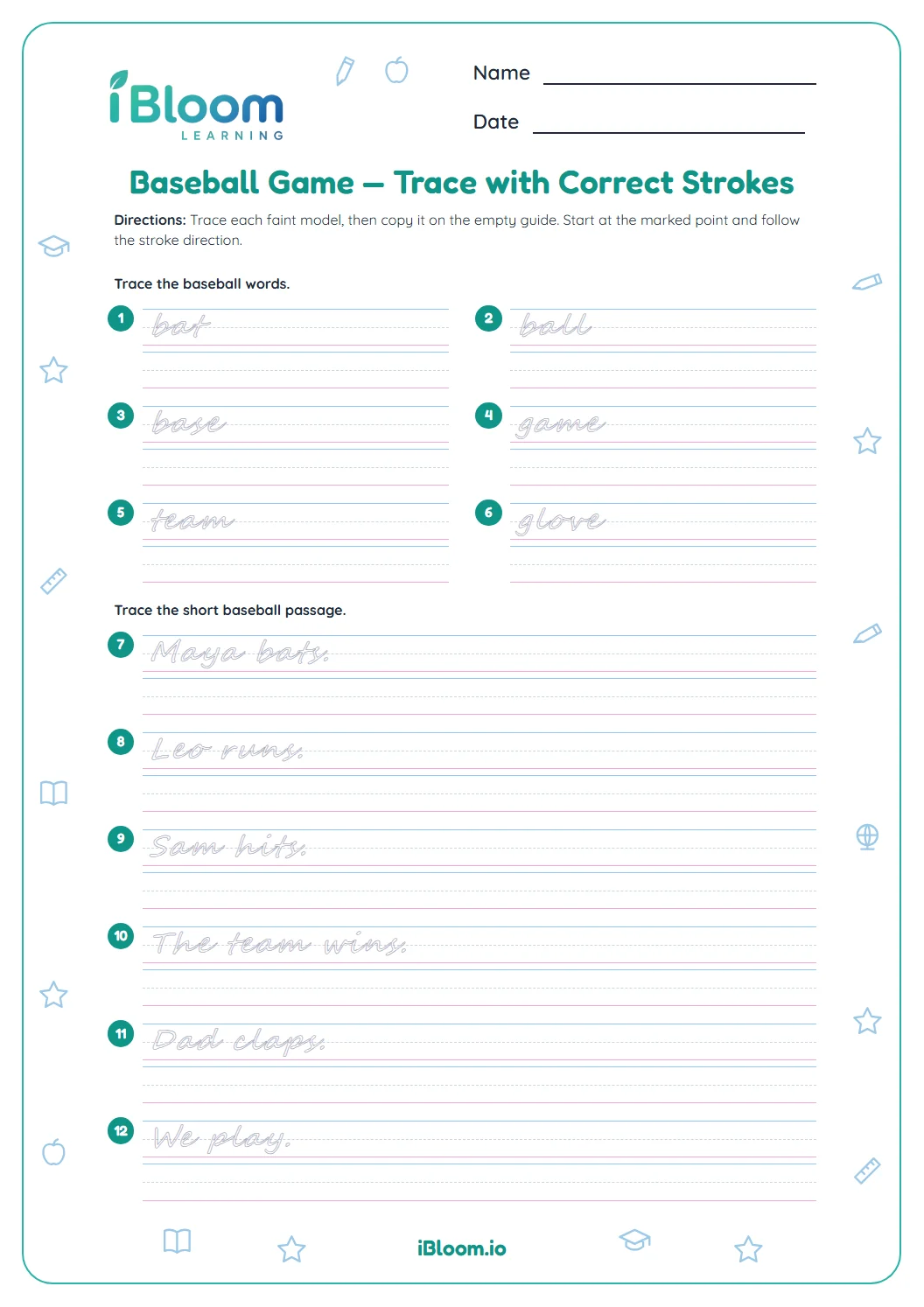
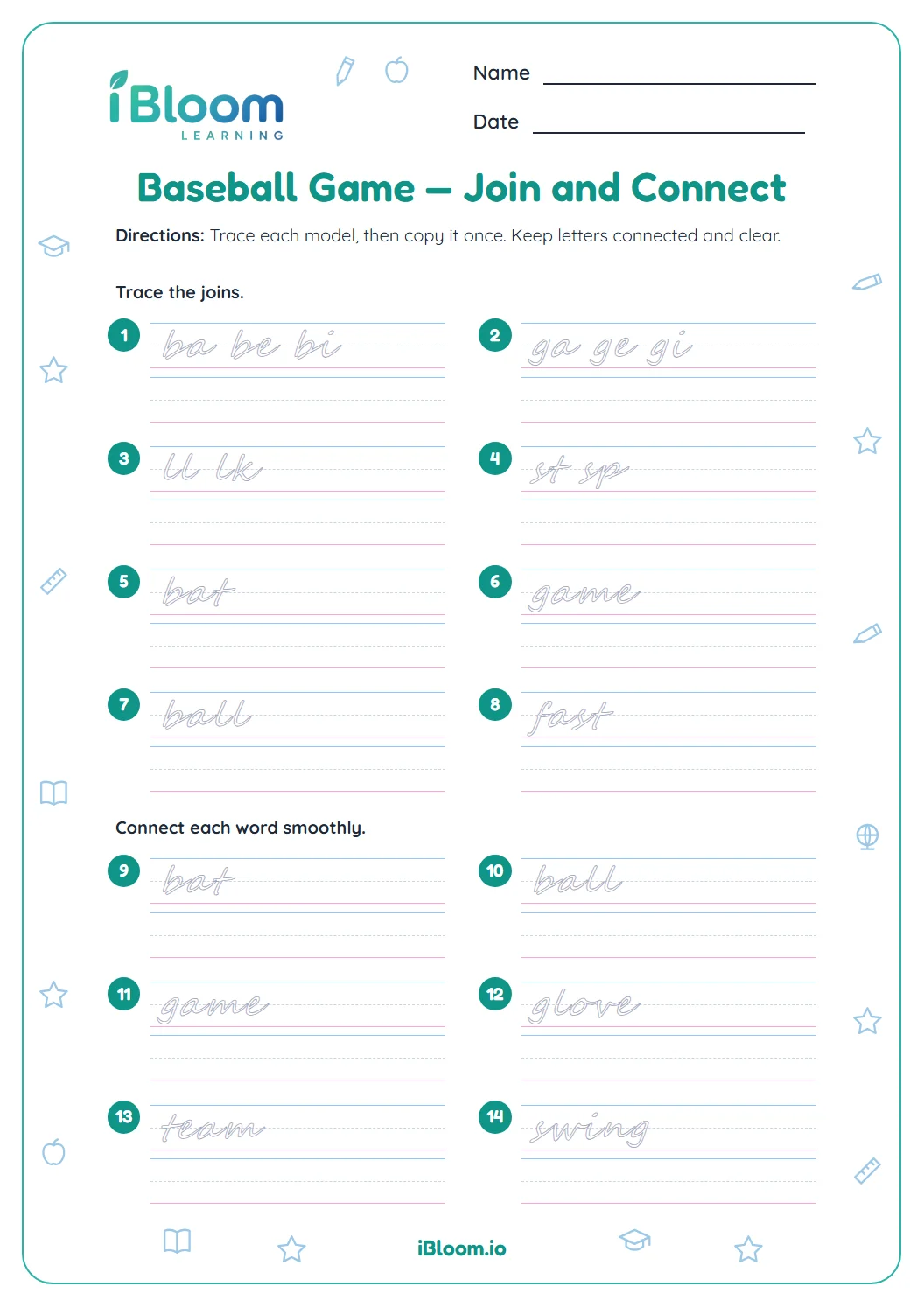
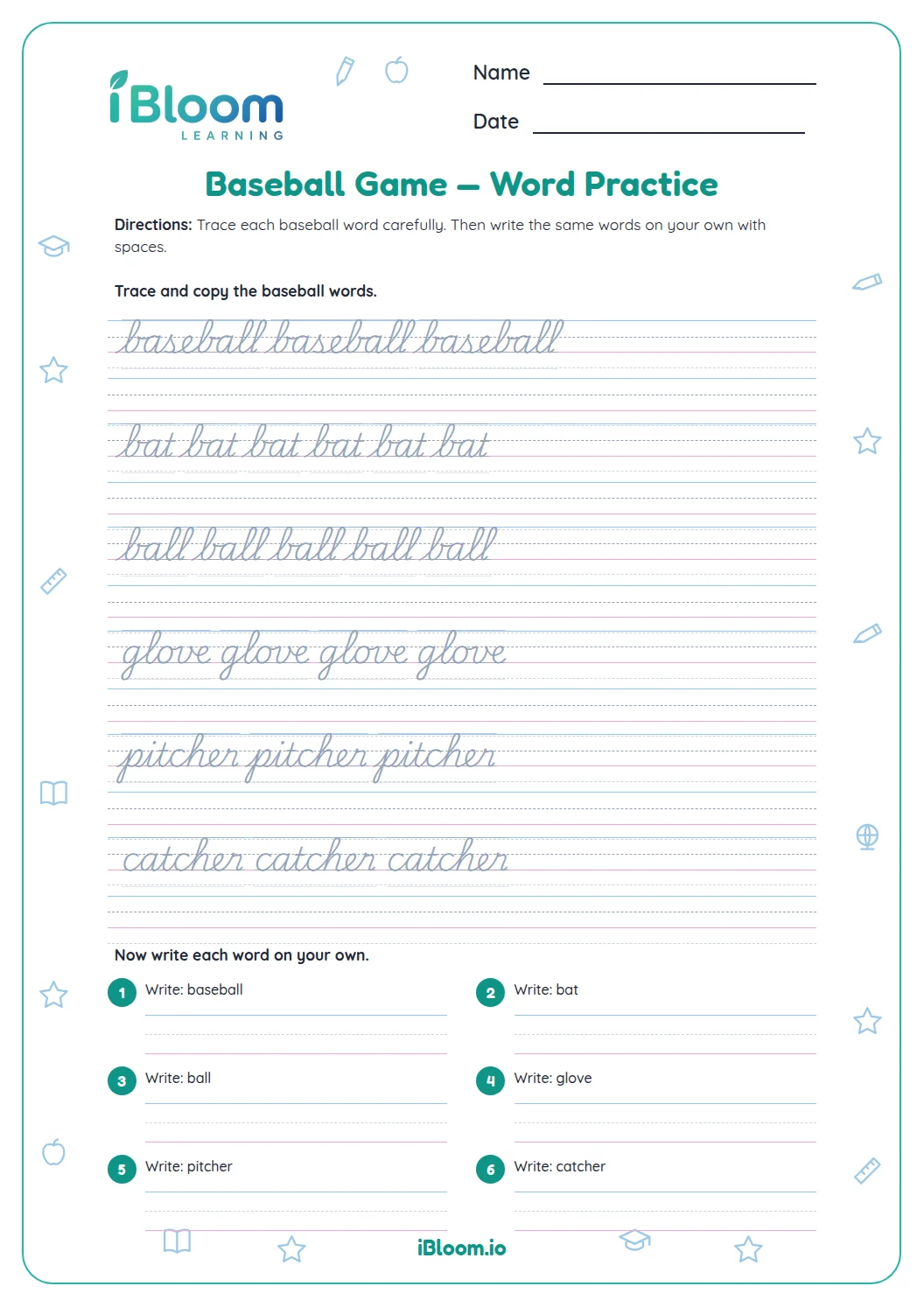
This baseball-themed cursive page gives learners 16 models to trace and copy: eight position and field words, four short sentences, and four longer game sentences. The repeated trace-and-copy format follows the old sheet’s handwriting practice while giving students a fresh set of baseball language.
Which baseball words are on the page?
Part A includes pitcher, batter, baseball, umpire, catcher, dugout, infield, and outfield. Trace each model, then copy the same word on the writing line.
How can students keep a cursive sentence readable?
Parts B and C move from short sentences to longer ones. Keep the letters connected where appropriate, leave a clear space between words, and include the capital letter and punctuation.
- 1Model: The batter hits the ball.
- 2Notice the capital T and the period.
- 3Copy the sentence with spaces between its words.
What should a learner check after copying?
Compare the copy with the model. Check that each word is spelled the same way, letters sit on the line, and the sentence begins and ends correctly.
How can you use this worksheet?
- 1Trace the gray cursive model once.
- 2Copy the word or sentence on the empty line.
- 3Keep spaces visible between words.
- 4Check capital letters and punctuation in sentences.
- 5Compare the copy with the model before moving on.
What should you check in cursive?
The mistake
Letters in a word do not join smoothly.
The fix
Slow down at each letter connection and keep the word shape clear.
The mistake
Words run together.
The fix
Leave a small space after each complete word.
The mistake
A sentence loses its capital or end mark.
The fix
Compare the beginning and final punctuation with the model.
What to practice next
Make more practice
Questions parents and teachers ask
What baseball words will students copy?
The word set includes pitcher, batter, baseball, umpire, catcher, dugout, infield, and outfield. Each appears as a cursive model to trace and copy, so the handwriting practice stays connected to the baseball game theme. Students can say each word aloud before tracing it, then compare spelling with the answer key.
Does the page include complete sentences?
Yes. Eight sentence models follow the word practice. Four are short, and four are longer, so learners can practice joining letters while keeping spaces, capitalization, and punctuation clear. The longer examples let students focus on linking words while keeping the phrase easy to read.
What does the answer key show for handwriting?
The key repeats the target words and sentences as a reference. Handwriting can vary from student to student, so use the key to check spelling and punctuation, then look for readable letter shapes and spacing. Look for correct spelling, legible letter forms, and clear spaces between words, even if the handwriting style differs.
Should a student write quickly for fluency?
No timer is needed. The directions focus on careful tracing and readable copying. A learner can first form the letters accurately, then repeat a word or sentence at a comfortable pace. Accuracy and steady letter formation are the focus; students can repeat a model after completing the page.
Which grades can use this sheet?
The source page lists Grades 2 through 5. Students can use the same models at different levels: newer cursive writers may focus on letter connections, while more experienced writers can attend to smoothness and spacing. The same set lets students work on basic connections, readable word shapes, and smooth sentence copying.