


About this worksheet
This printable cursive worksheet is for students in Grades 2–5 practicing connected handwriting with the Peter Piper rhyme. Two complete rhyme lines provide extended trace-and-copy practice. Twelve compact prompts ask students to complete rhyme words and related vocabulary, then write each answer in cursive. The answer key lists all 14 responses.
Which Peter Piper lines can students copy?
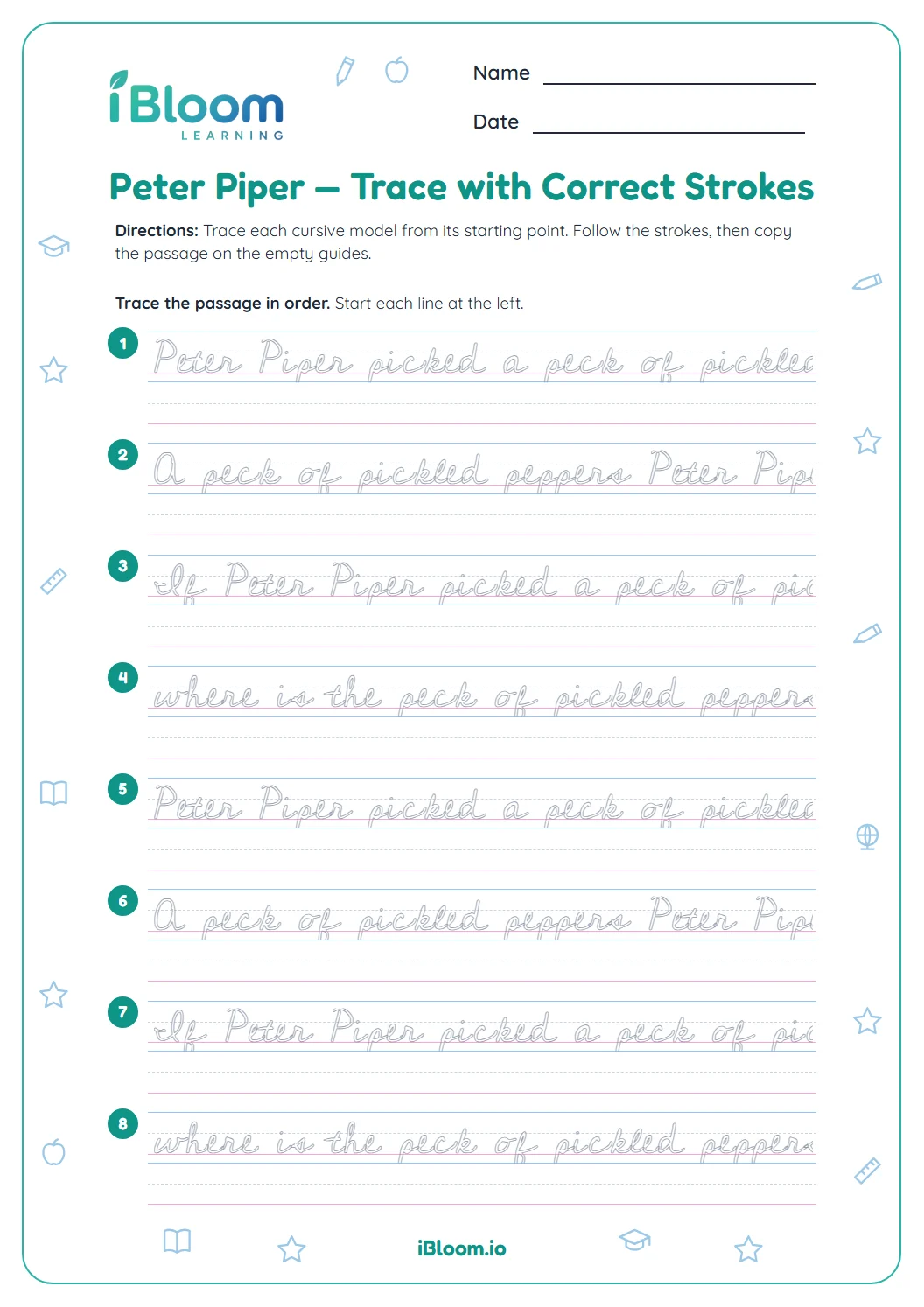
Part A presents two complete rhyme lines. Question 1, “Peter Piper picked a peck,” is a short model for tracing and copying with clear spaces between the words.
- 1Trace the complete line.
- 2Join letters within each word.
- 3Copy the line with clear word spaces.
Which rhyme words appear in the compact prompts?
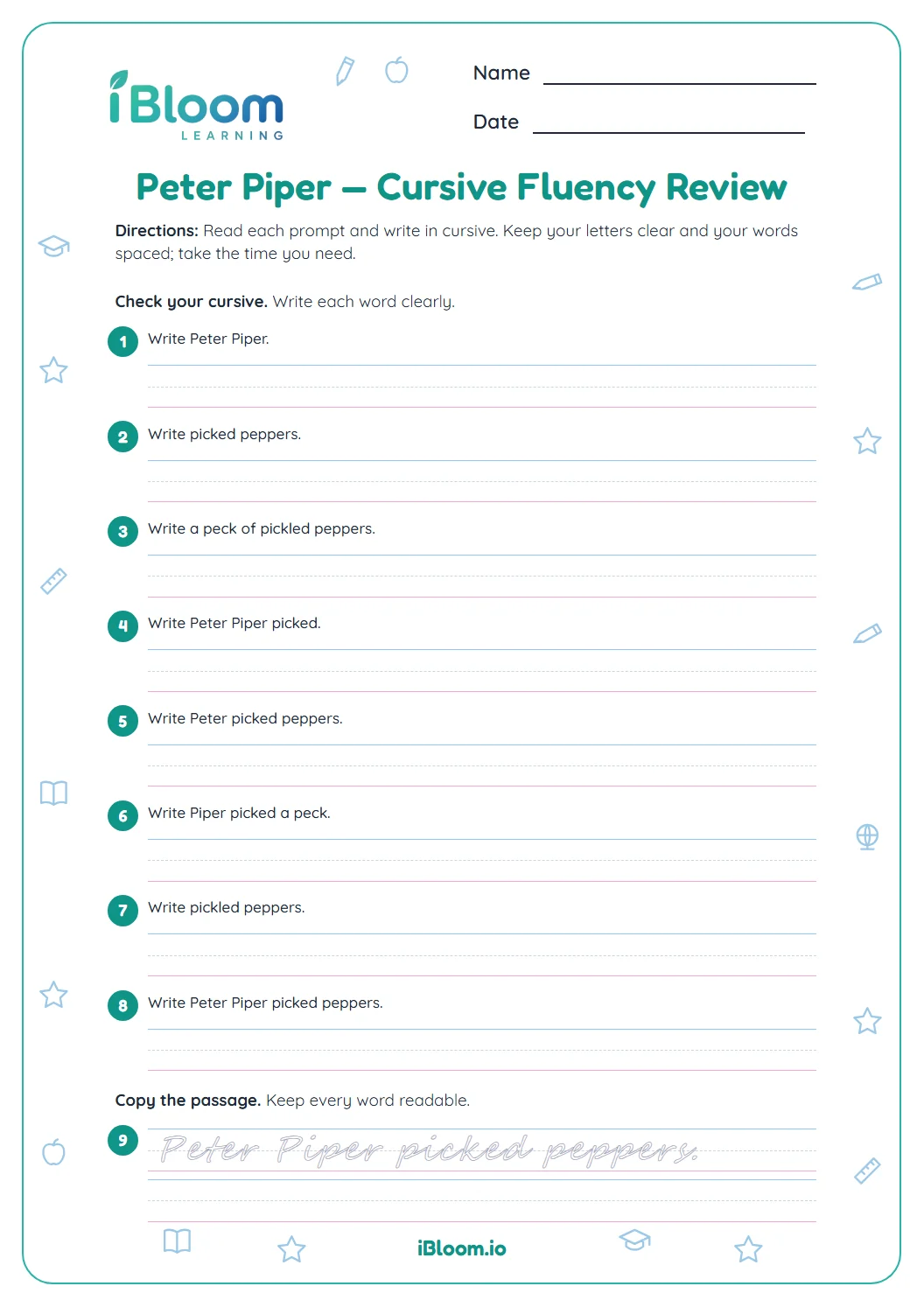
Part B completes names and words from the rhyme, including picks, picked, peck, pickled, and peppers. Students solve each short prompt and write the answer in cursive.
How can a student check the rhyme copy?
Compare each line with its model for word order, capitals, spacing, and punctuation. Use the answer key to check the short completions and spelling.
How to use this worksheet
- 1Trace “Peter Piper” as one complete phrase.
- 2Copy each short rhyme phrase with clear word spaces.
- 3Trace each complete sentence before copying.
- 4Keep letters joined inside words and preserve capitals and punctuation.
- 5Use the key to check each model’s wording.
Common mistakes and quick fixes
The mistake
Lifting between every letter so the letters do not connect.
The fix
Look for the exit stroke on each letter and carry it into the next letter where the form allows.
The mistake
Running words together without a visible space.
The fix
Leave a small word space even when the pencil stays on the page.
The mistake
Making p look like an unconnected print letter.
The fix
Trace the model slowly and follow the cursive entry and exit strokes around the descender.
What to practice next
Make more practice
Questions parents and teachers ask
What does “join and connect” mean here?
It means carrying a cursive letter’s connecting stroke into the next letter while leaving a clear space between words. This sheet uses two complete Peter Piper rhyme lines and 12 cursive word models to practice those joins in context, with a matching key.
How many questions are on the sheet?
There are 14 questions: two complete rhyme lines to trace and copy, followed by 12 cursive word models about rhyme words and related vocabulary. Students write each short answer in cursive. The answer key lists all target responses. This gives practice in longer copying and short written responses.
Which rhyme words are included?
The prompts include Peter, Piper, picks, picked, peck, pickled, and peppers, along with related words such as paper and parcel. Students complete each short prompt and write the answer in cursive, then check spelling with the key. The two complete lines repeat sounds from the familiar rhyme.
Is this a full passage copying worksheet?
The sheet uses two complete rhyme lines for extended copying and compact prompts for the remaining practice. Students still work with the rhyme’s repeated p sounds and letter joins, while the short answers keep the page within two worksheet pages.
What should I look for when checking a copy?
Check that the letters are recognizable, connections are smooth within words, and word spaces remain clear. Compare both rhyme lines with their models, then use the answer key to check the short word completions and spelling. The target text stays visible for a straightforward self-check.