
About this worksheet
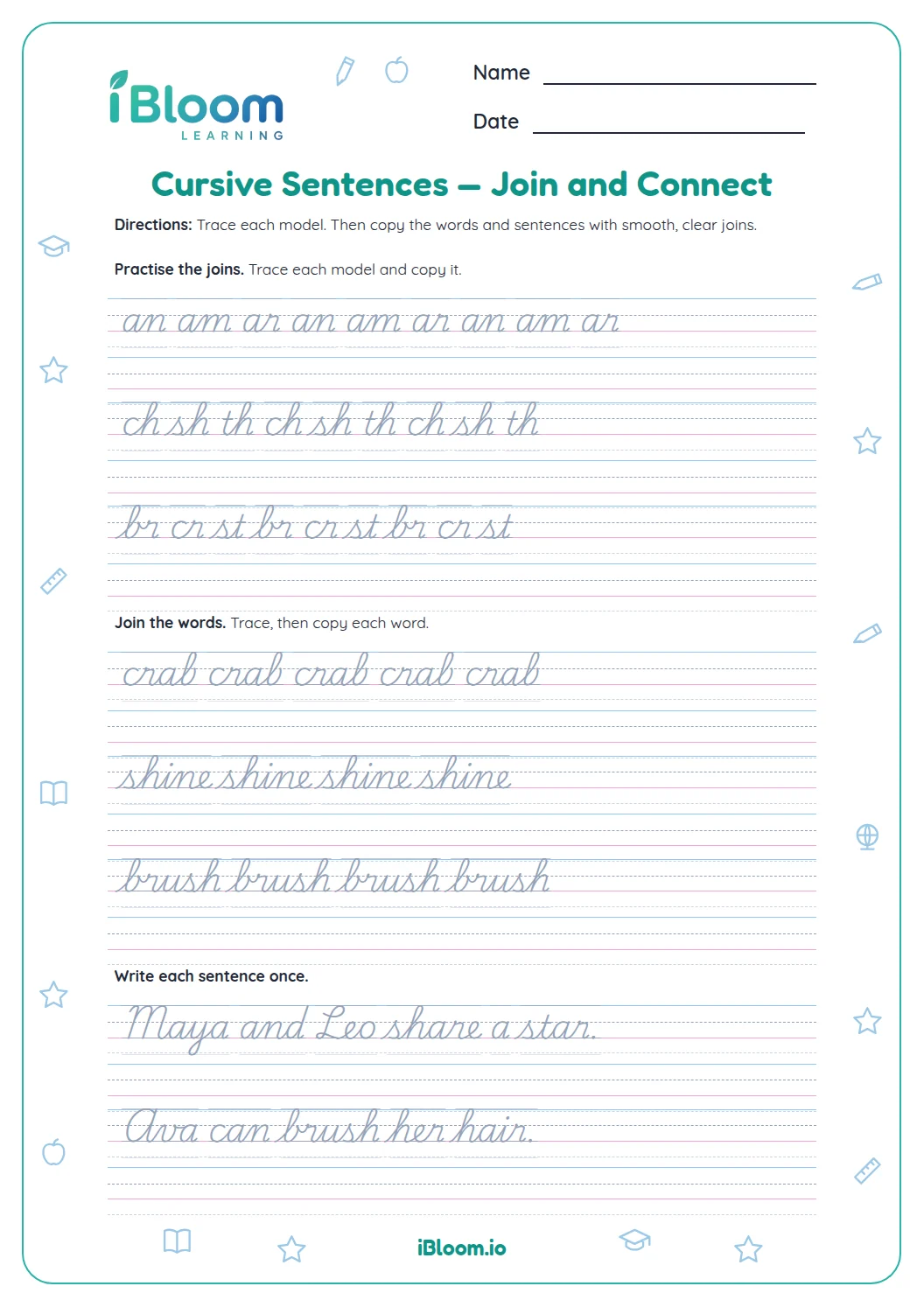
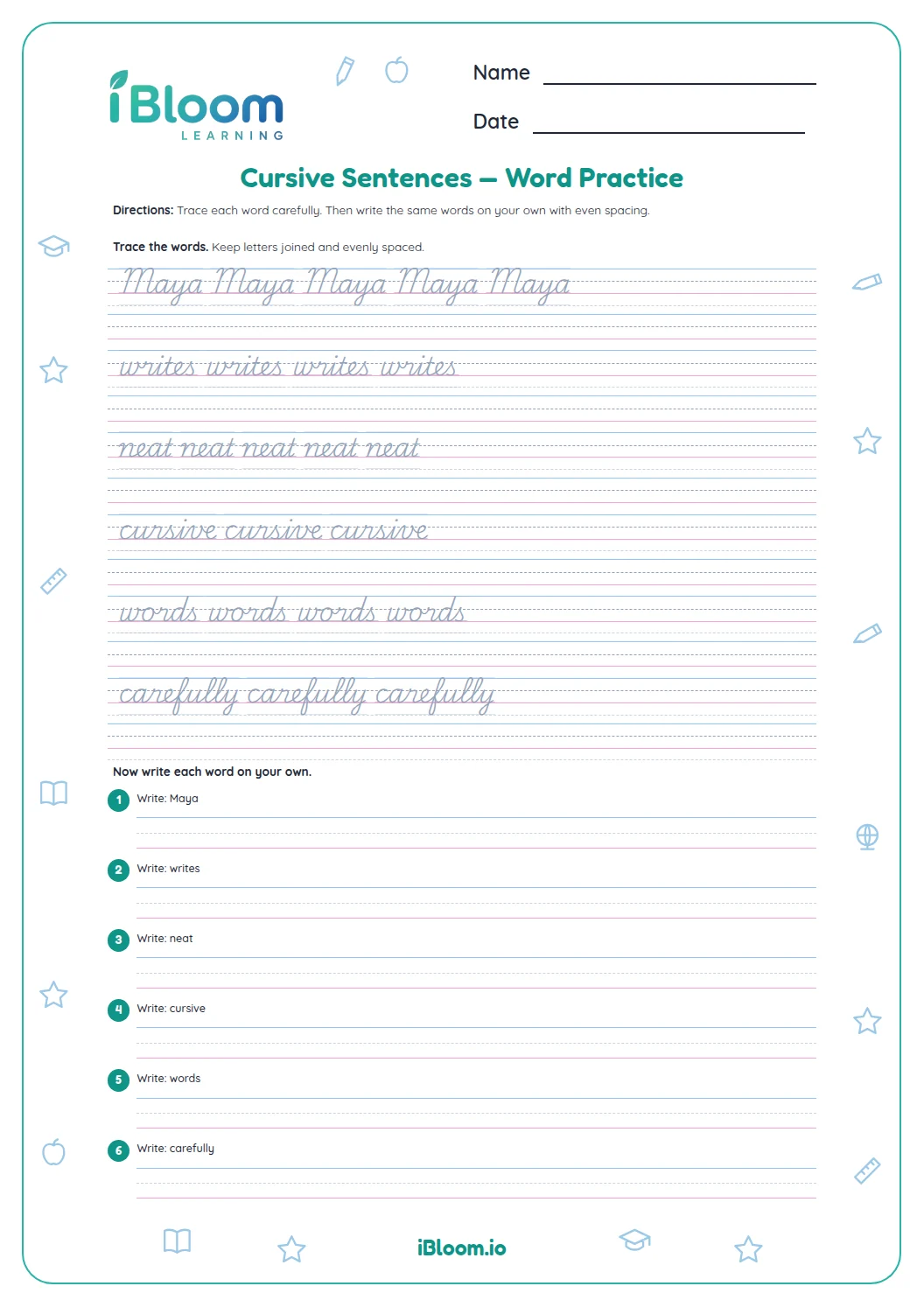
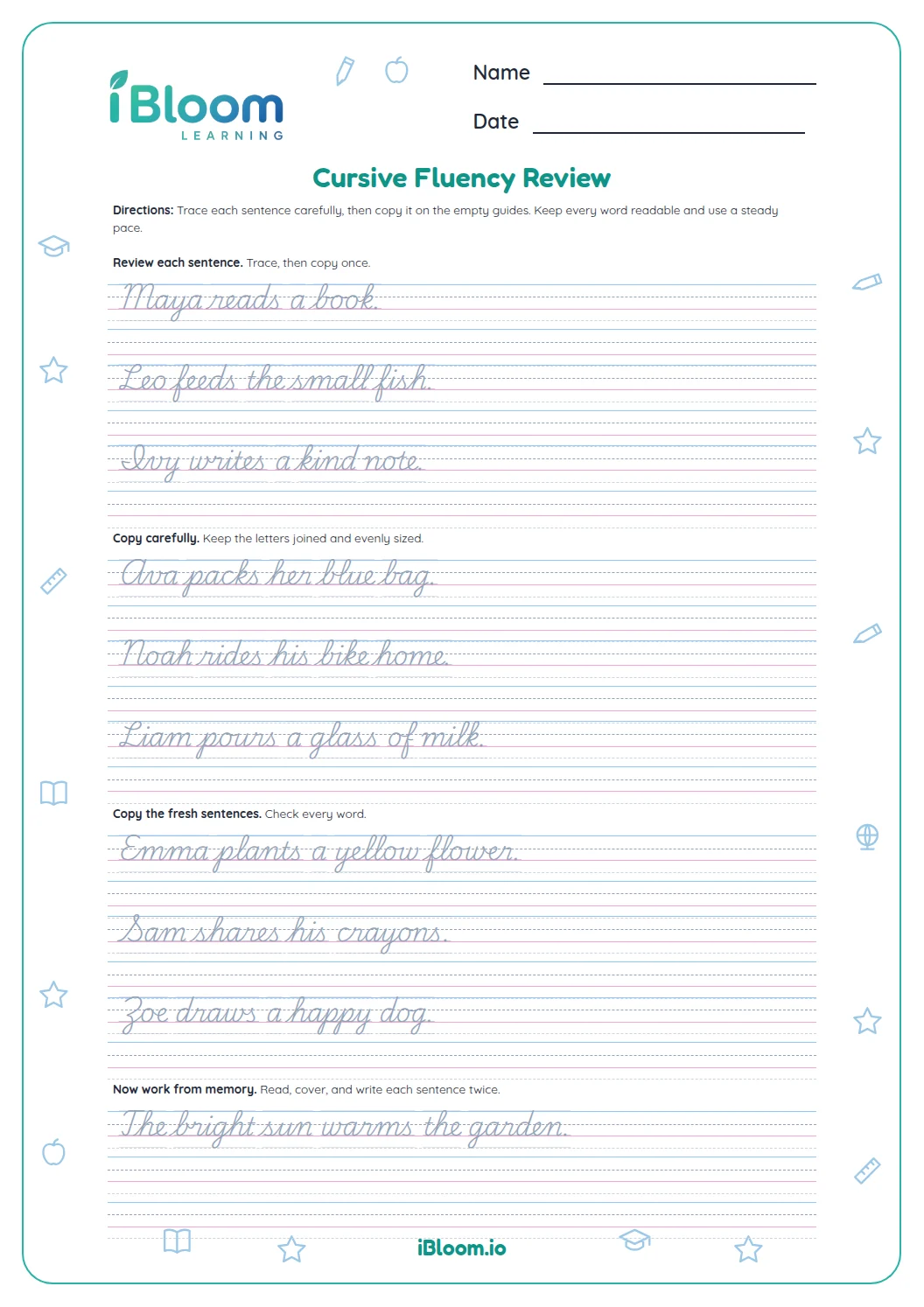
This printable cursive worksheet gives students six words and six complete sentences to trace and copy on handwriting lines. The words build into sentence practice, with a separate answer key showing each model in cursive. Use it for focused handwriting practice at home or in class.
Why start with words before sentences?
Words give students a chance to connect letters and keep a consistent slant before adding spaces and punctuation. The first part uses a mix of letter shapes and joins.
Trace the model once, then copy it without tracing.
- 1learn → trace the model → copy learn on the next row
What should students notice in cursive sentences?
Look for the capital at the start, connected lowercase letters, spaces between words, and ending punctuation. Keep letters resting on the baseline and make tall and descending strokes clear.
Each sentence is short enough to trace and copy as one complete thought.
How can families check cursive practice?
Compare the copied text with the printed model for spelling, capitalization, spaces, and punctuation. Letter shapes can vary by school cursive style; the goal is a readable, connected form.
The answer key shows the target wording for all 16 items.
How to use this worksheet
- 1Sit comfortably and place the paper at a slight angle.
- 2Trace the gray model slowly, following each connected letter.
- 3Copy the word or sentence on the empty row without tracing.
- 4Keep spaces between words and letters resting on the writing line.
- 5Check capitals, spelling, and end marks against the model.
- 6Pause between items if the writing becomes rushed or hard to read.
Common mistakes and quick fixes
The mistake
Lifting the pencil between letters that should connect.
The fix
Move slowly through the joins and lift only between words or where the cursive form requires it.
The mistake
Joining two words together without a space.
The fix
Leave a clear word space, then start the next connected group.
The mistake
Forgetting the capital or end mark in a sentence.
The fix
Check the first and last character against the model after copying.
What to practice next
Make more practice
Further reading
Questions parents and teachers ask
How many cursive items are included?
There are 12 items: six individual words and six complete sentences. Each appears as a cursive model with handwriting lines for tracing and copying. The separate answer key repeats the same text in cursive, so students can compare their letter shapes and joins.
Should students trace or copy first?
Trace the cursive model first, following each join and letter shape. Then copy the same word or sentence on the empty line. This sequence lets students compare their own spacing and joins with the printed model as they build control.
Are the sentence prompts complete?
Yes. The sentence section uses complete thoughts, including “The birds sing” and “Please close the gate.” Students copy each whole sentence, including its capital letter and ending punctuation, rather than copying an unfinished fragment. Students copy the capital letters and ending punctuation too, which helps preserve each full sentence.
How should students practice joins?
Move from one letter into the next without lifting the pencil when the cursive forms connect. Leave clear spaces between words, and check that each word remains easy to read. The models provide examples of connected writing and word spacing.
Is there an answer key?
Yes. The answer key repeats the words and sentences as cursive models. Compare letter formation, joins, spacing, and punctuation rather than expecting every student’s handwriting to look identical. The key shows the intended wording for each practice item.