


About this worksheet
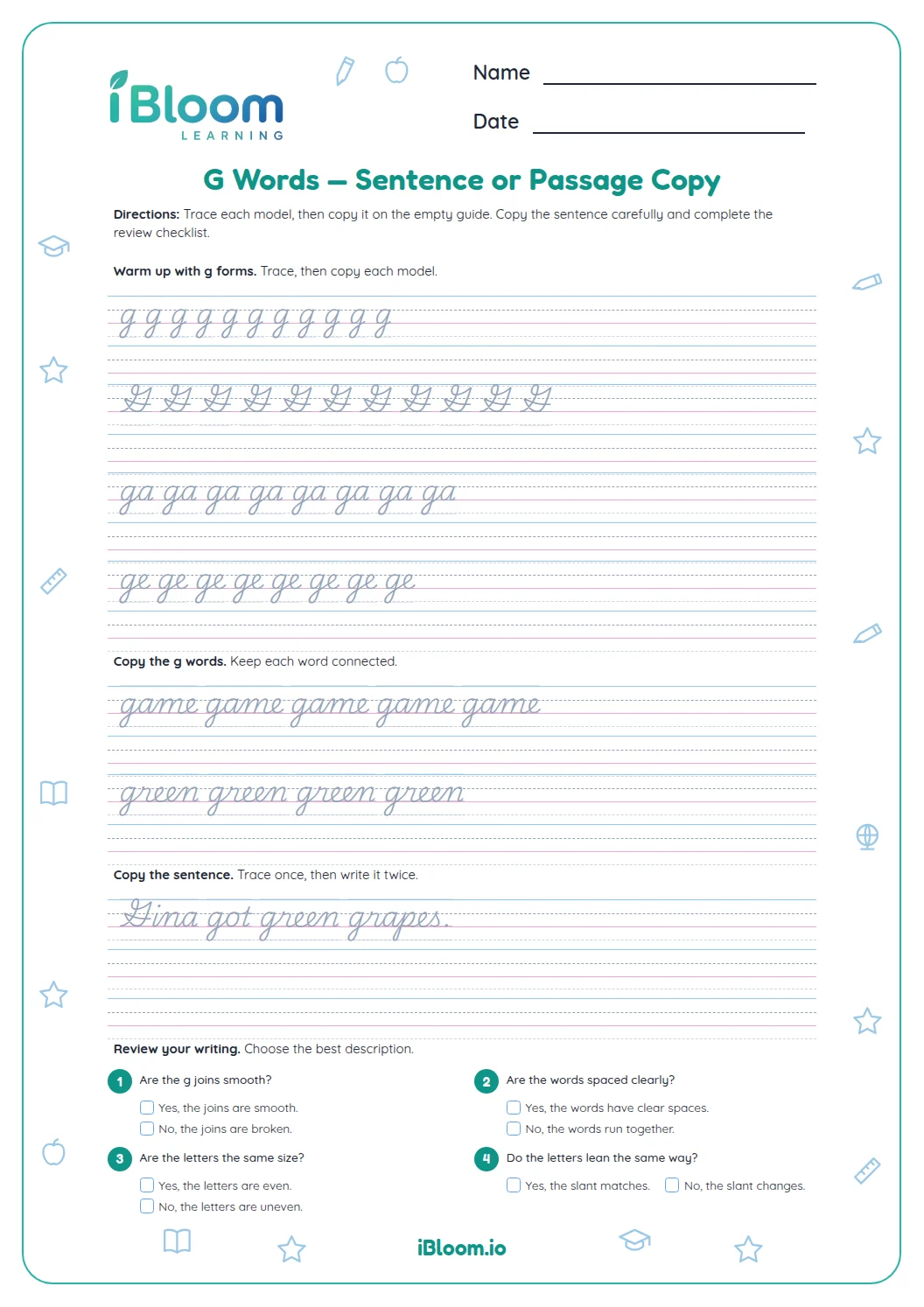
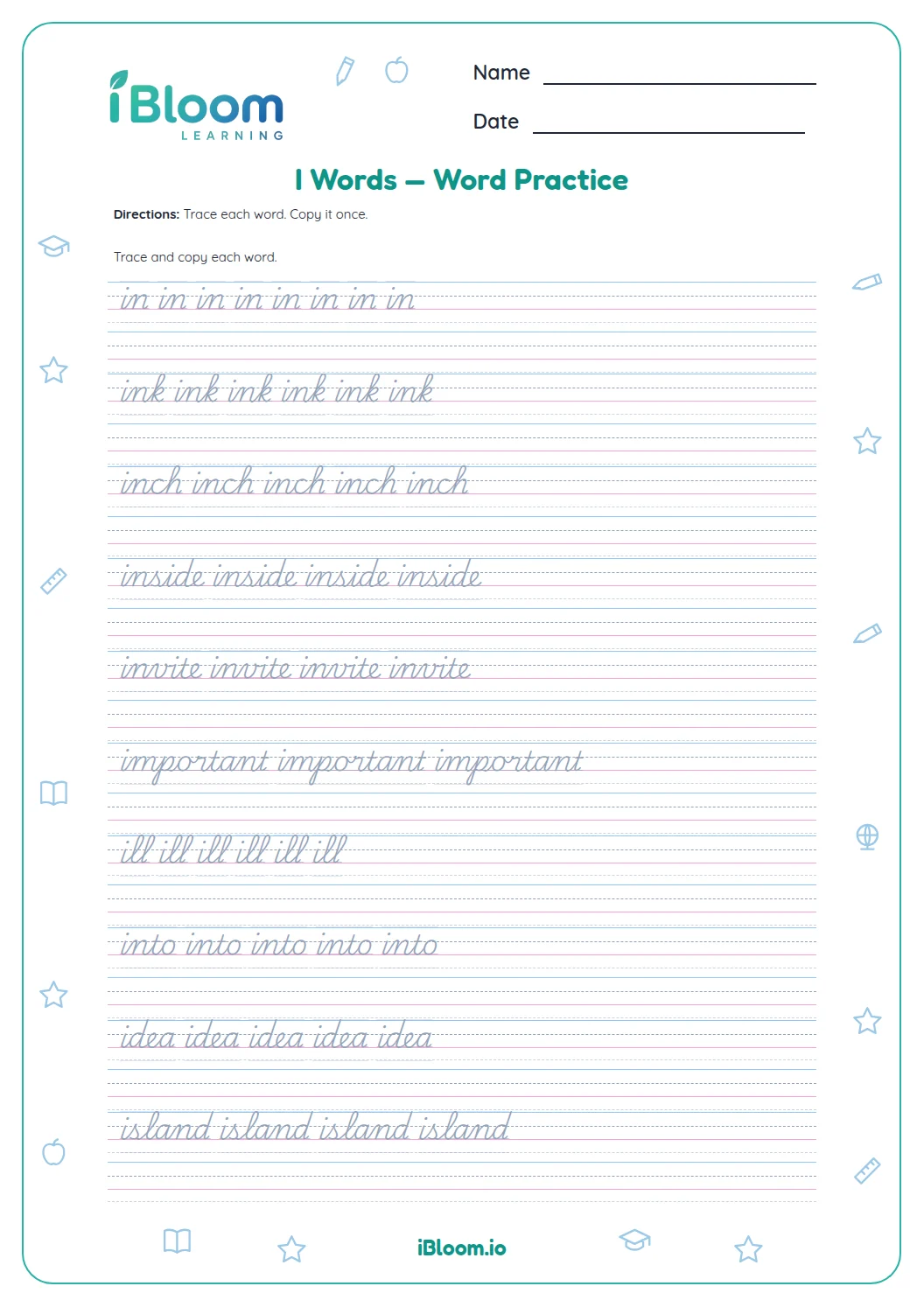
This cursive worksheet gives learners 14 G words to trace and copy on handwriting lines. The words include short forms such as “game” and “gift,” plus longer words such as “garden” and “guitar.” Children follow a cursive model, then write the same word independently; the answer key lists the target words.
What should I notice when writing lowercase g?
Follow the printed cursive model, paying attention to the oval, the loop below the line, and the exit stroke that joins the next letter. In “game,” keep the g connected as you move into a.
How do the word lengths build practice?
The sheet starts with short words such as “game” and “gift.” Later words like “garden,” “guitar,” and “globe” give more practice carrying the opening g into different joins.
How can tracing lead to independent writing?
Trace the gray model slowly, then copy the same word on the empty line. Compare letter size, spacing, and joins with the model rather than trying to write quickly.
How to use this worksheet
- 1Sit with the page angled comfortably.
- 2Trace each model at a steady pace.
- 3Keep lowercase letters an even size on the line.
- 4Copy the word once without tracing.
- 5Compare the copied word with the model and retry any unclear join.
Common mistakes and quick fixes
The mistake
Making the g too large for a lowercase letter.
The fix
Keep its oval near the height of the other lowercase letters.
The mistake
Lifting the pencil between joined letters.
The fix
Follow the exit stroke into the next letter where the model connects.
The mistake
Rushing the copy line.
The fix
Slow down enough to keep loops and spaces readable.
What to practice next
Make more practice
Further reading
Questions parents and teachers ask
Which words are on the sheet?
The 14 words are game, gift, goat, gold, garden, globe, grape, glove, grass, glass, giant, guitar, goose, and gate. Each begins with g and provides a cursive model for tracing and copying. The printed model remains available as a guide during the copying step.
What does a child do for each word?
For each item, trace the printed cursive word on the handwriting line, then copy it on the next line. A steady pace helps children attend to the lowercase letters, spacing, and the joins between letters. Comparing the tracing and copy helps children notice how the letters connect.
What grade is this for?
The source material places this practice in Grades 2 through 5. Learners can work at their own pace, taking time to trace the model carefully before copying each word without tracing. The same lowercase g appears in every word, with different following letters.
How should a lowercase g sit on the line?
Follow the model’s oval and lower loop. The oval sits with the lowercase letters, while the loop dips below the baseline. Keep the exit stroke moving toward the next letter when the cursive style joins them. Pause between words to check baseline, letter size, and spacing.
What does the answer key show?
The key lists the word expected in each item. Because handwriting varies, compare the learner’s letters with the model on the worksheet for shape, direction, size, spacing, and joins rather than expecting every copy to look identical. The practice moves from short words toward longer words with more joins.
How can families make practice useful?
Practice a few words at a time. Trace each model slowly, then copy it without tracing and compare the lowercase g and its joins. A child can point out one feature that matches the model before moving to the next word.