




About this worksheet
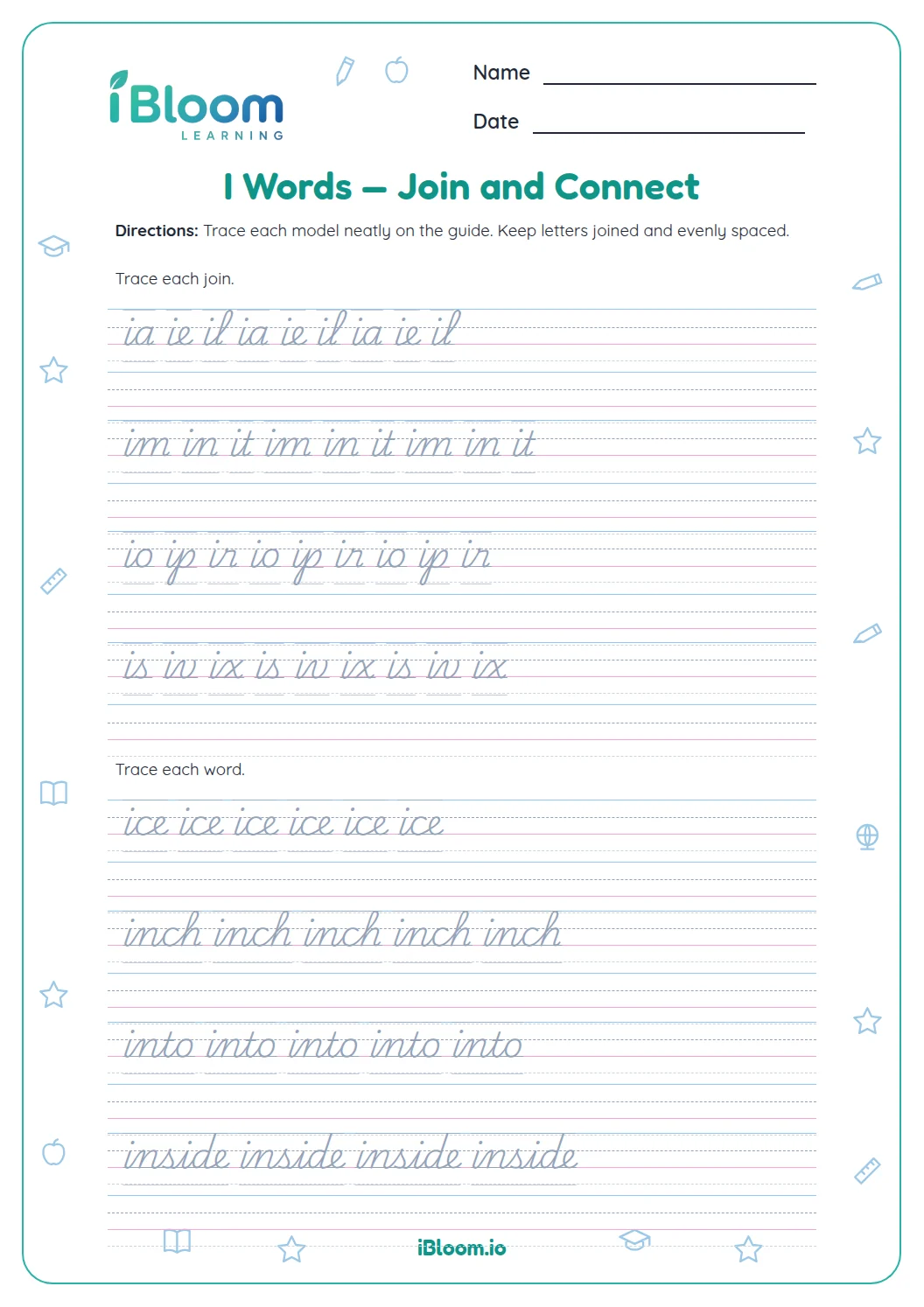
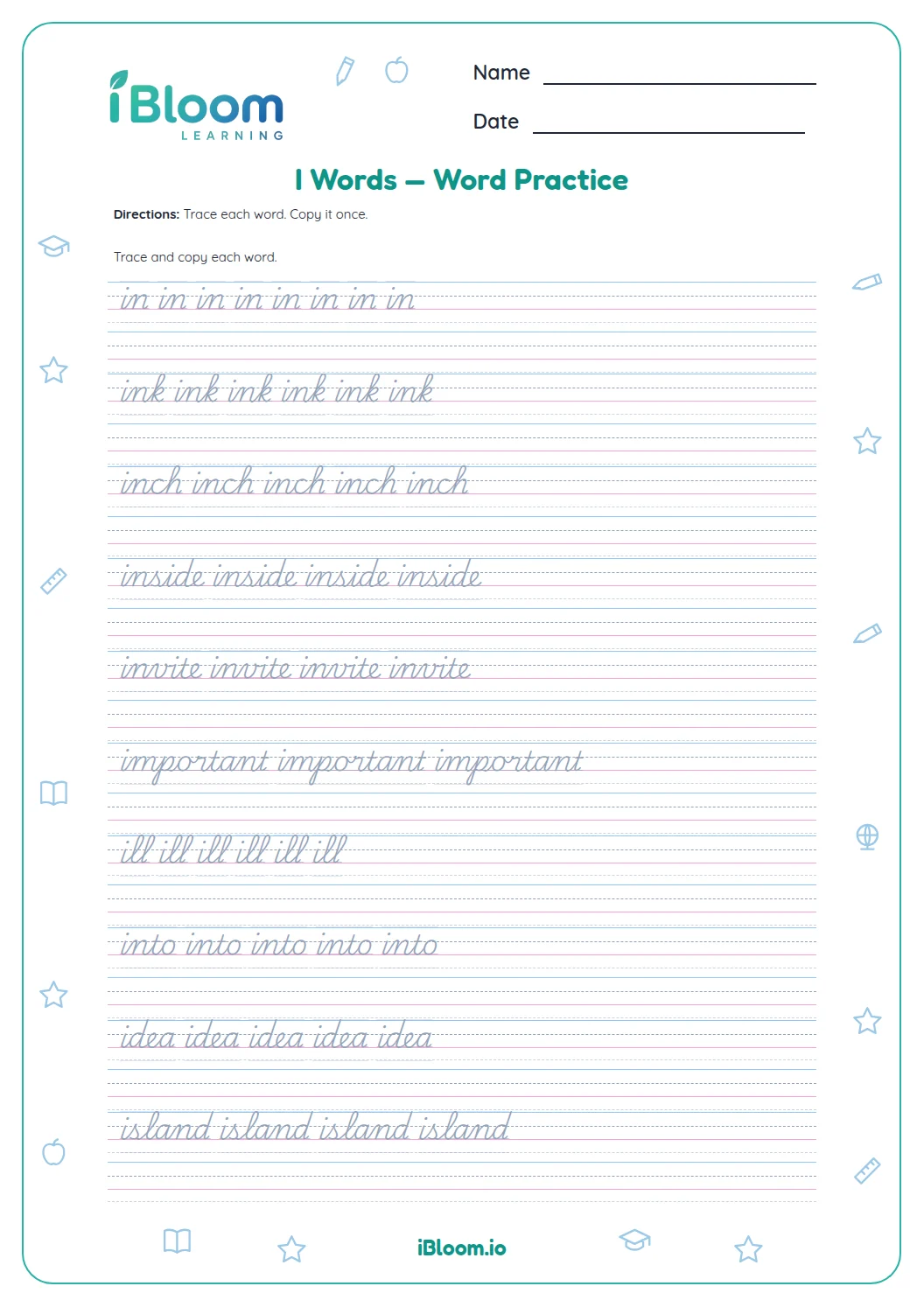
This free cursive worksheet gives children in Grades 2–5 twelve words beginning with lowercase i. Six numbered items each pair two words on a gray trace row with an empty row for copying both words. That makes twelve word traces and twelve word copies. Part A uses in, ink, ice, ill, if, and it. Part B moves to into, itch, item, inch, idea, and iron. Children follow each word from left to right and add the i dot after forming the word. The answer key provides matching models for checking shapes and joins.
How should a child start each i word?
Point to the left edge of the gray model. Follow its entry stroke upward, return to the baseline, and continue into the next letter. Add the dot over i after the connected strokes are complete.
Model one word slowly on separate paper while the child follows the printed example. The handwriting guides help compare letter height; they also provide a place to check whether the copied word sits on the baseline.
- 1First pair: in ink
- 2Trace in through the join from i to n, then add the dot.
- 3Trace ink the same way; copy both words on the empty row.
Why are these twelve words grouped this way?
Part A contains in, ink, ice, ill, if, and it in three pairs. These short words offer different joins after i. The repeated l in ill also gives a clear comparison between a short i and taller letters.
Part B contains into, itch, item, inch, idea, and iron in three pairs. These four-letter words require carrying the pen through more letters. Words with t give a chance to finish the connected strokes before adding the crossbar. Leave a clear space between the two words when copying each pair.
What should I look for in the copied row?
Compare the copy with the model for a recognizable initial i, a dot placed above it, smooth joins, and letters resting on the baseline. Check the taller letters against the model rather than making every letter the same height.
The answer key repeats the word models. Use it as a reference for the shapes and spelling while observing the child directly for stroke direction and pen movement.
Trace, copy, and compare
- 1Read both words in the pair and find the first i in each.
- 2Follow each gray model from left to right with a finger.
- 3Trace one word at a time, then add its dot and any t crossbar.
- 4Copy both words on the empty row, leaving a space between them.
- 5Compare each copy with its model and choose one join to improve.
Mistakes to notice and fix
The mistake
Stopping at the i dot before joining the next letter.
The fix
Finish the connected strokes of the word, then return to add the dot.
The mistake
Making i as tall as l in ill.
The fix
Compare the short i with the taller l letters and use the middle guide.
The mistake
Copying separate print letters on the empty row.
The fix
Point to the joins in the gray cursive word, then trace the connection once more.
What to practice next
Make more practice
Further reading
Questions parents and teachers ask
Which words are included?
The twelve words are in, ink, ice, ill, if, it, into, itch, item, inch, idea, and iron. All begin with lowercase i. They appear in six pairs, with three pairs in each part. Each pair has one gray trace row and one empty row for copying both words.
When should my child add the i dot?
Add the dot after finishing the connected strokes of each word. This gives the child a chance to practice joining i to the next letter without stopping immediately. For it, into, itch, and item, return to add the t crossbar after finishing the connected letters as well.
How does the answer key help with handwriting?
The answer key supplies the same words as cursive models for comparison. Look for readable letters, suitable height, joins, and dots when checking a copy. Watch the child write if you want to check stroke direction, because a finished word alone cannot show the order of its strokes.
Can we split the work into shorter sessions?
Yes, complete the three pairs in Part A first and save Part B for another session. Each item pairs tracing with independent copying, so a short session includes both kinds of practice. Before stopping, let the child choose one copied word and compare it carefully with the model.
What if the copied word looks different from the model?
Start by choosing one feature to improve, such as the initial i or the join into n. Ask the child to point to that feature in the model, trace it slowly, and try the word again on separate lined paper. Keep the focus on readable, controlled movement.