



About this worksheet
This Grades 2–5 J-word worksheet has 14 questions on two practice pages, with a separate two-page answer key. Students write June and jellyfish in cursive, then choose among J words to match 12 short clues. June is the only month between May and July, so the first writing prompt has one clear answer.
What is in the two writing prompts?
Part A asks students to write the month between May and July, then a J word that names a sea animal. These prompts have the sample answers June and jellyfish. Students should capitalize the month name and keep the letters readable in cursive.
How do the J-word choices work?
Part B gives 12 clues, each with three J-word choices. Clues point to a meaning or familiar use: jam is a sweet spread, a jet travels in the air, and a jigsaw is a puzzle. Reading the full clue helps students distinguish words that begin with the same letter.
- 1Clue: a sweet spread
- 2Choose: jam
- 3Check the word meaning against the clue.
What should students notice about lowercase j?
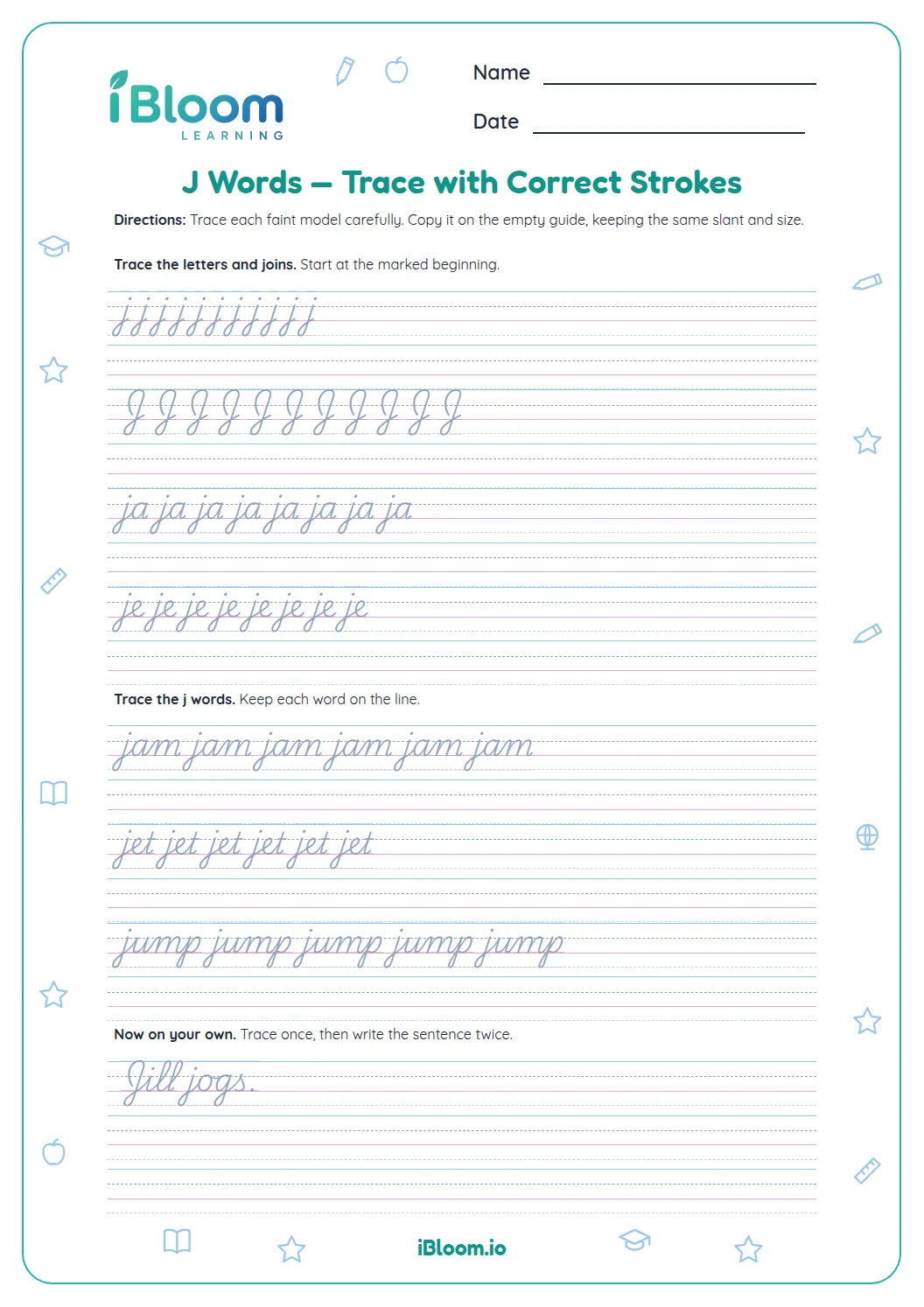
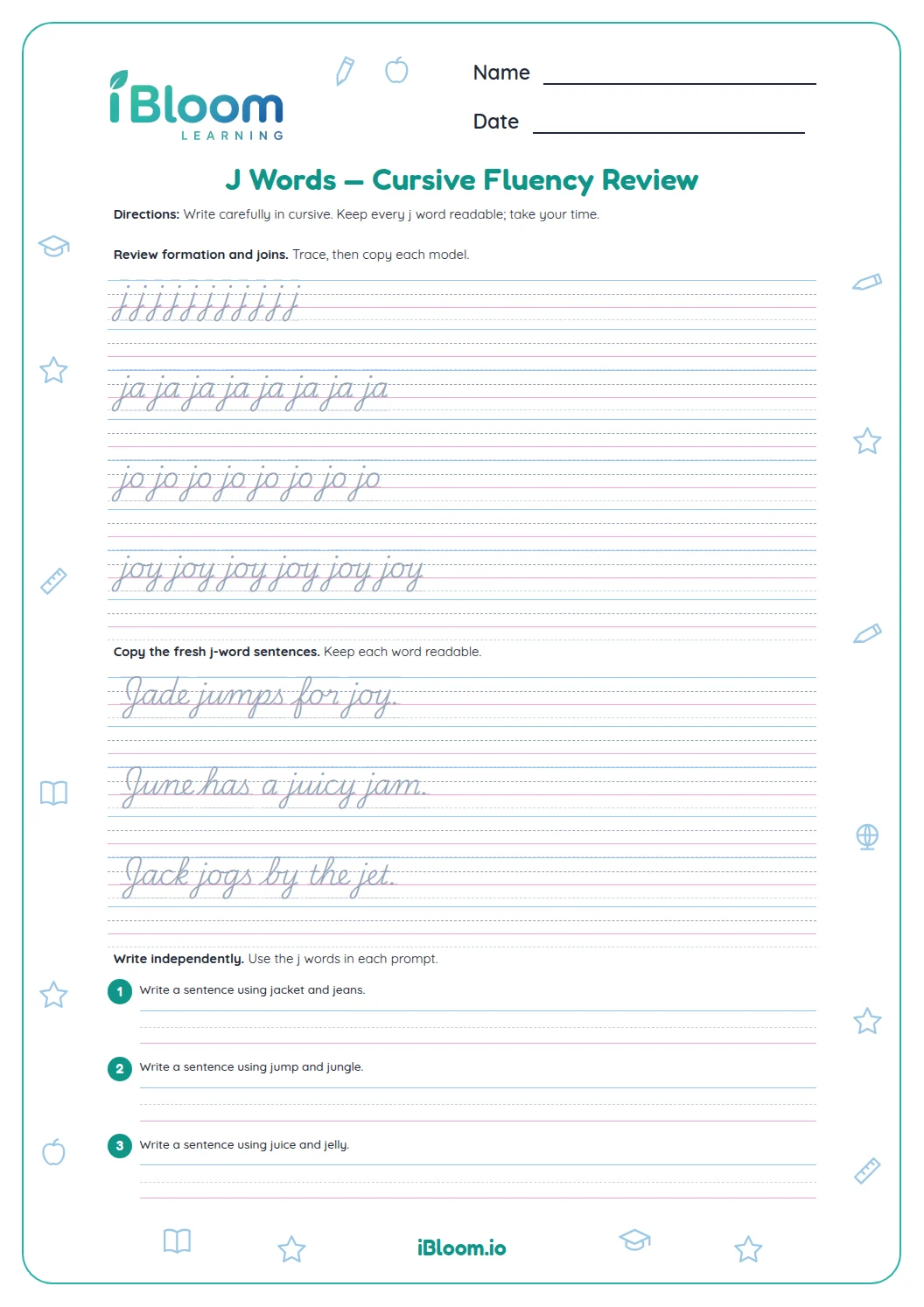
The lowercase j descends below the writing line and has a dot. Keep both features clear in jellyfish and other J words. In June, use an uppercase J because the word names a month. Compare each written model with the key after finishing.
How to use this worksheet
- 1{'heading': 'How to use the J-word page', 'items': ['Write June with a capital J.', 'Write jellyfish in cursive and check its spelling.', 'Read each clue before looking at the choices.', 'Choose the J word that matches the meaning.', 'Check the j dot and descender, then review the key.']}
Cursive details to check
The mistake
Writing june with a lowercase first letter.
The fix
Capitalize June because it names a month.
The mistake
Stopping the j at the writing line.
The fix
Carry the j below the baseline.
The mistake
Forgetting the j dot.
The fix
Add a clear dot after forming the word.
What to practice next
Make more practice
Questions parents and teachers ask
How many questions are on the sheet?
There are 14 questions: two cursive writing prompts and 12 J-word choices. Students write June and jellyfish, then select words such as jam, jacket, jungle, and journal to match short clues. The answer key provides the sample writing and correct choices.
Why is June capitalized?
June names a month, so it begins with a capital letter. The prompt identifies it uniquely as the month between May and July; July also begins with J, but it does not fit that clue. The answer key shows June with the capital J.
What does the worksheet ask students to write in cursive?
Part A asks students to write June and a J word for a sea animal. The answer key shows June and jellyfish as sample responses. Students can check that June is capitalized and that lowercase j descends below the line and carries a dot.
What kinds of clues appear in Part B?
The 12 clues describe a meaning or use, such as a sweet spread, a place with many trees, or a book of daily notes. Each clue has three J-word choices. Students read the clue, compare the meanings, and choose the matching word.
How many pages are in the printable?
The worksheet has two practice pages and a separate two-page answer key. The first page contains both cursive prompts and the first few word choices; the second page continues the remaining choices. The key follows the same two-page layout.