




About this worksheet
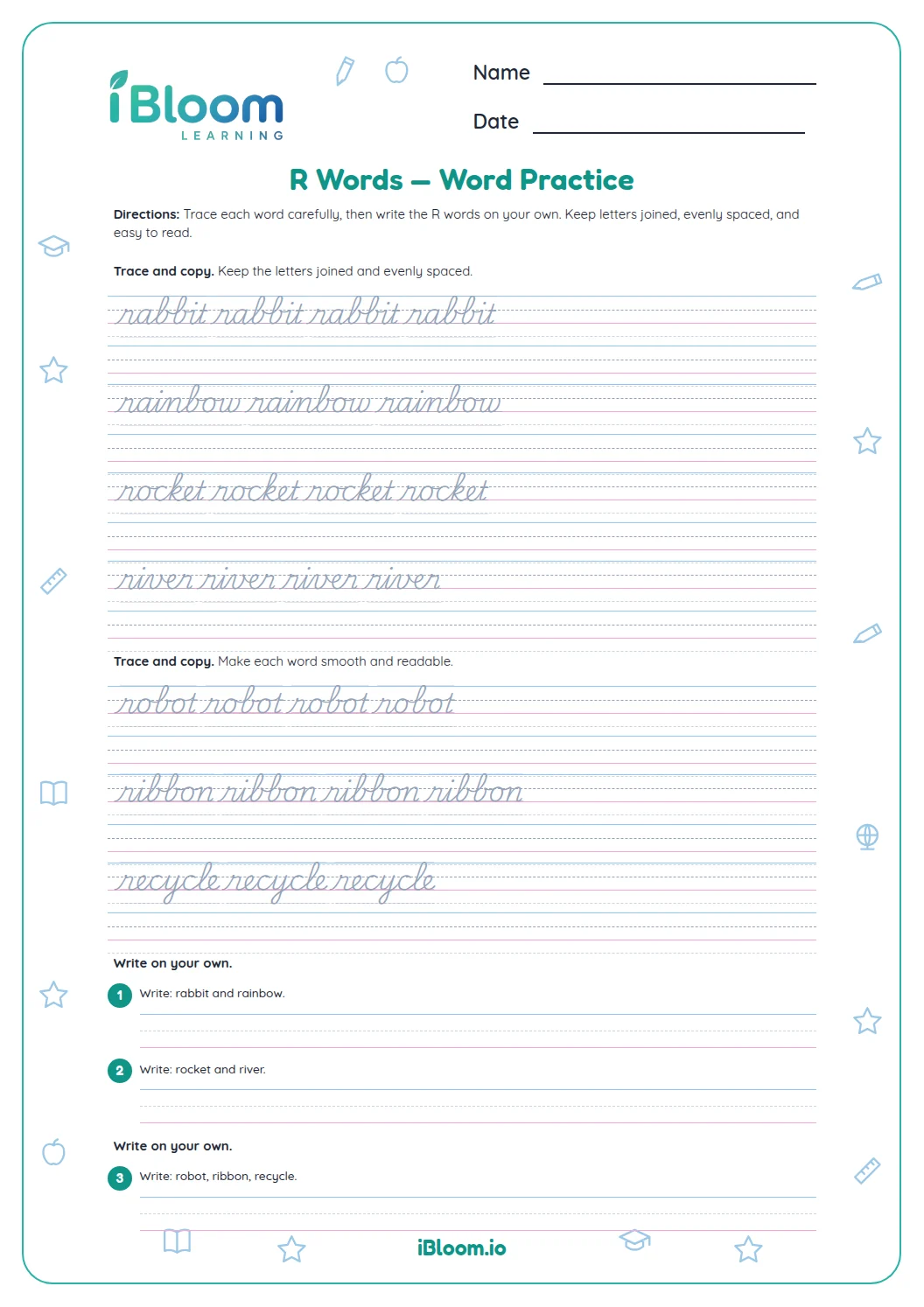
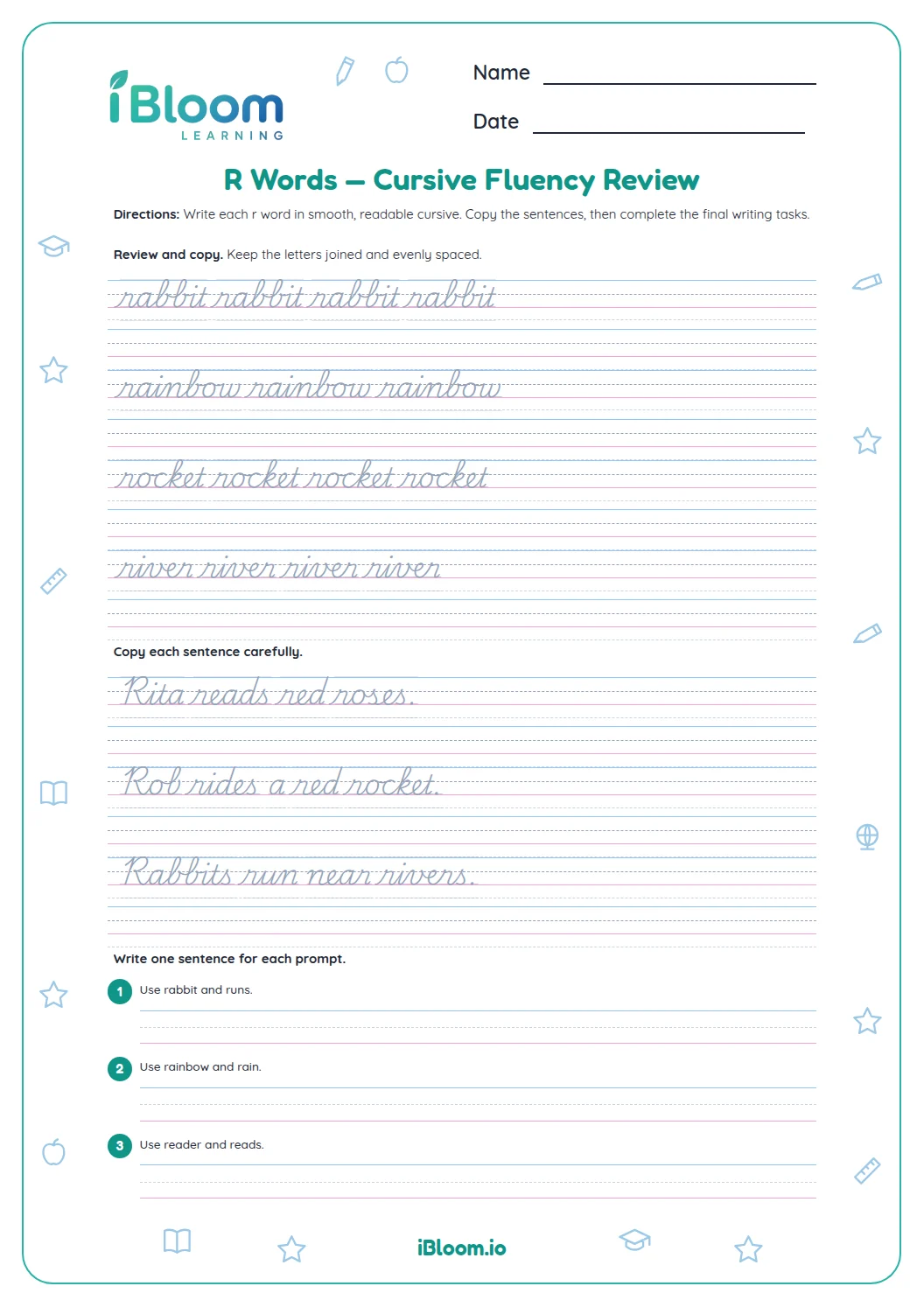
This printable gives Grades 2–5 learners 15 cursive words that begin with r to trace and copy on handwriting lines. Part A starts with short words such as run and red. Part B moves to longer words such as rabbit and remember, and Part C adds more R words, including rest and ruler. The separate four-page key shows the target cursive words for comparison.
What should learners notice in the lowercase r?
Watch the model’s entry stroke, short shoulder, and exit stroke into the next letter. In run, the r connects directly to u; in red, it connects to e. Trace the whole word, then copy it while keeping the joins clear.
- 1run
- 2Trace the r into u and n without lifting between letters.
- 3Then copy run on the next handwriting line.
How does the practice build from short to long words?
Part A uses short words, Part B gives more room to manage longer sequences such as remember and rainbow, and Part C returns to a mix of familiar lengths. Learners can pause between letters if needed, then work toward a smooth connected word.
How can an adult check a copied word?
Compare the letters and their order with the model. Look for a recognizable lowercase r, connected joins, and spacing that keeps the word readable. Handwriting can vary; the goal is a legible copy of the same word.
A simple trace-and-copy routine
- 1Sit with the paper steady and hold the pencil comfortably.
- 2Look closely at the first letter and the direction of its stroke.
- 3Trace the gray model slowly, following each connection.
- 4Copy the word on the blank handwriting line.
- 5Compare the spelling and joins with the target in the key.
Cursive joins to check
The mistake
Making the r too tall or too wide.
The fix
Use the model’s short shoulder so the letter stays recognizable.
The mistake
Lifting the pencil between letters in a word.
The fix
Follow the exit stroke into the next letter where the cursive model joins them.
The mistake
Letting letters crowd together.
The fix
Keep the word connected but leave enough room to read each letter.
What to practice next
Make more practice
Questions parents and teachers ask
Which R words are on the sheet?
The targets include short words such as run, red, and rest, plus longer words such as rabbit, remember, rainbow, and reading. All 15 begin with r and appear as cursive models to trace and copy. The key repeats the exact target so spelling and letter shapes are easy to compare.
How does tracing help with the joins?
Tracing lets a learner follow the model’s path through the lowercase r and into the next letter. After tracing, copying the same word gives a chance to practice the joins without following the gray guide. Learners can check the r and the next letter at the join.
Should the learner lift the pencil between words?
Yes. Each word is a separate practice item, so lift between words. Within each cursive word, follow the connected model and try to keep the letters joined where the handwriting style connects them. A second careful copy can help build a steady writing rhythm.
What should an adult look for in the copied word?
Check that the spelling matches the model and that the r is recognizable. Connected letters, steady spacing, and a readable word matter more than making every learner’s strokes identical. Compare the beginning and ending letters as well as the joins.
How many pages are in the worksheet and key?
The worksheet uses four pages because it gives each of the 15 cursive words generous handwriting space. Its separate four-page answer key repeats the target words in cursive for comparison. Short daily practice can revisit a few words at a time.