

About this worksheet
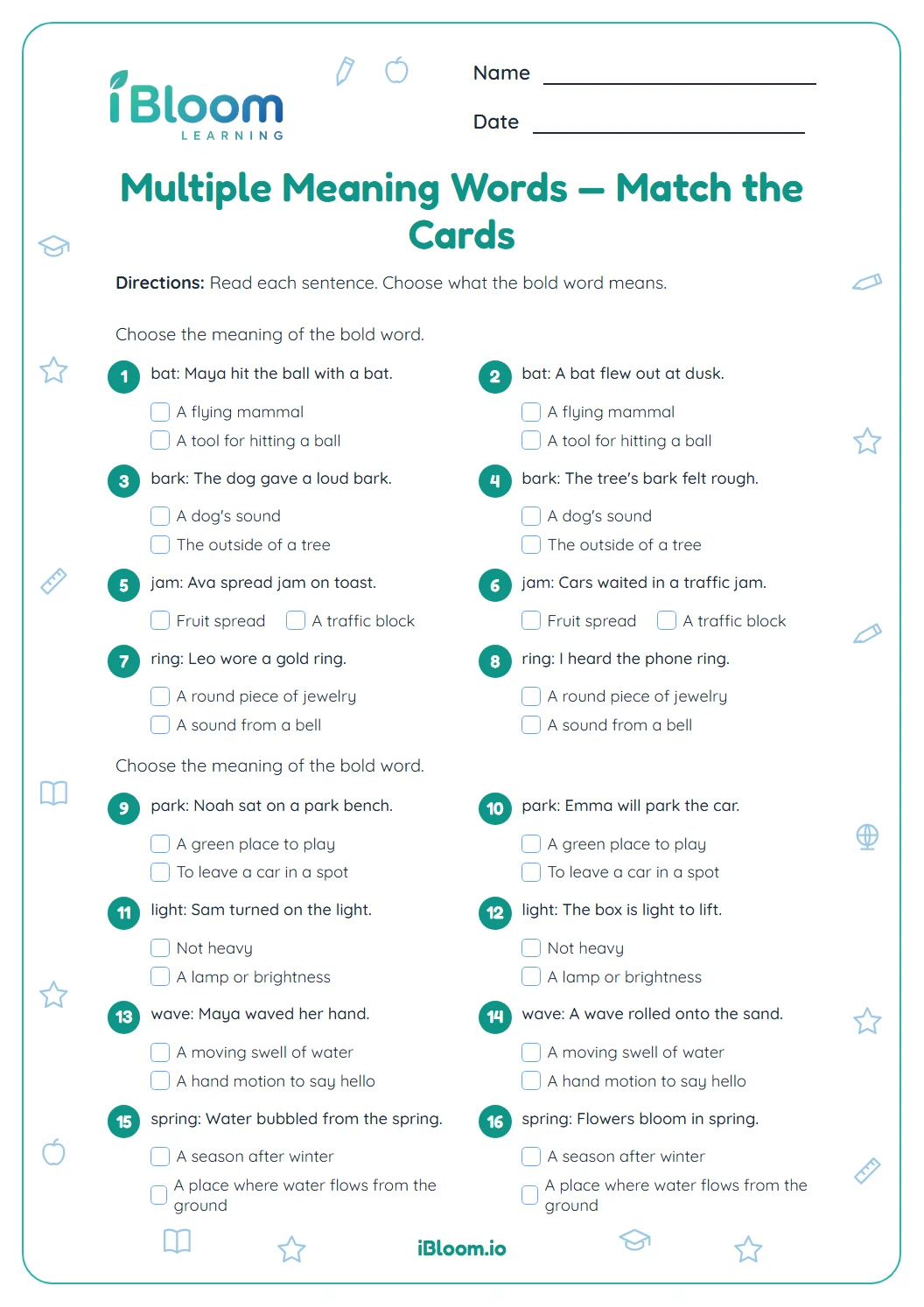
This Grade 2 reading worksheet practices multiple-meaning words in a two-step routine. First, children study sentence pairs that show words such as duck, bat, bark, and ring in different contexts. Then they cover the examples mentally and recall both meanings for eight target words. The answer key supports checking each choice and reviewing meanings that were hard to remember.
Aligned to L.2.4a
What is a multiple-meaning word?
It is one spoken and written word with more than one meaning. Ring can mean jewelry or a sound; a sentence shows which meaning the reader needs.
Which words help identify the meaning?
Read the whole sentence and look for words that connect to one meaning. In “The dog has a soft bark,” dog and soft help distinguish tree covering from a sound.
- 1“A duck can swim” names a bird.
- 2“Please duck under the branch” tells someone to lower their head.
- 3The sentence clues show two meanings of duck.
What does this recall practice include?
Sixteen questions revisit eight target words in two contexts. Part A asks about duck, bat, bark, and ring; Part B adds light, fly, watch, and spring.
How to use this worksheet
- 1Read the sentence aloud or silently.
- 2Find the word that could have more than one meaning.
- 3Notice nearby clue words.
- 4Try both answer choices in the sentence.
- 5Choose the meaning that makes the sentence sensible.
- 6Review missed items with the answer key.
Common mistakes and quick fixes
The mistake
Choosing the best-known meaning without reading the sentence
The fix
Read the full sentence first and point out the words that connect to the meaning.
The mistake
Using only one clue word
The fix
Check how the whole sentence works with each meaning.
The mistake
Confusing a word’s spelling with its meaning
The fix
The spelling stays the same here; use context to choose what it means in this sentence.
Common Core alignment
Children use sentence clues to choose between familiar meanings.
Use the sentence around a word as a clue to its meaning.
On this sheet: Each question places a multiple-meaning word in a sentence and asks for its meaning there.
Show the official wordingHide the official wording
Use sentence-level context as a clue to the meaning of a word or phrase.
What to practice next
Make more practice
Further reading
Questions parents and teachers ask
How is this worksheet organized?
The first eight questions show a word in two different sentences and ask which meaning fits each one. The last eight prompts cue one meaning for light, fly, wash, and swing. Together, the sections use the study-then-recall routine of the original cards.
Which multiple-meaning words appear?
The sheet uses duck, bat, bark, ring, light, fly, watch, and spring. Each word has two meanings in the context questions, such as a flying animal and a stick used to hit a ball for bat. The recall check revisits four of these words.
What should a child do in the recall section?
For each recall item, read the target word and choose the pair of meanings remembered from the first section. If either meaning is hard to recall, revisit the matching sentence pair and use its context before trying again.
How many questions are included?
There are 16 questions: eight context questions followed by eight recall checks. The key lists the intended meaning for every question, so an adult can review each pair and help the child revisit any meaning that was difficult.
How do context clues help with a word like spring?
The surrounding words point to the intended meaning. “We drank from the spring” points to a water source, while “The spring bounced back” points to a coil. Looking at the whole sentence helps distinguish the meanings and remember each use.