

About this worksheet
This Grade 3 printable has 14 questions across two worksheet pages and a two-page answer key. Students complete eight sentences with words formed using prefixes or suffixes, identify three affix meanings, and apply those meanings in three short contexts. The choices match the worksheet’s sentence-completion and word-part tasks; no separate word cards are needed.
How can context help identify an affixed word?
Read the whole sentence, then check which word both fits its meaning and uses a familiar word part. “Ava will ___ the note to fix a spelling error” points to rewrite. The prefix re- signals doing the action again.
- 1Ava will ___ the note to fix a spelling error.
- 2Choose: rewrite
- 3re- means again.
What do common prefixes and suffixes mean?
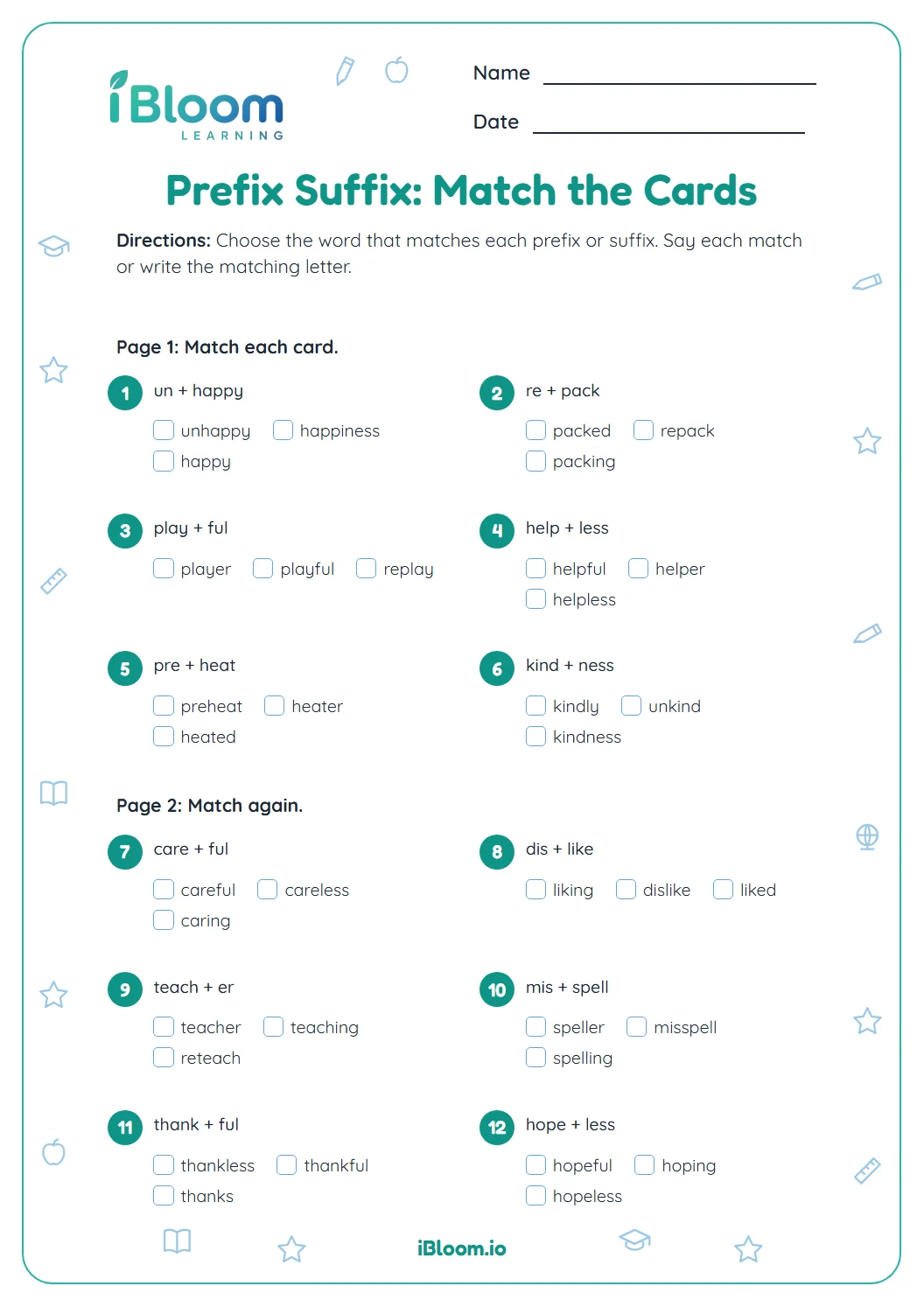
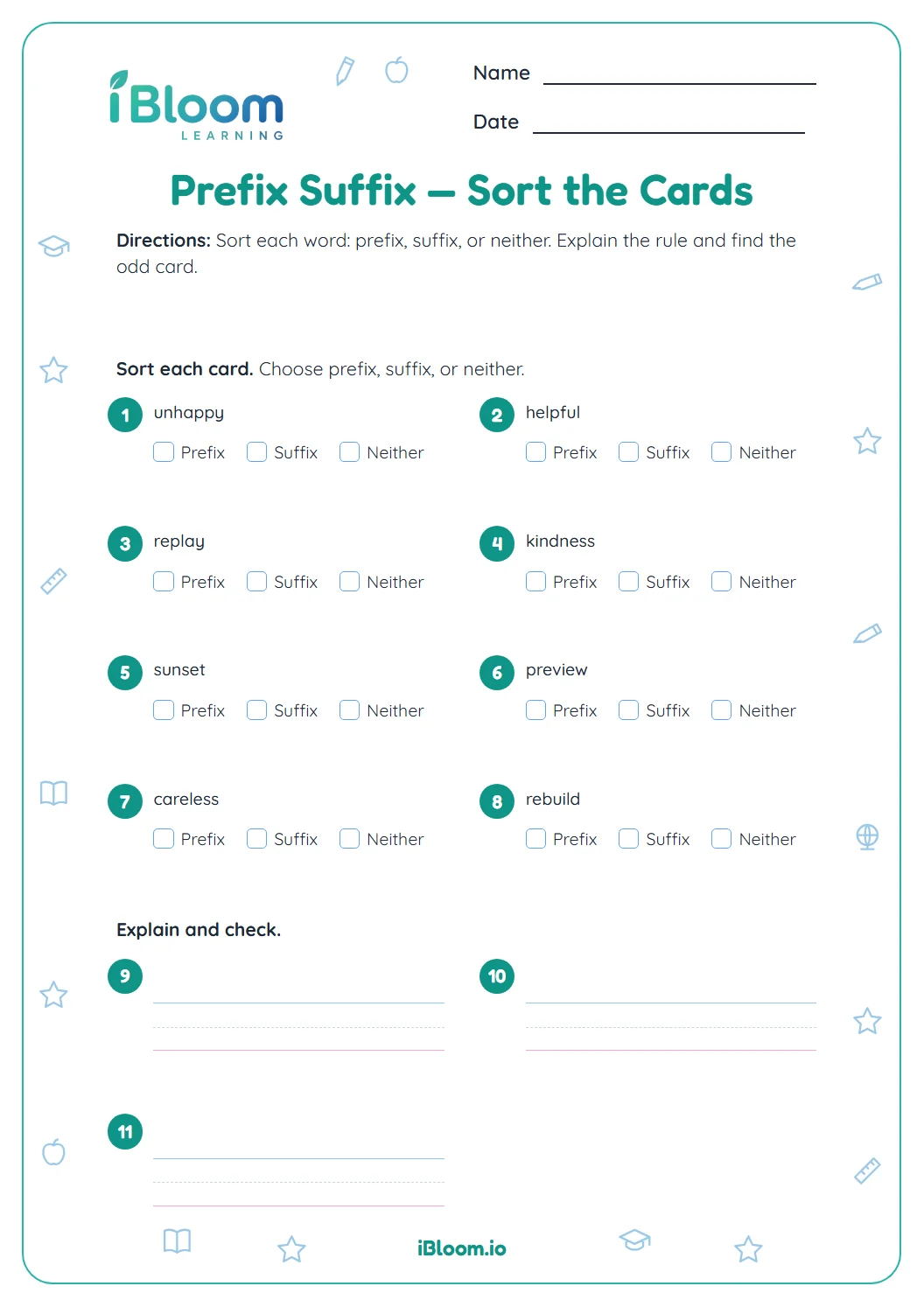
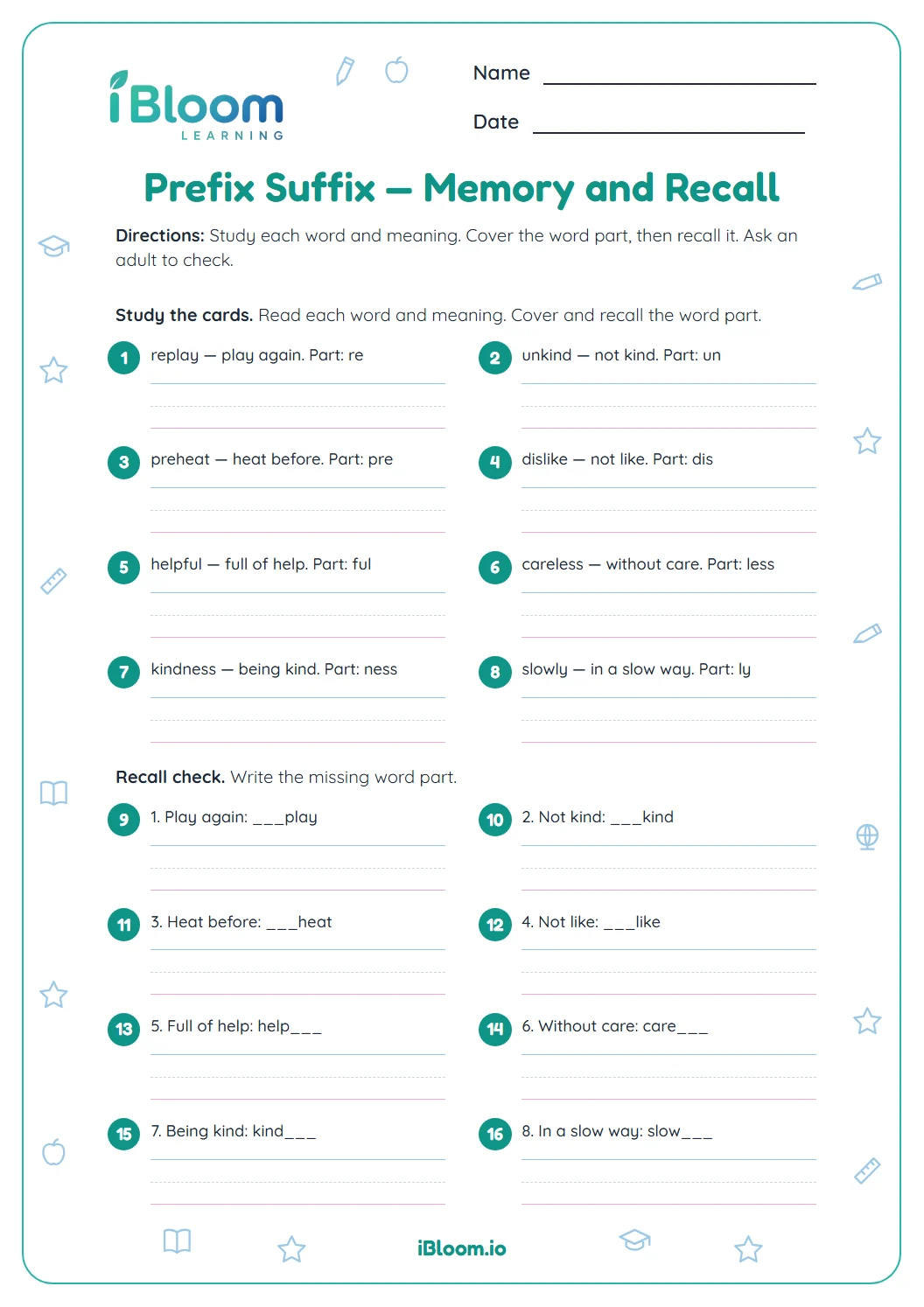
A prefix comes before a base word; a suffix comes after it. In repack, re- means again. In unkind, un- means not. In fearless, -less means without. Notice where the word part appears, then connect its meaning to the base.
How can students apply a word-part meaning?
Use the whole word and its sentence. Repaint means paint again, while unsafe means not safe. In hopeful, -ful means full of. These final questions ask students to apply the word-part clues in brief, familiar examples.
How to use this worksheet
- 1{'heading': 'How to use the prefix and suffix review', 'items': ['Read the whole sentence for a meaning clue.', 'Choose the word that fits the sentence.', 'Locate its prefix or suffix.', 'Connect the word part to its meaning.', 'Use the key to check the 14 responses.']}
Word-part mistakes and fixes
The mistake
Choosing a word because it shares a few letters.
The fix
Use both the sentence clue and the affix meaning.
The mistake
Placing a suffix before its base.
The fix
Remember that prefixes come before and suffixes come after.
The mistake
Treating re- and un- as the same clue.
The fix
Check whether the word means again or not.
What to practice next
Make more practice
Further reading
Questions parents and teachers ask
What is a prefix?
A prefix is a word part added before a base word. In repack, re- comes before pack and means again. One question asks students to choose the affixed word that fits a sentence; another asks what re- contributes to the word’s meaning.
What is a suffix?
A suffix is a word part added after a base word. In fearless, -less comes after fear and means without. The worksheet asks students to name that meaning, then apply a suffix clue in a short context such as hopeful.
Why use sentence context to study word parts?
A sentence gives clues about which affixed word fits and whether its meaning makes sense. For example, a spelling error points to rewrite, because re- means doing the action again. Students complete eight contexts, then apply word-part meanings in three more items.
How many questions are on this worksheet?
There are 14 questions: eight sentence completions, three questions about affix meanings, and three applications. Students choose words and meanings from the printed options, then use context to check their reasoning. The separate answer key lists the correct selection for each question.
Are word cards printed on the page?
No separate word cards are needed. The sentence-completion questions show the word choices beside each prompt, and later questions provide short choices about meanings and applications. Students can read the sentence first, compare the choices, and then check their selection with the key.