






About this worksheet
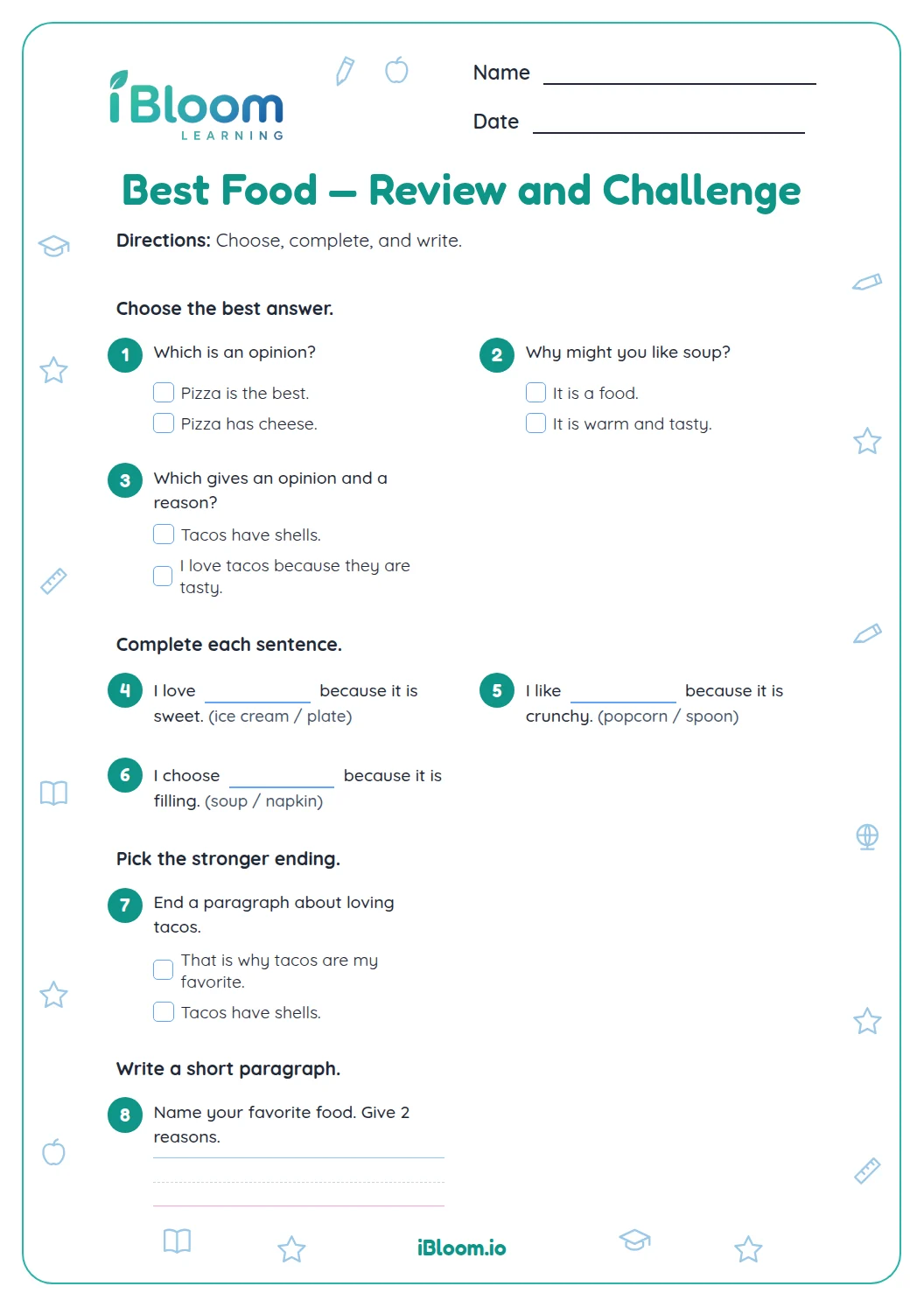
This free printable worksheet helps Grade 1 students write a short opinion about their best food. Children first tell opinions from facts, then choose the words that give a reason, and finally write their own three sentences: a food, a reason and an ending. It is made for first graders who can write a sentence with a grown-up nearby and are ready to explain why they think something. The practice supports Common Core W.1.1, writing an opinion that names a topic, says what you think, gives a reason and closes. A separate answer key shows every choice and a sample paragraph.
Aligned to W.1.1
What is on this worksheet?
Eleven questions about food, in four short parts that move from picking to writing. The topic stays the same all the way down the page, so children can put their energy into the opinion, the reason and the ending instead of hunting for ideas.
Part A is quick: three questions where children pick the sentence that tells what someone thinks. Part B turns to reasons. Part C is the writing part, with a starter for each of three sentences. Part D shows two short paragraphs, each with one piece missing.
- Part A, Fact or opinion: three multiple-choice questions (1 to 3)
- Part B, Pick the reason: three questions about the word because (4 to 6)
- Part C, Write a tiny paragraph: a food, a reason and an ending on writing lines (7 to 9)
- Part D, Check a paragraph: find the missing part (10 and 11)
- A separate answer key with a sample paragraph
How can a first grader tell an opinion from a fact?
A fact can be checked: you can look at it, count it or measure it. An opinion tells how someone feels, and a friend could feel differently. Words like best, yummy and fun often sound like opinions.
A good question to ask a child is “Could someone say the opposite and still be right?” In question 1, one person might say pizza is not the best food, but nobody can say pizza has no cheese when it does.
- 1Pizza has cheese. → fact (you can look and see)
- 2Pizza is round. → fact (you can look and see)
- 3Pizza is the best food. → opinion (someone else may pick tacos)
What makes a good reason in an opinion?
A reason tells why you think what you think, and it has to be about the food itself. In question 4, “my shoes are red” follows because, but it says nothing about pizza. “It is cheesy” does.
Because is the helper word for Grade 1 writers. Question 6 asks which word links an opinion to its reason, and the three sentences in Part C use the same pattern: I like it because.
- 1I like pizza because ___.
- 2my shoes are red → not about pizza
- 3it is cheesy → tells why pizza is good
- 4the bus is late → not about pizza
How do you check that a paragraph has all its parts?
A short opinion paragraph has a food (the topic), a reason and an ending. Part D gives children a paragraph to read and asks which one is missing, the way an editor would.
In question 10, “Pizza is the best food. I like it because it is cheesy.” has a topic and a reason but stops without an ending. In question 11, the word “it” never says which food, so the food name is missing.
How to use this worksheet at home or in class
- 1Talk about food first. Ask your child to say aloud a food they love and why, before any pencils come out.
- 2Read the directions and the first question to your child, then let them finish Part A.
- 3In Part B, have your child say each sentence aloud with the reason to hear whether it makes sense.
- 4For Part C, write the three starters on a sticky note if needed: My best food is, I like it because, That is why.
- 5Finish with Part D. Ask your child to point to the sentence that is the reason in each paragraph.
- 6Check with the answer key, then read your child’s paragraph out loud together and celebrate the ending.
Common mistakes and quick fixes
The mistake
Picking a fact as an opinion, such as “Pizza has cheese” in question 1.
The fix
Ask “Could a friend say the opposite and still be right?” A friend cannot say pizza has no cheese, so it is a fact. Then try the same test on “Pizza is the best food.”
The mistake
Repeating the opinion as the reason: “I like pizza because pizza is the best.”
The fix
Ask what pizza tastes, smells or feels like. A reason such as “it is cheesy” or “it is hot and yummy” tells something new, so the second sentence adds more than the first.
The mistake
Writing a paragraph with no ending, like the paragraph in question 10.
The fix
Give one starter, That is why, and read the three sentences back in order. A paragraph that stops after the reason sounds unfinished.
Common Core alignment
Most US states use the Common Core standards or a close state version. This Grade 1 writing standard names the parts of the paragraph on this page.
Write an opinion that names the topic, says what you think, gives a reason and ends.
On this sheet: Part C asks for a food, a reason and an ending, and Parts A, B and D practice each of those parts.
Show the official wordingHide the official wording
Write opinion pieces in which they introduce the topic or name the book they are writing about, state an opinion, supply a reason for the opinion, and provide some sense of closure.
What to practice next
Make more practice
Further reading
Questions parents and teachers ask
What is an opinion in first grade?
An opinion is what a person thinks or feels, and another person might think something different. “Pizza is the best food” is an opinion, while “Pizza has cheese” is a fact. Part A of this worksheet practices telling the two apart before children write opinions of their own.
Why does the worksheet use the word “because”?
Because is the simplest way for first graders to link an opinion to a reason. When children write “I like it because it is warm,” the sentence tells why, not only what. Question 6 checks the word, and the second line in Part C gives children the same starter.
How long should my child’s paragraph be?
Three sentences is plenty for Grade 1: the best food, one reason and an ending. Part C gives each sentence its own starter and lines. If your child wants to add a second reason, welcome it, but a short paragraph with all three parts matters more than a long one.
What if my child cannot spell the words yet?
Invented spelling is fine for this worksheet, as long as you can read it with your child. The focus is on the opinion, the reason and the ending. Say the sentence aloud first, then let your child sound out the words, and fix spelling later on another day.
What are the “check a paragraph” questions for?
Questions 10 and 11 show a short paragraph with one part missing, and children pick which part it is. Looking for what is missing helps young writers check their own work. After Part D, you can ask your child to reread their paragraph from Part C and look for the same three parts.
Can my child write about a food that is not in the examples?
Yes, any food works. Part C is open, so your child can choose pasta, apples, tacos or something else. A choice with a real reason is better than a copied one. The answer key shows a sample paragraph, but any food and reason that make sense are correct.