







About this worksheet
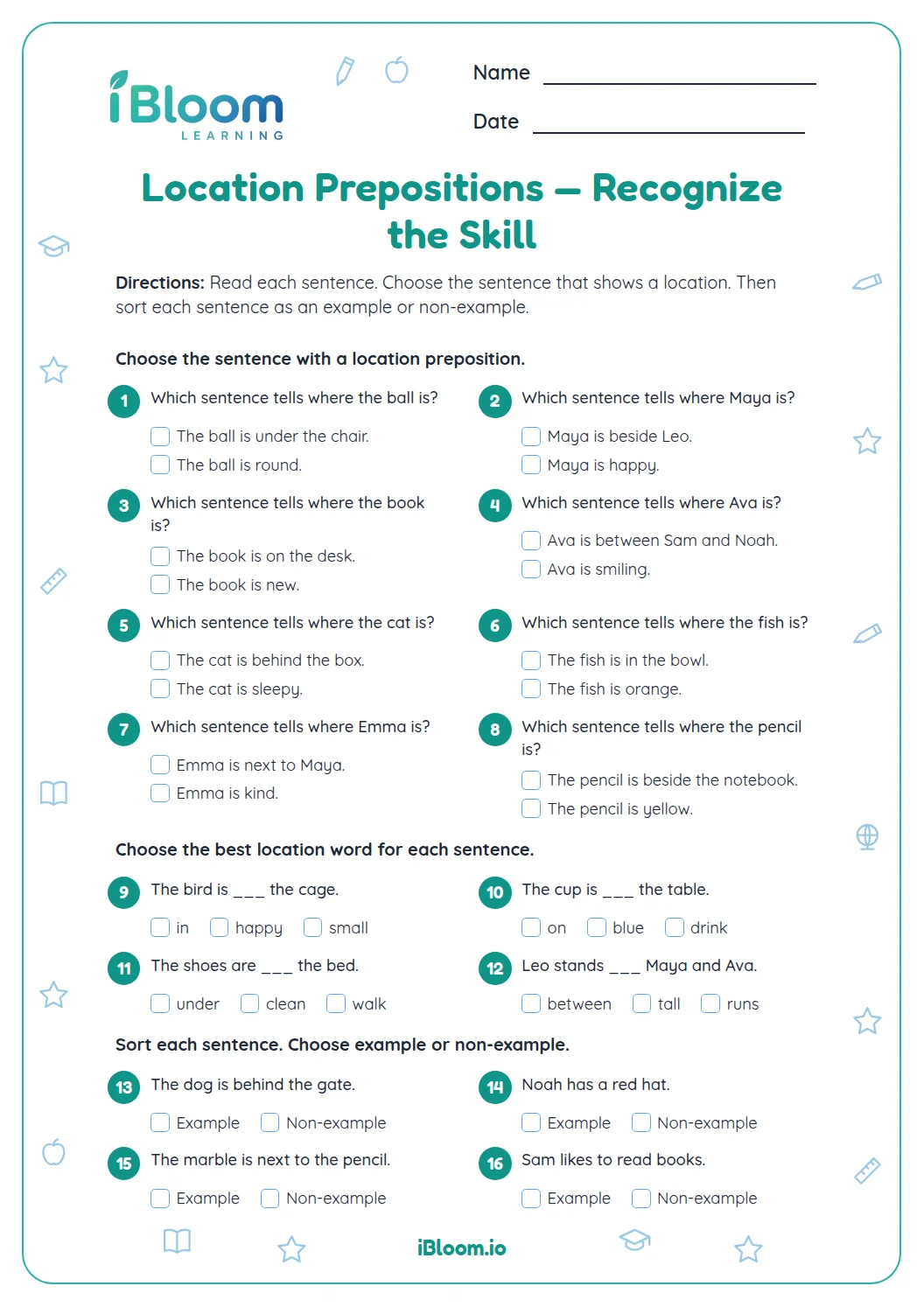
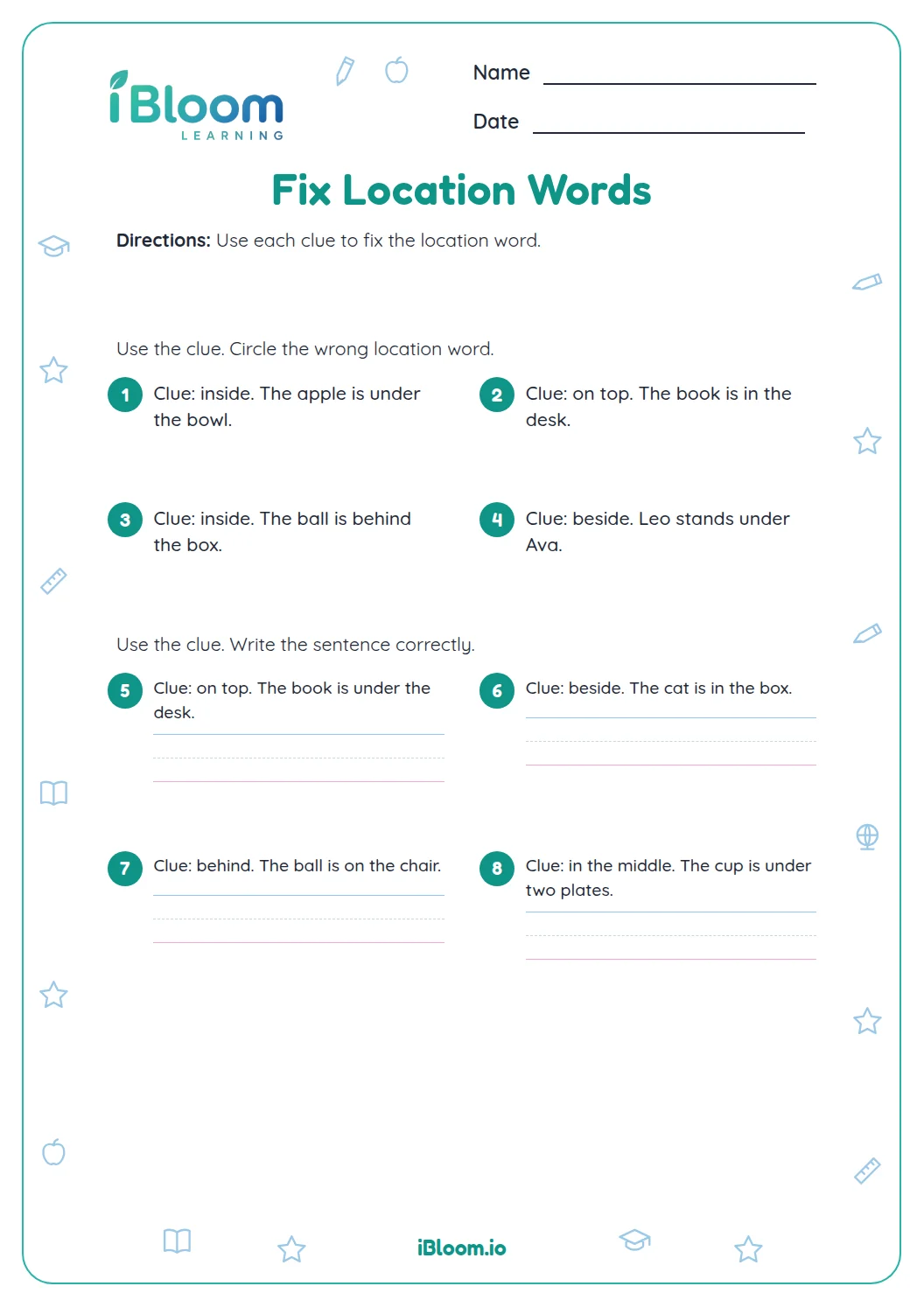
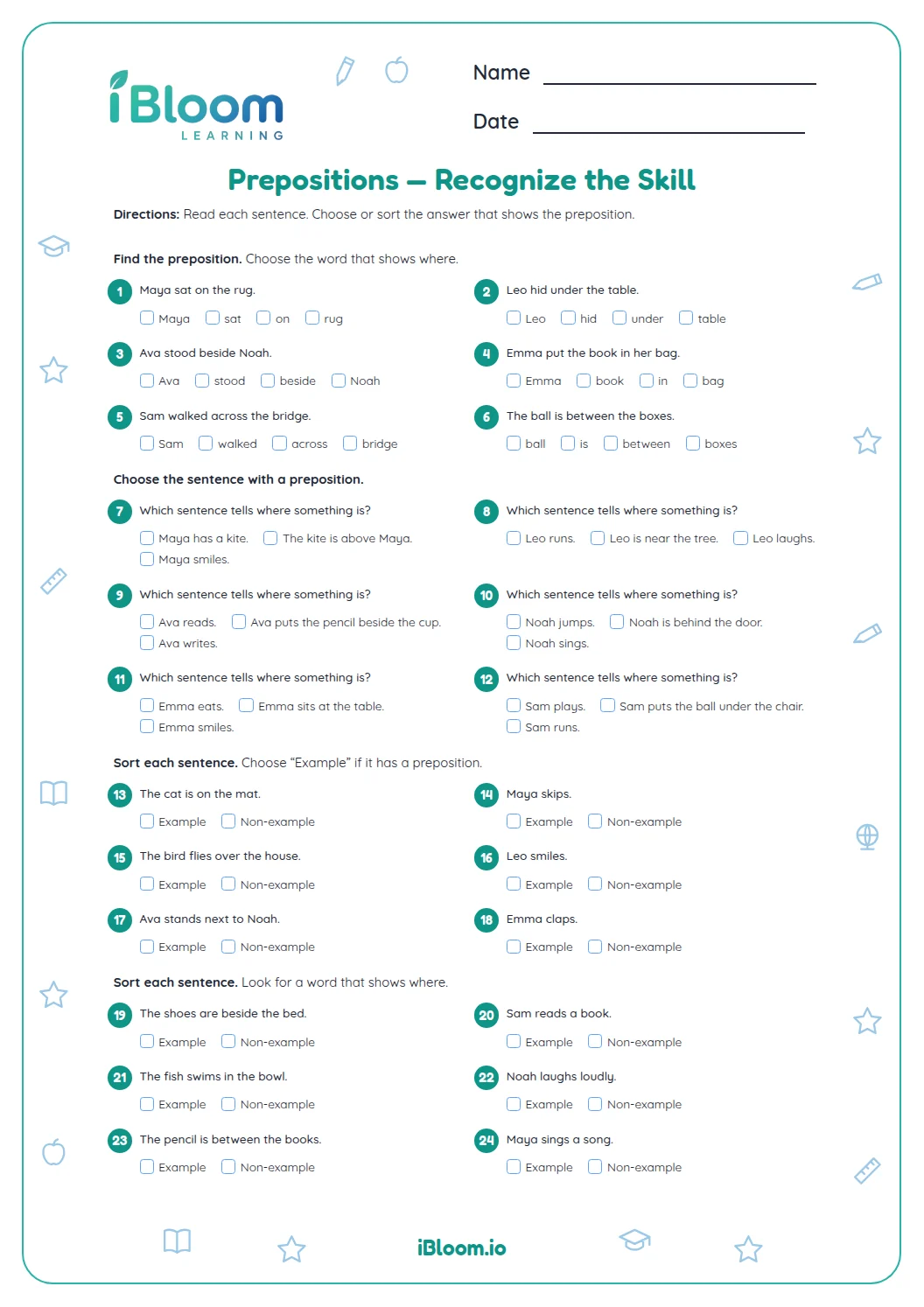
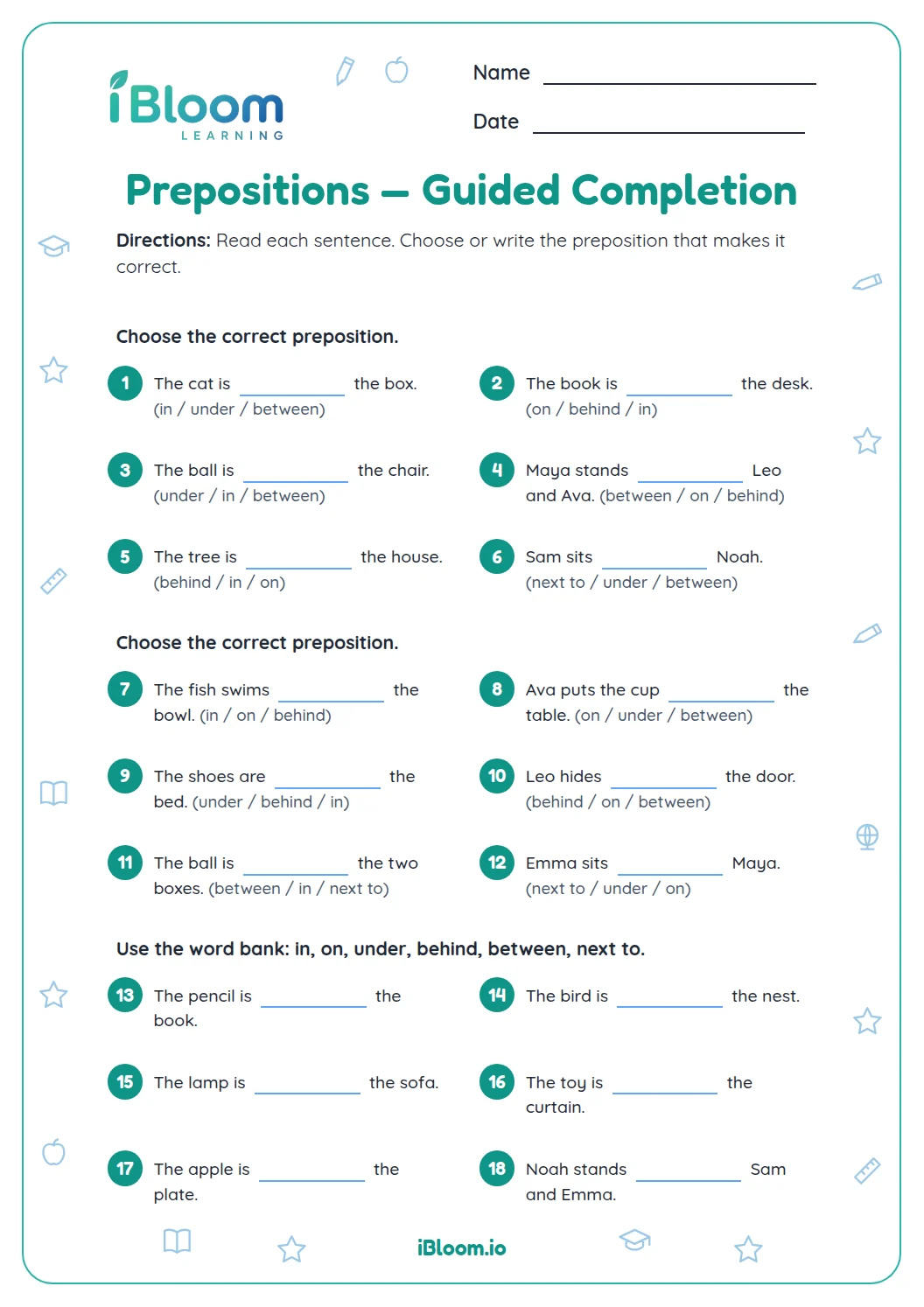
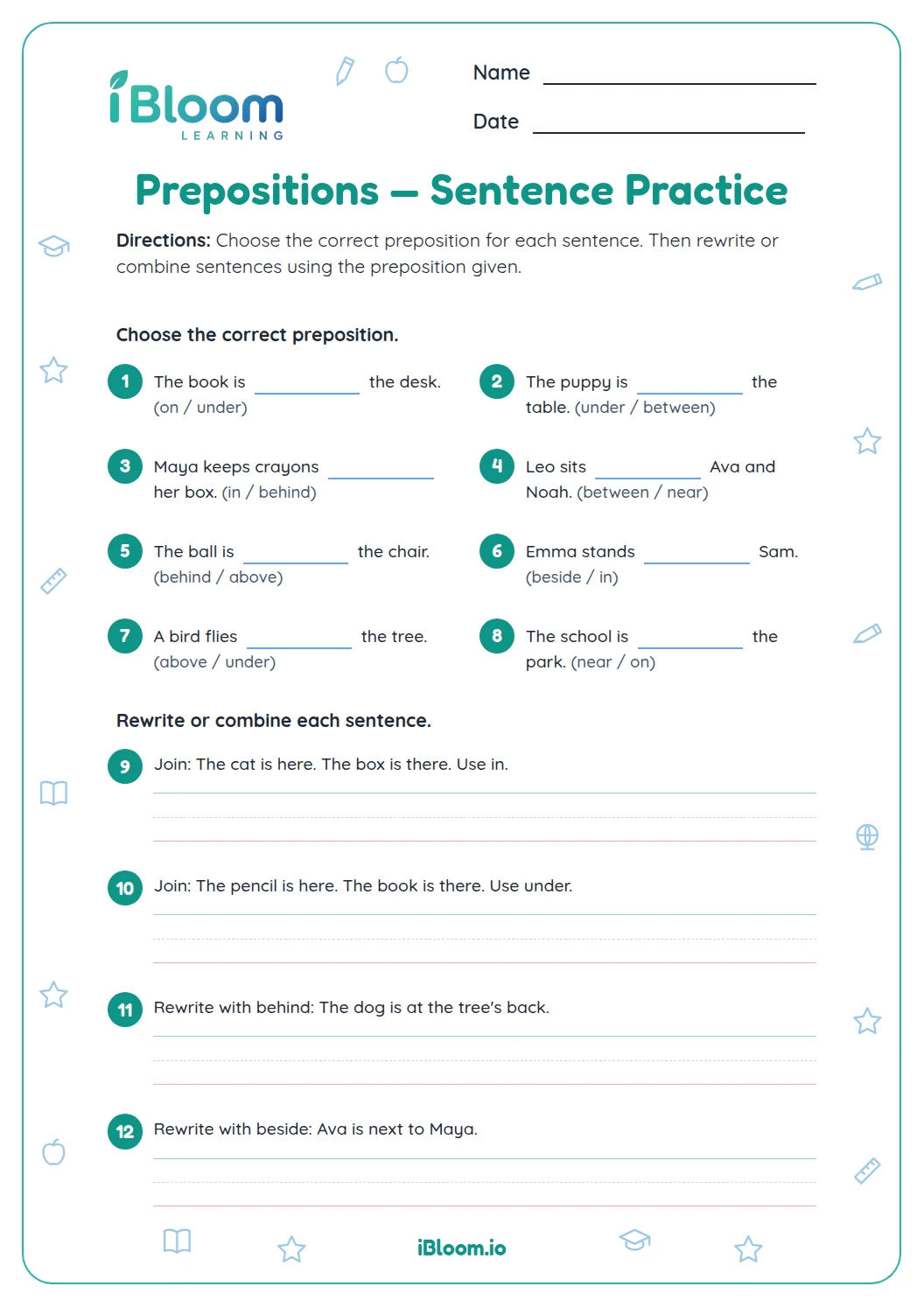
This Grade 1 printable practices location prepositions in complete sentences. Children choose a word that tells where something is, match a sentence to a location, edit capitalization and punctuation, and combine two related ideas. Its 16 items keep the old sheet’s sentence practice but vary the prompts and include clear answer choices. The worksheet aligns with CCSS L.1.1.i, using frequently occurring prepositions, and has a separate answer key with sample sentence corrections.
Aligned to L.1.1.i
Which word tells where it is?
A preposition can show the position of one thing compared with another. For “The apple is ___ the bowl,” choose in if the apple is inside it. Part A gives a small set of choices so students can focus on the location relationship.
- 1The apple is ___ the bowl. (in / under)
- 2An apple inside the bowl is in it.
- 3The apple is in the bowl.
How do you make the whole sentence clear?
Read the whole sentence after filling its location word. In Part B, choose the sentence that restates the same position. Part C asks children to fix capitalization and punctuation; Part D asks them to combine two ideas while keeping both location relationships clear.
- 1Rewrite: maya is behind leo
- 2Capitalize the names and add a period.
- 3Maya is behind Leo.
What does each part ask students to do?
Part A has six location-word choices. Part B has four meaning matches. Part C has four sentence edits for capitals and periods. Part D has two sentence-combining items; for example, question 15 should keep both near the box and behind the box.
How to use this worksheet
- 1Read the whole sentence, including the words before and after the blank.
- 2Picture the two things and their positions.
- 3Choose the preposition that matches the relationship.
- 4For editing, check the first letter and the ending punctuation.
- 5When joining ideas, keep the location word and avoid repeating the same idea.
- 6Use the key to compare meaning; accept other complete sentences that preserve the stated location.
Common mistakes and quick fixes
The mistake
Choosing a word by sound without checking the relationship, such as “in” when an object rests on top.
The fix
Say where each object is and compare that meaning with the sentence.
The mistake
Using between for only one reference object.
The fix
Between names a position with something on each side; use beside for next to one thing.
The mistake
Rewriting a sentence but forgetting its capital or period.
The fix
Point to the first word and last word, then check the first letter and ending mark.
Curriculum alignment
This sheet practices the skill described in the standard below.
Use common prepositions to show where people and objects are.
On this sheet: Students choose and use location prepositions in complete sentences.
Show the official wordingHide the official wording
Use frequently occurring prepositions (e.g., during, beyond, toward ).
What to practice next
Make more practice
Further reading
Questions parents and teachers ask
What is a preposition of place?
A preposition of place tells where one thing is in relation to another. This worksheet uses in, on, under, between, behind, and beside in short sentences. Children choose a location word, recognize a matching paraphrase, then edit or combine sentences using the same relationships.
How many questions are included?
There are 16 questions in four parts: six location-word choices, four meaning matches, four sentence edits, and two sentence combinations. The answer key includes the selected choices and sample corrected sentences. The worksheet and key each fill two pages for independent checking.
How should a child choose between “in” and “on”?
Ask whether the object is inside a container or resting on its surface. An apple inside a bowl is in the bowl; a book resting on a desk is on the desk. Question 1 and question 2 use these two familiar relationships.
What does “between” mean in question 4?
Between means in the space separating two people or things. In the sentence, Maya stands between Leo and Ava, so Leo and Ava are on either side of her. The other choice, in, does not express that position correctly here.
What sentence should students write for question 15?
A clear answer keeps both locations: “The cat is near the box and behind the box.” Saying “near and behind the box” leaves out the object connected to near. The key now gives the complete sentence, and another grammatical answer that preserves both locations is acceptable.
Does the worksheet have an answer key?
Yes. A separate two-page key marks the location choices and meaning matches, then offers sample edits and combined sentences. For written items, check that capitals and punctuation are correct and that the sentence still communicates each location named in the prompt.