




About this worksheet
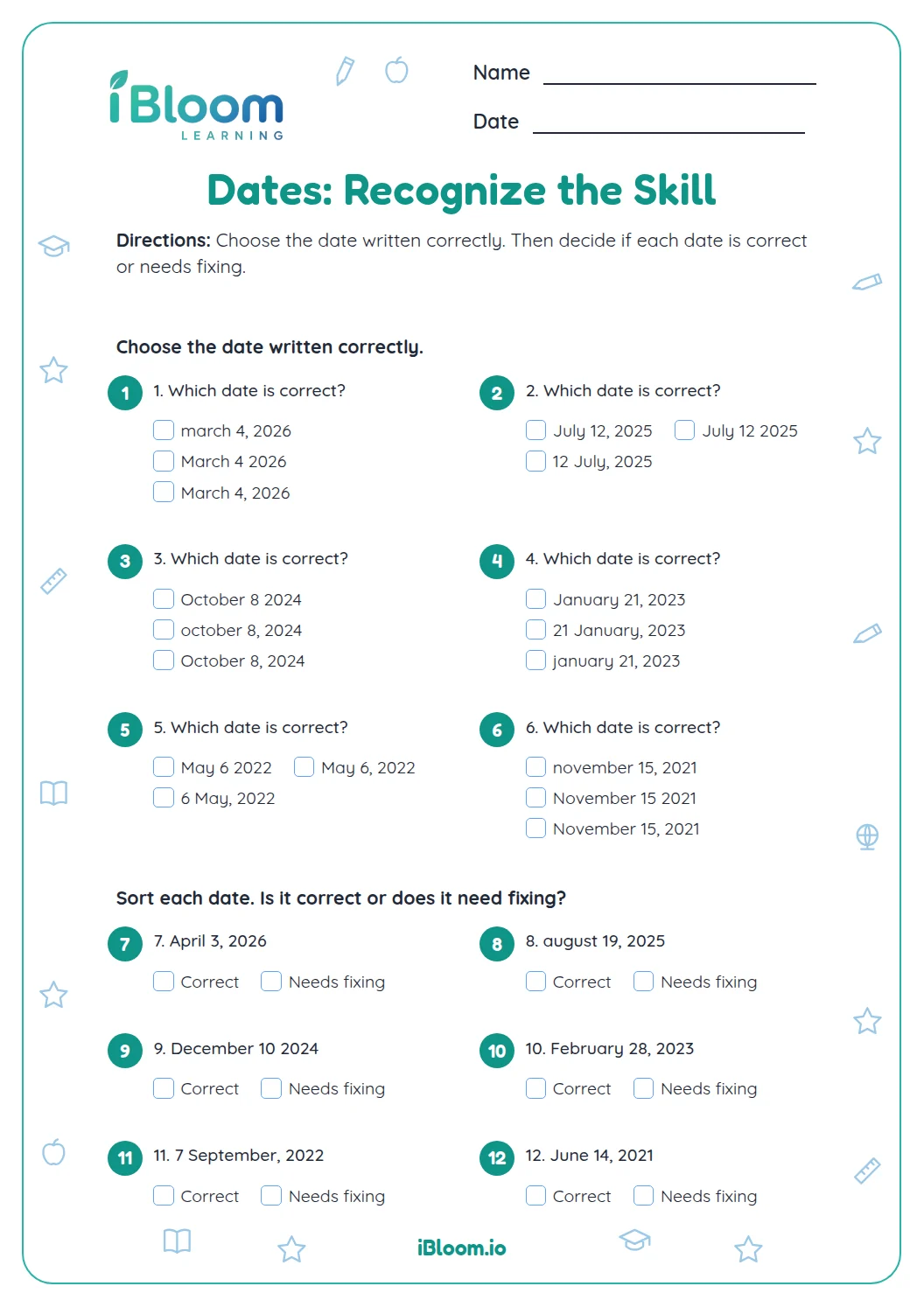
This Grade 1 printable practices conventional US date writing: capitalize the month, place the day before the year, and use a comma between them. Learners complete dates, recognize correct formats, edit errors, and write sentences that include a date. It contains 14 questions across three worksheet pages, followed by a separate answer key. These writing conventions align with CCSS L.1.2.
Aligned to L.1.2
What is the standard date order?
Write the month first, then the day, then the year. Capitalize the month and add a comma after the day: May 21, 2026.
How can a date be checked?
Check the three parts in order, then look for the comma before the year. In “april 12 2026,” capitalize April and add the comma: April 12, 2026.
How can a date fit into a sentence?
Keep the date format intact and place it in a complete sentence. For example: “Our class trip is on November 2, 2026.”
How to use this worksheet
- 1Read the whole date before editing it.
- 2Check the month’s capital letter.
- 3Put the month before the day and year.
- 4Add a comma after the day.
- 5Use a complete sentence when the prompt asks for one.
Common mistakes and quick fixes
The mistake
Leaving the month lowercase.
The fix
Capitalize the month name.
The mistake
Leaving out the comma.
The fix
Place a comma between the day and year.
The mistake
Putting the day before the month.
The fix
Use month, day, year order in this US format.
Common Core alignment
This worksheet practices L.1.2 through the questions on the printable.
The questions apply L.1.2 to writing dates practice.
On this sheet: The worksheet items directly practice writing dates.
Show the official wordingHide the official wording
Demonstrate command of the conventions of standard English capitalization, punctuation, and spelling when writing.
What to practice next
Make more practice
Further reading
Questions parents and teachers ask
What date format does this worksheet teach?
The worksheet teaches US month-day-year order, capitalized month names, and a comma between the day and year. Learners complete, recognize, correct, and use dates such as November 2, 2026. Learners can check each completed date against the model format before moving on.
Why does a date need a comma?
The comma separates the day from the year: November 2, 2026. Several questions ask learners to check the comma while keeping month, day, and year in order. Learners can check each completed date against the model format before moving on.
How many questions ask learners to rewrite a date?
Six prompts ask learners to correct capitalization, comma use, or order. Other items ask them to complete dates, choose a correct version, or use a date in a sentence. Learners can check each completed date against the model format before moving on.
How many pages are included?
There are 14 questions across three worksheet pages, followed by a separate answer key. The sections move from completing and recognizing dates to correcting and using dates in sentences. Learners can check each completed date against the model format before moving on.
What should be checked in a sentence answer?
Check that the month starts with a capital letter, the day comes before the year, and a comma separates them. Then make sure the sentence is complete and ends with punctuation. Learners can check each completed date against the model format before moving on.