







About this worksheet
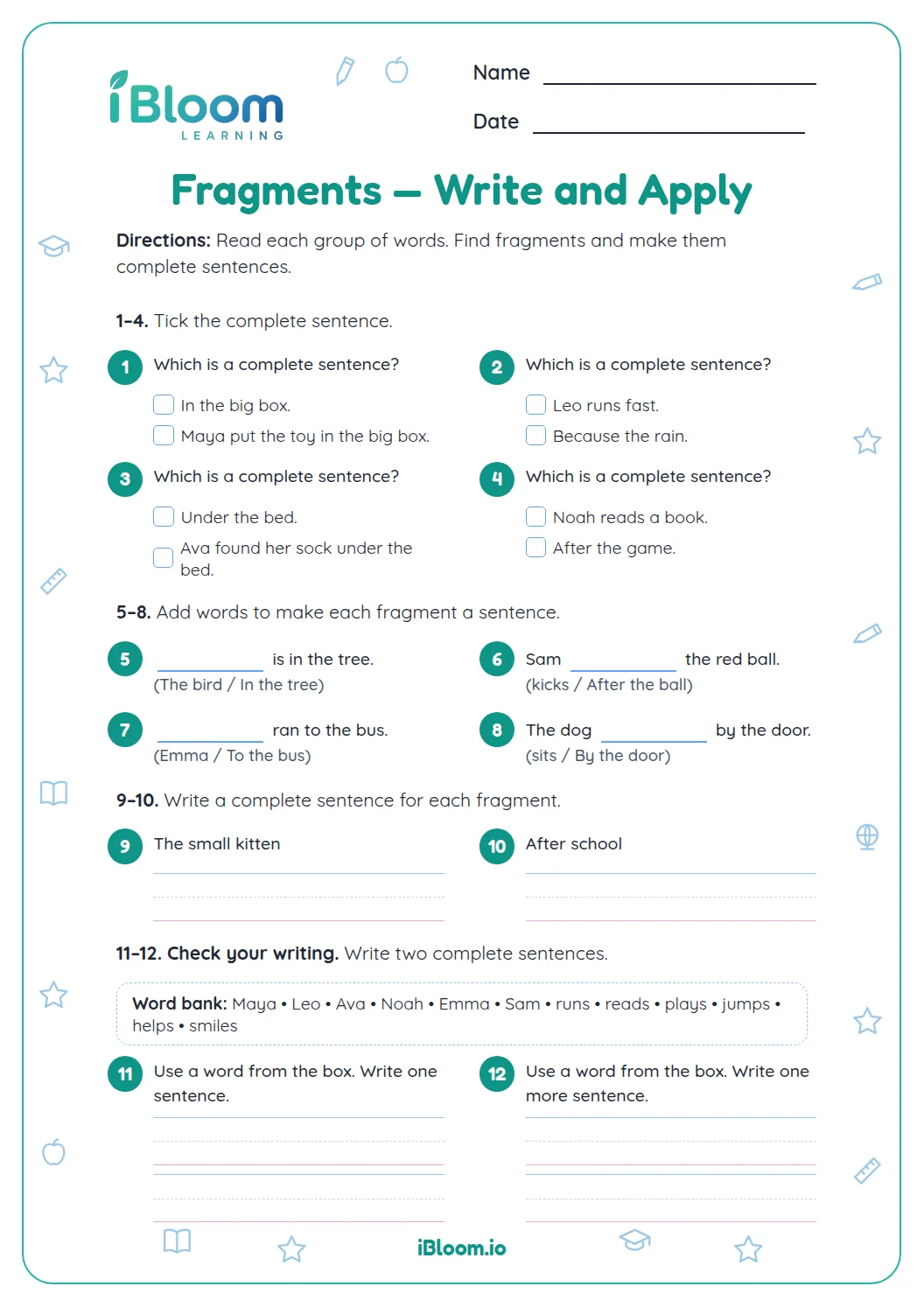
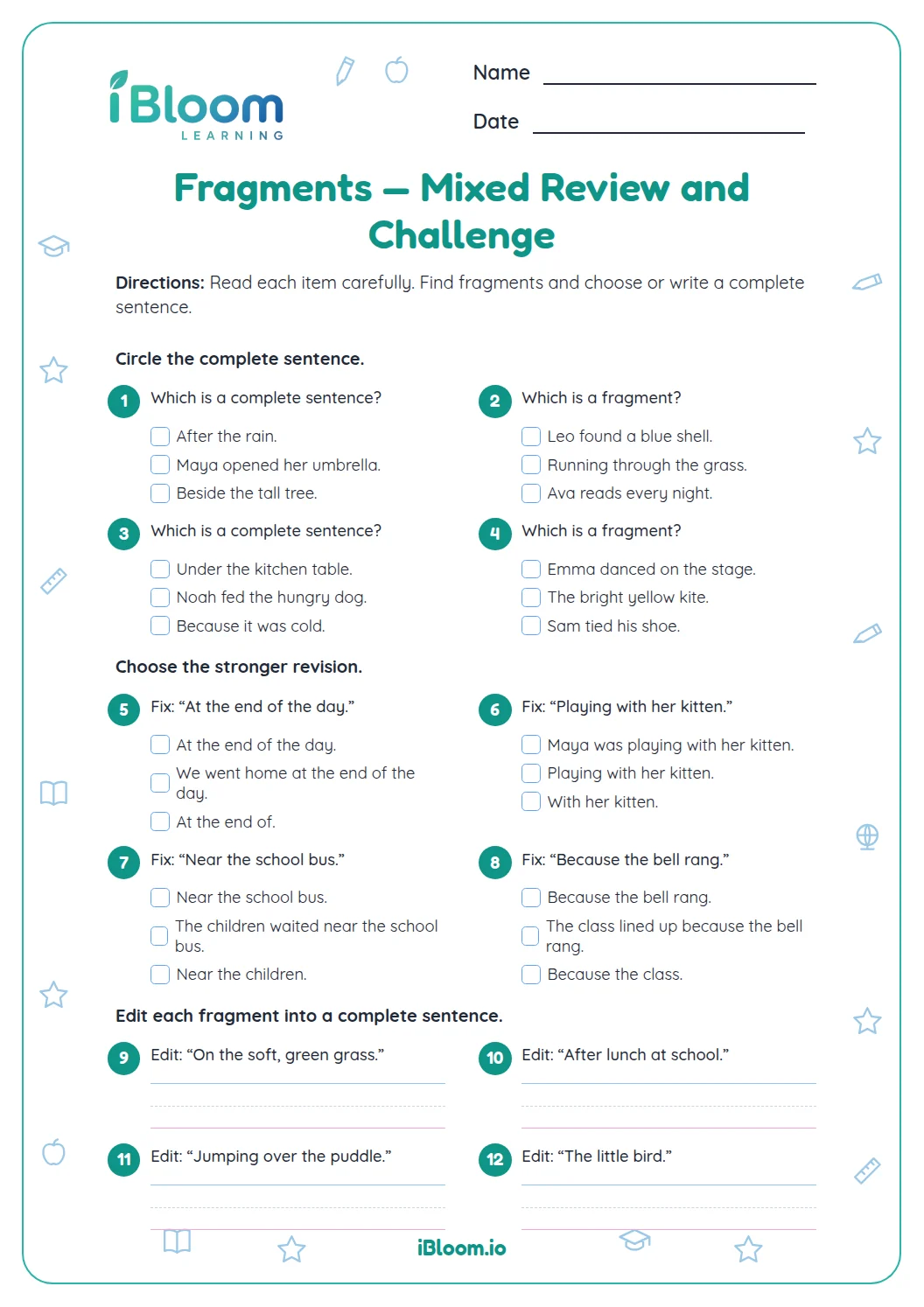
This free Grade 1 worksheet helps children notice whether a group of words expresses a complete thought. Part A asks them to label six examples as Sentence or Fragment. Part B presents four pairs and asks them to choose the complete sentence. Part C supplies two sentence beginnings with word choices to finish them. The examples use familiar people, pets, and actions so children can focus on meaning. Recognizing and completing these sentences supports Common Core L.1.1j. A separate answer key provides all 12 answers.
Aligned to L.1.1j
What makes these examples complete sentences?
A complete sentence tells a whole thought. In “The dog runs,” we know who the sentence is about and what the dog does. “The small dog” names someone but leaves us waiting to learn what happens.
Read each example as a statement on its own. All examples in Parts A and B have capitals and periods, so children must consider the thought. “Under the big tree” tells where; “After the rain” tells when. Neither tells who does what.
How can comparing two choices help?
Part B puts a fragment next to a complete sentence. Children can test both choices aloud and listen for missing information. The complete choices say what a named person or animal does, or describe what something is like.
- 1The dog. / The dog runs.
- 2The dog names who, but leaves the thought unfinished.
- 3The dog runs. tells who and what happens.
- 4Choose: The dog runs.
How do children finish the last two sentences?
Part C asks children to write one word from a pair. “The bird ___” becomes “The bird sings.” “My feet ___ wet” becomes “My feet are wet.” Reading the finished sentence aloud checks that the thought is complete.
When reviewing, ask for a spoken reason for one fragment answer. “It never tells what the dog does” is enough; children can explain the missing idea without memorizing grammar terms.
How to use this worksheet
- 1Say “The small dog” and ask what else the listener wants to know.
- 2Read Part A aloud if needed, keeping the choices visible.
- 3Compare both options in each Part B pair before choosing.
- 4Write the missing words in Part C and read the completed sentences aloud.
- 5Check the key and explain one corrected answer together.
Mistakes to notice and fix
The mistake
Calling “The small dog.” a sentence because it has a period.
The fix
Ask what the words tell us about the dog; punctuation alone cannot finish the thought.
The mistake
Choosing the longer group of words automatically.
The fix
Listen for a whole thought. “My cat naps” is complete even though it is short.
The mistake
Choosing blue in “My feet ___ wet.”
The fix
Try each word aloud. “My feet are wet” has a complete, sensible thought.
Common Core alignment
Recognize complete thoughts and supply words to finish simple sentences.
On this sheet: Students identify complete sentences and complete two simple sentences using word choices.
Show the official wordingHide the official wording
Produce and expand complete simple and compound declarative, interrogative, imperative, and exclamatory sentences in response to prompts.
What to practice next
Make more practice
Further reading
Questions parents and teachers ask
What is a fragment on this sheet?
A fragment is a word group that leaves the thought unfinished. “The small dog,” “Under the big tree,” and “After the rain” leave an idea unfinished: they name an animal, a place, or a time without saying what happens. Children choose Fragment for those examples in Part A.
Why do fragments have periods in Parts A and B?
The periods keep punctuation from giving away the answer. A capital letter and a period can surround an unfinished thought, such as “Under the big tree.” Ask children to listen to what the words say and decide whether the idea makes sense as a complete statement.
Can I read the questions aloud?
Yes, you can read each example and both choices aloud while your child decides. Keep the focus on whether the thought is complete. After choosing, ask your child to repeat the complete sentence or say what information is missing from a fragment on the sheet.
What should children write in Part C?
Children write sings in “The bird ___” and are in “My feet ___ wet.” Each prompt gives two words to test. After filling the blank, have the child read the whole sentence aloud so the activity connects recognizing a complete thought with producing one.
What is a useful next activity after checking?
Ask your child to turn one Part A fragment into a complete sentence orally. For example, “The small dog” could become “The small dog runs.” Accept different sensible endings. Then use the Making sentences link for more practice building a whole thought from familiar words.