








About this worksheet
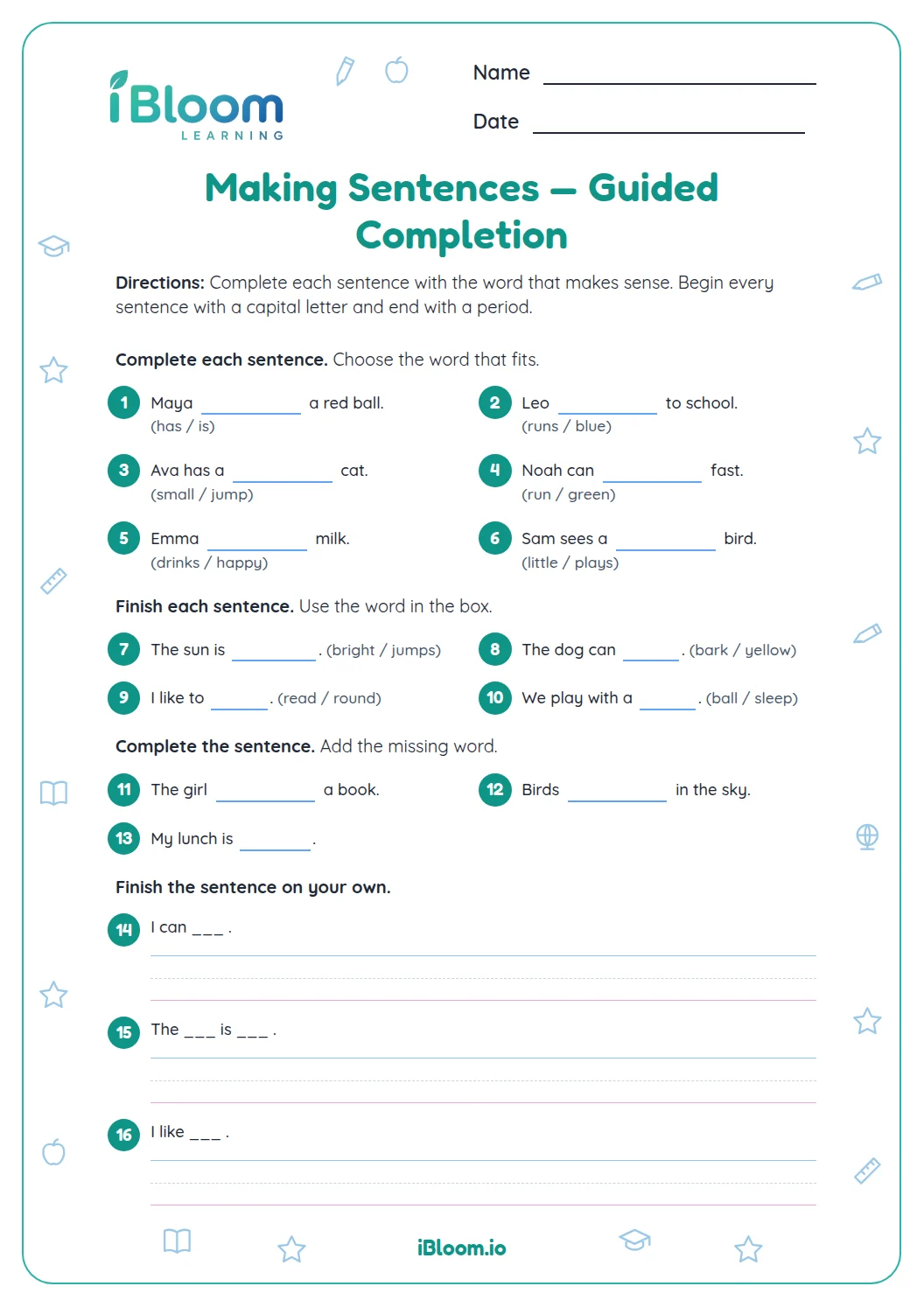
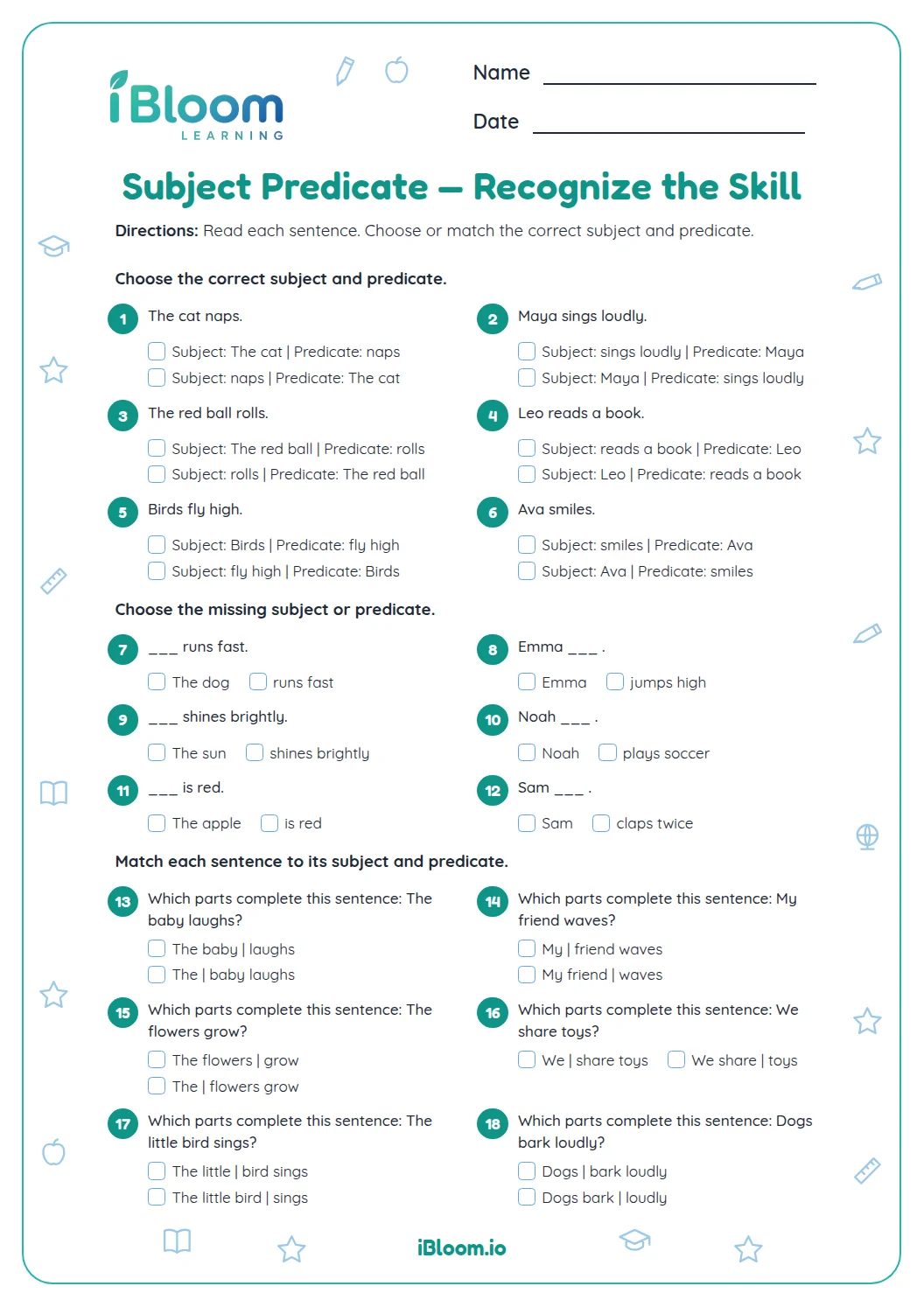
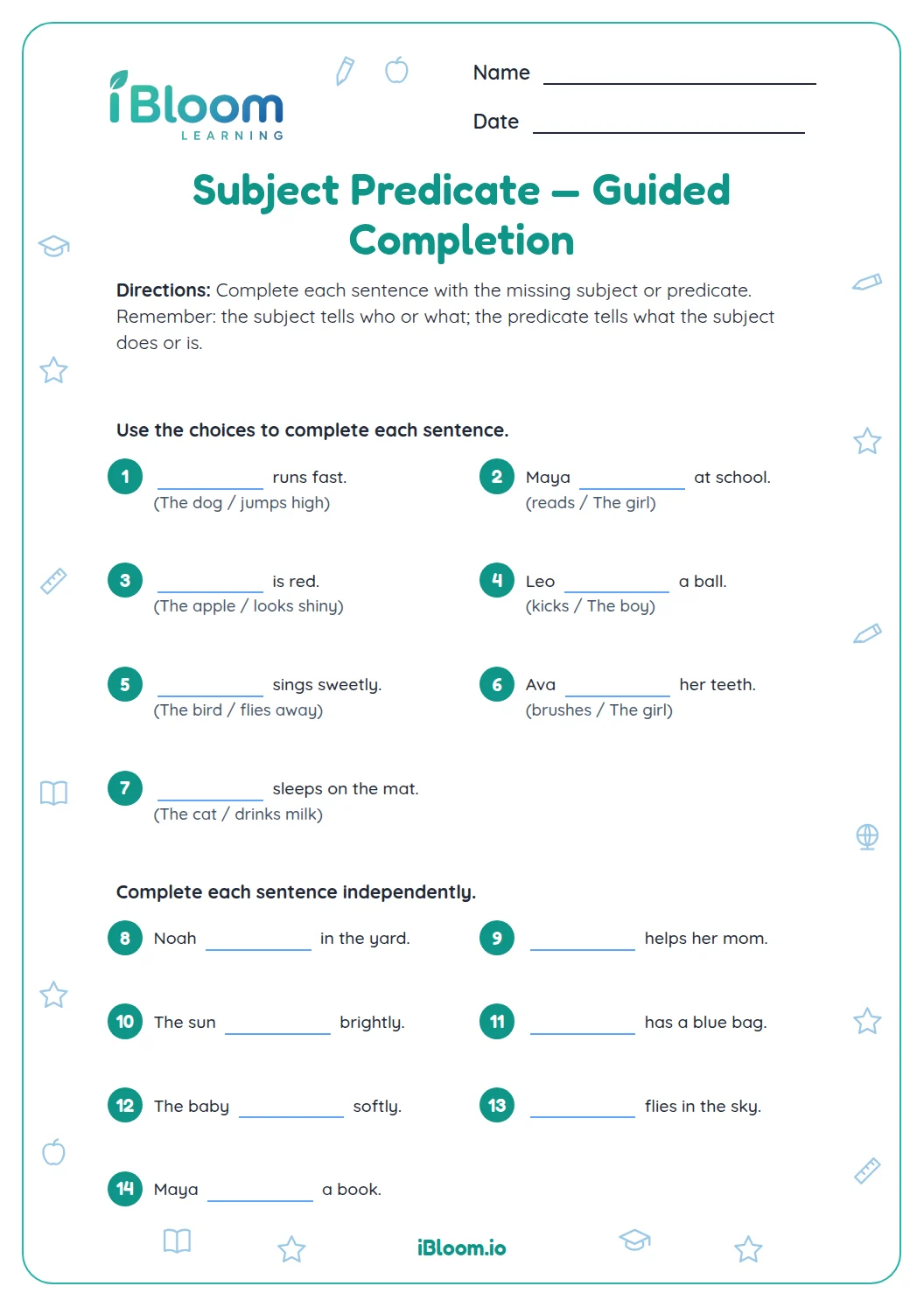
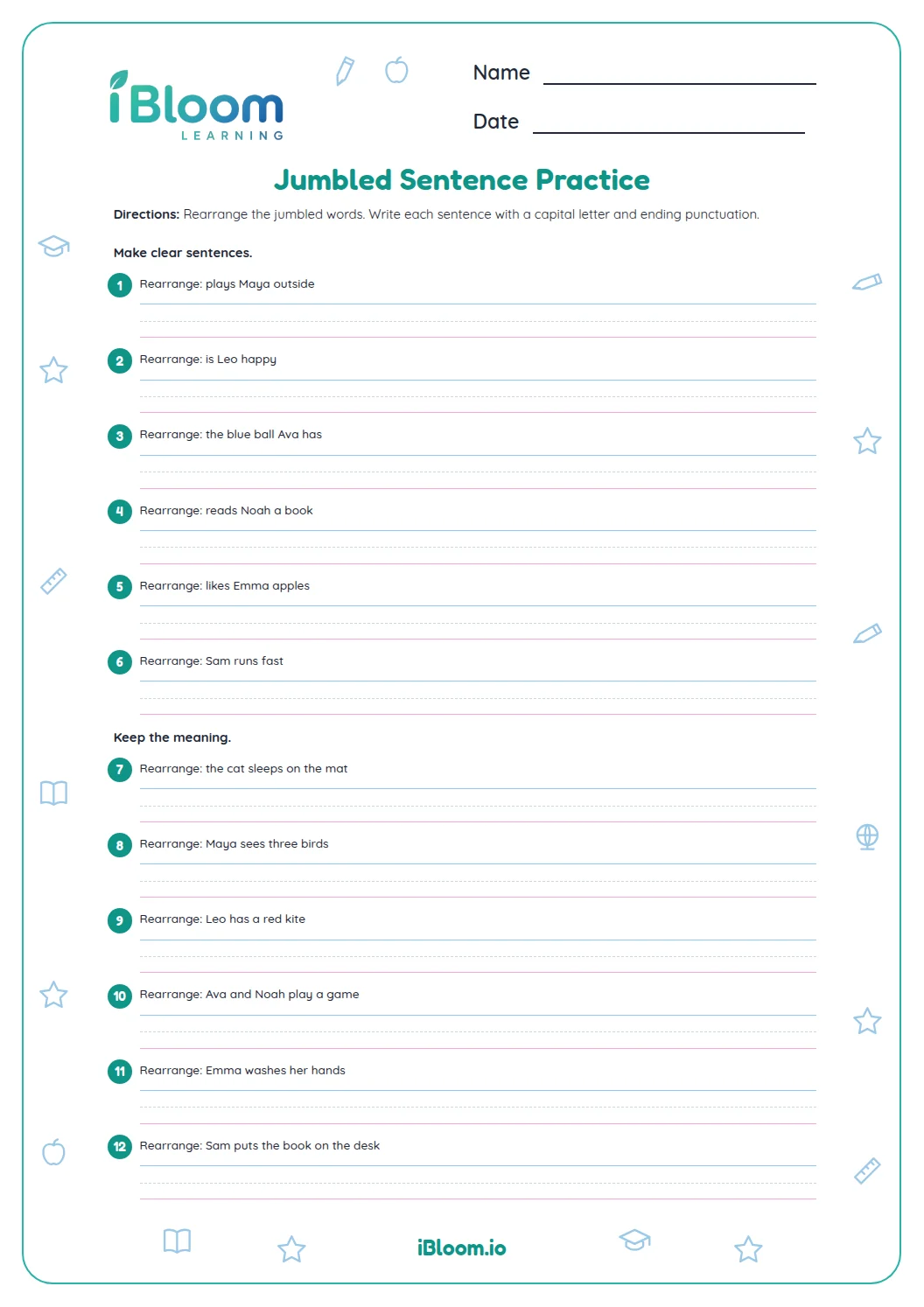
This free printable Grade 1 worksheet helps children turn word groups into complete, readable sentences. Part A asks them to choose four complete sentences. Part B gives four groups of words to put in order. Part C gives six sentences to rewrite with a capital at the start and a period or question mark at the end. The tasks practice producing sentences in CCSS L.1.1j and using end punctuation in L.1.2b. Short subjects and familiar actions keep the writing manageable. The answer key includes every complete sentence and correction.
Aligned to L.1.1j and L.1.2b
How can a child recognize a complete thought?
Read the choices aloud and ask whether the words tell something that makes sense on its own. “The dog” leaves the reader waiting for what the dog does. “The dog runs.” supplies that information.
Part A pairs complete sentences with fragments. Children choose before they write, so the first task lets them focus on meaning and structure.
How should children fix a jumbled sentence?
Have children say a possible sentence before copying it. A capital letter and an end mark give useful clues, but the words also need to make sense together. In Part B, all the supplied words belong in the final sentence.
- 1Words: cat / The / naps.
- 2Who is the sentence about? The cat.
- 3What does the cat do? It naps.
- 4Correct sentence: The cat naps.
How do children choose the ending mark?
Part C gives six sentences to rewrite with a capital at the start and a period or question mark at the end. Two statements and two questions are followed by one more statement and one more question for extra editing practice.
Ask children to finish each correction by checking both ends of the sentence. A correctly chosen question mark still needs a capital at the beginning. The key shows the full corrected sentence for comparison.
A short sentence-checking routine
- 1Read each pair in Part A and choose the words that make a complete thought.
- 2Say the Part B words in a sensible order before writing them.
- 3Use every word in each jumbled group exactly once.
- 4In Part C, decide whether the sentence tells or asks something.
- 5Rewrite with an opening capital and the right end mark, then read it aloud.
Mistakes to notice and how to help
The mistake
Choosing “The dog” as a complete sentence.
The fix
Ask what the dog does. “The dog runs.” gives the missing action.
The mistake
Writing “Naps the cat.” for the jumbled words.
The fix
Start with the supplied capital word The, then name the animal and its action.
The mistake
Ending “Where is my hat” with a period.
The fix
Read it as a question asking where. Add a question mark and capitalize Where.
Common Core alignment
Put words in order and rewrite complete statements and questions.
On this sheet: Parts B and C require children to produce complete sentences from prompts.
Show the official wordingHide the official wording
Produce and expand complete simple and compound declarative, interrogative, imperative, and exclamatory sentences in response to prompts.
Use periods for statements and question marks for questions.
On this sheet: Part C asks children to repair missing end punctuation.
Show the official wordingHide the official wording
Use end punctuation for sentences.
What to practice next
Make more practice
Further reading
Questions parents and teachers ask
How much writing is required?
Children choose answers for four questions and write sentences for ten questions. The writing begins with four word-order tasks, followed by six corrections. Each sentence is short, and the worksheet gives writing lines. Children can say an answer aloud first, then copy their complete sentence carefully.
Are the jumbled sentences open-ended?
Each jumbled group has one intended order using all its words. Capitals and end marks provide clues, and the resulting sentence must make sense. For “cat / The / naps.” the answer is “The cat naps.” Ask children to say the complete thought before they write.
Which punctuation marks are practiced?
The correction tasks practice periods and question marks. Two sentences tell something, and two ask something. Children also correct the lowercase first letters. Read each sentence aloud together if needed, then have the child decide whether it is telling information or asking for an answer.
What if my child chooses a fragment?
Ask what information is missing from the words your child chose. For example, “The dog” names an animal but leaves the reader waiting to hear what happens. Compare it with “The dog runs.” Then let your child reread the original pair and choose the complete sentence.
What should I check on the answer key?
Compare the sentence meaning, word order, opening capital, and ending mark. The key prints the complete answers for the writing tasks, so you can check each feature separately. If one feature needs work, have your child repair that part and then read the full sentence again.