









About this worksheet
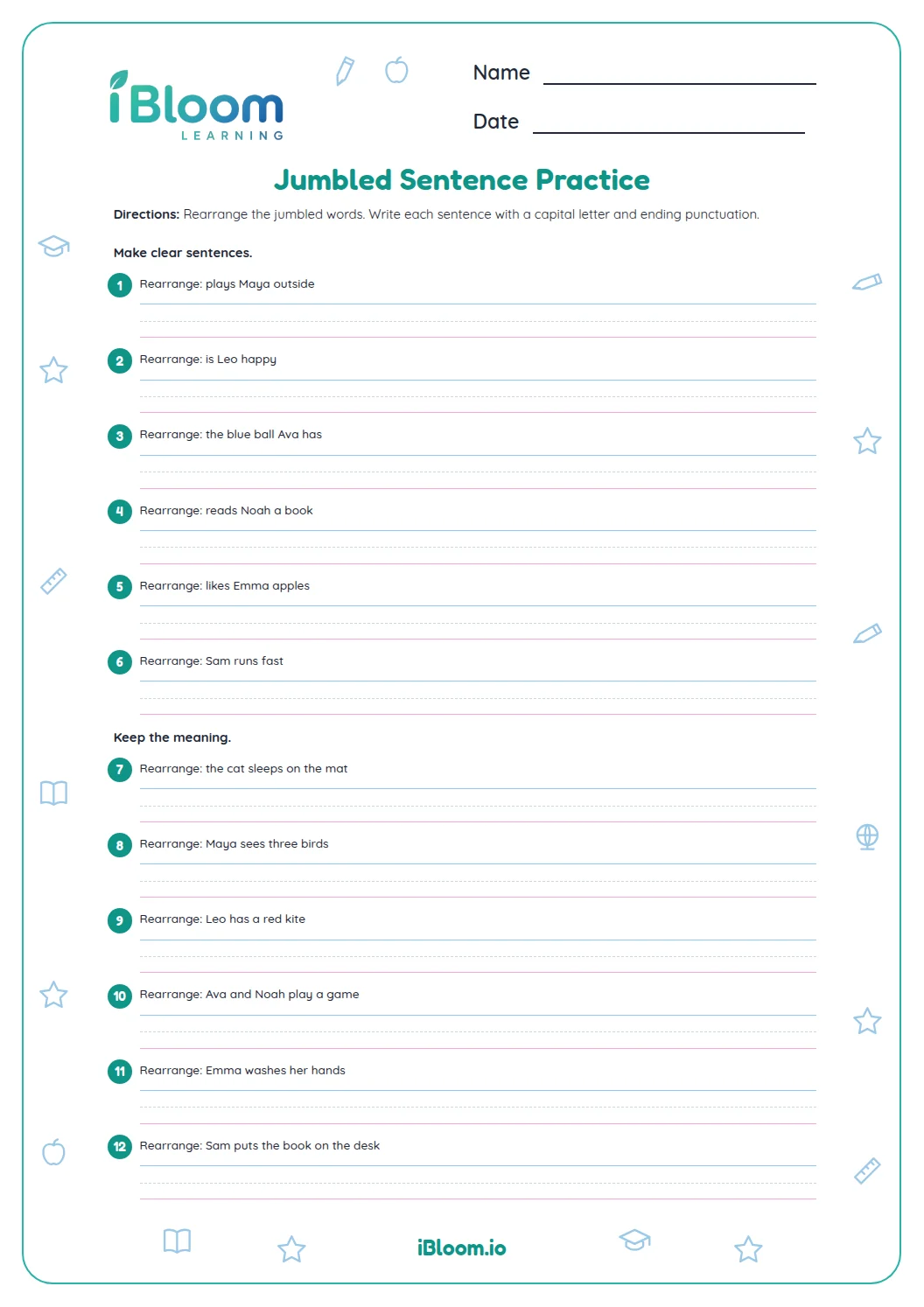
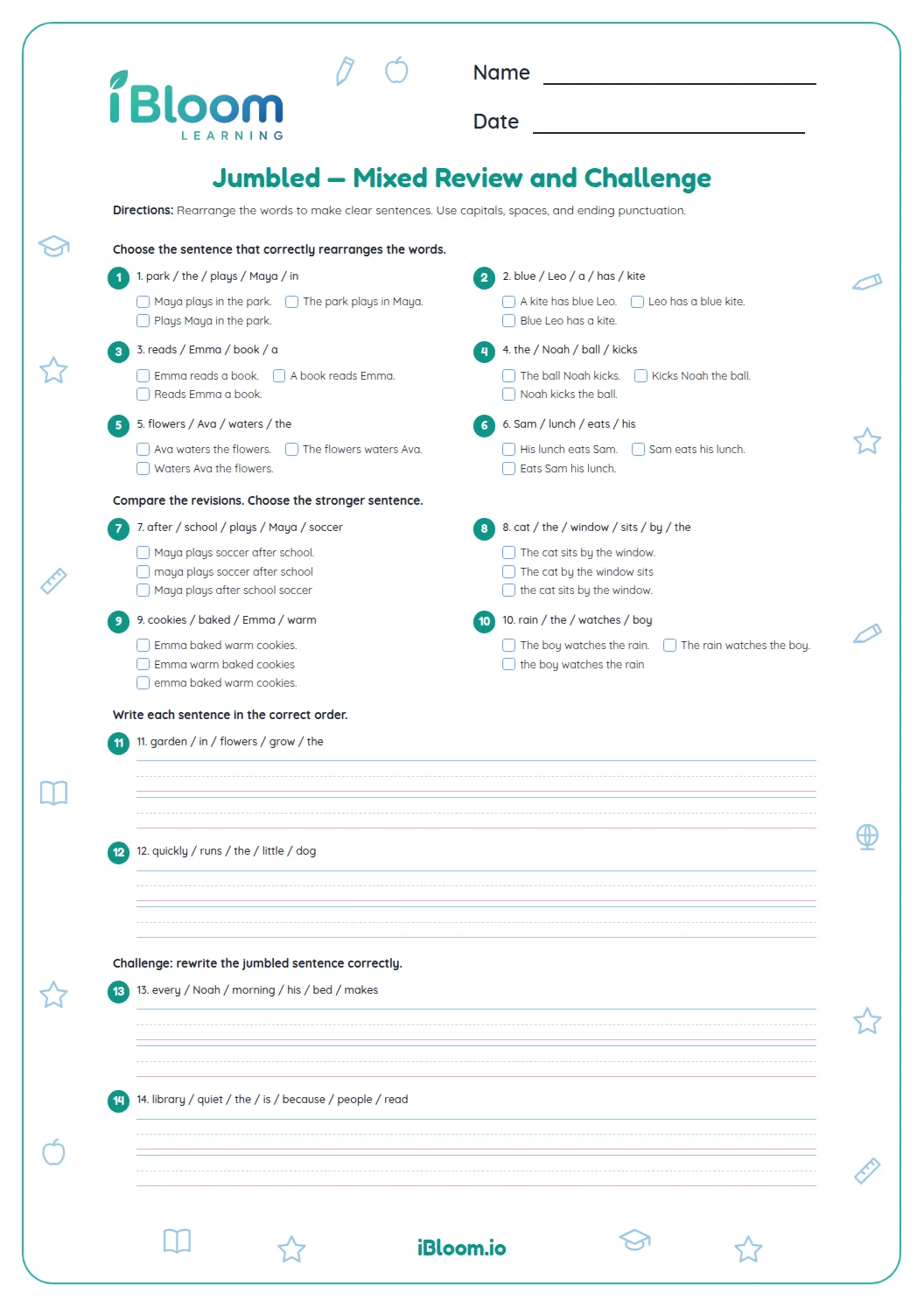
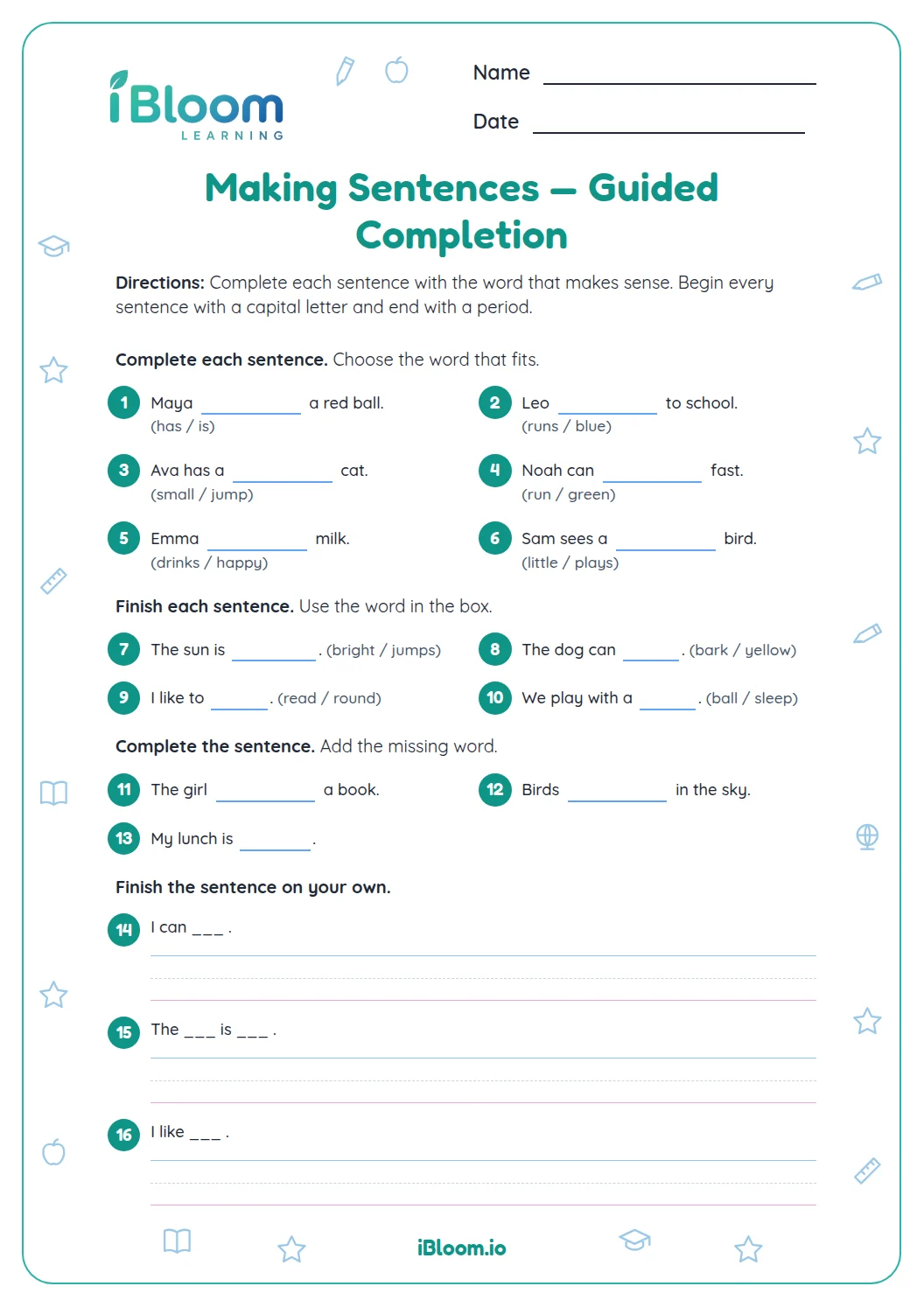
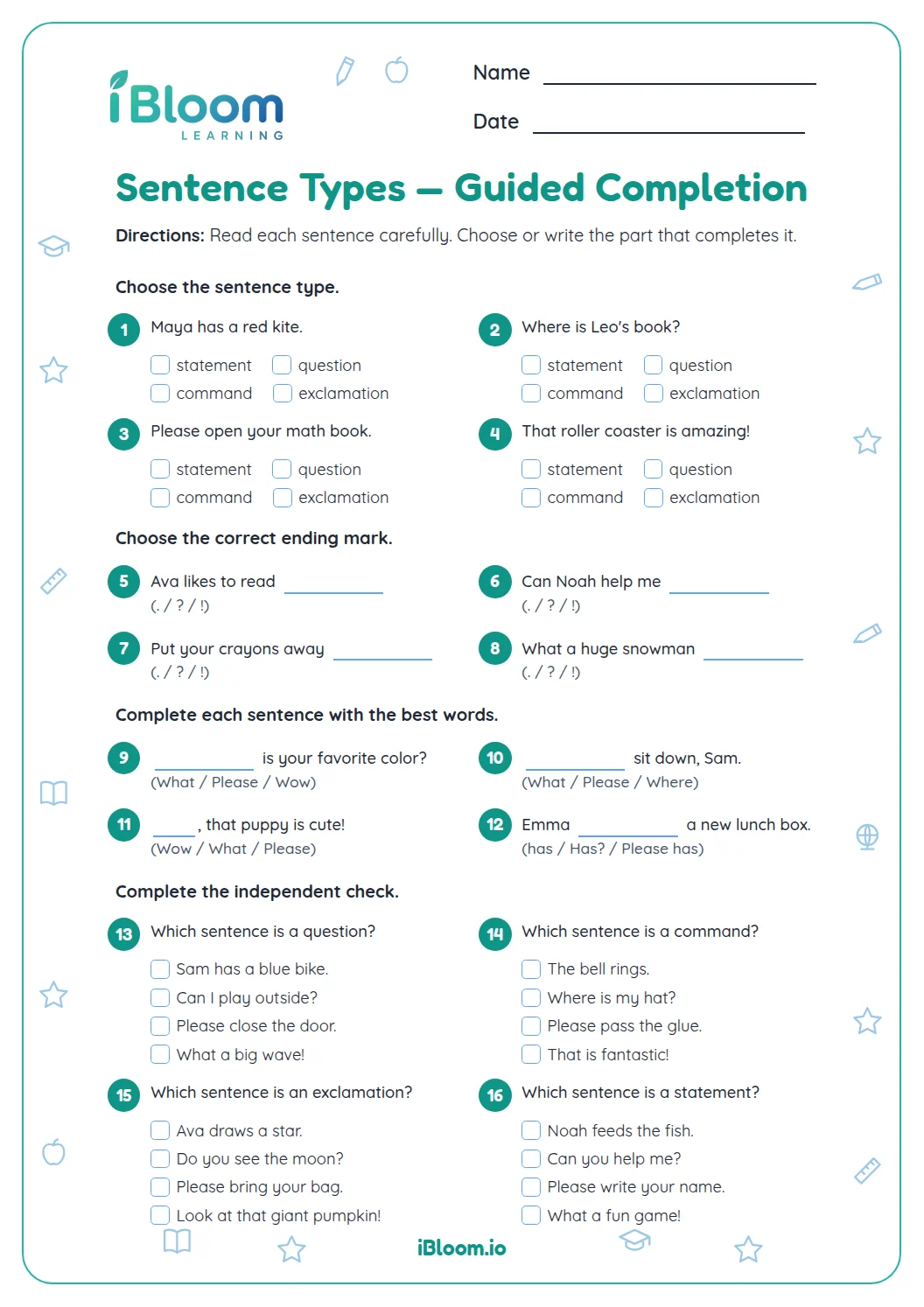
This free Grade 1 worksheet gives children 12 sentence tasks and one short paragraph to edit. Part A uses capitals and periods as clues for ordering four word groups. Part B asks children to fix four sentences, and Part C combines word order with editing in four more. Part D applies capitalization to three connected sentences about Sam’s pet fish. The work practices producing sentences under Common Core L.1.1j and using end punctuation under L.1.2b. A separate answer key shows the corrected sentences and paragraph.
Aligned to L.1.1j and L.1.2b
How do children find the right word order?
Start with who or what, then ask what that person or thing does. The capital and period in Part A give two extra clues. Read the result aloud before writing it.
- 1runs. / dog / The
- 2Who? The dog. What does it do? runs.
- 3Write: The dog runs.
What needs fixing in Part B?
The words are already in order in questions 5–8. Children copy each sentence with a capital at the beginning and a period or question mark at the end. Names such as Sam also need capitals.
Have your child say whether each sentence tells something or asks something. That decision explains the ending instead of making punctuation a guess.
How do children combine ordering and editing?
Questions 9–12 use lowercase word groups without end marks. A starting-word cue keeps the intended order clear. Children arrange the words, capitalize the beginning, and choose the end mark.
Use the key to check every word, not just whether the sentence sounds plausible. Each supplied word should appear exactly once.
What does the paragraph add?
Part D asks children to rewrite three connected sentences about Sam’s pet fish. Check the beginning of every sentence and both uses of the name Sam. Keep the printed periods and leave a space between sentences.
How to use this worksheet
- 1Read the Part A directions and name the capital and period clues.
- 2Say question 1 in order before writing it.
- 3Complete the remaining three word groups, using each word once.
- 4In Part B, check the first letter, any name, and the ending.
- 5In Part C, use the starting-word cue and reread the finished sentence.
- 6Rewrite the Part D paragraph, checking each sentence beginning and the name Sam.
Mistakes to notice and fix
The mistake
Copying “runs dog The” in the printed order.
The fix
Ask who runs. Put The dog together, then add runs.
The mistake
Writing “Where is my hat.” with a period.
The fix
Say the sentence as a question and replace the period with a question mark.
The mistake
Writing “sam can hop.” with a lowercase name.
The fix
Capitalize Sam and keep the period after hop.
Common Core alignment
Build complete sentences by putting supplied words in a sensible order.
On this sheet: Parts A and C ask children to produce complete sentences from supplied words.
Show the official wordingHide the official wording
Produce and expand complete simple and compound declarative, interrogative, imperative, and exclamatory sentences in response to prompts.
Use periods and question marks to finish the corrected sentences.
On this sheet: Parts B and C require children to supply sentence endings.
Show the official wordingHide the official wording
Use end punctuation for sentences.
What to practice next
Make more practice
Further reading
Questions parents and teachers ask
How many sentences will my child write?
Your child writes 12 separate sentences and a short paragraph of three sentences. The first three parts cover word order, capitals, and end punctuation. The final part carries the editing into connected writing about a pet fish, with space to copy all three sentences together.
Should children use every word in a jumble?
Yes, each supplied word belongs in the corrected sentence exactly once. The slashes separate the words and should not be copied. After writing, children can touch each original word and find its match in their answer, then reread the whole sentence to check its meaning.
Why do some questions give a starting word?
The starting word makes the intended sentence order clear. For example, Part C tells children to begin with we in one jumble and where in another. They still need to arrange the remaining words, capitalize the beginning, and decide whether the sentence needs a period or question mark.
Can I read the word groups aloud?
Yes, you can read each word while your child decides how to arrange it. Pause between the words so the printed jumble stays clear. Ask your child to say the completed sentence before writing, then check the capital letter and end mark together using the answer key.
What does the answer key show?
The answer key gives all 12 corrected sentences and the edited paragraph, including capitals and punctuation. Compare the words as well as the ending. In Part D, check that Sam begins with a capital both times and that each of the three sentences keeps its period.