




About this worksheet
This worksheet helps first graders spot verbs ending in -ing and use them to describe actions happening now. Part A asks students to choose a fitting action word. Part B moves from recognition to completing short sentences with an -ing verb.
Aligned to L.1.1.e
What is on the worksheet?
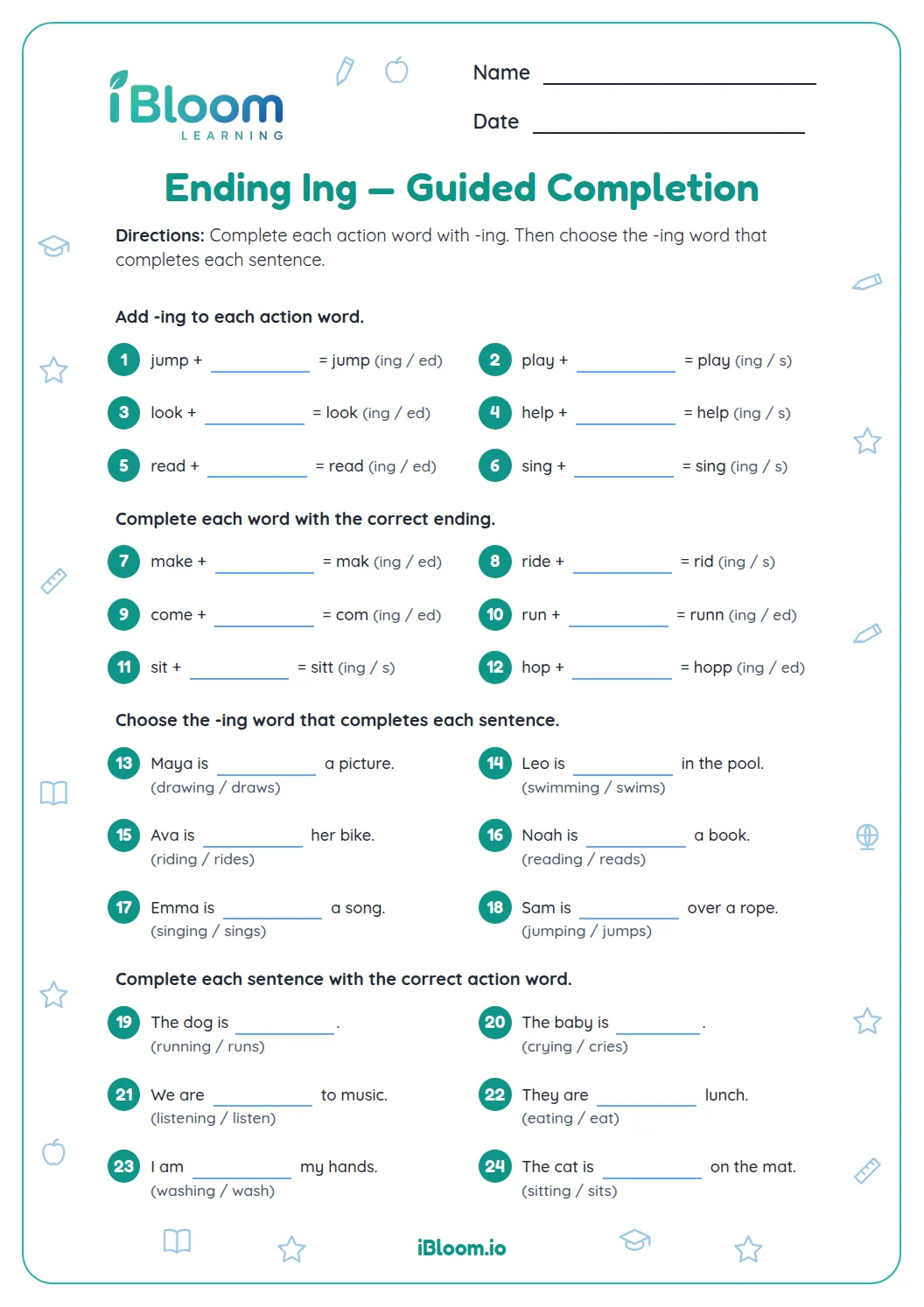
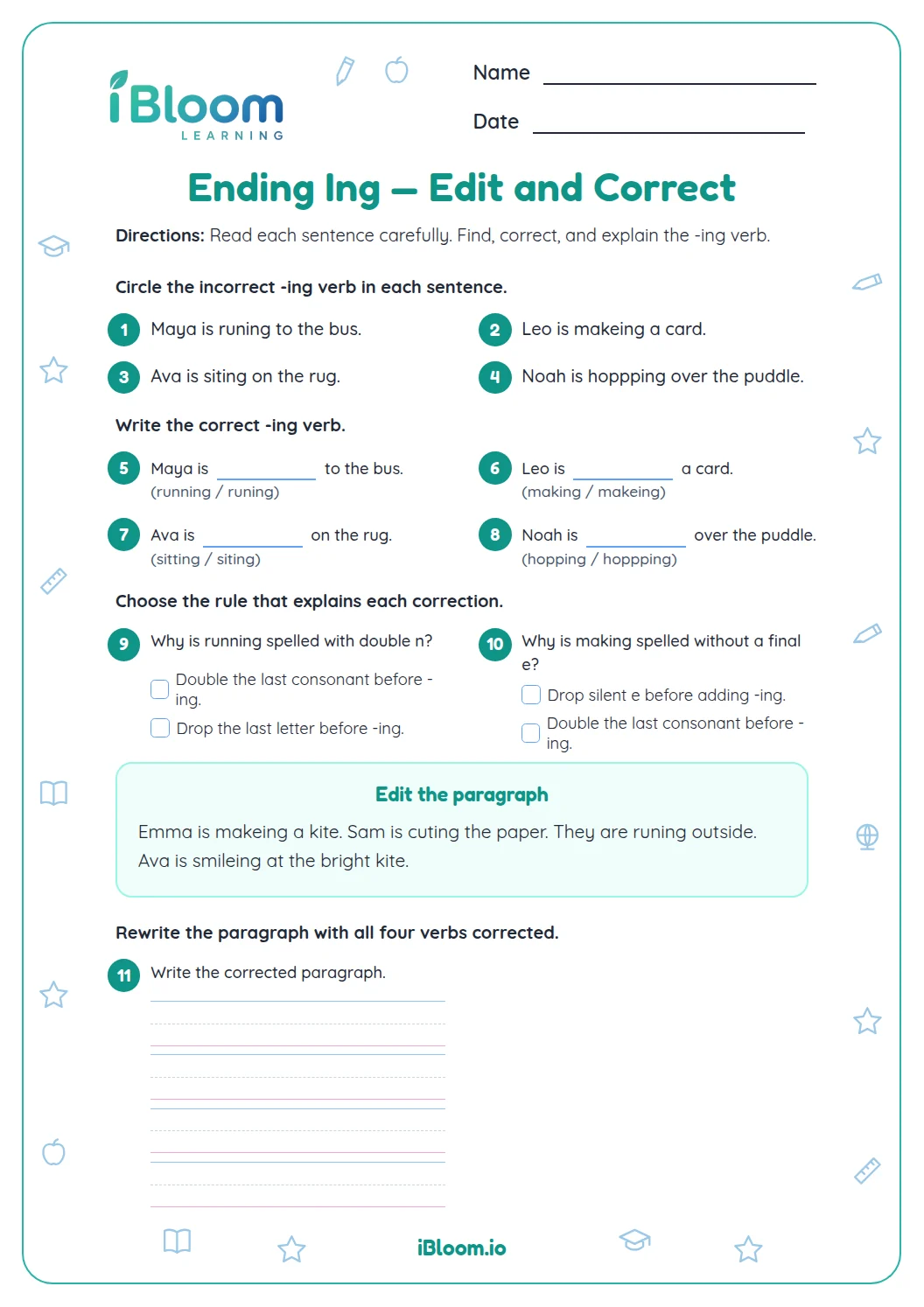
Part A asks students to recognize present-time action words that end in -ing. Part B gives short sentences and asks students to complete each one with a fitting action.
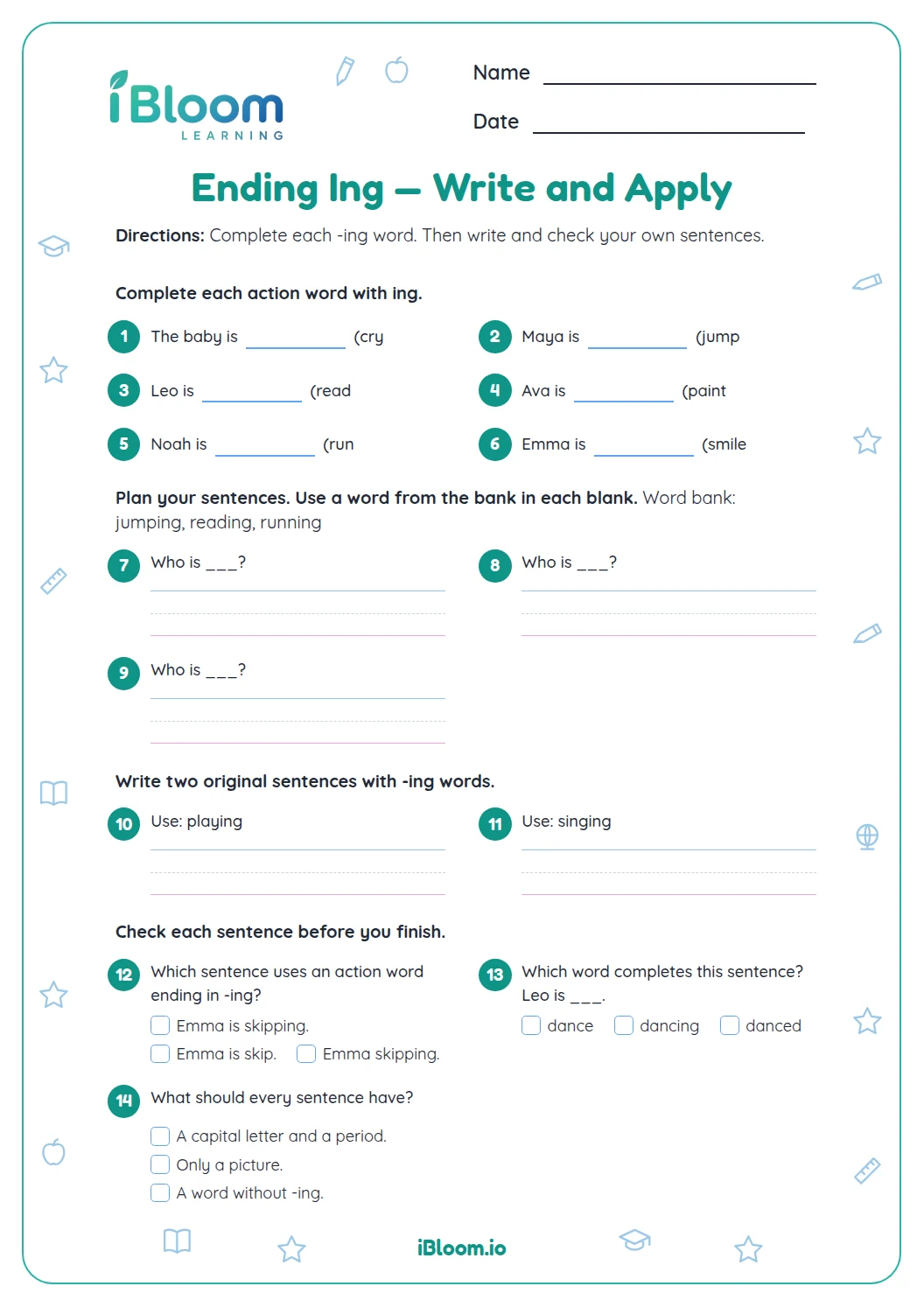
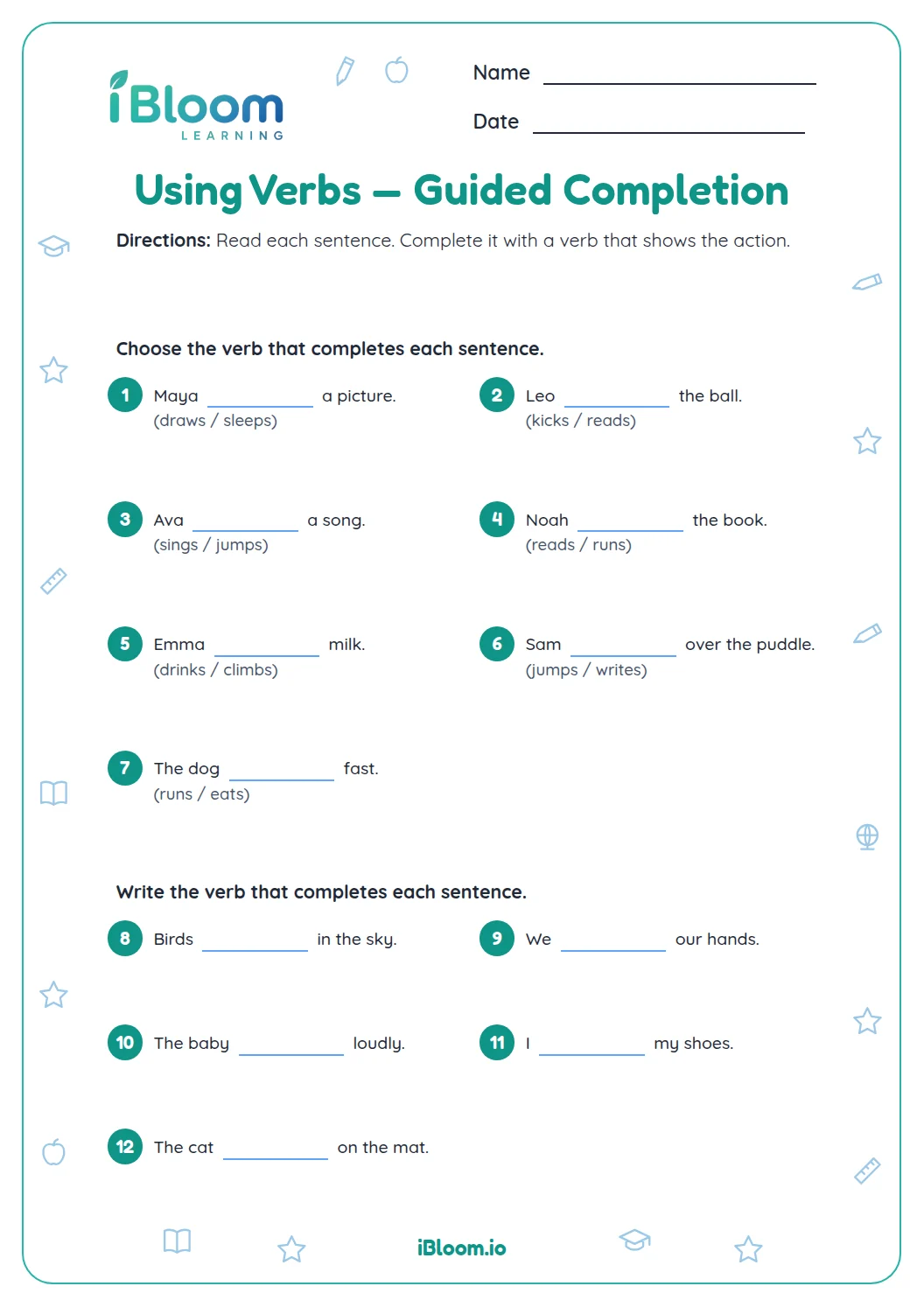
Part B asks students to complete six short sentences with an -ing verb. The key gives one fitting sample for each open response.
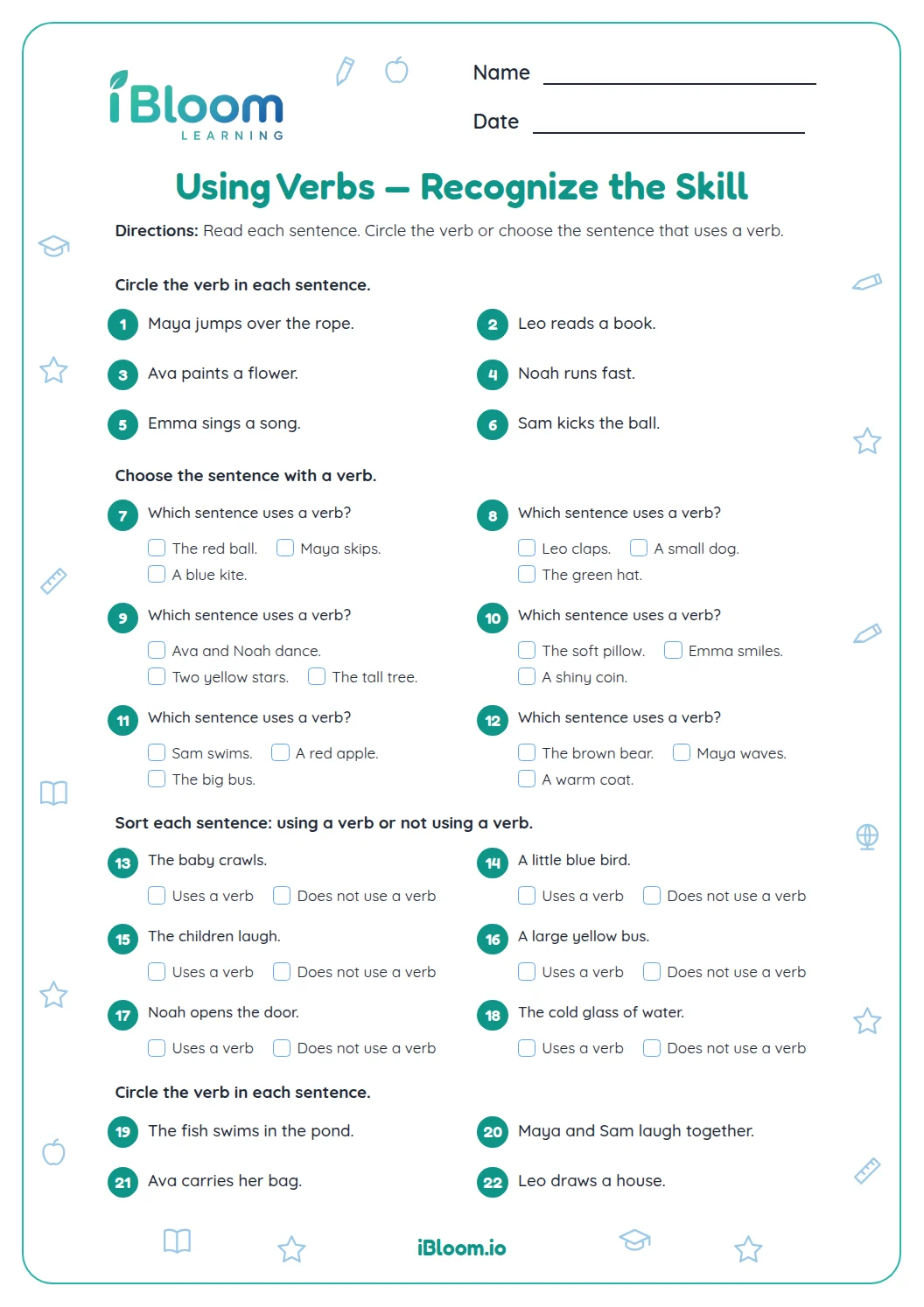
- Part A: choose the -ing action word in 8 items.
- Part B: complete a sentence with a fitting -ing verb.
- Sample answers are provided for open completions.
How do you recognize an -ing verb?
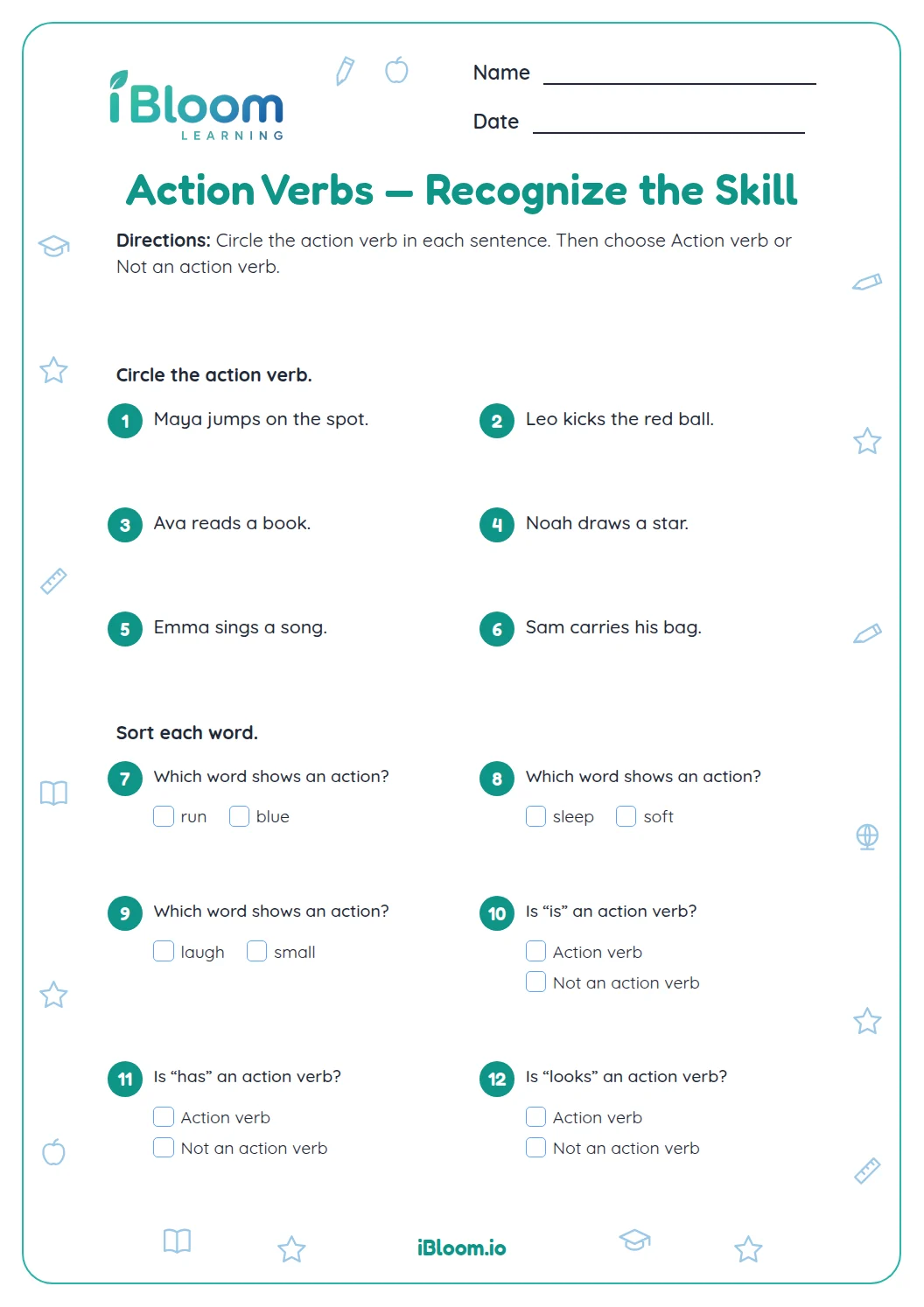
Look for a word that names an action and ends in the letters i-n-g. In “The baby is clapping,” clapping names the action. A word such as soft may describe something, but it is not an action.
In this worksheet, an -ing action appears with am, is, or are, as in “I am drawing.” Read the whole sentence to see who is acting and which action fits.
How can students use the form?
Say who is acting and what the person or animal is doing: “I am drawing.” Then check that the action word ends in -ing and fits the sentence.
For these sentence completions, several familiar actions may fit. The key gives one example, such as swimming for the fish in the pond.
How to use this worksheet
- 1Read each Part A sentence and identify who is acting.
- 2Choose the action word that ends in -ing.
- 3For Part B, read the subject and the rest of the sentence before adding an action.
- 4Use the key as a sample check; other -ing actions may fit when they make sense.
Common mistakes and quick fixes
The mistake
Choosing the base verb “draw” after “I am.”
The fix
Use the -ing form: “I am drawing.”
The mistake
Choosing a describing word such as “soft” instead of an action.
The fix
Ask what the subject is doing; choose a word that names that action.
The mistake
Writing an action that does not fit the subject.
The fix
Read the complete sentence aloud and check that its subject and action make sense together.
Common Core alignment
This worksheet supports Grade 1 language work with verbs in sentences.
Use verbs to convey a sense of past, present, and future.
On this sheet: Students identify and use familiar present-time verbs ending in -ing.
Show the official wordingHide the official wording
Use verbs to convey a sense of past, present, and future.
What to practice next
Make more practice
Questions parents and teachers ask
What does -ing tell the reader?
It is part of a verb that can name an action happening now, as in “The birds are singing.” The helping verb and the rest of the sentence show who is acting and when the action is taking place. Use the stated objects and counts to explain why the answer fits this particular question.
Can more than one verb fit a sentence?
Yes. Several actions may make sense in an open completion item. The key offers one sample, and another familiar -ing action is correct when it fits both the subject and the sentence meaning. Read the whole sentence aloud to check that the action and subject make sense together.
Should a child write only the verb?
For Part B, write the action word in the blank, as in “The dog is waiting by the door.” The other words are already supplied, so a complete sentence does not need to be copied. For example, the blank holds waiting, not the words “The dog is waiting by the door.”
Why does the sentence use “is” or “are” before the verb?
The helping verb works with the -ing verb to show an action in progress, as in “The fish are swimming.” The form of the helping verb matches the subject: one fish is swimming, while several fish are swimming. Use the stated objects and counts to explain why the answer fits this particular question.
What can students practice next?
Students can move on to action-verb practice and then use verbs in complete sentences. They can describe what a pet, a classmate, or a character is doing, then check that the action word fits its subject. These related activities keep attention on how verbs work in complete sentences.