






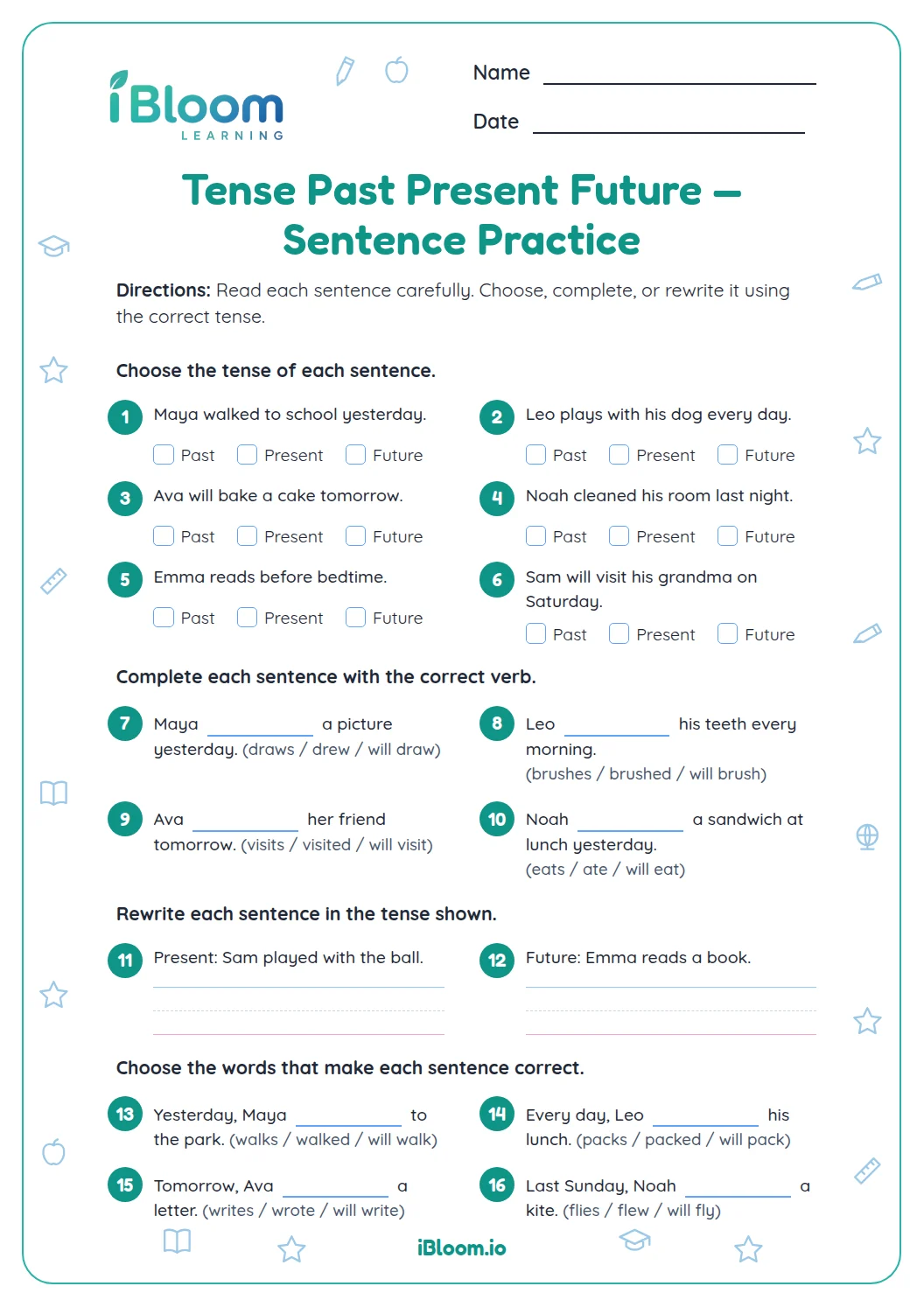

About this worksheet
This free printable Grade 1 grammar worksheet reviews verbs ending in -ing. Children identify an action in a complete sentence, supply an -ing form, and choose correct sentences that use a helping verb. The 15 questions are arranged in three parts, with a separate answer key. The sentence work supports CCSS L.1.1.c by asking children to use matching verb forms with singular and plural subjects.
Aligned to L.1.1.c
How can you spot the action word?
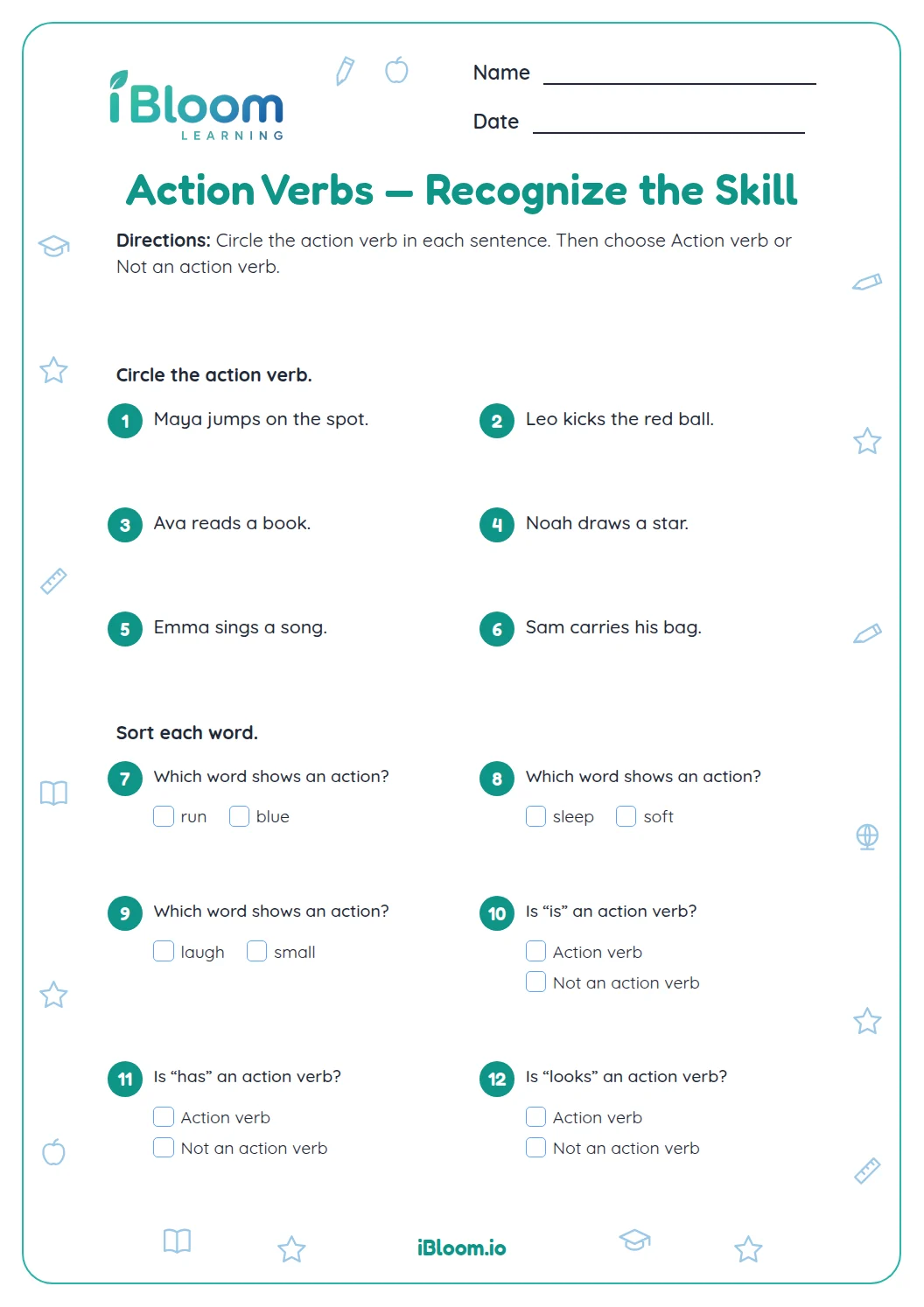
Ask what the person, animal, or thing is doing. In “The puppy is waiting by the gate,” waiting names the action. The helping word is helps the sentence show that the action is happening now.
Question 1 uses the same clue: Sam is jumping over a log. Jumping tells what Sam is doing.
- 1Sam is jumping over a log.
- 2Ask: What is Sam doing?
- 3The action word is jumping.
How do you make an action word end in -ing?
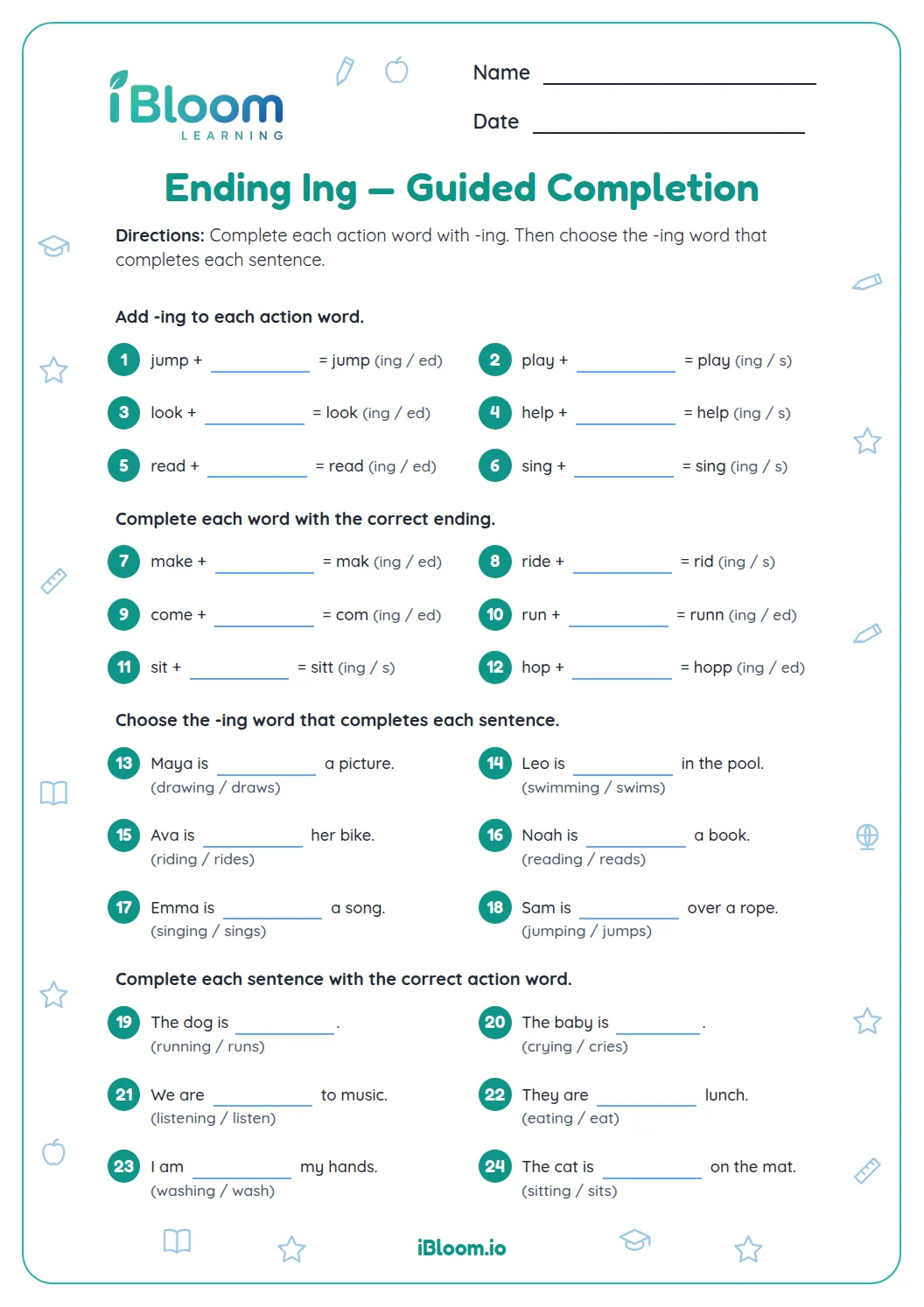
For many verbs, add -ing: wait becomes waiting. For a verb ending in silent e, drop e first: dance becomes dancing. For a short verb like hop, double the last consonant: hopping.
How does the whole sentence help?
An -ing word often needs a helping verb in these sentences: “The class is singing” or “The ducks are swimming.” Match is or are to one subject or more than one. The last part gives practice choosing complete, correct sentences.
How to use this worksheet
- 1Read the entire sentence first.
- 2Ask what action the subject is doing.
- 3Check whether the word ends in -ing.
- 4For a blank, use the base verb clue to spell the -ing form.
- 5Read the finished sentence aloud and check that is or are fits the subject.
Common mistakes and quick fixes
The mistake
Choosing a noun such as puppy instead of the action.
The fix
Ask “What is the puppy doing?” and find the word that answers.
The mistake
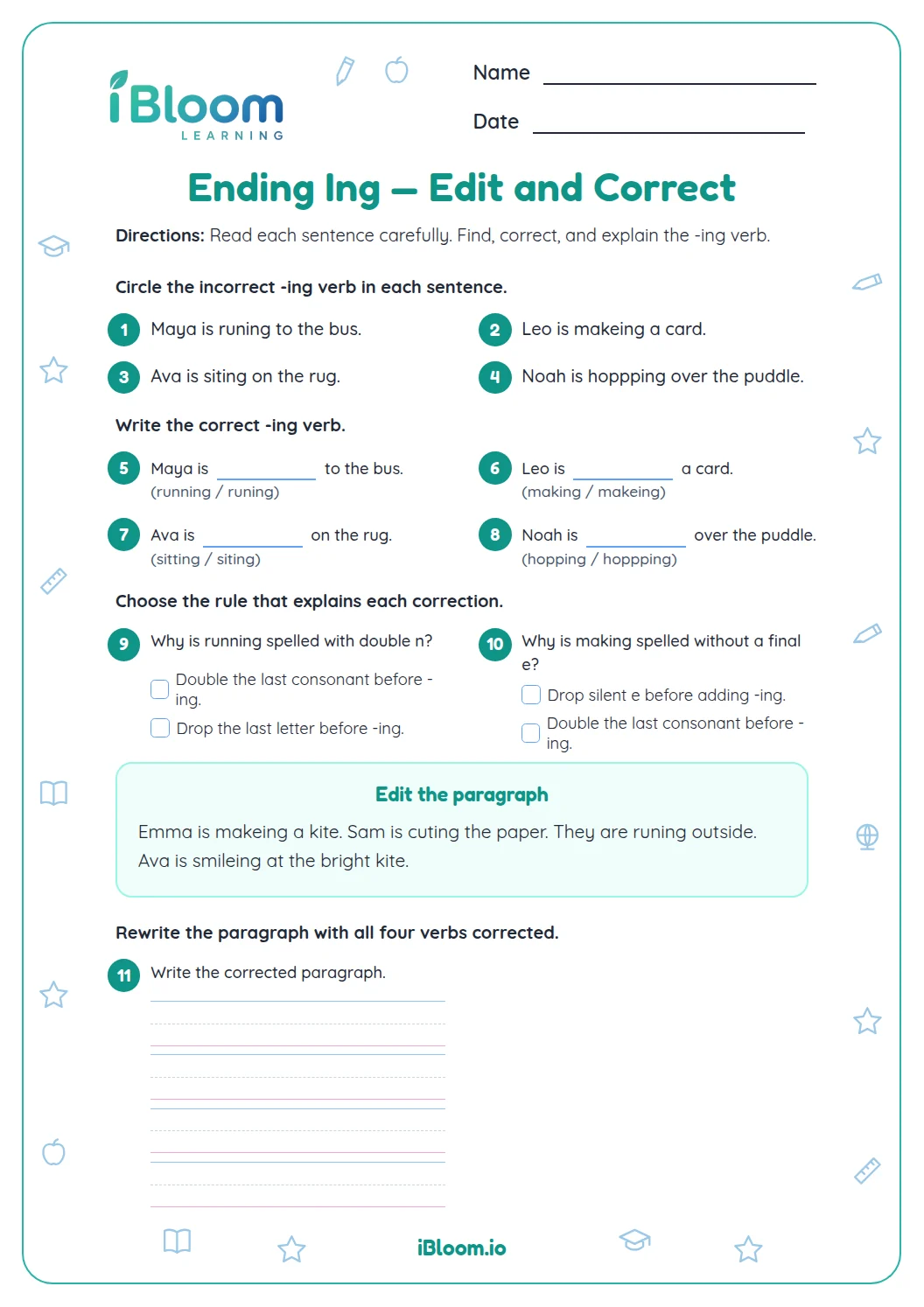
Writing danceing instead of dancing.
The fix
Drop the silent e before adding -ing.
The mistake
Writing “The cat are sleeping.”
The fix
Use is for one cat and are for cats.
Common Core alignment
This worksheet gives focused practice with the standard below.
Match a verb to a singular or plural subject.
On this sheet: Items ask children to place forms such as is hopping and are dancing in complete sentences.
Show the official wordingHide the official wording
Use singular and plural nouns with matching verbs in basic sentences (e.g., He hops; We hop).
What to practice next
Make more practice
Further reading
Questions parents and teachers ask
What is an -ing verb?
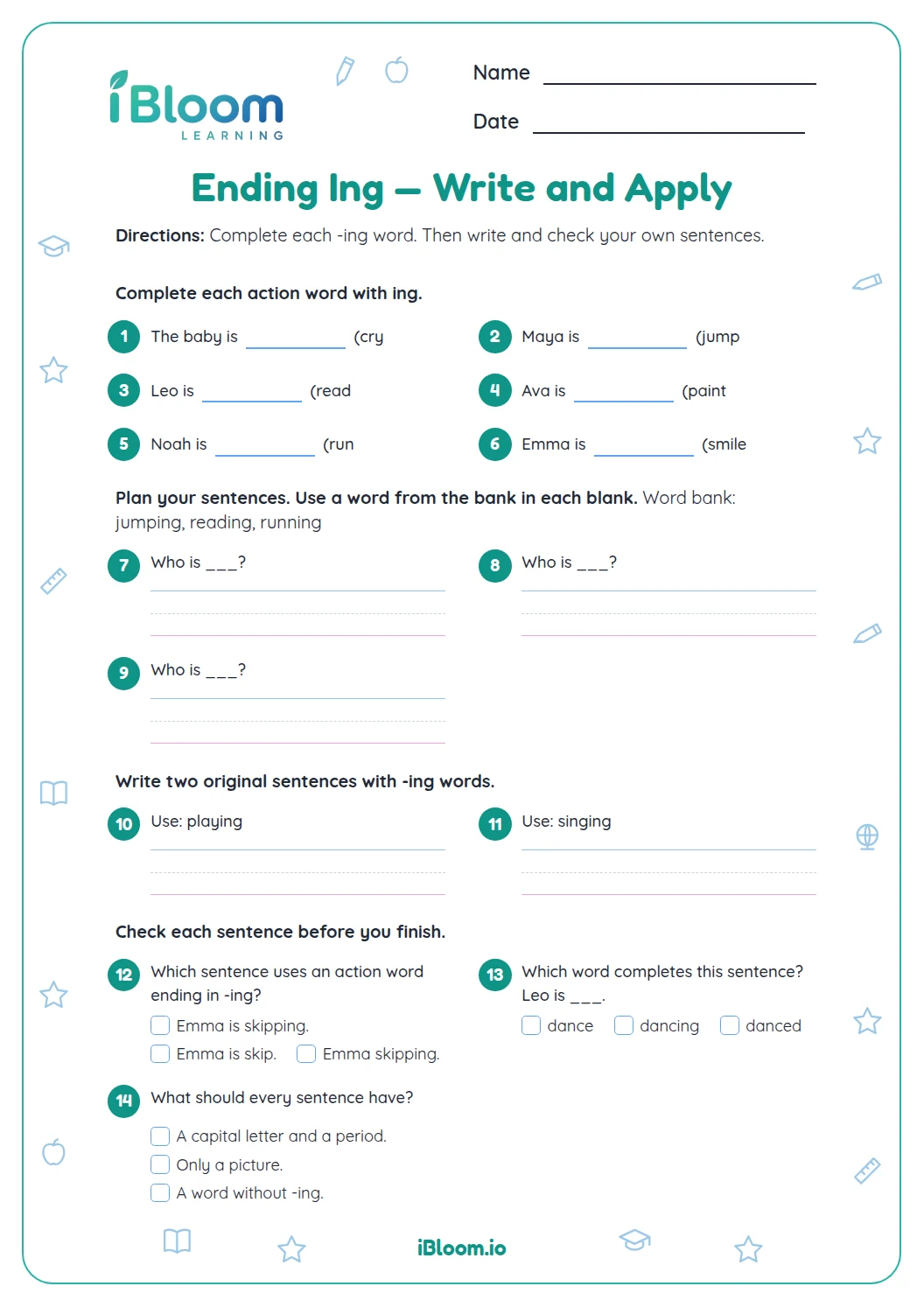
An -ing verb names an action, such as jumping, drawing, or swimming. It often works with a helping verb: “The puppy is waiting.” This worksheet asks children to spot the action, complete sentences, and write their own complete sentence using the pattern.
Does every word ending in -ing act as a verb?
No. A word’s job depends on its sentence. On this page, children look for an action being done, as in “The baby is smiling.” The words around it help readers decide whether it tells what someone or something is doing.
When should a sentence use is or are with an -ing verb?
Use is with one person or thing, as in “The cat is sleeping.” Use are with more than one, as in “The cats are sleeping.” Question 14 asks children to fix a sentence where the subject and helping verb do not match.
How does a verb change before -ing?
Many verbs simply add -ing, like wait to waiting. If a verb ends in silent e, drop the e before adding -ing, as in dance to dancing. Some short verbs double the last consonant, as in hop to hopping.
How many questions are included?
There are 15 questions in three parts: five items to find an action, five sentence blanks, and five sentence or verb-form checks. A separate answer key page lists the answers in order so children can check each response.
Is there an answer key?
Yes. A separate answer key page lists all 15 answers. Children can use it to check each selected action, completed -ing form, and sentence choice after finishing the worksheet. Review the sentence items together when a helping verb needs another look.