





About this worksheet
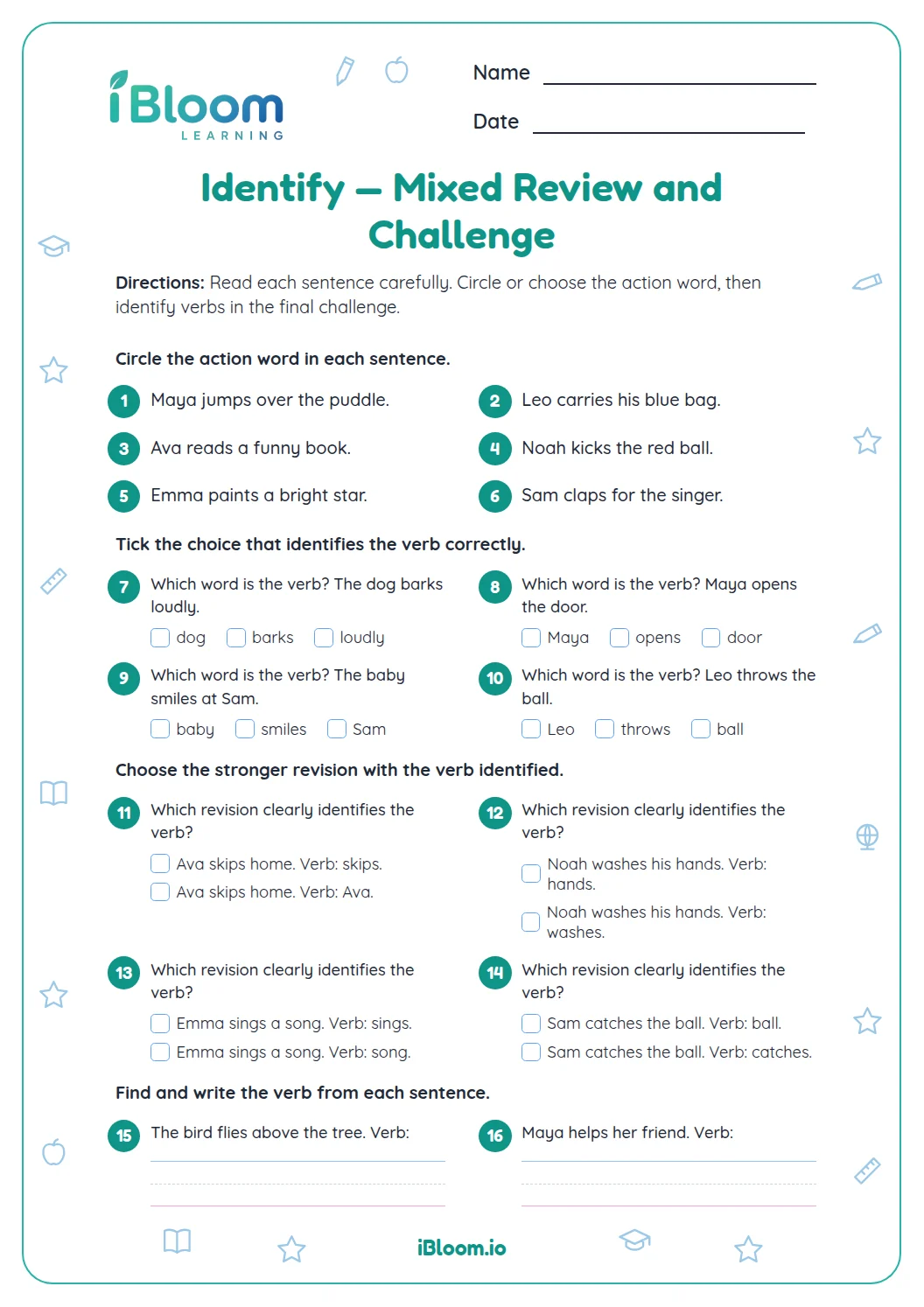
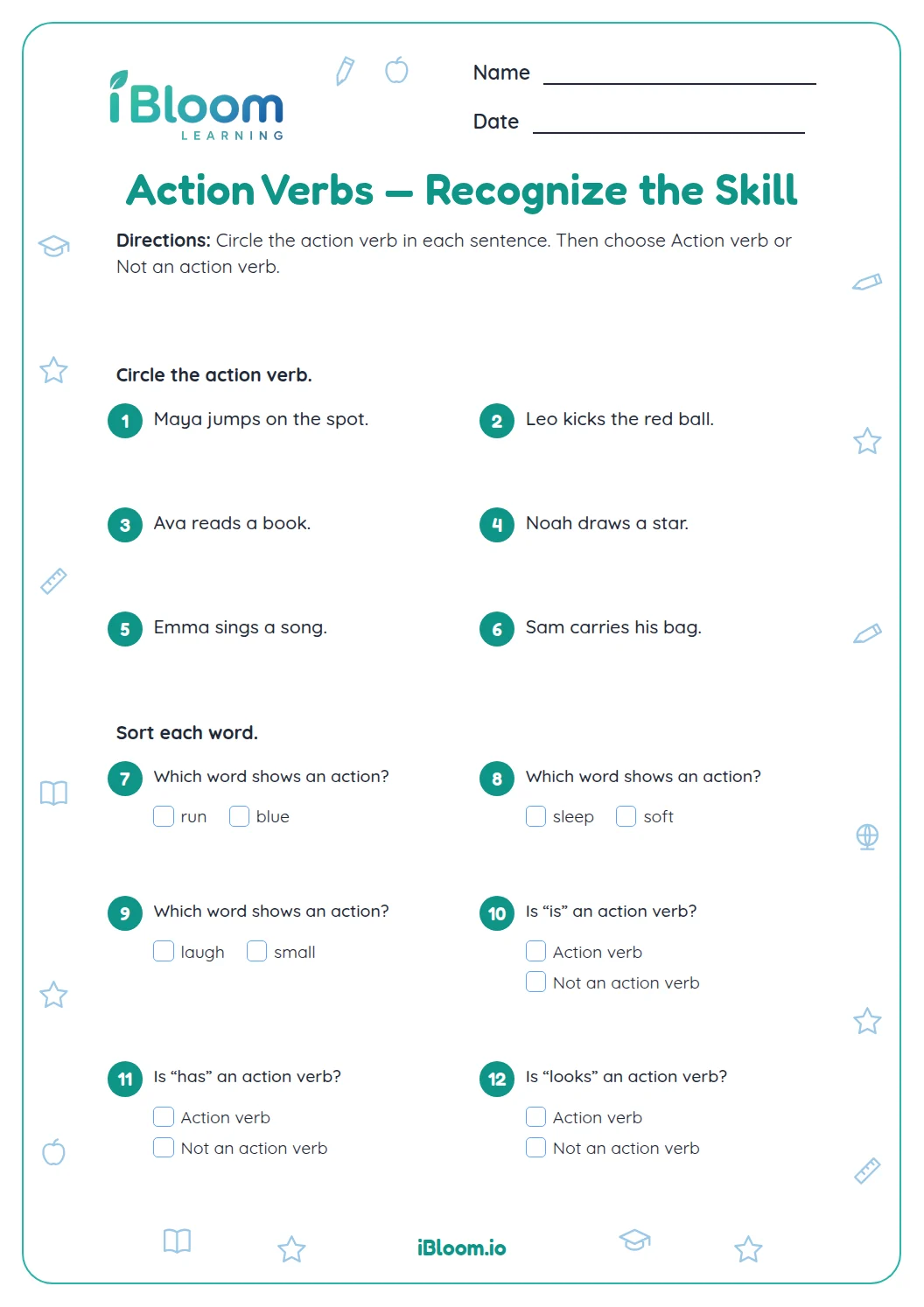
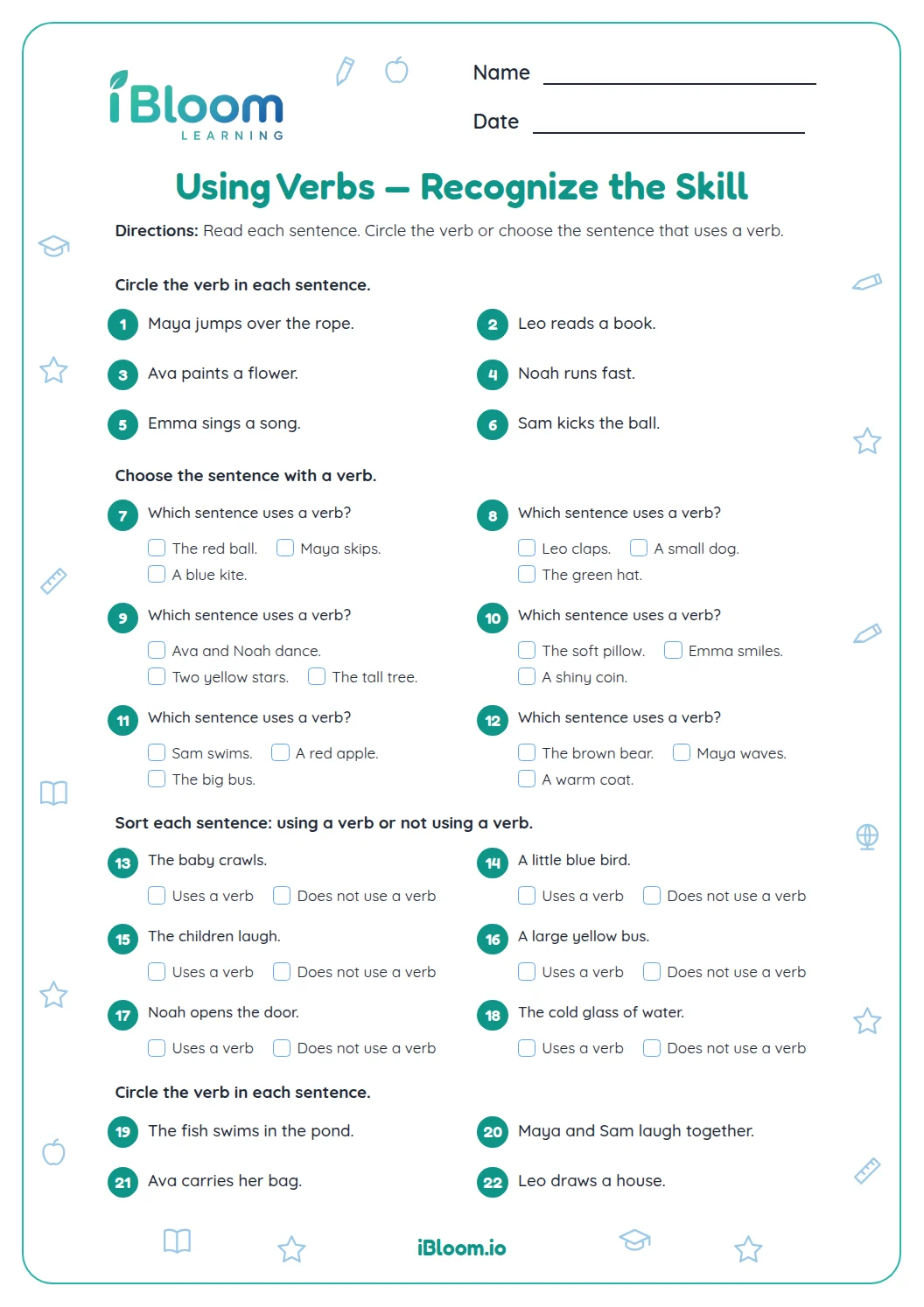
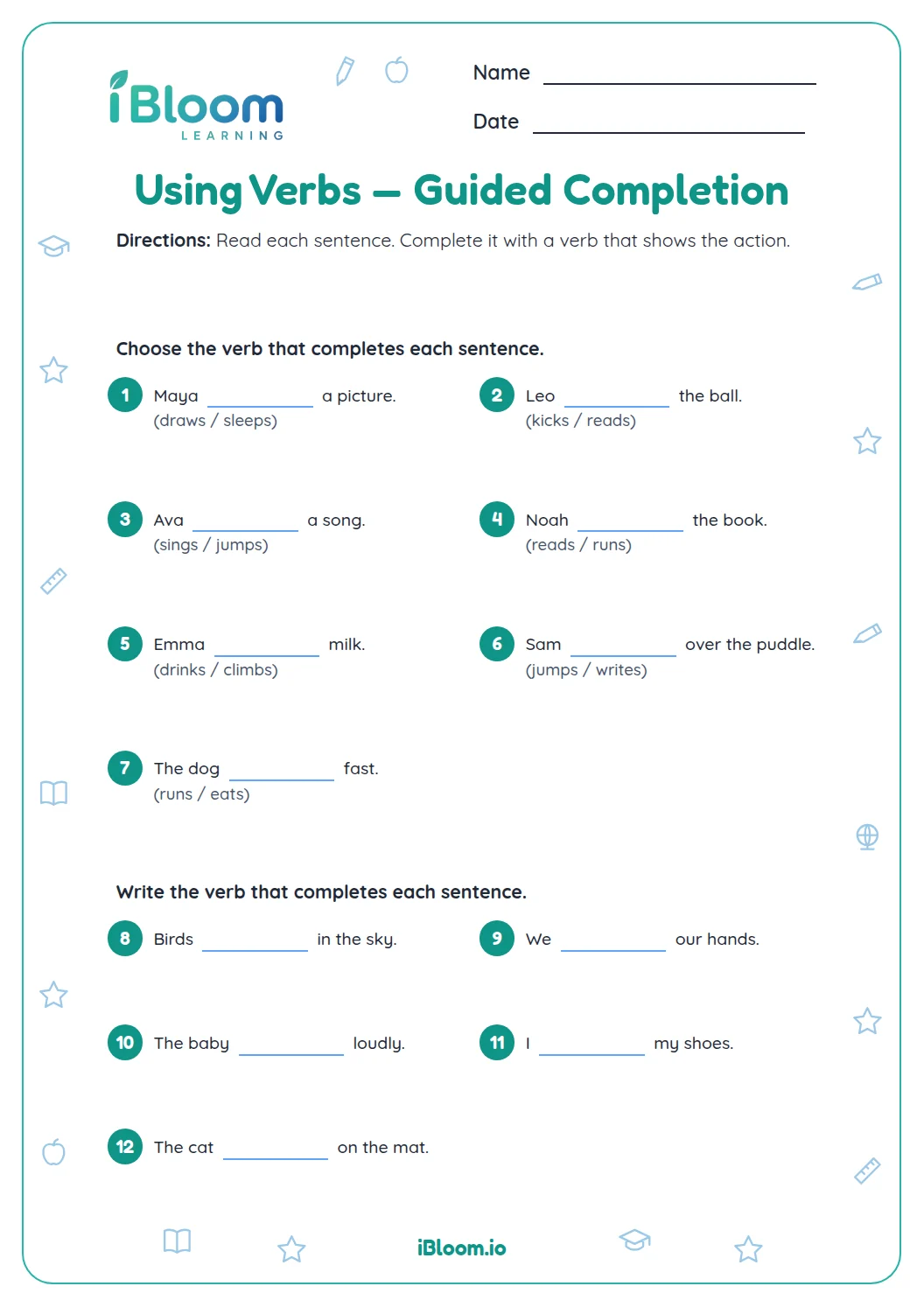
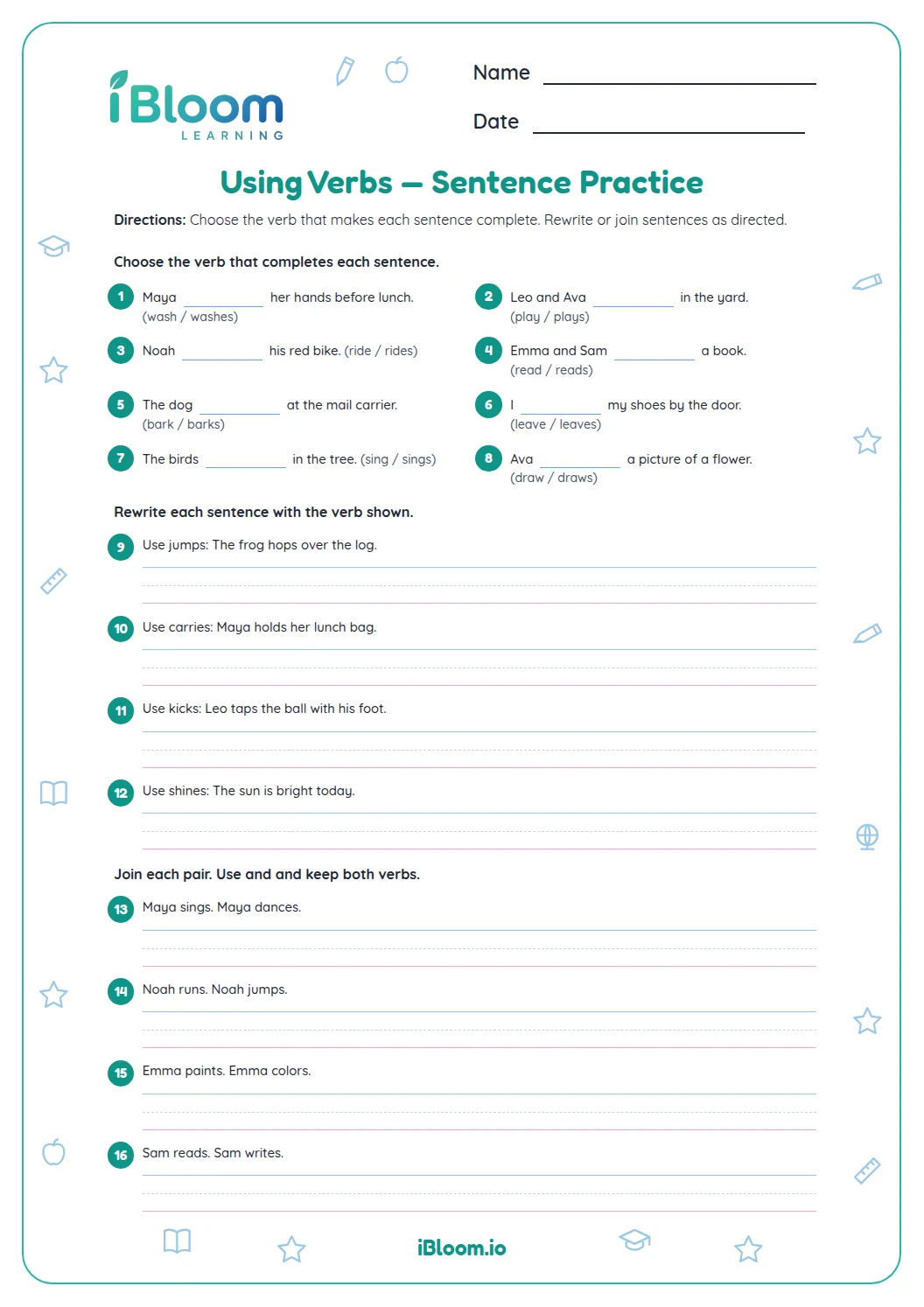
This printable Grade 1 grammar worksheet helps children identify verbs: words that tell what a person, animal, or thing does. Across 16 questions, learners choose action words, complete sentences with a fitting verb, and identify verbs among other words in short sentences. The practice aligns with Common Core L.1.1, with a focus on using verbs in standard English sentences. A separate answer key supports quick checking.
Aligned to L.1.1
How can a child find the verb?
Read the whole sentence and ask what action is happening. In question 1, “The rabbit hops,” hops tells what the rabbit does. Rabbit names the animal; hops names its action.
- 1The rabbit hops.
- 2Ask: What does the rabbit do?
- 3The rabbit hops.
- 4Verb: hops
How does a verb complete a sentence?
Part B gives a sentence with a missing action. Read each choice in the sentence: “Birds fly in the sky” makes sense, while “Birds blue in the sky” does not.
How do verbs differ from other words?
A noun can name a person, place, animal, or thing. An adjective can describe it. A verb tells an action or event, as in “Strong air moves the leaves. The wind blows hard.”
How to use this worksheet
- 1Read every sentence aloud once.
- 2Ask “What happens?” to locate the action word.
- 3In Part B, test each choice in the complete sentence.
- 4In Part C, write only the verb from the sentence.
- 5In Part D, cross out naming or describing words before choosing.
- 6Check each response with the answer key.
Common mistakes and quick fixes
The mistake
Choosing a noun such as rabbit as the verb.
The fix
Ask what the rabbit does; choose the action, hops.
The mistake
Choosing an adjective such as soft.
The fix
Try the word after “The baby”; sleeps tells what the baby does.
The mistake
Picking a word that does not fit the sentence.
The fix
Read the whole sentence with the choice inserted.
Common Core alignment
This sheet practices identifying and using verbs in simple sentences.
Use verb choices to identify action words in complete sentences.
On this sheet: Children identify verbs and choose a verb that makes a sentence grammatical.
Show the official wordingHide the official wording
Demonstrate command of the conventions of standard English grammar and usage when writing or speaking.
What to practice next
Make more practice
Further reading
Questions parents and teachers ask
What does a verb do in a sentence?
A verb tells what someone or something does or what happens. In “The rabbit hops,” hops is the verb because it tells the rabbit’s action. Children can ask “What happens?” to help find the verb in each sentence on the worksheet.
How many questions are on this page?
The worksheet has 16 questions in four parts. Children choose verbs in sentences, pick a verb to complete a sentence, write verbs they find, and distinguish a verb from nearby naming or describing words. A separate answer key is included.
Should my child write the whole sentence?
No. In the short-answer part, the prompt asks for the verb, so one action word is enough. For a multiple-choice item, choose one option. Reading the sentence aloud before answering can make the action easier to hear. A single-word response keeps attention on the verb’s role in the sentence.
What is an example of a verb?
Hops is a verb in “The rabbit hops” because it says what the rabbit does. Other verbs on this worksheet include cooks, reads, sleeps, and opened. A verb can name an action or something that happens. Read the whole sentence to see which word tells what happens.
What if a sentence has more than one action word?
This sheet uses short sentences with one target verb to keep identification practice focused. Some sentences can have more than one verb, such as “Mia reads and writes.” Ask the child to name both actions. The worksheet questions each have one intended answer, so children can check each response against the key.
Is an answer key included?
Yes. A separate answer key page lists the correct verb for every question. Children can complete the sheet first, then compare responses and reread any sentence where the action word was hard to spot. The key also lists the target verb used in each prompt.