



About this worksheet
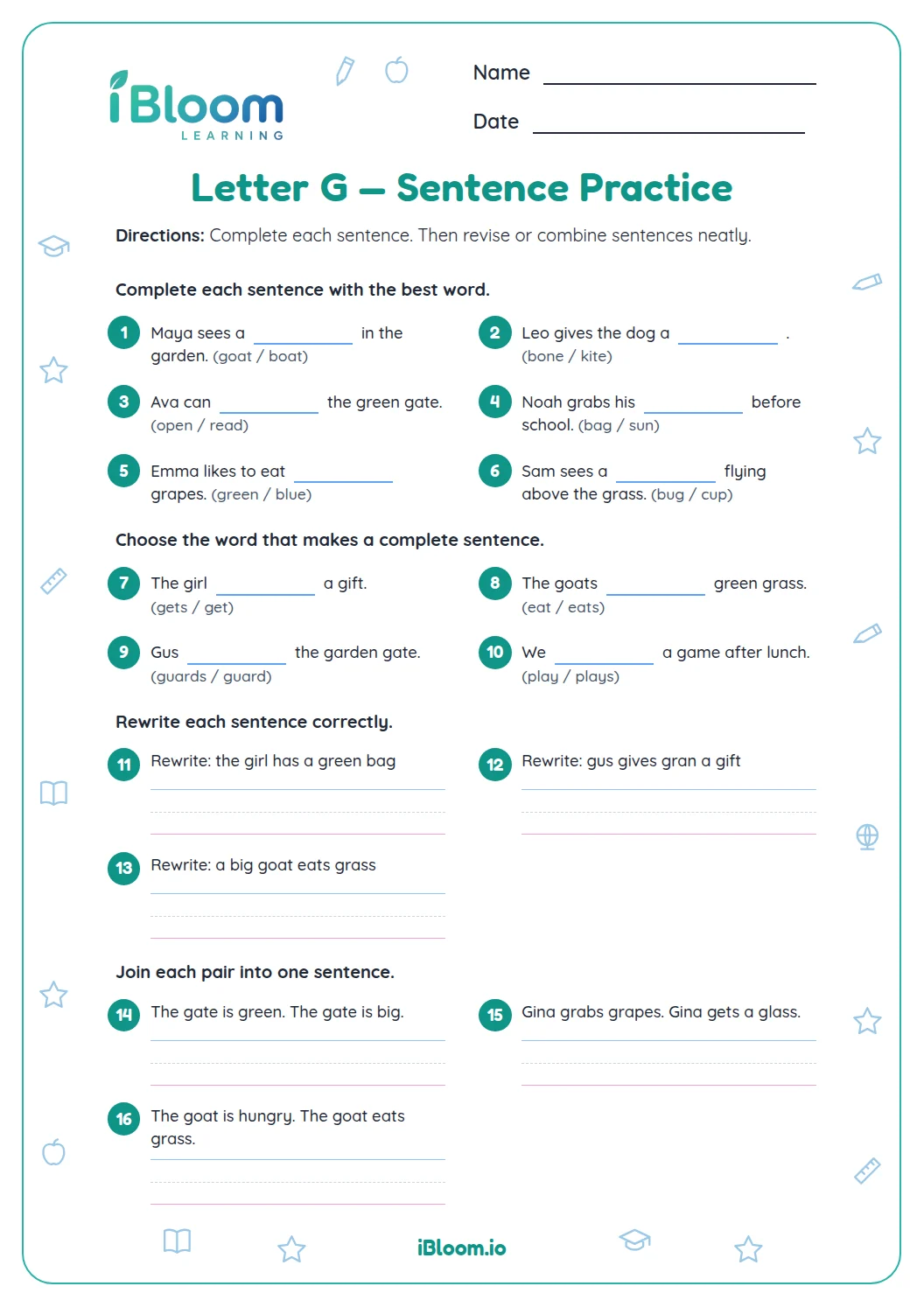
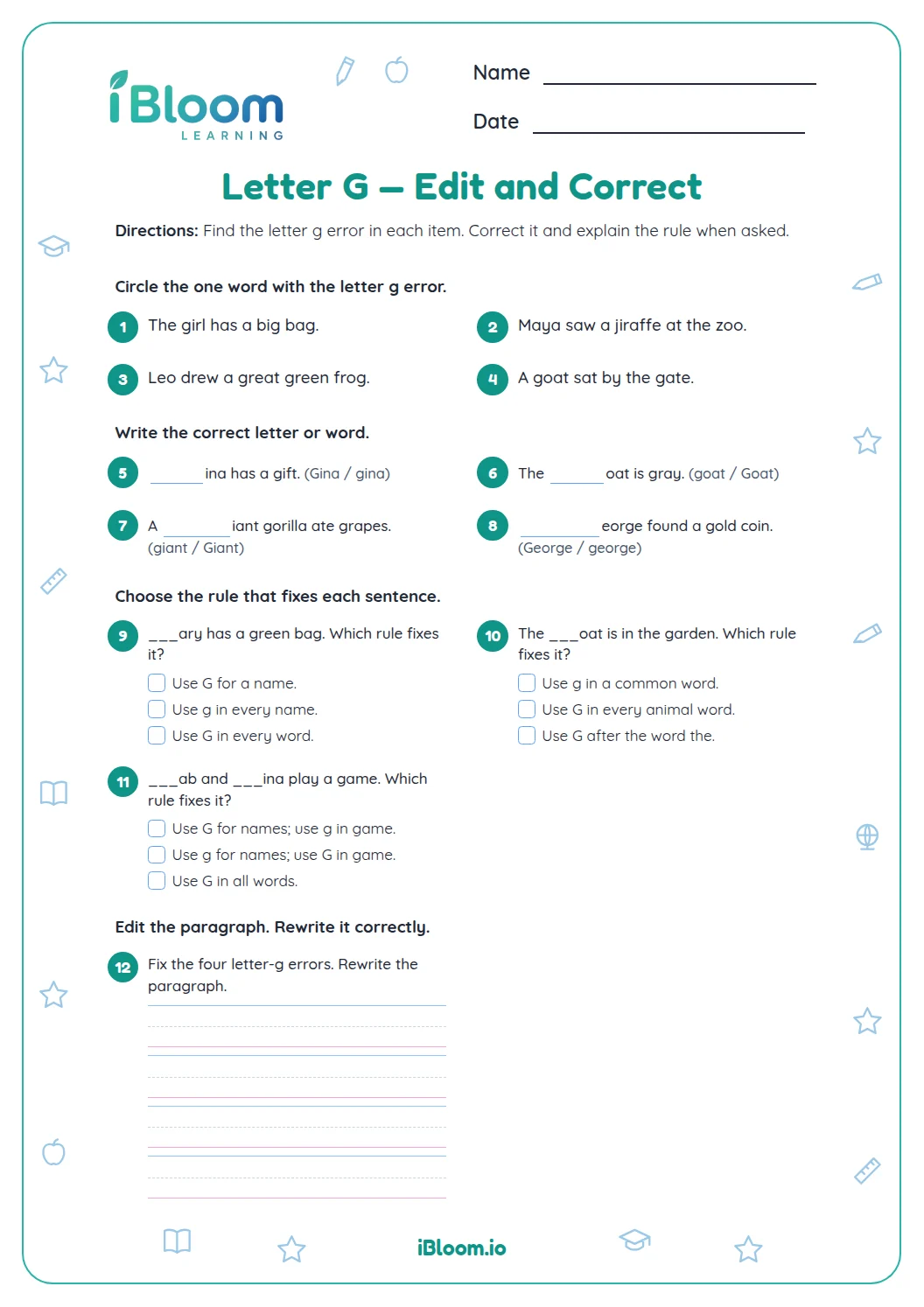
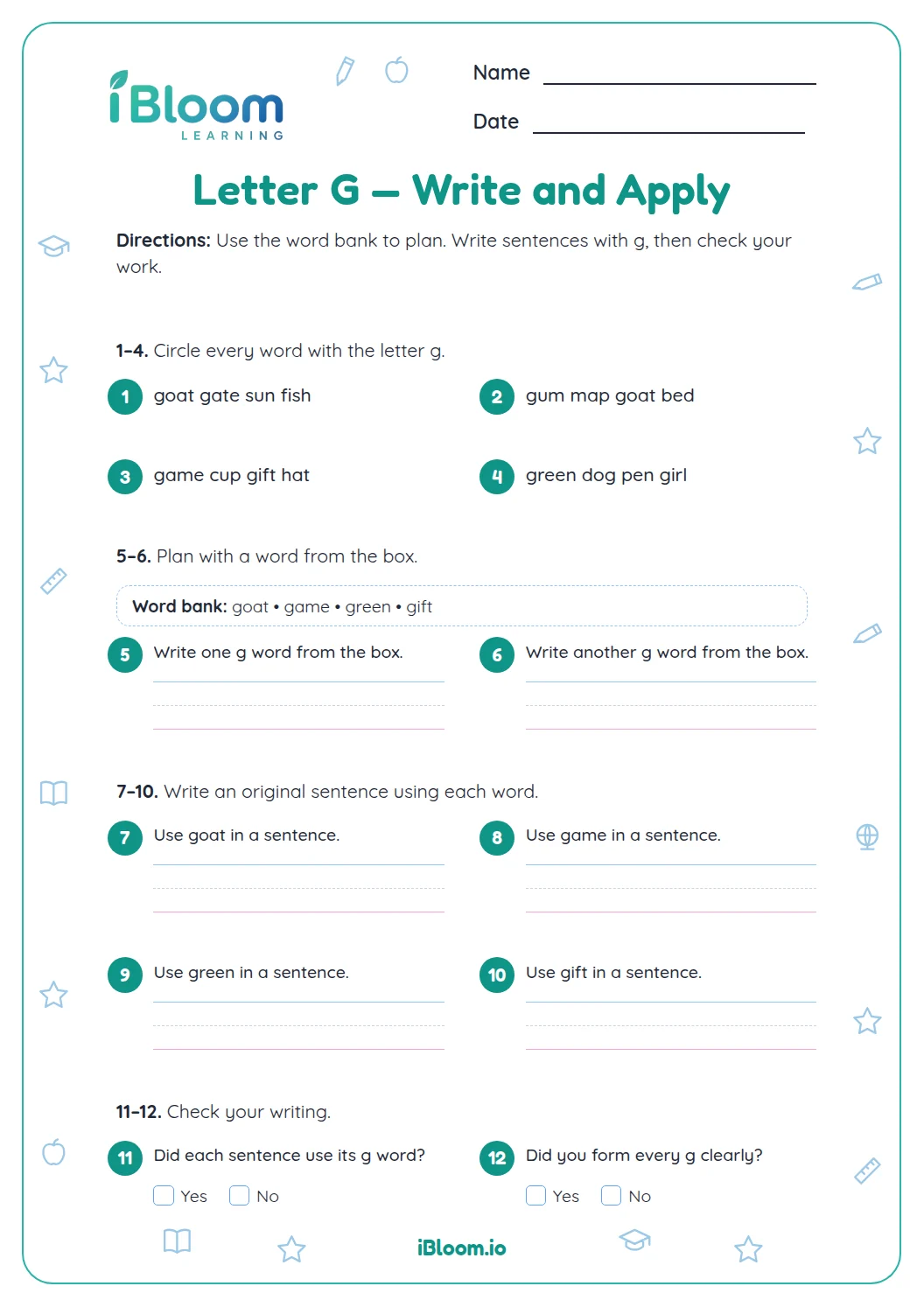
This Grade 1 letter G worksheet pairs handwriting with recognition. Children trace uppercase G and lowercase g, identify the forms in short words, and write each form in response to a prompt. Its 14 questions move from tracing to choosing and writing, and a separate answer key shows target forms and sample words. The practice supports printing uppercase and lowercase letters.
Aligned to L.1.1.a
How do children practice both forms of G?
Trace both forms in the model before moving to the word questions. The capital G stays above the line; lowercase g has a rounded top and a loop below the line.
- 1Question 1: Trace G and g, keeping the capital and lowercase forms distinct.
How can a child spot G in a word?
Look at the first or last letter in each printed word. Goat begins with g and bag ends with g, so the word choices keep attention on seeing the target letter.
What should a neat G look like?
An uppercase G is a large curved letter with a short line pointing inward. A lowercase g has a round top and a loop that drops below the writing line.
How to use this worksheet
- 1Trace one uppercase G and one lowercase g together first.
- 2Say the letter name while tracing each model.
- 3Point to the first or last letter before choosing an answer.
- 4Use the key to check letter forms; accept any sensible G word for the sample.
Common mistakes and quick fixes
The mistake
Writing lowercase g like uppercase G.
The fix
Compare the round top and descending loop with the model.
The mistake
Writing lowercase g when the prompt asks for uppercase G.
The fix
Check whether the prompt calls for the capital form.
The mistake
Choosing a word by sound but not checking its spelling.
The fix
Look at the printed first or last letter.
Common Core alignment
This page practices the skills named in the standard below.
Print uppercase and lowercase letters, including G and g.
On this sheet: Print uppercase and lowercase letters, including G and g.
Show the official wordingHide the official wording
Print all upper- and lowercase letters.
What to practice next
Make more practice
Further reading
Questions parents and teachers ask
How many questions are on the worksheet?
There are 14 questions: one trace prompt, five multiple-choice items, and eight short answers. The questions move from tracing G and g to recognizing them in words and writing the forms. A separate key gives the target letters and sample words for open responses.
Does it practice uppercase and lowercase G?
Yes. The first prompt asks children to trace both G and g, and later questions ask them to identify and write each form. Encourage the learner to compare the capital and lowercase shapes carefully, especially the lowercase letter’s loop below the writing line.
Which words appear in the practice?
The recognition prompts use garden, grape, dog, and related familiar words. Children identify whether G or g appears at the beginning, end, or middle. The writing prompts then invite a word starting or ending with g and a name beginning with G.
How should I use the answer key?
Use the key to check the printed letter forms and the multiple-choice answers. For open prompts such as writing a word that starts with G, accept another clearly spelled example with the requested letter position. Compare traced letters with the model rather than judging handwriting style.
How long does this worksheet take?
About 15 minutes is a useful estimate for tracing, reading the word prompts, and writing short answers. A child can pause between the sections or complete the tracing first and return to the word questions later. Keep the answer key nearby for checking.